
Instagram Outage Response Protocol for Social Media Marketers
A documented three-phase response protocol for Instagram outages covering immediate verification and ad pausing, post-recovery campaign management and compensation requests, and structural prevention through owned channels — helping social media marketers minimize disruption and financial loss when Meta platforms go down.
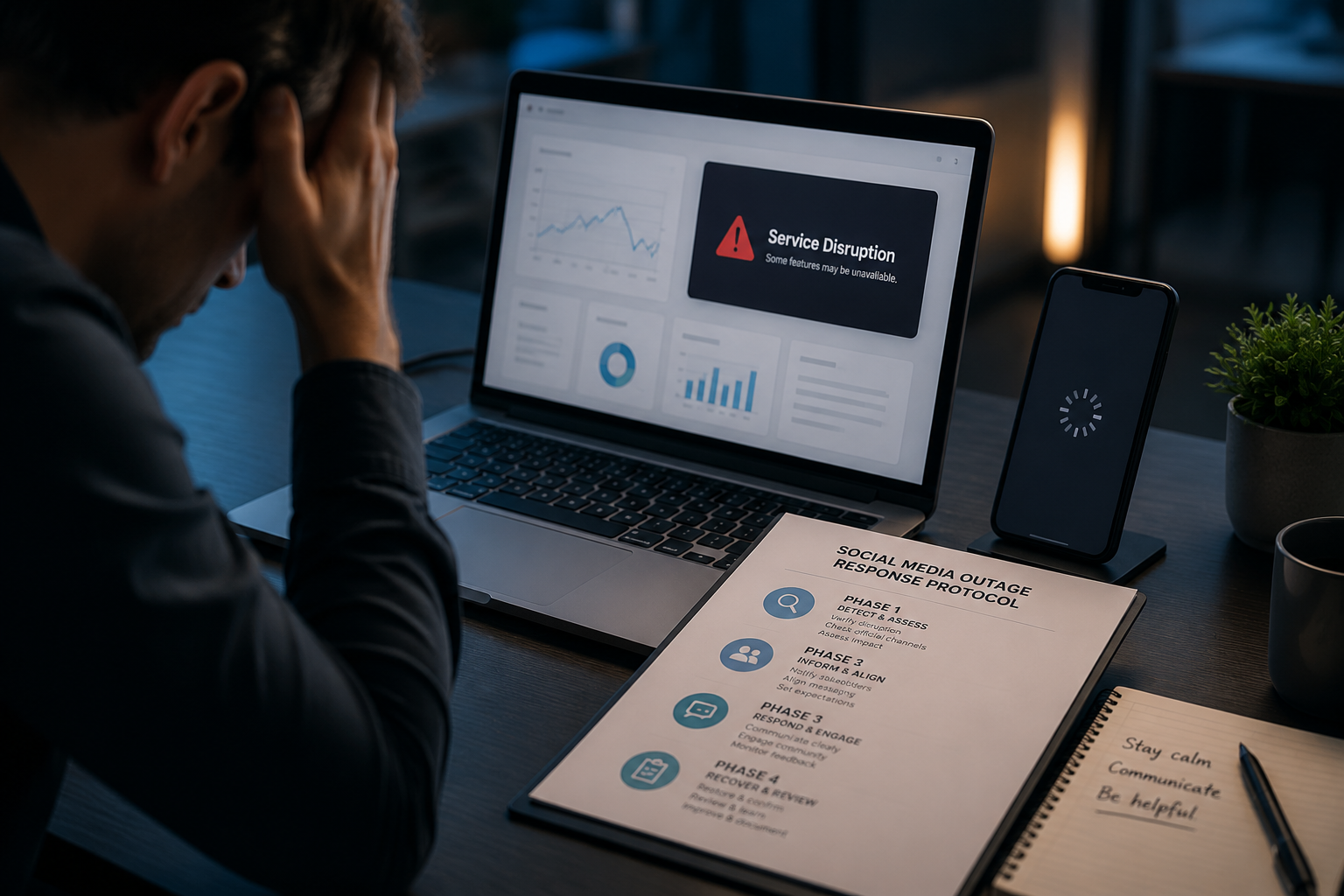
The worst moment in an Instagram outage is not when the app stops loading. It is ten minutes later, when Ads Manager still shows campaigns as active, the launch post is unreachable, comments are not moving, and someone asks whether this is “just us.” That is where an Instagram outage turns into a social media marketing problem: spend may still be running, customers may be stuck, and the team may not yet know who has authority to pause anything.
June 2026 gave marketers another reminder that this cannot live in the “rare event” folder. On June 12, Downdetector report volumes spiked across Meta services, with public reports cited in the low six figures for Facebook and more than 10,000 for Instagram within hours; a smaller Instagram-specific disruption followed on June 23, also crossing 10,000 reports.[1] The exact June 12 Facebook count varies by outlet, so the useful takeaway is not a false precision contest. The useful takeaway is that enough users were reporting trouble at once that a marketing team needed an outage workflow, not another browser refresh.
The cost of a few unavailable hours is easiest to underestimate when the dashboard still looks normal. During Meta’s six-hour outage in 2021, CNBC documented creators and small businesses reporting losses from a few hundred dollars to more than $5,000, tied to missed sales, affiliate links, sponsored posts, and interrupted customer communication.[2] There is no comparable systematic loss survey for the 2026 outages as of July 2026, so those 2021 examples should be treated as a proxy, not proof of identical losses today. Still, they are concrete enough to make the point: for a small business, an outage can land like a failed sales day, a spoiled launch window, or an invoice that still has to be paid.
The Three-Phase Outage Protocol
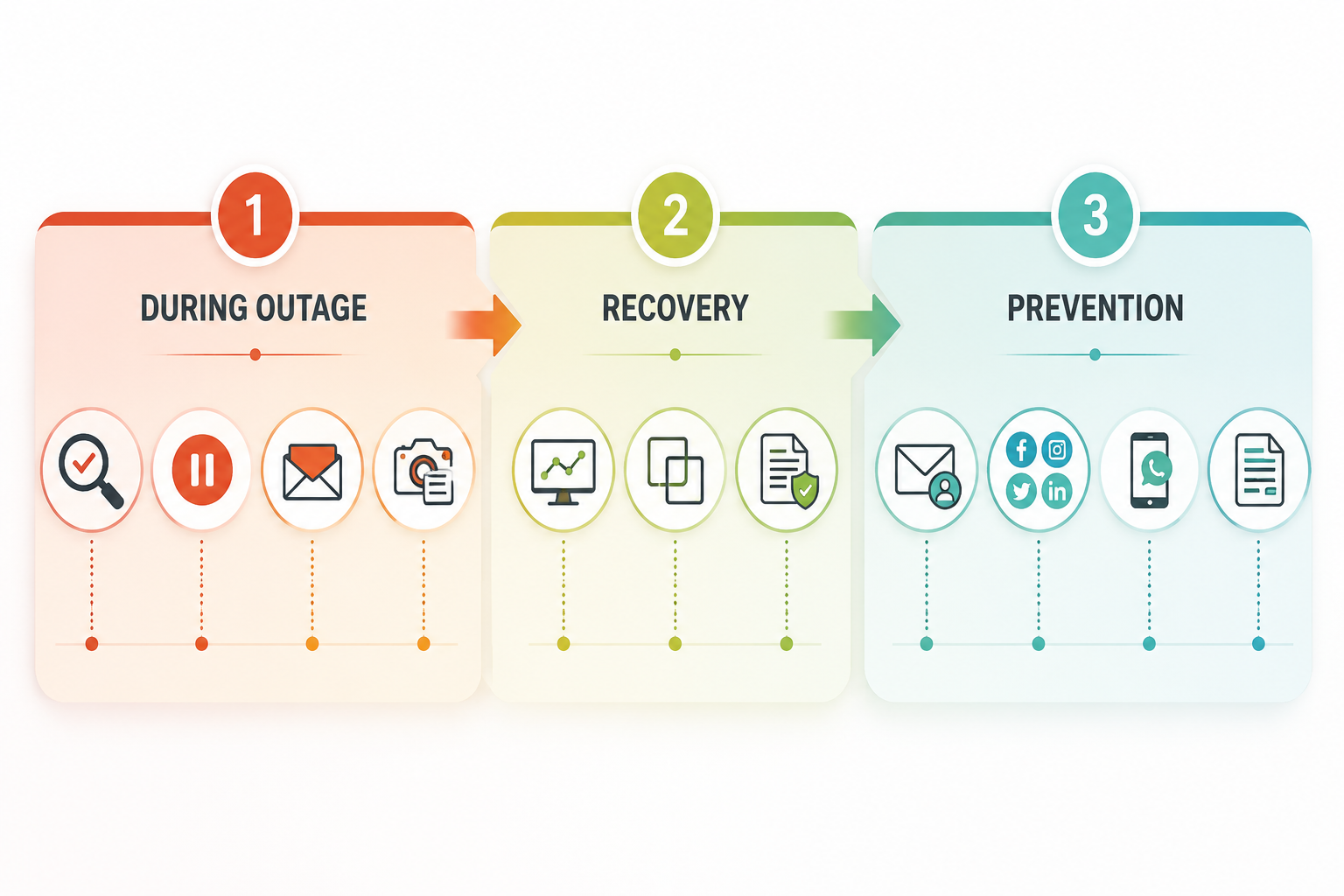
A useful protocol has to be short enough to run while people are annoyed, customers are messaging, and leadership wants an answer. This is the full flow before we slow down on the parts where money most often leaks.
| Phase | When it starts | Primary job | Owner decision |
|---|---|---|---|
| Phase 1: During the outage | Reports spike or Meta services become unreliable | Verify, pause risky spend, redirect communication, document evidence | Who can declare an outage and pause campaigns |
| Phase 2: Recovery | Service appears to return | Reopen communication, monitor ad behavior, duplicate damaged campaigns when needed, prepare claims | Who reviews performance before budgets return to normal |
| Phase 3: Prevention | Before the next outage | Build owned-channel fallback, diversify distribution, prepare templates | Who maintains the backup system so it is usable under pressure |
Phase 1: Confirm the Outage Before You Touch the Budget
The first decision is not whether to post an apology. It is whether the team is seeing a local account problem, a publishing-tool problem, a payment issue, or a broader Meta failure. Those require different responses. If one person cannot load Instagram on office Wi-Fi, that is not enough. If multiple team members on different networks see failures, customers are reporting broken links, Downdetector is climbing, and Meta’s status page shows service trouble, the team can stop debating whether the intern’s phone needs an update.[1][3]
The verification owner should have a tiny checklist, not a group chat argument:
- Check Instagram from at least two devices and two networks.
- Check whether Facebook, Messenger, WhatsApp, or Ads Manager are also affected.
- Open Downdetector and capture the report trend with the timestamp visible.
- Check Meta Status for business-tool disruptions and capture that screen too.
- Post the finding in the incident channel using a pre-agreed label such as “Meta outage likely” or “local issue only.”
The label matters because it unlocks the next action. A marketing coordinator should not have to persuade three people in real time that a platform failure is real while a conversion campaign is still spending. The team should decide in advance who can declare the incident, who can pause ads, and who needs to be notified after the fact rather than asked for permission.
Pause campaigns that depend on a working Meta path
The safest default during a confirmed outage is to pause campaigns whose conversion path depends on Instagram, Facebook, Messenger, or a Meta-hosted interaction. Smart Marketer’s outage guidance is direct on this point: stop spending against broken or unreachable paths, then review performance once service returns.[4]
Not every campaign carries the same risk. A broad awareness campaign with no urgent conversion expectation may be less exposed than a Story ad sending people to a flash-sale landing page, a lead campaign collecting in-platform forms, or a launch sequence relying on DMs. The pause rule should be written by campaign type so the person on duty does not have to interpret strategy during an outage.
| Campaign type | During outage action | Reason |
|---|---|---|
| Instagram Story or Reels ads driving urgent clicks | Pause | The user path is likely to fail or load inconsistently |
| Lead ads or DM-based campaigns | Pause | The conversion event may depend on Meta tools that are unstable |
| Launch-day sales campaigns | Pause and notify sales or ecommerce owner | A short window can materially affect revenue and customer trust |
| Evergreen awareness campaigns | Review before pausing | Risk may be lower, but delivery data can still become noisy |
| Retargeting campaigns with tight windows | Pause or cap depending on authority level | Bad timing can waste high-intent impressions |
The documentation should show what changed: campaign name, campaign ID, ad set ID if relevant, budget, time paused, person who paused it, and the verification screenshots that justified the action. This is not bureaucracy for its own sake. It keeps the post-outage conversation from turning into “who touched the campaign?” and gives the team something usable if it later asks Meta Support to review the spend.
Move the customer message somewhere you control
Once the outage is verified and spend is protected, the next job is customer communication. If the sale, event, launch, or support queue matters today, waiting for Instagram to recover is not a plan. Curiosity MG’s guidance on social media downtime emphasizes alternative communication paths such as email, SMS, and website updates instead of relying on the failed platform to explain the failure.[5]
The pivot does not need to be elaborate. It needs to be findable and calm. Put a short notice on the website or landing page if customers may be arriving from saved links. Send email to the affected segment if a launch or time-sensitive offer is underway. Use SMS only when the message is urgent enough to justify the interruption. If WhatsApp is also affected, which can happen when the disruption is broader across Meta services, do not treat it as the fallback.
A workable outage message says three things: the platform is unreliable, the customer can still complete the intended action through a specific alternate path, and the team will update that path when service returns. It should not over-explain Meta’s infrastructure, blame the customer’s device, or promise a recovery time the brand does not control.
Instagram is currently unreliable for some users. If you are trying to access today’s offer, use this direct link instead: [owned landing page]. We will update this page when Instagram access is stable again.That template is intentionally plain. During an outage, clarity beats brand voice gymnastics. The person reading it is trying to buy, register, ask a question, or confirm whether the business is still operating.
Start the incident file while the outage is still happening
Incident documentation is much easier before everything looks normal again. Create one folder or ticket per outage and store the evidence in a format someone outside the social team can understand. Screenshots should include timestamps where possible. Campaign exports are better than memory. Customer complaints should be sampled, not dumped without context.
- Downdetector and Meta Status screenshots.
- Screenshots of failed Instagram pages, broken Story links, loading errors, or unreachable DMs.
- Campaign IDs, ad set IDs, budgets, and pause or restart timestamps.
- A short timeline of what the team knew and what it did.
- Examples of customer impact, such as support tickets or replies asking why a link is not working.
This file has two audiences. The first is internal: the owner, client, finance lead, or sales manager who needs to know why performance moved. The second is Meta Support, if the team later files a compensation request. Documentation improves the odds of making a credible claim. It does not guarantee reimbursement.
Phase 2: Recovery Starts Before the Dashboard Looks Normal
The recovery phase begins when Instagram appears usable again, not when everyone feels confident. Feeds may load before DMs behave normally. Ads Manager may show delivery while conversion data is still distorted. Customers may have abandoned the path an hour earlier. The first recovery step is to reopen communication without pretending nothing happened.
A welcome-back message can be short: service appears to be returning, the direct purchase or registration link remains available, and customer support is watching for anyone who had trouble. If the outage interrupted a launch or live promotion, update the owned landing page first, then social. The page is the source of truth; Instagram is the distribution layer.
Watch ad performance for the next 12 to 24 hours
A campaign that ran through an outage may not simply snap back. Delivery can be uneven, learning data can be skewed, and conversion windows can contain behavior that was caused by platform failure rather than creative fatigue or weak targeting. Smart Marketer recommends monitoring performance after service resumes and, where campaigns underperform after an outage, duplicating them rather than editing the damaged campaign in place.[4]
That does not mean every paused campaign should be duplicated automatically. Use a recovery review. Compare the campaign’s pre-outage baseline with the 12-to-24-hour recovery window. Look at delivery, cost per result, click-through behavior, conversion rate, and comments or support messages that indicate users hit broken paths. If the campaign was barely affected, restarting may be enough. If the campaign spent during the disruption and now behaves strangely, duplication gives the system a cleaner start without burying the outage inside a long edit history.
| Recovery signal | Likely action |
|---|---|
| Campaign was paused quickly and metrics return near baseline | Restart and monitor |
| Campaign spent during the outage and cost per result remains unstable | Duplicate and relaunch after review |
| Launch window was materially interrupted | Adjust schedule, notify stakeholders, and document revenue exposure |
| Customer comments show confusion after recovery | Post a clarification and update owned-channel FAQ or landing page |
| Data is too noisy to judge | Extend monitoring before increasing budget |
Prepare the Meta Support request like a claim, not a complaint
If paid campaigns were affected, file the support request with the same discipline used for any vendor issue. Digital Marketing Institute’s guidance on platform failures includes pursuing compensation through the platform’s support process, using records of what happened and how the business was affected.[6] The request should include the campaign IDs, affected time window, screenshots, spend during the incident, observed performance issue, and a short explanation of the customer or revenue impact.
The tone should be factual. “Our campaign was active from this time to this time while Instagram was unavailable to users, and here is the supporting evidence” is stronger than a long narrative about frustration. The team may still get no credit, partial credit, or a response that does not resolve the issue. The point of the protocol is not to make compensation certain. It is to avoid showing up empty-handed if support asks for proof.
Phase 3: Prevention Is the Work Nobody Wants During a Good Week
The least glamorous part of outage planning is the part that pays off fastest under pressure: owned-channel infrastructure. Instagram already has the audience, the habits, the cultural momentum, and the creative surface area. Moving even a slice of that relationship into email, SMS, a website, or another platform takes longer than posting another Reel. That political reality is why many brands keep postponing it.
Still, if every customer path depends on one family of platforms, the business has accepted a single point of failure. The prevention layer does not require abandoning Instagram. It requires making sure Instagram is not the only place where demand, trust, and urgency can move.
Build the email list before the emergency
Email is the primary fallback because it is owned in the way that matters during an outage: the marketer can still reach subscribers when Instagram is unavailable. That does not make email effortless. The list has to be grown ethically, segmented enough to avoid blasting everyone with irrelevant updates, and connected to landing pages that can handle outage traffic.
For teams still choosing the infrastructure, the tool decision should not consume the outage plan. Pick a system the team can actually operate, then document the segments, approval path, and emergency templates. Readers comparing platforms can use this guide to AI email marketing tools that learn from campaigns, but the outage protocol itself only needs the fallback to be ready.
Keep at least one non-Meta distribution path alive
A second social platform is not a perfect substitute for Instagram. TikTok, LinkedIn, Pinterest, YouTube, and other channels have different formats, audiences, and rhythms. The reason to maintain one is not to pretend a brand can instantly move a launch audience across the internet. It is to avoid having every public update trapped inside the same outage.
The practical version is modest: choose the non-Meta channel where the audience already has some reason to follow, repurpose core campaign assets in advance, and keep the login, permissions, and posting workflow current. A lightweight content repurposing workflow helps because the team is not rewriting the whole campaign while the main channel is down.
Prepare urgent messaging channels with rules
SMS and WhatsApp can be useful for time-sensitive communication, but they need rules before anyone uses them in a panic. SMS should be reserved for messages that customers would reasonably consider urgent: event access, appointment changes, order deadlines, or launch windows they explicitly signed up to hear about. WhatsApp may work well for some audiences, but it should not be the only fallback for Meta outages because it belongs to the same parent company.
The rule set should answer three questions: which events justify an urgent send, who approves it, and where the message points. The answer to the third question should usually be an owned page, not another social profile.
Write the templates when nobody is rushing
Templates do not remove judgment. They remove avoidable typing. Every brand that relies on Instagram for sales, bookings, community, support, or launch traffic should have four short templates ready: outage notice, alternate purchase or registration path, welcome-back update, and internal stakeholder update.
| Template | Audience | What it must contain |
|---|---|---|
| Outage notice | Customers or followers | Plain statement that Instagram is unreliable and where to go instead |
| Alternate path | Buyers, registrants, or leads | Direct owned link and any changed deadline or access instruction |
| Welcome-back update | Customers and social audience | Service appears available again and support is watching for issues |
| Stakeholder update | Owner, client, sales, finance, or support | Timeline, campaign actions, spend exposure, and next review time |
These messages also protect trust. During a failure, vague automated-sounding updates can make customers feel ignored, while overconfident promises can make the brand look careless if the platform fails again. Teams thinking through the trust side of automated or templated communication may also want the broader failure-mode lens in When AI-Driven Marketing Fails and the AI-generated marketing trust gap.
What to Decide This Week
The protocol only works if the decisions are made before the outage. A social lead can draft the runbook, but the authority questions need explicit answers. Who verifies the outage? Who can pause campaigns? Who owns the website notice? Who sends the email? Who tells sales or the client? Who files the Meta Support request? Where do screenshots go?
Those answers do not need a large crisis program. They need one shared document, one evidence folder, one incident channel, and one person per action. Instagram can remain a strong demand and community channel. It just should not be treated as operationally stable infrastructure that never needs a fallback.
A marketer cannot prevent Meta from going down. A marketer can prevent every outage from becoming an improvised financial and communications problem.
References
- Downdetector, Downdetector.
- Facebook, Instagram outage hurt creators, small businesses, CNBC, October 9, 2021.
- Meta Status, Meta.
- Meta Outage: 5 Tips, Smart Marketer.
- Marketing During Social Media Downtime, Curiosity MG.
- What Should You Do When a Social Media Platform Fails, Digital Marketing Institute.
Comments
Join the discussion with an anonymous comment.