

How Retailers Manage Limited Product Launches from Start to Finish
A practical, evidence-backed playbook covering the full system behind successful limited product launches—pre-launch strategy, scarcity mechanics, fair-access infrastructure, bot mitigation, launch-day execution, and post-drop follow-up. Based on real brand examples and sourced data from Supreme, SKIMS, Nike SNKRS, New Balance, and industry benchmarks.
On launch day, a limited product release stops being a marketing idea and becomes a queue of operational decisions. The creative has already done its work. Now the retailer has to decide who gets access first, whether the checkout can hold, how inventory is reserved, what happens when bots arrive, who answers customers who cannot get through, and how the team uses the demand that does not convert. That is the practical answer for retailers managing limited product launches: the drop is not one tactic, but a compressed stress test of demand creation, access control, ecommerce infrastructure, customer communication, and post-drop retention.
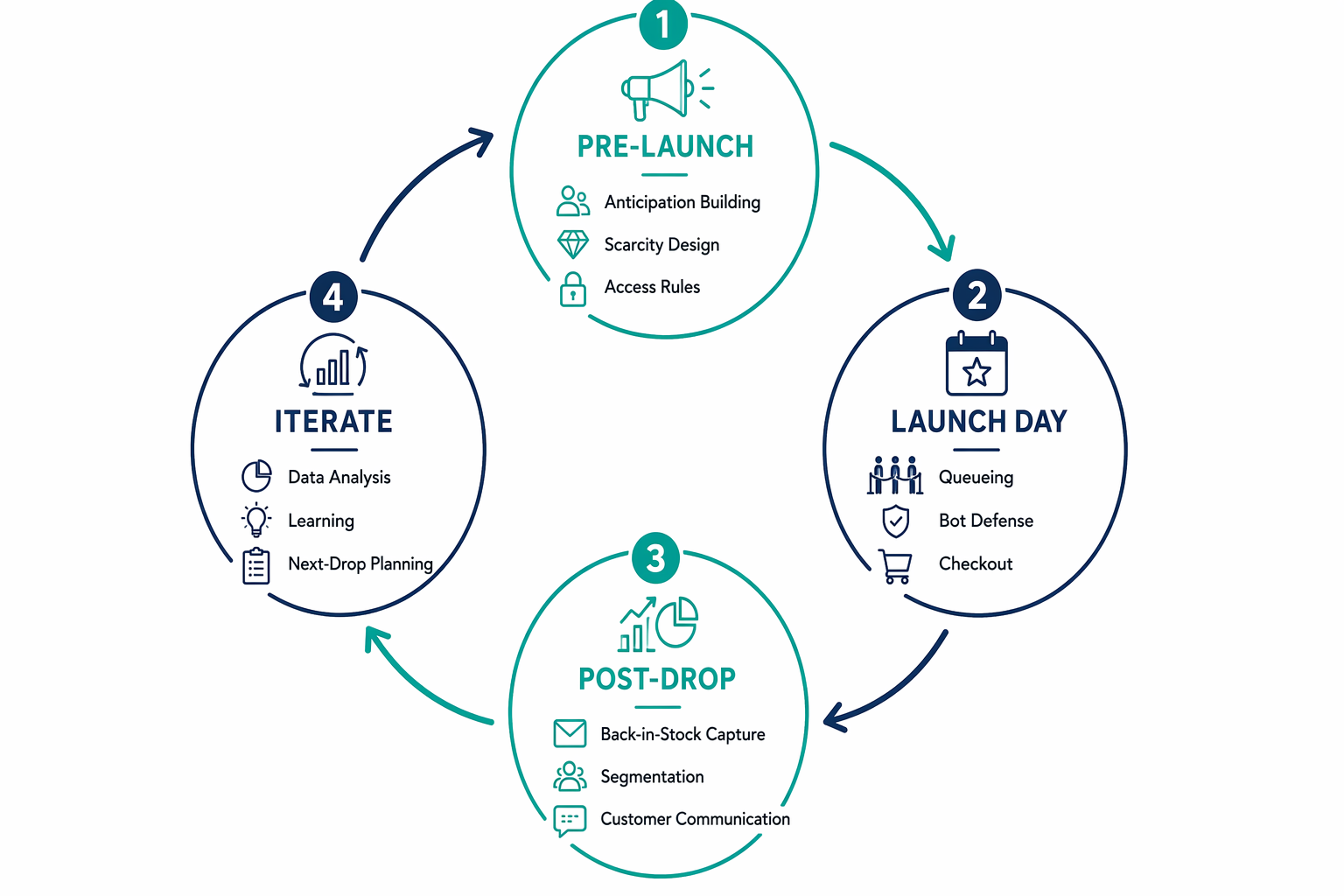
The Full Drop Cycle
A clean limited launch usually looks simple from the outside: teaser, wait, release, sellout. Internally, the cycle is longer and less glamorous. The decisions that protect trust happen before the countdown clock appears, and the value of the drop is often captured after the limited SKU is gone.
| Phase | What the retailer decides | What can break |
|---|---|---|
| Pre-launch | Audience, scarcity mechanic, access rules, inventory allocation, CRM capture | Vague eligibility, inflated demand signals, unclear stock expectations |
| Launch day | Queueing, bot defense, checkout flow, payment handling, customer support scripts | Overselling, site crashes, bot complaints, duplicate orders, support overload |
| Post-drop | Waitlist messaging, back-in-stock flows, segmentation, cancellations, loyalty treatment | Angry non-buyers, lost email demand, poor replenishment signals |
| Iteration | Drop performance review, inventory assumptions, access fairness, repeat customer behavior | Learning only from sellout speed instead of customer quality and trust |
The point is not that every retailer needs Nike-level infrastructure or Supreme-level cultural demand. Supreme is still the cleanest example of the drop itself becoming the marketing event: limited supply, recurring release rhythm, and community attention substitute for much of what other brands would buy through traditional advertising. AdRoll describes the brand as generating major demand without traditional advertising, while CoreMedia cites VF Corp’s $2.1 billion acquisition price for Supreme as evidence of the commercial value built around that model.[1][2]
That model is not a template most retailers can copy wholesale. It is more useful as a warning: if the release rhythm is the media channel, then fulfillment, fairness, and recovery are part of the media channel too. A broken launch is not hidden backstage. Customers experience it as the brand.
Scarcity Has to Be Designed Before It Is Announced
The first real planning question is not “How do we create urgency?” It is “What kind of scarcity can we defend operationally?” A secondary-cited 2022 Journal of Retailing meta-analysis by Barton et al. found that quantity-based scarcity consistently outperformed time-based scarcity in head-to-head testing, though the source trail available here is secondary rather than independently verified.[3] That makes the finding useful for planning, not a universal law.
Quantity scarcity creates a different customer expectation than time scarcity. If customers hear “500 units,” they expect the retailer to know how those units are allocated, whether cart reservation exists, how cancellations are handled, and whether inventory is being held for VIPs, retail partners, or later restocks. If customers hear “available for 24 hours,” they expect enough production, preorder capacity, or delayed fulfillment logic to make the window meaningful.
- Use quantity scarcity when stock is genuinely capped and the team can explain how access works.
- Use time scarcity when production or preorder rules can support the full purchase window.
- Use loyalty or invite access when the business goal is customer quality, not maximum traffic.
- Use waitlists when unmet demand will guide replenishment, segmentation, or the next release.
This is where many drops become unfair before they become exciting. The brand promises exclusivity, but the ecommerce team has not defined whether loyal customers, first-time subscribers, app users, wholesale partners, employees, creators, or the general public get priority. SKIMS-style community expectation and Nike SNKRS-style access mechanics matter here less as brand stories than as operating lessons: customers may tolerate missing out, but they are less forgiving when they do not understand the rules.
Fair Access Is Not a Nice-to-Have
The least useful version of drop marketing assumes that all traffic is good traffic. Queue-it’s product drop examples show why that is naive: one gaming company blocked 700,000 bots across four drops, and in one event bot traffic exceeded genuine traffic by 14 times.[4] That is not a creative problem. It is a capacity, fairness, fraud, analytics, and customer trust problem arriving at the same second.

The bot problem also poisons the data after the fact. If the team cannot separate real shoppers from automated traffic, it may overestimate product demand, underestimate checkout friction, misread channel performance, and reward the wrong acquisition source. A sellout can look like validation while the customer file fills with people who never had a fair chance to buy.
Queue-it also cites research by Nguyen and Tuan finding that fairness explains 80% of the variance in customer trust for online retailers.[4] The original study is being used here as cited research rather than independently verified primary review, but the managerial implication is still sound: perceived fairness is not a soft metric when the entire premise of the launch is that many customers will lose.
Fairness design does not mean everyone gets the product. It means customers can understand the rules before the release, experience the same rules during the release, and receive credible communication afterward. Random selection, invite-only access, loyalty tiers, verified accounts, queue tokens, cart timers, and purchase limits are all valid only if they match the promise the brand made in public.
What the Launch-Day System Needs to Decide
- Entry: whether customers enter through a public product page, app, email link, loyalty portal, raffle, or waiting room.
- Eligibility: whether access is open, tiered, invite-only, geography-limited, or account-verified.
- Inventory reservation: whether stock is reserved at cart add, checkout start, payment authorization, or order confirmation.
- Abuse controls: purchase limits, bot screening, duplicate account detection, payment checks, and cancellation rules.
- Communication: what customers see when they are waiting, when stock is gone, when payment fails, and when an order is canceled.
Small retailers often cannot buy every layer of this stack. They can still publish plain rules, cap quantities per customer, avoid hidden VIP allocations, prepare sold-out messaging, and keep support aligned with the promise. Larger retailers have fewer excuses. If the forecast suggests a traffic spike, queueing, bot mitigation, inventory synchronization, and support escalation are not optional extras.
The Best Drops Create Value Beyond the Limited Item
A limited launch earns its cost when it produces second-order value: new customers, stronger loyalty behavior, better demand data, broader catalog interest, or a repeatable release rhythm. EQL reports that across more than 10,000 launches on its platform, 48% of participants were new to the brand.[5] That figure should be read as vendor-reported platform data, not a neutral industry baseline, but it does show why retailers treat drops as acquisition events rather than only sellout events.
New Balance shows the more durable version of the same logic. Its collaborative drop strategy did not only move limited pairs; it helped create demand for original 550 and 990 silhouettes, with restocks drawing virtual queues of more than 70,000 people and brand search interest more than doubling year over year in 2022, according to HackerNoon.[6] That is the kind of halo effect retailers should look for: the limited product makes the core catalog more desirable instead of trapping attention inside a single SKU.
The operational lesson is to build the drop around a customer journey that continues after the limited item sells out. A collaboration can introduce a customer to the brand. A waitlist can reveal size-level demand. A sold-out page can capture replenishment intent. A post-drop email can move disappointed customers toward adjacent products without pretending those products are the same thing.
Run the Launch Like an Operating Room, Not a Watch Party
The public countdown encourages everyone to stare at the same page. The team should be watching different things. Marketing needs traffic and conversion by source. Ecommerce needs queue health, checkout errors, payment failures, inventory depletion, and page response. Customer support needs a live issue log and approved language. CRM needs to know when to suppress, trigger, or redirect messages. Merchandising needs to know whether sellout is broad or concentrated in a few sizes, colors, or regions.
| Function | Launch-day responsibility | Decision it supports |
|---|---|---|
| Marketing | Monitor traffic quality, source mix, paid spend, social response | Whether to throttle promotion or hold budget |
| Ecommerce | Watch queue, checkout, payment, inventory, site performance | Whether to pause, slow, redirect, or escalate |
| CRM | Control launch emails, SMS, waitlist triggers, sold-out messaging | Whether to keep sending, suppress, or switch to capture mode |
| Support | Track complaints, bot reports, order confusion, cancellation questions | Whether customer-facing rules need clarification |
| Merchandising | Read sell-through by SKU, size, geography, and customer segment | Whether demand supports replenishment or future allocation changes |
The worst time to write the support response is after customers start sending screenshots. Before the launch, the team should agree on the language for common failure points: “in cart” does not mean reserved, payment authorization failed, duplicate orders may be canceled, the queue does not guarantee inventory, and waitlist signup is not a preorder unless the retailer says it is.
This is also where leadership needs the right dashboard. Sellout time is emotionally satisfying and often misleading. A healthier launch review looks at eligible traffic, bot-filtered traffic, conversion by access group, checkout failure rate, cancellation rate, support volume, email capture, repeat-customer participation, new-customer participation, and post-drop revenue from adjacent products.
Sold Out Is the Beginning of Segmentation
A sold-out page is not a dead end unless the retailer leaves it that way. Klaviyo’s 2025 ecommerce benchmarks, cited via scandiweb, indicate that back-in-stock flows achieve a 65% open rate and 12% to 15% conversion, making them the highest-converting flow type in that benchmark set.[3] As with the scarcity meta-analysis, the source path here is secondary, but the operational point is practical: the disappointed audience is often the cleanest demand signal the brand will get.
Post-drop follow-up should split customers by what actually happened, not by one generic “thanks for the hype” message. Buyers need confirmation, shipping clarity, care instructions, loyalty prompts, or complementary product suggestions. Non-buyers who reached checkout may need a different message from people who only joined the waitlist. Customers blocked by payment errors should not receive the same copy as customers who arrived after sellout.
- Create a buyer segment for fulfillment updates, loyalty reinforcement, and cross-sell only where relevant.
- Create a high-intent non-buyer segment from cart, checkout, queue, and waitlist behavior.
- Capture size, color, and variant demand instead of treating all missed demand as equal.
- Separate bot-filtered or suspicious activity from human demand before forecasting the next release.
- Review support tickets as launch data, not only as customer service cleanup.
A careful post-drop review often changes the next launch more than the campaign recap does. If loyal customers were consistently shut out, the access model may need earlier member entry. If first-time customers joined heavily but did not convert, the issue may be account creation, payment friction, or unclear rules. If one size sold instantly and adjacent sizes lagged, the story is allocation, not hype.
What Different Retailers Can Realistically Borrow
The useful playbook is tiered. Copying the surface of a famous drop is how teams end up with a countdown timer, angry customers, and no learning. Borrowing the operating discipline is more realistic.
| Retailer situation | Reasonable limited-launch system | What to avoid |
|---|---|---|
| Small brand with modest traffic | Clear rules, limited quantity, email or SMS waitlist, manual support preparation, clean sold-out capture | Pretending scarcity exists if replenishment is already planned but undisclosed |
| Growing DTC brand with repeat launches | Loyalty segmentation, early access windows, cart limits, back-in-stock flows, post-drop demand review | Sending everyone to the same public page when customer priority matters |
| High-demand retailer | Queueing, bot mitigation, inventory synchronization, payment monitoring, support escalation, cancellation policy | Treating bot traffic as proof of demand |
| Marketplace or multi-region retailer | Regional allocation rules, fraud controls, localized communication, inventory reservation logic | Letting hidden allocation decisions create public fairness complaints |
Invite-only access can also serve loyalty growth when the mechanics are honest. Queue-it cites one apparel brand that used an invite-only waiting room and grew membership by 40% in four months across two drops.[4] That is a vendor-sourced case, so it should not be treated as a guaranteed outcome. It does show the trade-off: limiting access can increase membership motivation, but only if customers believe membership changes their real chances.
The standard for a limited launch should not be whether the product disappeared quickly. It should be whether the team can repeat the system without burning customer trust: the rules were clear, real shoppers had a fair path, inventory behaved as promised, support could answer the obvious questions, and the unmet demand became useful data. Scarcity can create attention in a day. It becomes a growth engine only when the retailer designs it as a repeatable trust system.
References
- Unrolling the Supreme Brand, AdRoll
- The Business of Hype: How to Master the Drop, CoreMedia
- Secondary-cited 2022 Journal of Retailing scarcity meta-analysis and Klaviyo 2025 ecommerce benchmarks, scandiweb
- Product Drops: 8 Strategies, 5 Benefits & 27 Examples (2026), Queue-it
- Limited Edition Product Drops Create Loyal Communities, EQL
- Why Product Drops Are the New Brand Growth Strategy, HackerNoon
Comments
Join the discussion with an anonymous comment.