

The B2B Content Differentiation Paradox: Why AI Increases Both Output and Sameness
AI makes content production dramatically easier, but the structural mechanics of LLMs push output toward statistical averages — leaving B2B brands struggling to stand out. This article explains why the sameness problem runs deeper than editing and what strategic shifts (brand context systems, original research, first-party data) can actually reverse it.
The strange thing about AI in B2B marketing is that it can make a team feel more productive and less distinctive at the same time. The calendar fills faster. The campaign has more supporting assets. The first draft no longer takes three quiet hours nobody had. Then the content reaches review, and the relief starts to thin out: the claims sound familiar, the examples could belong to any competitor, and the “brand voice” conversation returns for the third time that month.
That frustration is not just editorial pickiness. In The Growth Syndicate’s report based on 110 B2B marketing leaders, 63% cited increased noise and less differentiation as a major concern with AI in marketing, ranking it above budget limitations, quality control, and data privacy. In the same report, among respondents with a definitive view, 34% believed AI would make differentiation harder, compared with 16% who saw new opportunities — roughly a 2:1 split. Trust in AI-generated content averaged 5.8 out of 10, which is not panic, but it is nowhere near confidence either.[1]
A larger industry sample points in the same direction, even if the measurements are different. The Content Marketing Institute’s 2026 B2B Content and Marketing Trends Report, based on 1,015 marketers, found that content differentiation remains a top challenge for 24% of B2B marketers. It also found that 12% say content quality decreased with AI, while 22% report no change in creative capabilities.[2] Those numbers should not be stretched into a universal verdict on AI effectiveness. They do suggest something more specific and more useful: many teams are adopting AI without feeling a corresponding increase in creative or strategic advantage.
Output, Quality, and Differentiation Are Not the Same Problem
A lot of AI content debates become useless because they collapse three separate questions into one.
| Question | What It Measures | What AI Often Improves | What AI Does Not Automatically Solve |
|---|---|---|---|
| Can we produce more? | Output volume and speed | Drafting, repurposing, outlining, versioning | Whether the content deserves attention |
| Is the content acceptable? | Clarity, grammar, structure, completeness | Readable first drafts and cleaner asset variants | Whether the argument is specific to the company |
| Is the content defensible? | Distinctive point of view, proprietary evidence, market memory | Only when supplied with non-generic inputs | Whether a competitor could publish the same thing tomorrow |
The first question is where AI has delivered the most obvious relief. B2B teams can turn a webinar into emails, a report into social posts, a sales deck into a blog outline, and a rough subject-matter expert interview into something coherent. That matters, especially for teams that have been operating with more channels than people.
The second question is where editing, prompting, and workflow discipline help. A generic AI draft can be made clearer. It can lose the stiff transitions, the empty opening, the “in today’s fast-paced landscape” language, and the evenly weighted list of obvious best practices. There is a place for that work. If the immediate problem is sentence-level sameness, cleanup workflows like the ones covered in “Why AI Content Still Sounds Generic” are worth using.
The third question is the one that gets undercounted in dashboards. Differentiation is not the same as acceptable quality. A polished article can still be strategically weak if another company, using the same model and the same public category language, could generate an equivalent version tomorrow. That is the standard B2B content teams need to apply more often: not “does this read well?” but “what does this contain that only we could credibly say?”
Why AI Pulls B2B Content Toward the Average
The sameness problem is not a mysterious failure of creativity. It is a predictable result of asking a model trained on broad public patterns to produce plausible category content.
In B2B categories, public information is already crowded with convergent language. Competitors describe the same buyer pains. Analysts and vendors repeat similar maturity curves. Search results reward explainers that cover the same definitions, benefits, implementation steps, and objections. Product pages cluster around similar claims because everyone wants to sound secure, scalable, automated, integrated, and easy to use.
When a model is asked to write from that public pool, it is very good at recognizing what a credible answer in the category usually looks like. That is the gift and the trap. It can produce content that feels informed because it has absorbed the surface shape of the market: the usual problem statement, the usual buyer concerns, the usual list of best practices, the usual executive tone. But unless the prompt supplies something more specific, the model has little reason to depart from the most probable path.

This is why better prompting often improves the draft without changing the strategic center. A prompt can ask for a sharper tone, a stronger hook, fewer clichés, a more skeptical angle, or examples for a specific role. Those instructions can move the language away from the blandest version of the answer. But if the underlying inputs are still public assumptions and generic buyer descriptions, the output remains bounded by what the model can infer from everyone else’s visible content.
The issue becomes especially visible in categories where the approved language has already been sanded down by committees. A model trained on that environment learns the pattern. It learns that vendors “empower teams,” “unlock insights,” “streamline workflows,” and “drive measurable outcomes.” It learns that every market has “rapidly evolving demands.” It learns that every solution helps organizations “do more with less.” None of those phrases is automatically false. That is part of the problem. They are too safe to be useful as proof of a distinct market view.
The Model Cannot Remember Your Market for You
Strong B2B content usually depends on accumulated market memory: what buyers misunderstand after the third sales call, which objections are actually political rather than technical, where implementations stall, which metrics executives claim to care about but rarely fund, what customer language keeps appearing in renewal conversations, and which “best practice” breaks down in a particular operating environment.
That memory is not automatically present in a public model. It lives in sales notes, support tickets, onboarding calls, win-loss interviews, product usage patterns, customer advisory boards, implementation retrospectives, and the heads of people who have spent years hearing buyers describe the same problem in slightly different ways. If that material never reaches the content system, AI will fill the gap with category consensus.
This is why AI can make a weak content strategy look more operationally mature. The surface area expands. The assets become more consistent. The team ships more often. But the content may still be missing the very material that gives a brand its right to be heard: evidence, experience, and judgment that competitors cannot scrape from the same visible web.
Editing Can Fix Readability Without Fixing Sameness
There is a familiar rescue operation inside many content teams now. AI produces a draft. The editor removes the obvious filler. A subject-matter expert adds a comment or two. Someone rewrites the introduction. The final piece is more readable than the first draft, and everyone agrees it is “good enough” to publish.
Sometimes that is a perfectly rational decision. Not every asset needs to be a flagship argument. A product update email, a webinar description, a nurture sequence variant, or a basic how-to article may only need to be accurate, useful, and on time. The mistake is treating that same standard as evidence that the brand is building a stronger market position.
Readability is the price of entry. Differentiation begins later, when the content makes a choice another competent team might not make. It names a tradeoff. It rejects a common assumption. It shows a pattern from customers that has not yet become public consensus. It explains why the standard advice fails under a specific condition. It carries a point of view that came from operating in the market, not just summarizing it.
That distinction matters because AI can make middling content less visibly bad. It can smooth the prose, complete the structure, and add the expected caveats. A draft that once would have looked thin may now look professional. But a professional version of a generic argument is still generic; it is just harder to reject in review.
The Buyer Side of the Paradox
The sameness problem is not confined to marketing teams arguing over copy. Buyers are also learning to treat AI-generated insight with caution. Gartner reported in May 2026 that 69% of B2B buyers turn to sales reps to validate AI-generated insights. Gartner also predicted that by 2030, 75% of B2B buyers will prefer sales experiences that prioritize human interaction over AI.[3]
The 2030 figure is a forecast, not a settled outcome. Four years is a long time in AI adoption. But the current validation behavior is already worth noticing. If buyers are using people to test, interpret, or challenge AI-generated information, then human expertise is not disappearing from the buying process. It may be becoming more valuable precisely because AI makes plausible information easier to obtain.
That has consequences for content. A buyer who can generate a basic market explanation on demand has less reason to reward a vendor for publishing another basic market explanation. The content has to do something the buyer cannot easily ask a general-purpose model to do: reveal a pattern from real implementations, explain a hidden risk, compare tradeoffs with unusual honesty, or help the buyer make sense of conflicting internal pressures.
What Competitors Cannot Prompt Into Existence
The strategic answer is not to use AI less. It is to stop expecting the model itself to be the source of difference. The work shifts upstream, into the inputs the model receives and the knowledge system around it.
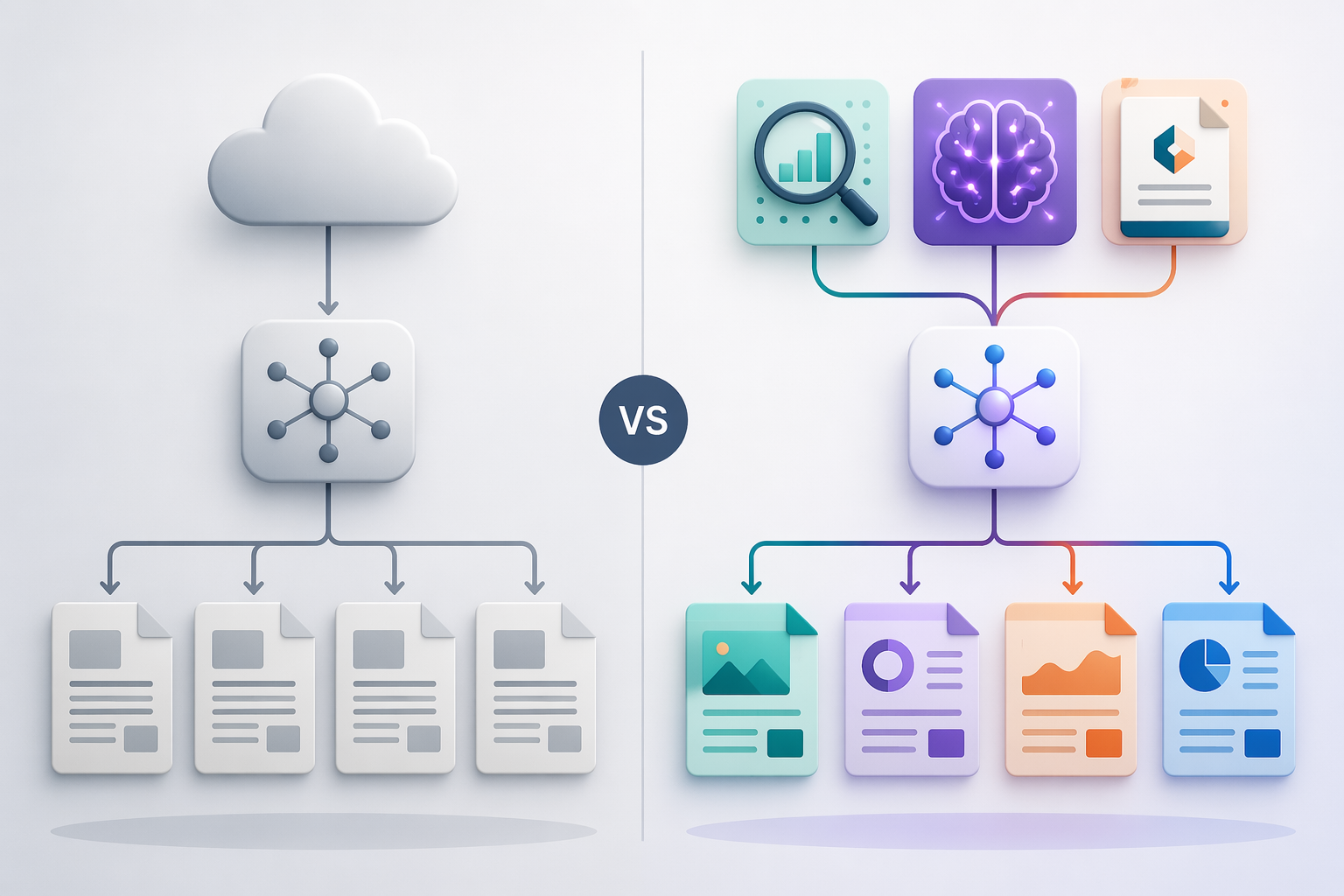
A useful test is simple: if a competitor can get the same substance from the same public model, the substance is not a durable differentiator. The company may still publish it for search coverage, sales enablement, or educational utility. But it should not confuse that asset with thought leadership, category creation, or brand distinction.
Brand Context Systems
Most brand voice documents were not built for AI. They describe tone in adjectives: confident, clear, helpful, expert, pragmatic. Those words are too broad to guide a model away from category average because nearly every B2B brand wants the same qualities.
A brand context system is more specific. It captures what the company believes, what it refuses to claim, which customer problems it understands better than competitors, which proof points are approved, which analogies are overused, which market myths it challenges, and how its point of view changes by audience. It gives AI a body of judgment to work from, not just a tone to imitate.
The practical difference shows up in the draft. A generic prompt asks for “a blog post about AI governance for enterprise teams.” A stronger context system tells the model that the company believes governance fails when it is treated as a legal review layer rather than an operating model, that security leaders care about auditability before innovation language, that the product team should not claim full automation, and that the strongest customer evidence comes from reducing review bottlenecks rather than eliminating human review. The model can still write quickly, but now it is constrained by market-specific choices.
Original Research
Original research changes the content equation because it gives the company evidence that did not already exist in the public average. That does not always require a massive annual benchmark report. It can include structured customer interviews, a focused survey of a narrowly defined buyer group, a recurring analysis of anonymized implementation patterns, or a review of common failure points observed by the services team.
The point is not to decorate a generic article with a statistic. The point is to let the evidence shape the argument. If customer interviews show that budget approval stalls because the economic buyer does not trust the operational metrics, that should change the content. If onboarding data shows that teams with one internal owner succeed faster than teams with larger committees, that should change the advice. If support conversations show the same misconception appearing after purchase, that should change the pre-sale education.
This is where B2B content can become harder to copy. A competitor can imitate the format of a benchmark report. It cannot reproduce the same customer base, the same implementation history, or the same observed pattern unless it has also done the work.
First-Party Data
First-party data is not automatically interesting. A dashboard full of product events, CRM fields, and campaign metrics can easily become noise. Its value depends on whether the team can turn it into a market observation that helps buyers make a better decision.
For content, the useful questions are usually practical. Which features do successful customers adopt first? Which onboarding sequence correlates with fewer support escalations? Which objections appear in lost deals but disappear in retained accounts? Which roles consume educational content before a buying committee expands? The answers may not always be publishable in raw form, and they often require careful privacy review. But even when used internally, they can give AI-assisted content a sharper understanding of what actually happens in the market.
Real Expert Input
Subject-matter experts are often brought in too late, after the draft has already chosen the argument. At that point, their role is reduced to fact-checking, softening claims, or adding a quote. That is an expensive way to produce a slightly more accurate generic piece.
The better use of expert input is before drafting. Ask the sales leader what buyers only admit after trust is built. Ask customer success which expectations need to be reset early. Ask product where the market is asking the wrong question. Ask implementation teams which “simple” step causes delays. Ask executives which category assumption the company is willing to argue against in public.
AI can then help structure, test, and adapt that expert material. It can turn a messy transcript into themes, compare claims across interviews, draft outlines for different funnel stages, or create variants for sales and demand generation. But the distinctive unit is still the expert observation. Without it, the model is mostly arranging the market’s existing language into a new order.
“AI-Free” Is a Signal, Not a Strategy
Some brands are already responding to AI sameness as a perception issue. Improvado’s 2026 AI marketing trends report notes examples of brands using “AI-free” positioning as a differentiator.[4] That move makes sense in markets where buyers are tired of synthetic-feeling content or where human craft is part of the product promise.
For most B2B companies, though, “AI-free” is too blunt to carry the strategy. Buyers usually do not need a moral declaration about the production process. They need content that helps them understand a problem better than they did before. A human-written article with no evidence can still be forgettable. An AI-assisted article grounded in original research, customer reality, and a clear market belief can still be valuable.
The distinction worth defending is not human versus AI. It is public-average input versus owned-market knowledge.
The Content Investment Question Changes
Before AI, the bottleneck in many B2B content programs was production capacity. Teams had more ideas than writers, more campaigns than editors, and more channels than budget. AI has not removed that constraint completely, but it has changed its shape. The scarce resource is less often the ability to produce words and more often the ability to produce defensible perspective.
That should change planning conversations. A quarterly content plan built only around topics, keywords, formats, and publication dates is incomplete. It also needs to identify the proprietary input behind the work. Which pieces are based on customer interviews? Which draw from product data? Which express a company belief that leadership is willing to stand behind? Which are simply coverage pieces that help with discoverability but should not be mistaken for differentiation?
This does not mean every article needs original data. That would create a different kind of bottleneck and probably a lot of forced research. The point is portfolio discipline. Some content can be utilitarian. Some can be AI-assisted and lightly edited because the job is narrow. But the content meant to shape perception, support a category point of view, or influence late-stage confidence needs stronger inputs than the public internet.
A practical review question is enough to expose the gap: what does this piece know that the model could not already infer? If the answer is nothing, the team can still publish it. But it should be honest about what kind of asset it is producing.
AI Can Accelerate the Work, But It Cannot Supply the Difference
The best use of AI in B2B marketing is not pretending the model has a market perspective of its own. It is using AI to increase the speed and usefulness of work already anchored in something real: a sharper brand context, original evidence, first-party data, and expert judgment from people close to customers.
When those inputs are missing, AI tends to give teams more of what the category already sounds like. Sometimes that is enough for a routine asset. It is not enough for a brand trying to become more memorable in a market where everyone else is also publishing faster.
The next content investment conversation should start before the prompt. Not with how many assets AI can help produce, but with what proprietary context, evidence, or expertise the company is building for AI to work from.
References
- AI B2B Marketing Report, The Growth Syndicate
- 2026 B2B Content and Marketing Trends Report, Content Marketing Institute
- Gartner Survey Finds Sixty-Nine Percent of B2B Buyers Turn to Sales Reps to Validate AI-Generated Insights, Gartner, May 20, 2026
- AI Marketing Trends, Improvado
Comments
Join the discussion with an anonymous comment.