

Apple's OpenAI lawsuit could disrupt AI marketing tools
The Apple-OpenAI lawsuit threatens OpenAI's iOS distribution, hardware roadmap, and IPO timeline, creating real risks for marketing teams relying on ChatGPT tools. This article explains the threat to your AI tool stack and provides practical steps to reduce dependency risk.
The practical question behind Apple’s lawsuit over OpenAI’s hardware plans is not whether ChatGPT disappears from your team’s browser tomorrow. It is whether OpenAI’s business pressure can travel downstream into the tools marketers now use for briefs, drafts, ad variants, reporting summaries, customer research, and internal automation.
That risk is real enough to plan around. Apple’s July 10, 2026 federal lawsuit accuses OpenAI of using trade secrets to build upcoming AI hardware, and the dispute lands at an awkward point for OpenAI: its iOS distribution relationship, hardware roadmap, and IPO narrative are all under pressure at once.[1] None of that means marketing teams should abandon ChatGPT. It does mean they should stop treating OpenAI access, pricing, and product cadence as if they were a stable utility bill.
The risk map marketers should care about
There are three places this lawsuit could matter operationally: distribution, roadmap, and financing. Each one is boring until it breaks a workflow.
- Distribution: OpenAI has 900 million weekly active users, with a large portion of usage tied to iOS devices; if the Apple relationship weakens, ChatGPT loses some of the frictionless consumer access that helped normalize it inside work habits.[2]
- Roadmap: Apple is seeking a preliminary injunction against OpenAI’s hardware program, and OpenAI CFO Sarah Friar has confirmed the company is targeting release toward the end of 2026.[3]
- Financing: OpenAI’s growth story depends on convincing investors that usage, enterprise adoption, device strategy, and compute investment can scale together; legal uncertainty can complicate that story before it ever reaches a marketing team’s renewal cycle.
A marketing manager does not need to predict the court outcome to see the exposure. If OpenAI faces slower distribution through Apple channels, a delayed hardware launch, or a more cautious IPO process, the company may have more reason to protect margins, reshape enterprise packages, or prioritize the products that best support its financing story. The downstream effects would not necessarily arrive as a headline. They could show up as API pricing changes, feature gating, slower support, model-routing changes inside third-party tools, or annual contract terms that quietly become less flexible.
How a partnership became a competitive conflict
The Apple-OpenAI fight is not a random legal flare-up. It follows a familiar arc: partnership, platform integration, strategic overlap, then conflict over who controls the user interface.
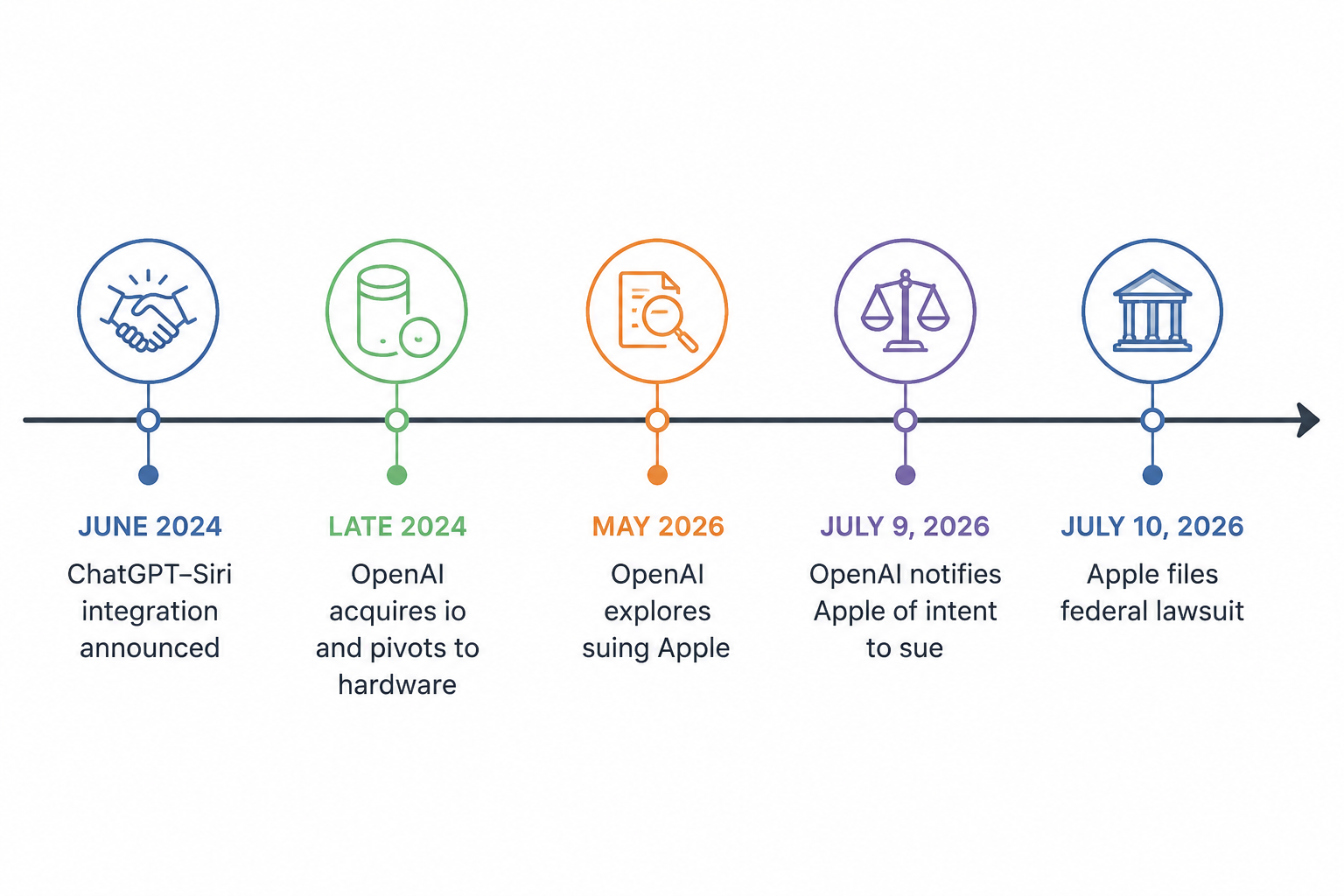
| Moment | Why it matters for marketers |
|---|---|
| June 2024: Apple announces ChatGPT integration into Siri | OpenAI gains a path into default mobile behavior, not just voluntary app usage. |
| OpenAI acquires io for $6.5 billion | The company signals that hardware and direct consumer interfaces are part of its growth plan. |
| May 2026: reports say OpenAI explored suing Apple first | The relationship has moved beyond tense partnership into legal positioning. |
| July 10, 2026: Apple files a federal trade secrets lawsuit | The dispute becomes a direct threat to OpenAI’s hardware schedule and Apple distribution relationship. |
Apple’s 2024 ChatGPT-Siri integration made sense at the time: Apple needed a generative AI answer, and OpenAI needed distribution. By 2026, the strategic geometry looked different. OpenAI had acquired io for $6.5 billion and was moving toward dedicated AI hardware, while reports in May 2026 said OpenAI had explored legal action against Apple before Apple filed its own lawsuit in July.[3][4]
OpenAI has pushed back. The company said it is “not aware of any evidence that this complaint has merit,” and Apple’s claims have not been tested in court.[5] That distinction matters. Marketing teams should not treat Apple’s allegations as proven facts. They should treat the lawsuit as a business event that may change incentives around distribution, product investment, and pricing.
The cleanest way to read the conflict is through control of the interface. ChatGPT inside Siri made OpenAI useful inside Apple’s environment. OpenAI hardware would let the company build a consumer relationship outside Apple’s environment. That is not a side plot for marketers; it is the same kind of platform dependency problem that has repeatedly reshaped acquisition costs, attribution, creative testing, and content distribution.
Why OpenAI’s business pressure can become your tool-stack pressure
OpenAI is not a small SaaS vendor with one lawsuit and a few nervous customers. It is a high-growth infrastructure company with enormous usage, expensive compute obligations, and a financing story that depends on future scale. CNBC reported that OpenAI generated $5.7 billion in Q1 2026 revenue while burning approximately $3.7 billion, had a $600 billion compute spend commitment, and had confidential IPO planning tied to Q4 2026 with a projected $280 billion 2030 revenue target.[6]
Those numbers do not prove that prices will rise. They do show why pricing, packaging, and enterprise prioritization are not abstract concerns. A company carrying that level of compute commitment has to keep proving that usage can turn into durable revenue. If a major distribution channel becomes less certain, or a hardware launch is delayed, the pressure to monetize existing channels more efficiently can increase.
That is where marketers feel the impact. Most teams do not have a single “OpenAI line item.” They have ChatGPT seats, a writing platform that calls OpenAI’s API, a meeting-summary tool, a CMS assistant, a chatbot vendor, a reporting workflow, and a few Zapier or Make automations built by someone who has since moved roles. The dependency is distributed, so the risk is easy to undercount.
A price change in the API can appear as a vendor package change. A model availability change can appear as worse output quality in a content tool. A new enterprise tier can appear as a procurement surprise. A product delay can appear as features staying in beta longer than the roadmap promised. The marketing team experiences the vendor stack, not OpenAI’s balance sheet, but the two are connected.
The injunction threat is the near-term issue
The most immediate operational risk is not the courtroom drama around employee movement. It is the possibility that Apple’s requested preliminary injunction slows OpenAI’s hardware program. Lowenstein Sandler partner Bryan Sterba put it plainly: “This could really, really slow down OpenAI’s plans to go to market.”[7]
Hardware matters because it is part of OpenAI’s attempt to move beyond being an app, API, and model provider. If the company wants a direct consumer interface, a device strategy gives it a way to reduce dependence on Apple and other gatekeepers. Apple’s lawsuit targets that path at the moment OpenAI is trying to prove it can own more of the user relationship.
For marketing teams, the point is not whether a new OpenAI device would have replaced an iPhone, a smart speaker, or a desktop workflow. The point is that product roadmaps, investor confidence, and pricing power are linked. If a key launch is delayed, leadership may protect other growth levers more aggressively. Enterprise revenue is one of those levers.
Treat the colorful allegations carefully
Apple’s complaint includes the kind of details that travel well on social platforms. The most memorable is Apple’s allegation that more than 400 former Apple employees now work at OpenAI.[8] That figure should slow readers down, not speed them up. CNN’s review found at least 10 direct hires through LinkedIn, while other reporting has noted that the larger figure may include indirect hires or people with very short Apple tenures.[8][9]
That does not make Apple’s allegation irrelevant. It makes it unproven. For a marketing risk assessment, the useful distinction is simple: do not build a forecast on the assumption that Apple will prove every claim, but do not ignore the fact that a major platform owner is now trying to restrict OpenAI’s hardware plans through federal litigation.
The same caution applies to rumored product details. Reports about a screen-free AI speaker or other form factors may be directionally interesting, but OpenAI has not confirmed enough detail to make the device itself the center of a marketing operations plan. The more durable fact is that OpenAI is pursuing hardware and Apple is trying to slow or block that work.
This is a platform-dependency problem, not just an AI-news problem
Marketing teams have seen versions of this before. TikTok ban threats forced brands to reconsider creator spend, paid social mix, and organic content calendars. Apple’s IDFA deprecation changed attribution, audience building, and performance reporting. Neither case maps perfectly to OpenAI, but both are reminders that a platform relationship can feel stable right up to the point when legal, policy, or business incentives change.
The AI version is harder to see because OpenAI is often hidden inside other tools. A content strategist may think the team uses five AI products when three of them depend on the same model provider. A paid media manager may not know whether the ad-variant generator uses OpenAI directly, uses OpenAI through a vendor, or can switch models without changing workflow. Procurement may have the contract. Operations may have the automation. The risk sits between them.
Paolo Pescatore described the bigger fight as one moving “beyond models and chatbots towards who controls the device, interface and direct consumer relationship.”[10] That framing matters because marketers increasingly build workflows around whichever interface is easiest for the team to adopt. If that interface is controlled by a company facing distribution conflict, roadmap pressure, and financing expectations, the workflow inherits some of that instability.
What to do this quarter
The right response is not a dramatic tool purge. ChatGPT may still be the best tool for many marketing workflows. The useful move is to find concentration before it finds you.
Audit where OpenAI sits in the stack
Start with a plain inventory. List every AI-assisted workflow used by marketing, content, lifecycle, paid media, sales enablement, and analytics. For each one, identify whether the team uses ChatGPT directly, OpenAI’s API directly, or a vendor that depends on OpenAI behind the scenes.
| Workflow | Dependency question | Operational risk to check |
|---|---|---|
| Content briefs and drafts | Does the tool use OpenAI only, or can it route to another model? | Output quality drops or costs rise after a vendor pricing change. |
| Paid media variant generation | Can campaign teams export prompts and testing logic? | Ad testing slows because prompts are trapped inside one interface. |
| Reporting summaries | Is the model provider named in the contract or security review? | Leadership reporting depends on a tool whose underlying model may change. |
| Internal automations | Who owns the API key and usage limits? | A quiet rate-limit, billing, or authentication change breaks a recurring task. |
| Customer-facing chat or search | Is there a fallback model or manual escalation path? | Support or lead-routing quality changes without enough warning. |
This audit should not live only in a procurement spreadsheet. The person who owns the content calendar knows which deadlines would slip. The paid media lead knows which tests would disappear. The marketing ops person knows which automations were built quickly and never documented. Put those people in the same room for an hour and ask what breaks if OpenAI-backed features get more expensive, slower, or less available.
Pressure-test fallback tools before you need them
Fallback testing is usually postponed because the primary tool works. That is exactly why it needs to happen now, while the team can compare outputs calmly instead of rebuilding a workflow during a launch week.

Pick three real tasks, not abstract demos: a product launch brief, a paid social variant set, and a performance-summary memo. Run each through ChatGPT, Google Gemini, Anthropic Claude, and Perplexity. Do not score them only on writing quality. Score them on speed, source handling, brand voice control, exportability, privacy fit, and whether a non-expert on the team can repeat the process.
The goal is not to crown a universal replacement. Gemini may be better for a Google-heavy workflow. Claude may be stronger for long-form synthesis. Perplexity may be useful for research paths that need visible source trails. ChatGPT may remain the default for speed and familiarity. The win is knowing which workflow can move where if the default changes.
Renegotiate flexibility before renewal
Annual AI contracts can be useful when they lock in favorable pricing, but they become risky when they lock the team into a vendor that cannot explain its model dependency. Before renewal, ask whether the vendor can switch between model providers, whether pricing is protected if its underlying API costs change, and whether your team can export prompts, workflows, templates, and historical outputs.
- Ask vendors to name their primary and fallback model providers.
- Avoid multi-year commitments unless pricing and model-routing terms are explicit.
- Keep at least one month-to-month option for a critical workflow.
- Require export rights for prompts, templates, workflows, and usage data.
- Document who owns API keys, billing alerts, and rate-limit monitoring.
The uncomfortable procurement question is whether a vendor is selling software or reselling access to a model with a nicer interface. Both can be worth paying for. Only one gives your team meaningful insulation if the underlying economics change.
Watch the IPO timeline as an operating signal
The lawsuit outcome may take time. Marketing teams need earlier signals. OpenAI’s IPO timeline is one of them. CNBC reported confidential IPO planning targeting Q4 2026, though that timing remains fluid and could change for reasons unrelated to Apple.[6]
If the IPO is delayed, valuation expectations are cut, or investor commentary shifts toward margin discipline, treat that as a reason to revisit your AI budget assumptions. Pricing changes often reach customers after the strategic pressure is already visible. A one- or two-quarter lead time is enough to test alternatives, renegotiate contracts, and brief leadership before the renewal conversation becomes urgent.
The working conclusion
Apple’s lawsuit may fail, settle, narrow, or drag on. OpenAI may keep shipping, keep growing, and keep being the most useful AI tool in a marketing team’s day. Those possibilities are not in conflict with preparation.
The mistake would be assuming that because ChatGPT works today, the economics and access patterns around OpenAI-powered tools will stay steady. Marketing teams do not need to panic or turn every legal headline into a migration plan. They do need to know where OpenAI sits in the stack, which workflows can move, and which vendor contracts leave them exposed if the platform underneath them changes.
References
- Apple sues OpenAI alleging trade secret theft — CNBC, 2026-07-10
- Why Apple and OpenAI are reportedly betting on AI hardware in 2026 — Scientific American
- Can an Apple lawsuit derail OpenAI's hardware plans? — TechCrunch, 2026-07-19
- Apple files lawsuit accusing OpenAI of stealing trade secrets — AP News, 2026-07-10
- OpenAI pushes back on Apple trade secret lawsuit — TechCrunch, 2026-07-14
- OpenAI preps for IPO in 2026, says ChatGPT must be 'productivity tool' — CNBC, 2026-03-17
- Apple's Trade Secret Claims Could Disrupt OpenAI's Hardware Plans — Lowenstein Sandler
- Apple accuses OpenAI of using stolen trade secrets to create its upcoming AI gadgets in new lawsuit — CNN, 2026-07-10
- Apple v. OpenAI lawsuit: 8 key allegations explained — Mashable
- Apple, OpenAI suit spotlights battle over physical AI — The Hill
Comments
Join the discussion with an anonymous comment.