

Apple vs Nvidia: Two AI Monetization Paths for Marketers
This article compares Apple's services-first AI monetization model to Nvidia's infrastructure-heavy approach, using their market cap battle as a lens to help marketing leaders decide which strategy fits their team's budget and timeline.
On July 17, 2026, Apple was valued at $4.88 trillion and Nvidia at $4.86 trillion, close enough that the “world’s most valuable company” headline could change with an ordinary trading day. The more useful detail was the shape of the move: Apple was up 23% year to date, while Nvidia was up 9%, after Nvidia had already reached a $5 trillion valuation in October 2025 and then seen growth slow from that peak pace.[1][2]
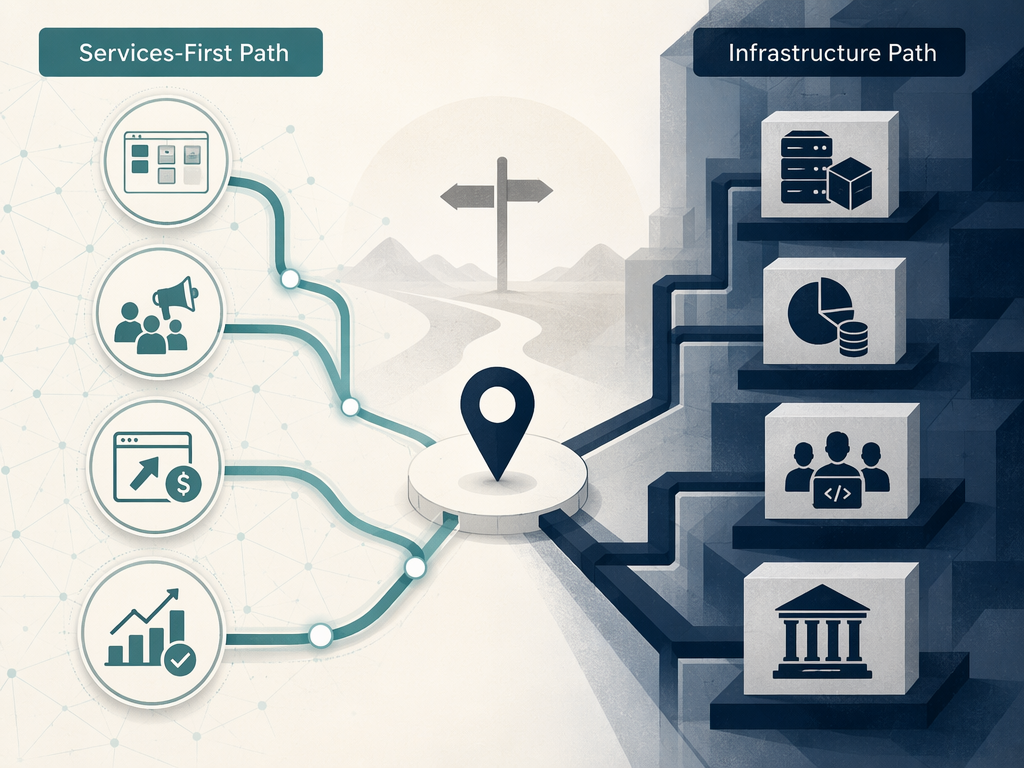
That snapshot is not a durable scoreboard. It is a clean way to see two very different AI monetization models standing almost side by side. Nvidia represents the infrastructure path: sell the compute, chips, and systems that other companies need to build and run AI. Apple represents the services-first path: use AI to make existing products, subscriptions, app economics, and device distribution more valuable.
For marketing leaders, the question is not which company has the better AI story for investors. It is which model looks more like a budget request that can survive finance review, team capacity limits, and a quarterly performance target.
The two models hiding inside the Apple-Nvidia market cap story
Nvidia’s AI economics are extraordinary because the company sits near the base layer of the AI buildout. If enterprises, hyperscalers, governments, and software companies want more AI capability, they need more infrastructure. Goldman Sachs estimated $527 billion in hyperscaler capex in 2026, and also estimated that AI-related companies had added about $27 trillion in market value since November 2022.[3]
That is not a small-tool decision scaled up. It is a capital cycle. Nvidia benefits when other organizations decide they must spend heavily before they can compete. The payoff can be enormous, but so is the dependency on demand for AI capacity, data centers, chips, power, and deployment at scale.
Apple’s model is less dramatic and, for most marketing teams, more recognizable. Its services revenue reached $109.2 billion in FY2025, up 14% year over year, with reported services gross margin around 76.7% compared with overall company gross margin around 47%.[4][5] That margin gap matters. Apple does not need every AI feature to become a standalone AI product. It can improve the value of services, increase engagement, support subscription retention, strengthen App Store economics, and make its installed base more productive.
The distribution advantage is already in place. Apple had more than 2.5 billion active devices and more than 1 billion paid subscriptions, according to figures cited in 2025 company and market breakdowns.[6] A new AI capability can move through channels Apple already controls: devices, operating systems, default apps, subscriptions, developer economics, and the App Store.
That is the part worth borrowing. Not the brand aura, not the hardware mythology, and not the idea that every company can wait out the AI cycle because it owns a giant ecosystem. The lesson is narrower and more useful: when you already have distribution, customer relationships, usage data, and paid products, AI can be monetized by improving those channels instead of building a new AI business from scratch.
Apple’s AI leverage looks like work marketers already own
The marketing version of Apple’s advantage is not a phone in every pocket. It is the set of pipes many teams already manage but underuse: CRM segments, lifecycle programs, email and SMS lists, website personalization, paid media learning loops, content operations, sales enablement, product usage triggers, community channels, partner co-marketing, and customer support insights.
An Apple-style AI budget case starts with those assets. It asks where AI can reduce cycle time, improve targeting, increase conversion, or lift retention inside a workflow that already exists. It does not begin with a request to create a parallel AI stack that the team has no time to operate.
That distinction matters because many AI proposals collapse at the absorption layer. The tool is approved, the pilot looks promising, and then the actual work lands on a demand gen manager, a lifecycle marketer, and a marketing ops lead who are already closing the quarter. If the AI plan requires them to become prompt engineers, data architects, QA reviewers, workflow designers, and change managers at the same time, the ROI case is already carrying more weight than the org chart can support.
A services-first plan is easier to defend because it starts from a measurable business surface. For example, a team can use AI to shorten paid search ad variation production, improve onboarding email personalization, repurpose webinar content into sales follow-up assets, cluster churn-risk accounts for customer marketing, or help service reps surface relevant retention offers. Those are not hypothetical moonshots. They are workflow changes with owners, baselines, and review points.
The Nvidia-style path is real, but it asks for a different kind of company
There are cases where the infrastructure path makes sense. A global enterprise with proprietary data, a deep technical bench, regulated workflows, and enough volume to amortize model development may need more than embedded AI features inside existing SaaS tools. A large agency building proprietary campaign intelligence, a marketplace with unique behavioral data, or a platform company turning AI into a product layer may have a legitimate reason to fund custom systems.
But that is a high bar. The Nvidia analogy is tempting because it sounds strategic: build the capability, own the stack, control the data, capture the upside. In a normal marketing budget meeting, it can also become a way to import hyperscaler logic into a team that cannot hire the people, govern the data, maintain the workflows, or wait long enough for the platform bet to pay back.
Goldman Sachs Research has put the baseline estimate of potential AI-related capital revenues to U.S. companies at $9 trillion.[3] That number helps explain why investors rewarded the infrastructure layer. It does not mean every marketing organization should behave as if it is building part of that layer.
What kind of AI plan survives a budget meeting?
The pressure on marketers is not abstract. Spencer Stuart reported that 67% of marketers face CEO or CFO pressure to generate AI cost savings within two years, and 36% expect AI-related headcount reductions. The same research found that companies with more than $20 billion in revenue were three times more likely to expect 20% or greater AI cost savings from marketing.[7]
That is the meeting environment. Finance wants an efficiency story. Leadership wants growth language. The team wants a plan it can actually run. A useful AI budget case has to connect all three without pretending a workflow pilot is a transformation program.
Some of the optimistic AI performance data is worth knowing, but it should not be thrown into a deck without caveats. NVIDIA’s State of AI report said 88% of enterprises reported AI increased annual revenue, with 30% saying the increase was greater than 10%; 87% reported AI reduced annual costs, with 25% saying the reduction was greater than 10%. The survey included more than 3,200 respondents across five industries, but it was self-reported and likely reflects an audience already engaged enough with AI to respond to an AI-focused survey.[8]
BCG’s marketing research points to a different constraint: adoption at scale. In a 2025 survey of about 60 senior marketing executives, only 15% of AI initiatives operated cross-functionally at scale. The same research found that CMOs expected marketing effectiveness, at 57%, and personalization, at 45%, to be AI’s top sources of value.[9]
Read together, those figures argue for discipline. AI can produce revenue and cost gains, but the plan most likely to survive inside a marketing organization is the one tied to a cross-functional workflow people can adopt, not a tool collection assembled because every vendor now has an AI tab.
A practical split: services-first by default, infrastructure when the conditions are real
| Your situation | More likely fit | What the budget case should emphasize |
|---|---|---|
| Limited budget, near-term ROI pressure, small marketing ops or analytics team | Apple-style services-first model | Workflow efficiency, lifecycle lift, content velocity, owned-channel conversion, measurable savings within existing tools |
| Strong CRM, active customer base, subscription or repeat-purchase revenue | Apple-style services-first model | Personalization, retention, upsell, onboarding improvement, better use of existing customer data |
| Fragmented tools, weak data governance, no clear workflow owner | Start with a narrow services-first pilot | One use case, one owner, one baseline metric, and a manual QA process before expanding |
| Large proprietary dataset, technical talent, platform ambitions, longer payback window | Potential Nvidia-style infrastructure or platform investment | Custom capability, defensibility, data advantage, governance, and multi-year value creation |
| Agency, marketplace, or enterprise team turning AI into a client-facing or productized capability | Hybrid or infrastructure-leaning model | Reusable systems, margin expansion, differentiated delivery, and the operating cost of maintaining the capability |
The table is intentionally uneven. Most marketing teams are not choosing between “do AI” and “ignore AI.” They are choosing between embedding AI into the work that already produces revenue and funding a new capability layer that must be staffed, governed, integrated, measured, and defended.
How to build the Q3 2026 AI budget case
A defensible Q3 2026 plan should begin with the current revenue path, not the AI vendor category. Pick the motion where marketing already has influence and where a small improvement would be visible: lead-to-opportunity conversion, trial activation, renewal support, cart recovery, sales follow-up, content production time, paid media iteration, or customer segmentation.
Then define the role AI will play in that motion. Is it reducing production time? Improving message relevance? Helping teams prioritize accounts? Turning long-form assets into channel-specific variants? Summarizing customer signals for a human reviewer? Each answer implies a different owner, risk level, and metric.
- Start with one owned workflow where the team already has data, distribution, and accountability.
- Set a baseline before the AI change: hours spent, conversion rate, cost per asset, response time, retention rate, or pipeline contribution.
- Choose tools that fit existing permissions, review processes, and systems of record.
- Assign a human reviewer for outputs that affect customers, brand claims, pricing, legal language, or segmentation decisions.
- Report the result in finance language: cost avoided, time reallocated, revenue influenced, conversion lifted, or risk reduced.
This is where the Apple comparison earns its keep. Apple can monetize AI because it has high-margin services, existing subscriptions, app economics, and device distribution. A marketing team can make the same kind of argument at smaller scale: we already have the audience, the campaign calendar, the CRM, the content engine, and the lifecycle programs; AI funding will increase the yield of those assets.
That budget case is less glamorous than asking for a proprietary AI platform. It is also easier to inspect. Finance can understand fewer agency hours, faster campaign launches, improved renewal outreach, higher email conversion, lower content production cost, or better sales follow-up coverage. The team can understand who will do the work on Monday.
Where the services-first recommendation can be wrong
There is a real risk in making the Apple-style recommendation too universal. Some companies will create durable advantage by investing early in infrastructure, proprietary models, data products, or AI-native platforms. If a marketing organization sits inside a company with unique data, engineering support, executive patience, and a clear path to productizing the capability, a narrow workflow-efficiency plan may understate the opportunity.
The test is whether the organization can absorb the bet. A larger AI platform investment needs technical owners, data governance, integration capacity, model evaluation, security review, change management, and a payback horizon that leadership will honor when quarterly numbers get uncomfortable. Without those conditions, the strategy is not bold. It is unfunded complexity.
The budget answer most teams should take from Apple vs Nvidia
The Apple-Nvidia market cap race is useful because both companies reached nearly the same valuation neighborhood through very different AI economics. Nvidia monetizes the buildout. Apple monetizes the installed base.
Most marketing teams should copy the second pattern first. Build the AI case around existing workflows, owned distribution, customer data, subscription or retention paths, content operations, and measurable improvements that can show up inside a quarter or two. Reserve the Nvidia-style argument for teams with the capital, technical capacity, proprietary data, and time horizon to make infrastructure pay off.
References
- Apple, Nvidia vie for title of world's most valuable company, CNBC, July 17, 2026.
- Apple unseats Nvidia to become world's most valuable company as AI bets shift, Reuters, July 17, 2026.
- Why AI Companies May Invest More than $500 Billion in 2026, Goldman Sachs.
- Apple's $100 Billion Secret: AI Gets the Hype, Services Still Bring in the Money, Inc.
- Services gross margin data, Seeking Alpha / Apple Earnings.
- Apple Revenue Breakdown 2025 ($416B), FourWeekMBA.
- The AI Reckoning: Why Marketers Think 2026 Is a Make-or-Break Year, Spencer Stuart.
- How AI Is Driving Revenue, Cutting Costs and Boosting Productivity for Every Industry in 2026, NVIDIA Blog.
- From Campaigns to Business Value: AI in Marketing, BCG, 2025.
Comments
Join the discussion with an anonymous comment.