

What Alphabet’s $175B AI CapEx Signals for Google Ads Strategy
Alphabet’s record $175–185B AI infrastructure spend for 2026 signals a structural shift in Google Ads toward owned surfaces and AI-native campaign types. This article explains what the numbers mean for campaign structure, budget allocation, and channel mix over the next 12–18 months.
Alphabet’s 2026 capital expenditure guidance is the most useful Google Ads roadmap currently available to marketers. The company guided to $175 billion to $185 billion in full-year 2026 CapEx after spending $35.7 billion in Q1 alone; for comparison, 2025 CapEx was $91.4 billion.[1] That is not just “Alphabet is betting on AI.” It is Google funding the surfaces, models, and infrastructure that will decide where commercial demand can be captured.
For paid media teams, that distinction matters. A six- or seven-figure Google Ads budget is not exposed to “AI” in the abstract. It is exposed to the places Google chooses to improve, monetize, and protect: Search, AI Mode, AI Overviews, Gemini, and YouTube. CapEx does not tell a media director the exact release date of every ad format. It does tell them which parts of the ecosystem are getting the infrastructure required to become more valuable.
The canary is Google Network. In Q1 2026, Google Network ad revenue fell 4% to $6.97 billion, while Search grew 19% and Cloud grew 63%.[2] That decline should not be treated as proof of one tidy causal chain. Network revenue can be affected by advertiser mix, publisher dynamics, macro conditions, and campaign allocation choices. But it is hard to ignore when it appears beside surging owned-surface growth, expanding Services margin, and an earnings call that spent its strategic attention elsewhere.
That is the practical answer to how Alphabet earnings affect AI marketing strategy: they turn platform direction into a budget exposure problem. The question is no longer whether Google will keep automating ad buying. It is whether a marketer’s current account structure assumes too much value will remain in inventory Google is no longer financially emphasizing.
The Money Is Moving Toward Owned Surfaces
Search, AI Mode, AI Overviews, Gemini, and YouTube have one strategic advantage over the open web publisher layer: Google controls the user experience, the data feedback loop, and the monetization path. AI infrastructure compounds that advantage. Better models can answer more queries directly, classify intent with less reliance on exact phrasing, generate ad assets, route demand across surfaces, and keep users inside environments where Google controls the auction mechanics.
The revenue mix already points in that direction. Google Services operating margin expanded to 45.3% in Q1 2026 from 42.3%, partly because high-margin Search grew while lower-margin Network declined.[2] When margin improves as demand concentrates on owned surfaces, it becomes risky to assume Google will spend equal strategic energy defending every part of the older publisher ecosystem.
AI Overviews add another layer to the same story. Seer Interactive data cited in industry reporting found paid CTR for queries with AI Overviews fell from 19.70% to 6.34% between June 2024 and September 2025, across 3,119 search terms and 42 client organizations.[2] SearchInfluence also cited LLMrefs data indicating that more than 80% of searches now end without a website visit.[3] These are not identical measures, and neither should be stretched into a universal forecast for every category. Together, they support a narrower but important point: Google has both the capability and incentive to absorb more user activity into its own result environments.
That changes the paid media job. The old default was to chase demand through keywords, placements, and publisher reach. The emerging default is to become legible to Google’s AI systems wherever those systems decide intent, assemble creative, and choose the surface.

Why Network Dependence Gets Strategically Weaker
Network inventory can still clear efficient conversions in some accounts. The issue is not that every Network impression becomes worthless. The issue is that Network-heavy performance starts to carry more strategic risk when the platform owner is investing more aggressively in owned AI surfaces than in the open web layer.
That risk shows up in budget reviews before it shows up in a clean postmortem. A campaign may still hit blended CPA while its incremental reach quality deteriorates. A retargeting pool may still convert while its source traffic becomes harder to replenish. A display or Network line may still look efficient because attribution is generous, not because the inventory is getting stronger.
The useful move is not to declare a universal Network moratorium. It is to stop treating Network-dependent performance as a stable foundation for next year’s plan. Segment it. Cap it. Stress-test it against incrementality. If an account’s growth case depends on more spend flowing through publisher inventory that Google’s own financials suggest is becoming less central, that case needs a harder defense.
| Budget Area | What Alphabet’s Q1 2026 Signals Change | Planning Implication |
|---|---|---|
| Google Network | Revenue fell 4% to $6.97 billion while management attention centered on AI infrastructure and owned surfaces. | Reduce dependence; separate proven incremental pockets from blended-efficiency inventory. |
| Search | Search revenue grew 19%, and Google sees more monetization opportunity in complex queries. | Expect intent capture to move beyond exact keyword matching and into AI-mediated query interpretation. |
| AI-native campaigns | More than 30% of customer search spend now uses AI-enabled campaigns such as AI Max or Performance Max. | Build testing fluency before these structures become the default operating layer. |
| First-party data | AI systems need stronger signals as query paths and surfaces become less transparent. | Prioritize conversion quality, audience signals, offline data, and value rules over keyword expansion alone. |
| Gemini | Analysts view ads as the more plausible monetization path than subscriptions alone. | Monitor inventory development, but avoid assuming an exact rollout schedule. |
Keyword-First Structures Are Becoming Less Sufficient
Keywords still matter because they expose intent language, category structure, and commercial demand. But a keyword-first account structure increasingly describes the marketer’s preferred control system, not necessarily Google’s delivery system.
AI Mode, AI Overviews, and Gemini-style interactions make user intent longer, less standardized, and less likely to map neatly to a bid on a phrase. Philipp Schindler said on Alphabet’s Q1 2026 earnings call that Google sees “upside” in the current 20% ad coverage rate for search queries, with Gemini expanding the ability to monetize longer, more complex searches.[2] That is a monetization statement, but it is also a campaign-structure warning.
If Google can understand and monetize more complex queries, the marketer’s edge shifts from owning every keyword variation to feeding the system better intent, creative, audience, and value data. The account that wins is less likely to be the one with the largest keyword list and more likely to be the one whose signals tell Google which conversions are actually worth buying.
That changes how budget owners should evaluate account maturity. A mature account is not just one with clean match types, careful negatives, and segmented ad groups. It also has reliable conversion imports, value-based bidding where appropriate, usable creative variants, consent-aware audience inputs, and enough campaign architecture discipline to test automation without handing the whole budget to a black box at once.
AI Max Claims Need Testing, Not Worship
Google says advertisers using the full AI Max feature suite see 7% more conversions at a similar CPA.[4] BofA, citing Google management, reported a much larger 27% conversion uplift tied to Alphabet’s new AI ad formats.[5] Other market commentary has pointed to figures around the mid-teens. The right response is not to average those numbers into a fake consensus.
Those figures likely describe different mixes of features, advertisers, baselines, and campaign maturity. A brand with constrained exact-match search coverage may see one outcome. A retailer already running broad match, Performance Max, and high-quality feed data may see another. A B2B advertiser with long sales cycles and weak offline conversion imports may see automation find more form fills without improving pipeline quality.
The practical interpretation is that AI Max deserves structured testing, especially in accounts where keyword coverage is hitting diminishing returns. It does not deserve a budget transfer justified by the highest published uplift number. The test should define what “better” means before launch: more qualified conversions, lower marginal CPA, higher value per lead, improved query coverage, or incremental revenue that survives a holdout or geo split where possible.
- Keep the first AI Max test narrow enough that a bad result does not distort the quarter.
- Compare against the campaign’s marginal performance, not only its blended historical CPA.
- Watch search term quality, creative combinations, and landing-page routing, not just conversion count.
- Import downstream conversion values if lead quality varies materially.
- Document what was enabled, because “AI Max” can mean different feature combinations.
The same logic applies to Performance Max. The question is not whether Performance Max is good or bad in a general sense. The question is whether the account has the measurement, creative, feed, audience, and exclusion discipline required to make an AI-native campaign accountable.
First-Party Data Becomes the Budget Control Layer
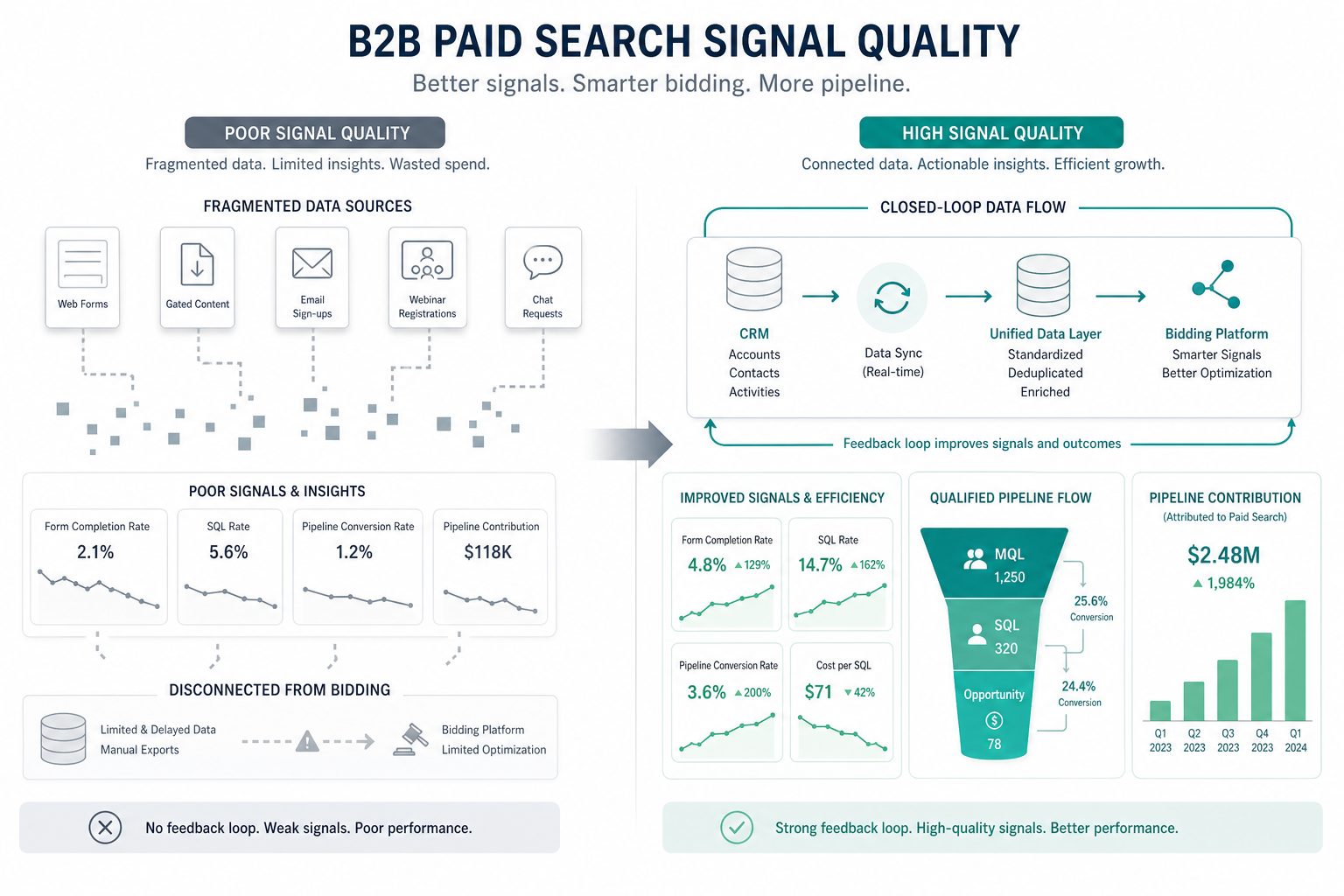
As Google’s AI systems take more responsibility for interpreting intent and routing spend, first-party data becomes less of a measurement hygiene project and more of a budget control layer. The system can only optimize toward the outcomes it can see and value.
That matters most in categories where the first conversion is a poor proxy for business value. A demo request, trial start, appointment, quote form, or cart event can hide wide variation in revenue quality. If the account sends all of those events into Google Ads as equal wins, AI-native delivery will learn from the wrong scoreboard.
The next 12 to 18 months should therefore put more pressure on conversion architecture than on keyword expansion. Paid media teams need clean primary and secondary conversion definitions, offline conversion imports where sales cycles require them, value rules that reflect margin or lead quality, and audience signals that help the system distinguish profitable demand from cheap activity.
This is where many budget plans understate the work. Moving money into AI-native campaigns is easy. Making that money accountable requires data plumbing, CRM alignment, consent management, and finance agreement on what value should be optimized. The CFO does not need to understand every bidding option. They do need to trust that the media team is not asking a model to maximize low-quality conversions because those are the only ones properly tagged.
Gemini Ads Are Directionally Likely, Even If Timing Slips
Gemini is the clearest case where financial logic is more persuasive than product language. Morningstar argued in July 2026 that ads are “the optimal monetization strategy” for Gemini, noting Google Search ARPU of $44 compared with a roughly 5% paid-to-total user ratio for AI chatbots.[6] If that comparison holds, subscriptions alone are unlikely to be the most attractive monetization path for a product with mass-market reach.
That does not mean advertisers should build a Gemini media plan with a hard launch date. Reports on July 16, 2026 said Gemini 3.5 Pro had been delayed beyond its initial June 2026 target, which may affect the pacing of Gemini ad rollouts and AI Mode expansion.[7] Today, July 21, 2026, is also Alphabet’s Q2 2026 reporting date after market close, so the most recent confirmed financial base remains Q1.
The distinction matters. Directionally, Gemini ad inventory deserves preparation. Tactically, it deserves caution. Marketers should watch how Google defines commercial intent inside conversational experiences, whether Gemini inventory enters existing campaign types or separate controls, what brand-safety and query transparency look like, and whether early pricing reflects novelty more than proven incrementality.
What Changes in the Next Budget Cycle
The budget conversation should move from “How much are we spending on Google?” to “Which parts of Google are we funding, and how exposed are we to surfaces Google is deprioritizing?” That is a different level of planning.
A reasonable 12- to 18-month adjustment does not require a dramatic account rebuild. It does require a different burden of proof. Network-heavy spend should have to show incrementality, not just favorable blended CPA. Keyword expansion should have to compete with investments in conversion quality and AI-native testing. Performance Max and AI Max should be treated as operating capabilities the team needs to understand, not experimental novelties kept outside the main planning cycle.
For a mature advertiser, the planning sequence can be simple: identify where current Google Ads performance depends on Network or opaque inventory; isolate campaigns where AI-native testing can happen without risking core revenue; improve first-party conversion signals before scaling automation; and create a monitoring lane for Gemini and AI Mode inventory so the team is not learning the surface after competitors have already bid it up.
Alphabet’s CapEx does not tell marketers the exact date each ad surface changes. It does tell them which direction Google is financially committed to. That is enough to start reducing Network dependence, building AI-native campaign competence, improving first-party data inputs, and watching Gemini inventory before it becomes crowded.
References
- Alphabet Earnings: AI Propels Business Across Segments, Cloud Is Brightest, Morningstar
- Alphabet Q1 2026: Google Network ad revenue falls 4% as AI reshapes the web, PPC Land
- How Will AI Search Affect Paid Ads in 2026?, SearchInfluence
- We’re upgrading Dynamic Search Ads to AI Max, Google Blog
- Alphabet's new AI ad formats seen boosting conversions and spending, Proactive Investors
- Alphabet: Reports Indicate That Company Is Considering Ads Within Gemini in 2026, Morningstar, July 2026
- Reports on Gemini 3.5 Pro delay, Reuters and Bloomberg, July 16, 2026
Comments
Join the discussion with an anonymous comment.