
AI in Marketing Analytics: Why Only 6% of Teams Have Fully Embedded It — and How to Join Them
This article helps marketing managers, analytics leads, and CMOs understand why AI adoption in marketing analytics is stalling at 6% despite 80% feeling pressure to adopt. It identifies the real barrier — data readiness and strategic ownership — and provides a practical roadmap to fix foundations, audit readiness, and implement high-impact use cases.
The AI Adoption Gap: High Pressure, Low Embedding
The marketing analytics function is caught in a paradox that no amount of tooling alone can resolve. According to the Supermetrics 2026 Marketing Data Report, which surveyed 435 marketers across the US, UK, Germany, Australia, and Singapore, 80% of marketing professionals report feeling pressure from leadership to adopt AI into their workflows. Yet only 6% say they have fully embedded AI into their analytics operations. That gap — 80% pressure versus 6% execution — is not a story about tool shortages or budget constraints. It is a story about structural readiness.
The instinct when confronted with this statistic is to assume the problem is technological: the AI isn't good enough, the platforms aren't integrated, or the models aren't accurate. The data tells a different story. The barrier is not the quality of the AI. It is the quality of the data foundation and the clarity of who owns the strategy that sits on top of it.
This article is written for marketing managers, analytics leads, and CMOs who feel that pressure but suspect — correctly — that buying another AI dashboard or subscribing to another analytics platform will not solve the underlying problem. The thesis is straightforward: the path to joining the 6% requires fixing data foundations, clarifying ownership, and treating AI as a decision aid rather than a replacement for judgment.
Three Structural Blockers Holding Marketing Analytics Back
The Supermetrics report identifies three interconnected blockers that explain why the 6% figure is so low. None of them are about the AI models themselves.
1. Data Fragmentation and Poor Signal Quality
Marketing data lives in silos — ad platforms, CRM systems, email service providers, analytics tools, spreadsheets. The Pedowitz Group, in its analysis of AI limitations in marketing analytics, identifies signal quality as the primary constraint: AI models are only as reliable as the data they ingest, and most marketing data is messy, sparse, or inconsistently structured. When teams attempt to apply AI to fragmented data, the outputs inherit the fragmentation. The result is not insight; it is noise with a polished interface.
2. Ownership Ambiguity
The Supermetrics report found that 52% of marketing teams say data strategy decisions are made by external teams — IT, finance, or third-party agencies. Only 31% of CMOs are involved in those decisions. When the people who understand the marketing context are excluded from data strategy, the resulting infrastructure serves reporting requirements rather than analytical questions. AI models trained on data that was structured for compliance or finance will answer compliance and finance questions, not marketing ones.
3. Lack of Defined Use Cases
The report reveals a striking asymmetry in how AI is actually deployed: 87% of marketers use AI for content creation and copywriting, but only 39% use it for reporting and analytics. AI is being applied where it is easiest to implement, not where it delivers the highest strategic value. Meanwhile, 37% of teams report lacking a clear AI strategy from leadership, and 39% cite data privacy concerns as a barrier. Without a defined use case tied to a specific business decision, AI adoption defaults to generic content generation — useful, but not transformative.
| Blocker | Key Statistic | Core Issue |
|---|---|---|
| Data fragmentation | Only 33% can activate data effectively | AI inherits the mess; outputs are unreliable |
| Ownership ambiguity | 52% say external teams own data strategy | Marketing context is lost in infrastructure decisions |
| Undefined use cases | 87% use AI for content; 39% for analytics | AI is deployed where it's easy, not where it's valuable |
The Data-First Solution: Auditing Your AI Readiness
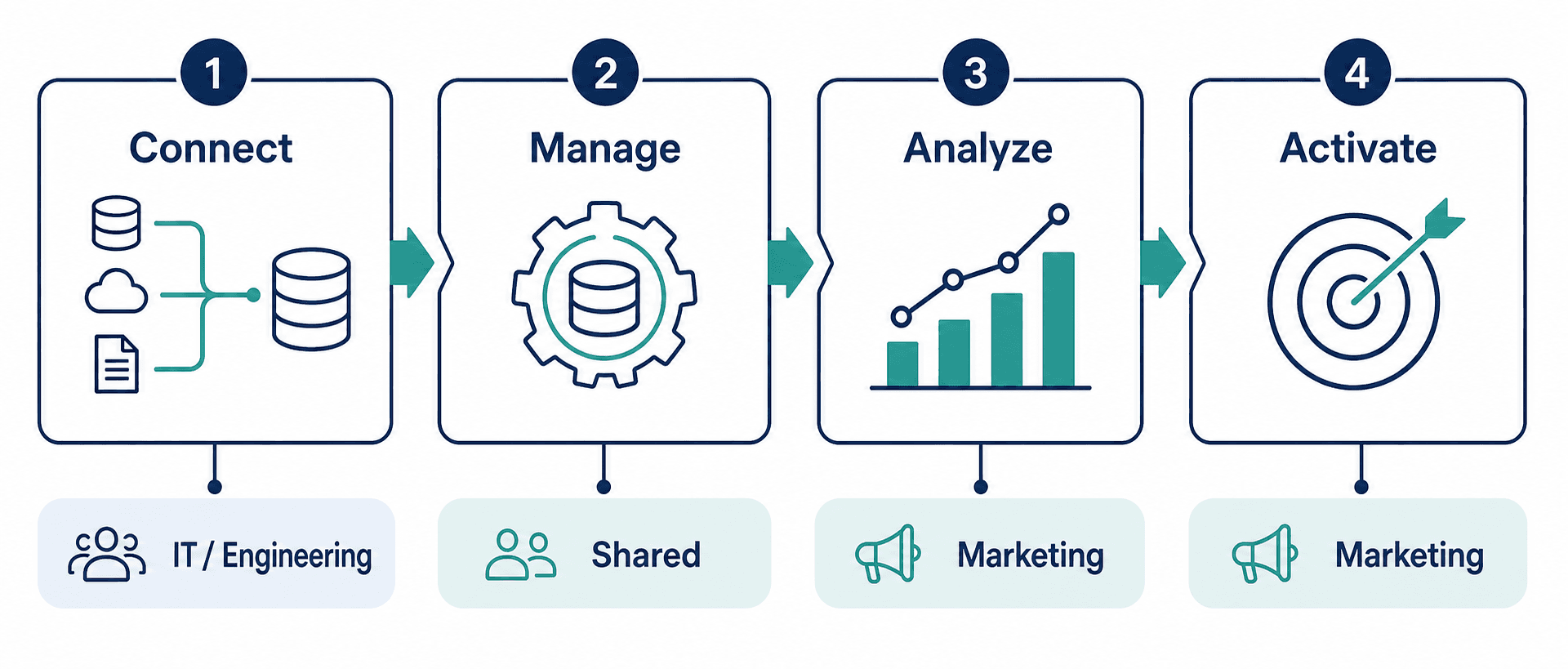
The Supermetrics report introduces a four-stage data ownership model that provides a practical framework for diagnosing where your organization actually stands. The stages are sequential, and most teams attempt to skip directly to the final stage.
| Stage | What It Involves | Typical Owner | Common Failure Mode |
|---|---|---|---|
| Connect | Integrate data sources into a unified pipeline | IT / Engineering | Data is connected but not governed |
| Manage | Clean, standardize, and govern data quality | Shared (IT + Marketing) | No one is responsible for ongoing data hygiene |
| Analyze | Apply analytics and AI models to generate insights | Marketing Analytics | Insights are produced but not acted upon |
| Activate | Push insights into campaigns, CRM, and decision workflows | Marketing Operations | Activation is attempted without clean data |


Comments
Join the discussion with an anonymous comment.