
Which AI Email Features Actually Move Metrics in 2026
Not all AI email features deliver equal results. This article identifies the features that produce measurable lifts—send-time optimization and AI subject lines for quick wins, predictive segmentation for sustained gains—and explains why the widely cited 41% revenue benchmark applies only to full-stack AI adoption, not single features.
The most dangerous number in AI for email marketing is not wrong so much as misapplied. The widely repeated 41% revenue lift belongs to fuller AI workflow adoption, not to turning on one feature and waiting for the weekly dashboard to improve. Digital Applied’s 2026 breakdown attributes that benchmark to programs using AI across several functions, including segmentation, personalization, subject lines, and send-time optimization; programs using only single AI features are reported closer to an 8–14% lift.[1]
That distinction matters because email teams rarely implement “AI” as one thing. They enable a send-time model. They try subject-line generation. They add a churn-risk audience. They let a copy assistant draft a promo block. Each one touches a different metric, needs a different amount of history, and creates a different cleanup burden.
For teams managing a live program, the better question is not whether AI works. It is which feature moves a metric you already report, with data you already have, without creating more review work than it removes.
The Feature Matrix: What Each AI Email Feature Actually Moves
A useful AI email rollout starts with the metric pathway. If the feature cannot explain which step changes — more people opening, better audience selection, fewer unsubscribes, faster campaign assembly — it is not ready to sit in a performance plan.
| Feature | Primary metric moved | Reported lift or effect | Data prerequisite | Main caveat |
|---|---|---|---|---|
| Send-time optimization | Open rate, downstream click and revenue opportunity | Open-rate lift commonly reported in the 5–22% range; some sources report higher depending on baseline and measurement method.[1][2][3] | Basic subscriber-level engagement history; no content rebuild | Apple MPP and inflated opens can distort the readout if reporting is not adjusted |
| AI-generated subject lines | Open rate and test velocity | AI subject lines are reported to outperform human-written versions by 26% on average, with the practical advantage of producing 20–30 variants per campaign instead of 3–5.[2][3] | Campaign history plus enough send volume to test variants responsibly | Lift narrows when a brand already runs disciplined multi-variant testing |
| Predictive segmentation | Revenue per send, conversion rate, audience efficiency | Reported at 2–3x revenue per send over behavioral segmentation when data quality is strong.[1][2] | At least 6 months of clean engagement data and 500+ purchase events for reliable propensity scoring.[1][2] | Weak or fragmented first-party data turns the model into expensive guesswork |
| AI content generation | Production hours, campaign throughput | Reported to save about 72% of campaign creation time.[2] | Brand guidelines, offer rules, approval workflow, examples of usable copy | Autonomous AI content underperforms AI-assisted content with editorial review.[2] |
| Churn and frequency optimization | Unsubscribe rate, complaint risk, list fatigue | Churn and frequency models are reported to reduce unsubscribe rates by 15–25% when trained on 90+ days of subscriber interaction history.[3] | Subscriber-level interaction history across sends, clicks, purchases, and opt-down behavior | Over-suppression can hide from short-term revenue reporting while protecting long-term list health |
| Full-stack AI deployment | Revenue, lifecycle efficiency, cross-campaign performance | The 41% revenue benchmark applies to broader AI workflow adoption, not an isolated feature.[1] | Clean data, multiple AI functions, implementation discipline, reporting alignment | A benchmark from a mature stack becomes misleading when used to justify a single toggle |
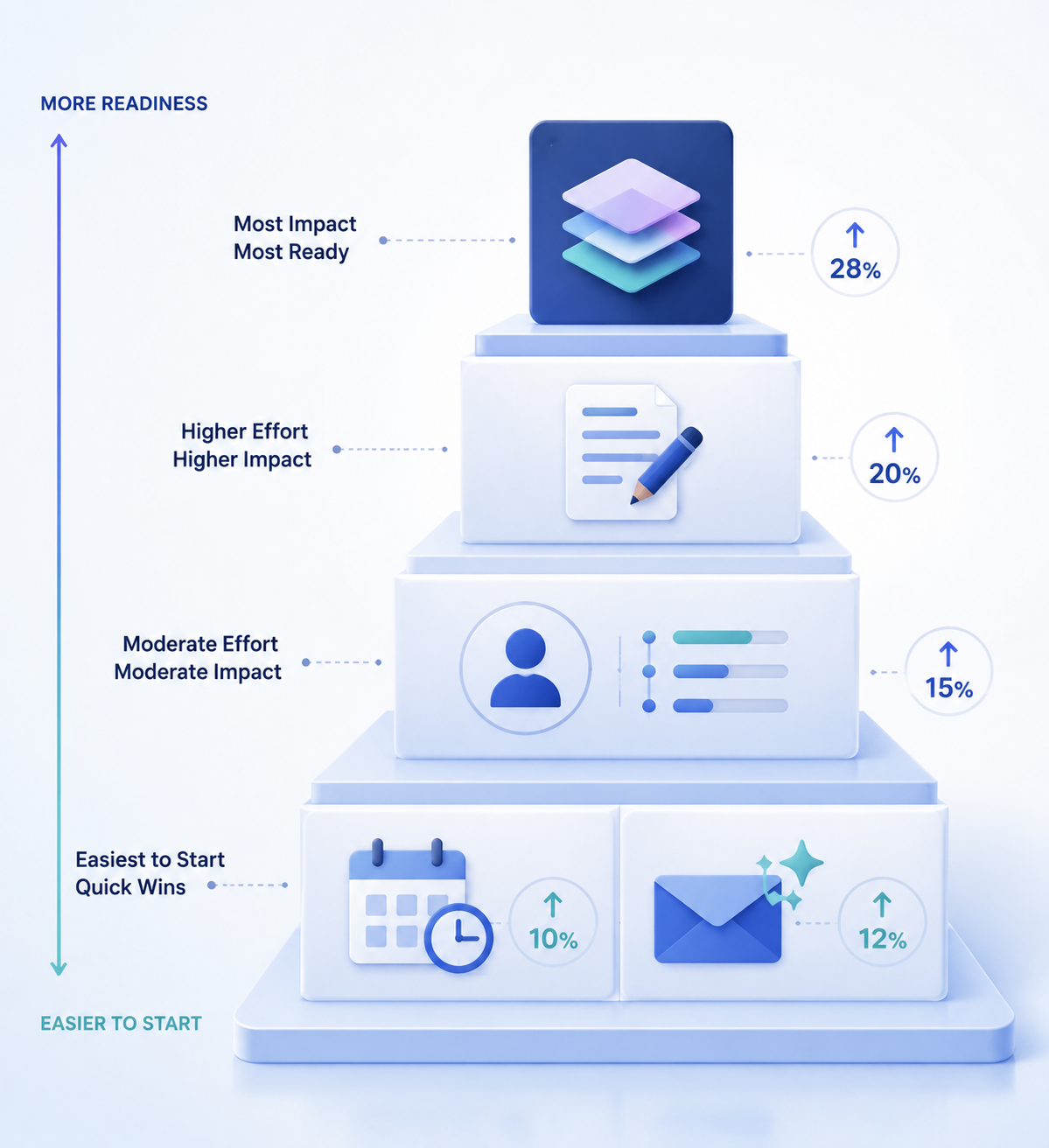
The order is not accidental. Send-time optimization and subject-line generation are the most forgiving first moves because they change delivery timing and test volume before they ask the team to trust a new audience model or publish machine-written copy at scale.
For readers who want the older benchmark trail before applying the 2026 feature view, the AI Email Marketing ROI Benchmark Data 2024 piece is the more appropriate place to inspect the revenue-claim context. The implementation decision here is narrower: which feature deserves the next test slot.
Start With Send-Time Optimization If the Baseline Is Sound
Send-time optimization is not glamorous, which is part of its appeal. It does not ask the copywriter to surrender brand voice. It does not require a new offer taxonomy. It changes when a subscriber receives a message based on prior engagement patterns, then lets the same creative compete under better timing conditions.
The reported lift range is wide enough to deserve caution. Hustler Marketing cites a 5–15% open-rate lift, while Digital Applied’s materials cite 15–22% in one guide and 20–30% in another.[1][2][3] The conservative reading is not that one of these numbers must be “the” answer. It is that send-time optimization has a plausible and repeatedly reported path to open-rate improvement, but the size of the lift depends on the starting point, the industry mix, and how opens are adjusted in a post-Apple MPP environment.
That makes it a clean first test for many teams. If the program already has regular sends, subscriber-level engagement history, and enough volume to compare an optimized group against a holdout or control cadence, the feature can be evaluated without rewriting the lifecycle program.
The failure mode is usually not the model itself. It is reporting. If the team celebrates a lift in raw opens while ignoring click rate, revenue per recipient, unsubscribes, or machine-open inflation, the dashboard can make a timing model look more valuable than it is. The test should be read through the downstream metric that matters for that campaign type: opens for editorial reach, clicks for demand-gen traffic, revenue per send for ecommerce, or unsubscribes for high-frequency promotional calendars.
Use AI Subject Lines to Increase Test Discipline, Not Just Cleverness
AI subject-line tools are easy to oversell as creativity engines. Their more defensible advantage is throughput. A team that manually writes three versions for a campaign often chooses among style preferences. A system that produces 20–30 usable candidates gives the marketer enough range to test length, specificity, urgency, benefit framing, and curiosity without spending the whole planning meeting on the subject line.[2][3]
The average performance claim is attractive: AI-generated subject lines are reported to outperform human-written subject lines by 26%.[3] But the more mature the existing testing practice, the less magical that number should feel. A brand that already writes multiple variants, keeps a subject-line archive, and segments by audience intent has less low-hanging fruit than a team sending one manager-approved line to the full list.
The right workflow keeps the machine in the option-generation role and the operator in the judgment role. Reject variants that overpromise the offer, conflict with the landing page, lean on fatigue-heavy urgency, or create deliverability risk. Then test the remaining candidates in a way that can teach the next campaign something.
- Use AI to generate more variation than the team would normally produce manually.
- Group candidates by testable idea, not by which one sounds most polished.
- Keep a human review gate for accuracy, tone, compliance, and offer fit.
- Measure against the current subject-line process, not against a weak straw-man control.
This is where AI can improve a habit most teams know they should have but rarely maintain. The subject line is small, but the testing discipline around it compounds.
Predictive Segmentation Is Worth Waiting For
Predictive segmentation is the feature most likely to produce a beautiful slide and a disappointing rollout. The upside is real: cited sources report 2–3x revenue per send over behavioral segmentation.[1][2] The condition attached to that number is just as important as the number itself.
A propensity model needs enough history to distinguish a likely buyer from a recent clicker, a lapsing customer from a seasonal purchaser, and a high-intent visitor from someone who only engaged with a giveaway. Digital Applied and Hustler Marketing both place the practical threshold at at least 6 months of clean engagement data and 500+ purchase events before predictive scores become reliable enough to use for revenue-driving segmentation.[1][2]
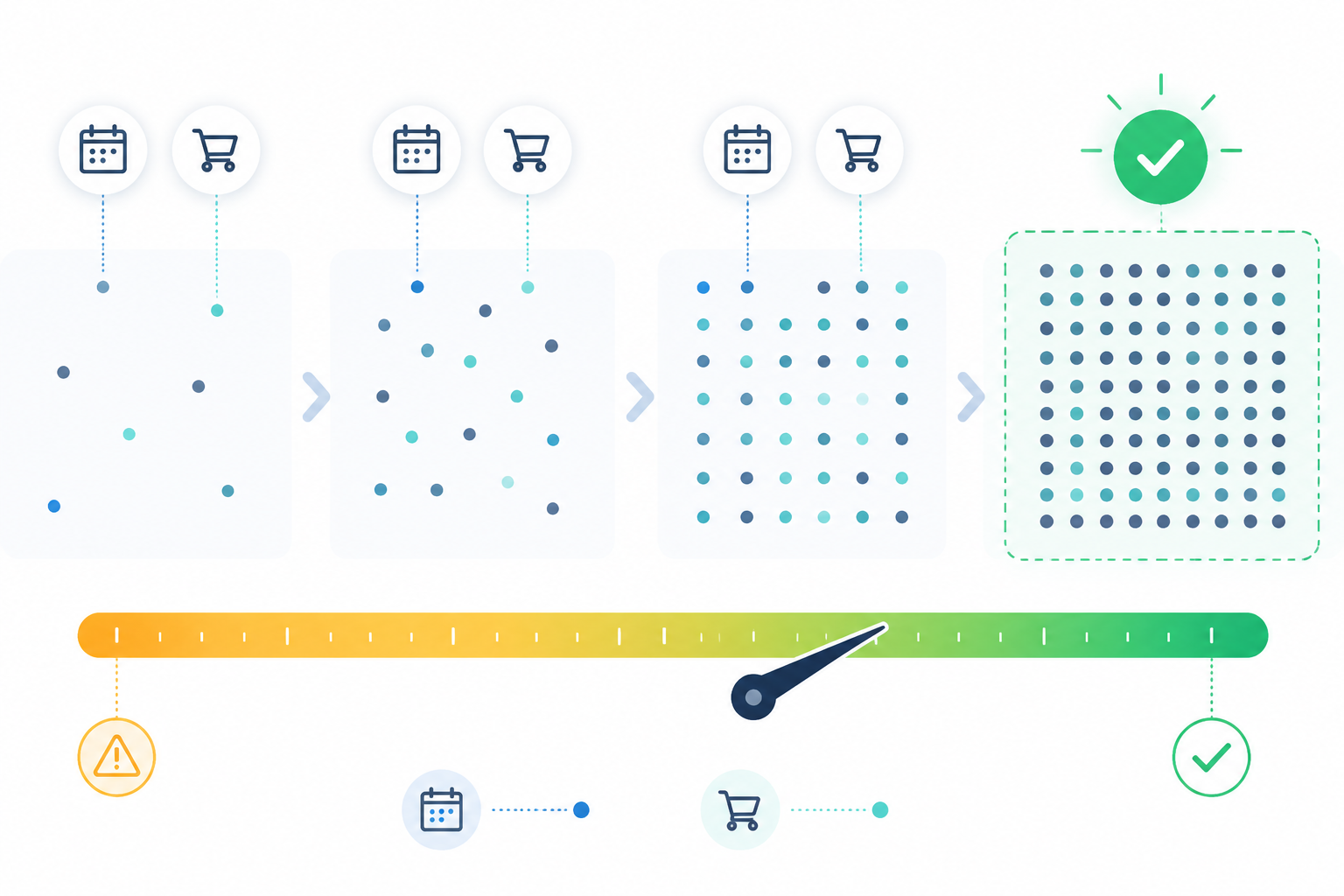
Those prerequisites are not technical trivia. They decide whether the model is reading customer behavior or amplifying noise. A fragmented program with ecommerce purchases in one system, webinar engagement in another, and email behavior partially obscured by privacy-driven open inflation may have enough contacts but not enough usable signal.
| If your program has... | Predictive segmentation read |
|---|---|
| Regular sends but limited purchase history | Defer revenue propensity models; use behavioral segments and send-time optimization first |
| Fewer than 500 purchase events | Treat predictions as exploratory, not as the basis for major audience suppression or budget allocation |
| 6+ months of clean engagement and 500+ purchases | Test predictive segments against current behavioral segments on revenue per send and unsubscribe rate |
| Unified first-party data across email, site, and purchase behavior | Predictive segmentation becomes a stronger candidate for sustained revenue lift |
The comparison should be against the segmentation already in use. If the current program only separates customers from non-customers, a predictive model may look spectacular because the baseline is thin. If the current program already uses recency, frequency, monetary value, category interest, lifecycle stage, and suppression rules, the improvement may be more modest but still valuable.
The operator’s test is simple: does the predictive audience improve revenue per send without increasing unsubscribes, complaints, or discount dependency? If the answer requires ignoring list fatigue, the lift is borrowing from a future reporting period.
AI Content Generation Is a Production Feature Before It Is a Performance Feature
AI copy tools deserve a place in the stack, but not because every campaign should become autonomous. Hustler Marketing reports that AI content generation can save about 72% of campaign creation time, while also noting that pure AI-autonomous content underperforms AI-assisted content with editorial oversight.[2]
That is the right way to read the feature. The measurable win is often production speed: first drafts, modular copy blocks, product-description variants, localization starts, preheader options, and QA prompts. The risk appears when saved time is mistaken for publishable quality.
A useful AI-assisted workflow still has human gates for offer accuracy, brand fit, legal claims, segmentation context, and fatigue. The time saved should go somewhere visible: more variants tested, faster lifecycle updates, cleaner QA, or more frequent refreshes of stale automations. If it only creates more campaigns with weaker review, the time saving can turn into downstream cleanup.
Churn and Frequency Models Protect the Number That Usually Gets Reviewed Too Late
Churn prediction and frequency optimization rarely get the same attention as revenue personalization because their best work is subtractive. They send less to some people. They delay another promo. They route a fatigued subscriber into a softer touch. In a weekly readout, that can look less exciting than a revenue spike.
The measurable case is unsubscribe reduction. Digital Applied reports that churn-prediction and frequency-optimization engines reduce unsubscribe rates by 15–25% when trained on 90+ days of interaction history per subscriber.[3] That training window matters because frequency tolerance is individual. A daily opener and a quarterly buyer should not be governed by the same fatigue rule.
This feature is especially useful for teams with high promotional pressure, seasonal cadence swings, or multiple departments competing for the same list. The caveat is that success may not show up as a dramatic revenue lift in the first campaign. It may show up as a lower unsubscribe rate, fewer complaints, and a larger reachable audience over time.
How the Features Compound When Layered in the Right Order
Single-feature lifts are easier to test, but the stronger programs eventually layer the features. Digital Applied describes the effect as compounding: send-time optimization increases the chance that the message is seen, AI subject-line testing improves the open decision, and predictive segmentation improves who receives which message in the first place.[3]
That does not mean every team should jump straight to a full-stack deployment. It means the rollout order should avoid building on a weak layer. A predictive segment is less useful if the program cannot measure engagement cleanly. AI-generated copy creates more risk if the offer library and approval rules are loose. A send-time model is easier to trust when the reporting view separates raw opens from more durable outcomes.
- Enable send-time optimization where the platform supports a controlled readout.
- Add AI subject-line generation to increase variant volume and testing discipline.
- Use AI-assisted content for drafting and versioning, with editorial review before send.
- Introduce churn and frequency optimization when fatigue or unsubscribe pressure is visible.
- Move into predictive segmentation after the purchase and engagement data meet the threshold.
- Treat full-stack AI revenue benchmarks as mature-program comparisons, not launch promises.
VerticalResponse’s 2026 email guidance also frames AI implementation as a phased readiness problem rather than a single switch, which fits how most teams actually absorb new tooling without destabilizing production.[4]
Tool Selection Should Follow the Metric, Not the Demo
The AI email vendor landscape is crowded enough that comparison tables can create false precision. Litmus’s evaluation guidance is more useful when it pushes teams to assess workflow fit, governance, testing, and integration needs rather than just feature checkboxes.[5] A subject-line generator inside the existing ESP may beat a more impressive standalone tool if it preserves the test workflow and reporting view.
Vendor-sourced rankings need an extra filter. ZoomInfo’s 2026 B2B tool comparison is useful for seeing how B2B platforms position AI email capabilities, but it is still a vendor-published comparison that ranks its own product highest.[6] Klaviyo-skewed ecommerce materials have the opposite scope issue: they may be highly relevant for purchase-heavy retail programs and less transferable to long-cycle B2B demand generation.
Platform-specific economics deserve their own analysis. Teams evaluating Salesforce should separate feature-level performance from implementation cost, data readiness, and operating complexity; the Salesforce Marketing Cloud AI ROI breakdown and the Salesforce AI marketing results analysis are better places to go deeper on that stack.
The Practical 2026 Priority
For most email teams, the first move is send-time optimization if the ESP supports it and the reporting setup can read beyond raw opens. The second is AI subject-line testing, especially where the current process produces too few variants to learn much. Both features can move open-rate mechanics with minimal content disruption and relatively light data requirements.
Predictive segmentation should not be dismissed, but it should wait for the right inputs: at least 6 months of clean engagement data and 500+ purchase events before revenue propensity scores are treated as reliable.[1][2] AI content generation should be managed as an assisted production workflow, not an autonomous performance engine, because the best-supported gain is time saved under review, not unsupervised copy outperforming a careful human process.[2]
AI email features move metrics when the feature matches the data maturity and the metric being optimized. They disappoint when a full-stack revenue benchmark is used to justify a single-feature rollout.
References
- AI Email Marketing 2026: 41% Revenue Increase Guide — Digital Applied
- AI for Email Marketing in 2026: What Works & What Doesn't — Hustler Marketing
- Predictive and Generative AI in Email Marketing Guide (Dual-Engine Model) — Digital Applied
- Email Marketing in 2026: Trends, Tactics, and What to Do Now — VerticalResponse
- Guide to Evaluating AI Tools for Email Marketing — Litmus
- 10 Best AI Email Marketing Tools for B2B in 2026 — ZoomInfo via Pipeline

Comments
Join the discussion with an anonymous comment.