
Salesforce AI Marketing
An evidence-based evaluation of Salesforce's AI marketing features for marketing managers and senior leaders building a business case. Covers which Einstein features deliver measurable ROI, which fall short, and what the early Agentforce claims actually mean — with clear separation of independent data from vendor-sourced metrics.
Key Integrations
Marketing Categories
⚠ Notable Limitations
Opportunity Insights only 52% accurate on close predictions; Agentforce ROI claims vendor-sourced and unverified; Einstein requires 1,000+ leads for reliable scoring
The Data Landscape: What We Know vs. What Salesforce Tells Us
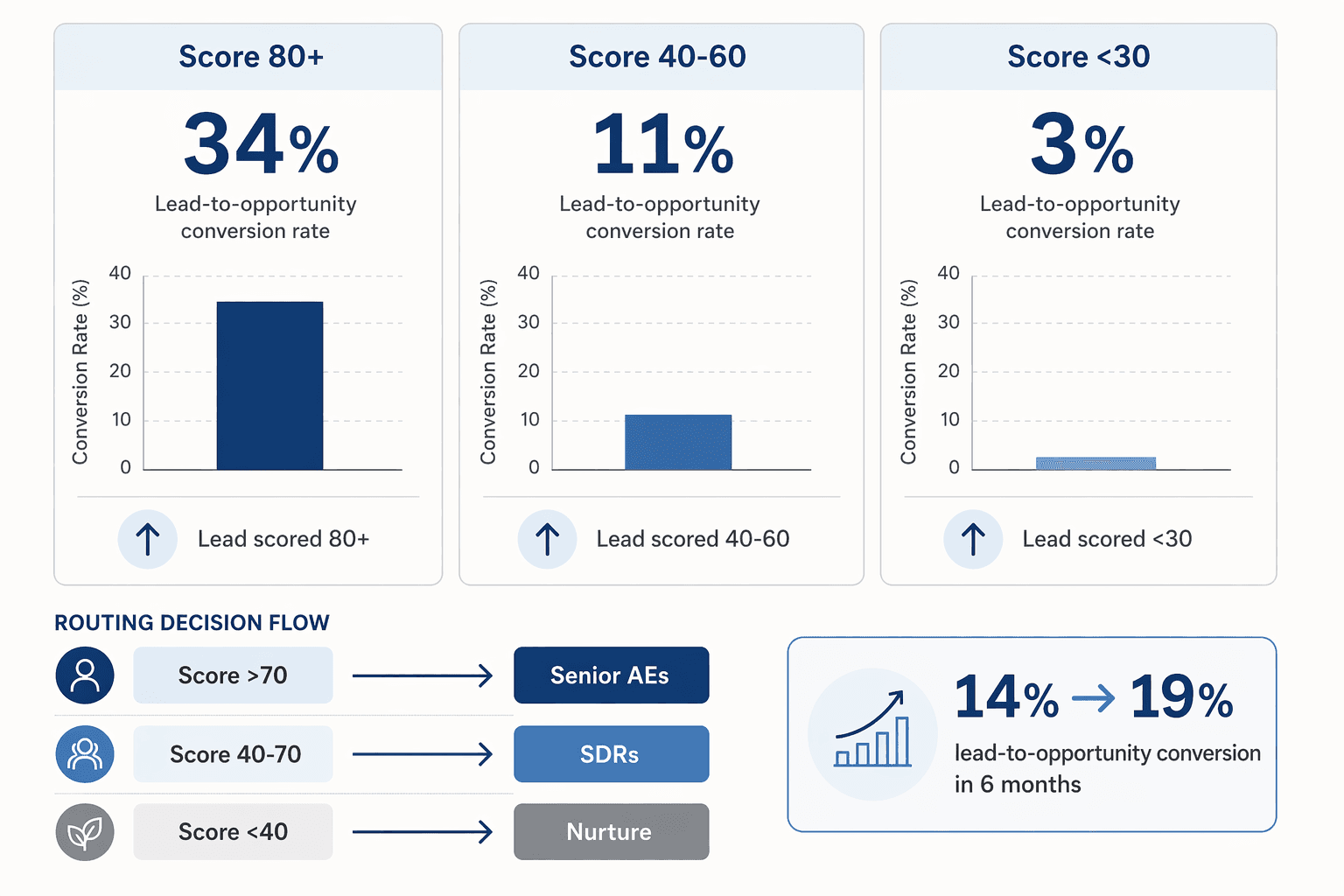
Any honest evaluation of Salesforce's AI marketing capabilities has to start with a confession: the data is not all the same quality. When you read that Einstein Lead Scoring converts 80+ scored leads at 34%, that comes from an independent 18-month study by Cotera covering 22 sales reps, 180,000 contacts, and 23,000 opportunities. When you read that Agentforce Marketing delivers a 32% increase in marketing ROI, that comes from Salesforce's own Customer Success Metrics page. These two statements carry very different weights, and building a business case on the wrong one can lead to expensive disappointment.
This article separates the evidence into two tiers. Tier one is independently verified data — numbers from the Cotera study, which tracked real Salesforce instances over 18 months and published methodology. Tier two is vendor-sourced data — metrics from Salesforce's marketing pages, partner case studies, and earnings disclosures. Both tiers are useful, but they serve different purposes in a business case. Independent data tells you what a feature actually does. Vendor data tells you what the vendor wants you to believe.
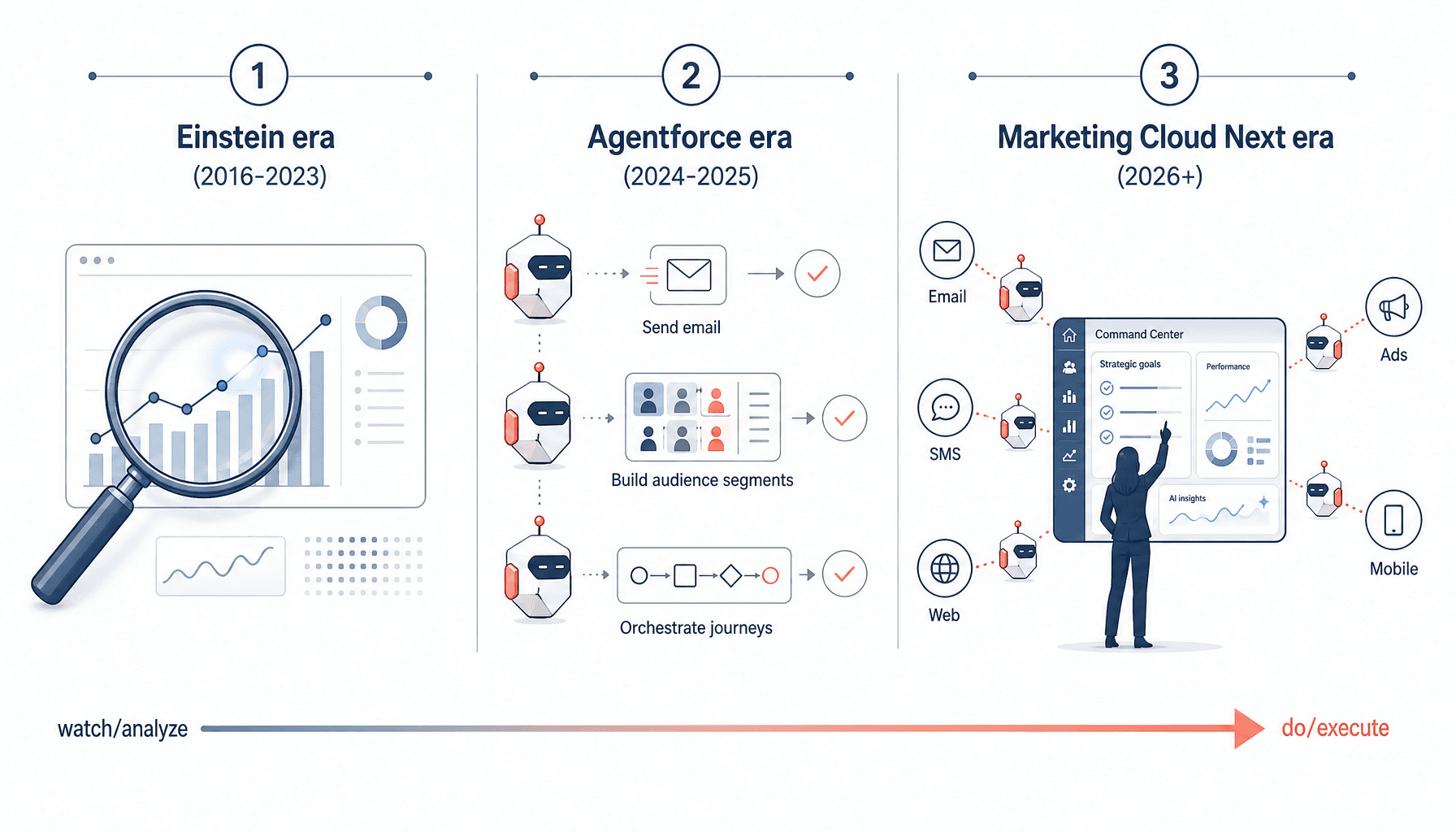
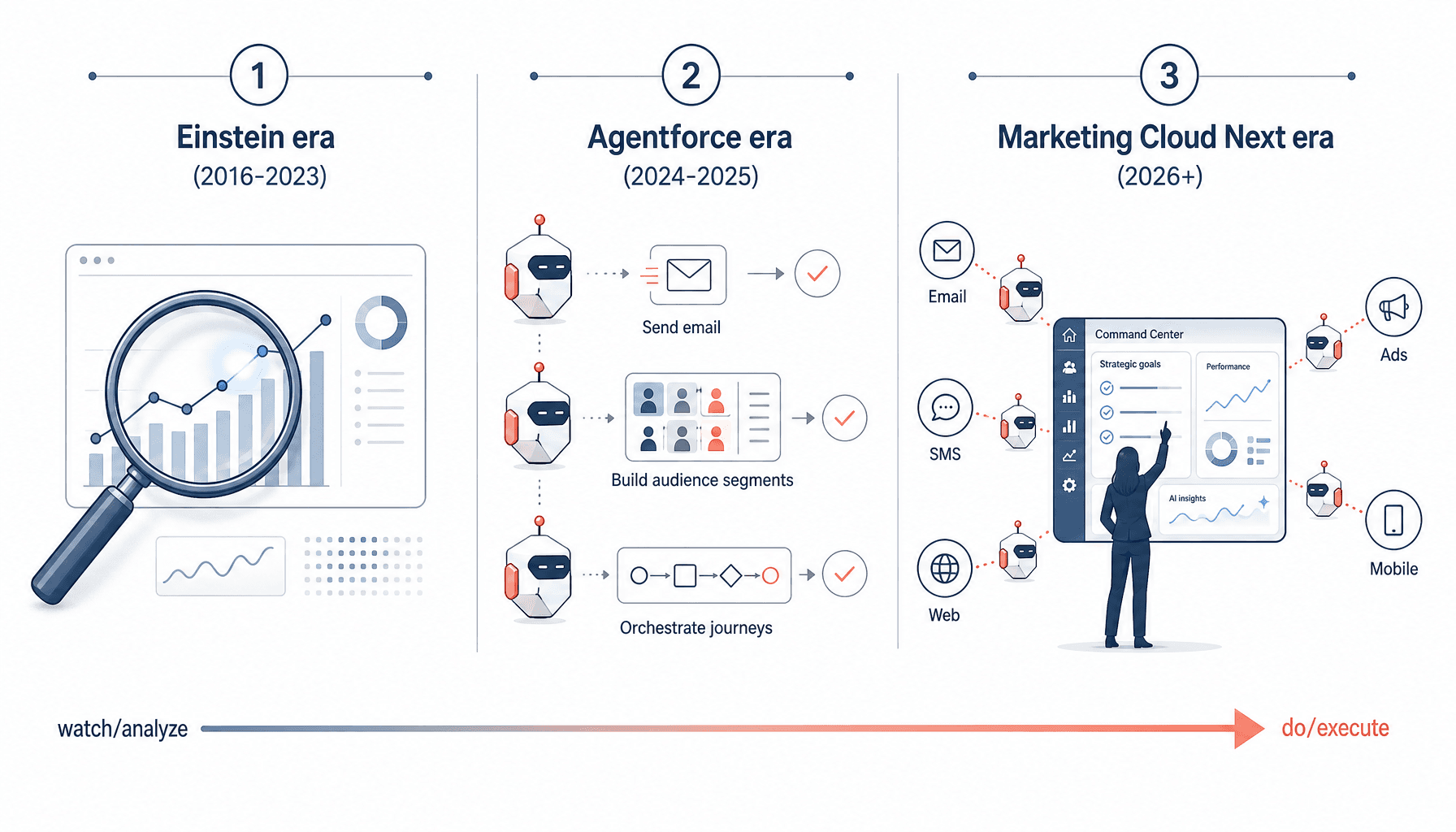
The second complication is nomenclature. Salesforce has rebranded Marketing Cloud to Agentforce Marketing, with Marketing Cloud Next as the next-generation native platform. Different articles use different names depending on publication date. This article uses the naming conventions from the source material and notes where terminology shifts matter.
Einstein Lead Scoring: The Clear Winner
If you are building a business case for Salesforce AI investment, start here. Einstein Lead Scoring is the feature with the strongest independently verified ROI, and the data is specific enough to model against your own pipeline.
The Cotera study tracked lead scoring performance across 23,000 opportunities and found clear conversion tiers by score range:
| Lead Score Range | Conversion Rate | Action |
|---|---|---|
| 80+ | 34% | Route to senior AEs immediately |
| 40–60 | 11% | Assign to SDRs for qualification |
| Below 30 | 3% | Send to nurture sequence |
The most operationally significant finding was the routing rule improvement. Before score-based routing, the team's lead-to-opportunity conversion rate sat at 14%. After implementing Einstein scoring with rules that sent scores above 70 to senior account executives, 40–70 to SDRs, and below 40 to nurture, that rate climbed to 19% over six months. That is a 36% relative improvement in conversion efficiency, achieved through better assignment rather than more volume.
For teams evaluating whether to adopt Einstein Lead Scoring or a competing solution, the decision often comes down to existing infrastructure. If your CRM is already Salesforce, the marginal cost of enabling scoring is lower than migrating to a separate platform. For a detailed comparison of how Einstein stacks up against HubSpot's predictive scoring, see our Salesforce Einstein vs HubSpot Predictive Scoring guide.
Einstein Activity Capture: Time Savings That Add Up
Activity Capture is the quiet workhorse of the Einstein suite. It does not generate headlines about conversion lifts, but it solves a problem that every sales and marketing operations team knows well: reps do not log their activities consistently, and incomplete data undermines every downstream analysis.
The Cotera study documented the before-and-after clearly. Manual logging compliance sat at roughly 40% — meaning 6 out of 10 emails, meetings, and calls never made it into the CRM. After enabling Einstein Activity Capture, compliance jumped to 85%. That is more than double the data quality, achieved without any change in rep behavior.
| Metric | Before (Manual) | After (Einstein Activity Capture) |
|---|---|---|
| Logging compliance | ~40% | 85% |
| Manual correction rate | N/A | ~8% of auto-logged activities |
| Time saved per rep per day | 0 | 15–20 minutes |
| Total time saved (22-rep team) | 0 | ~1,375 hours/year |
The 1,375 hours per year figure is worth pausing on. For a 22-person team, that is the equivalent of adding roughly 0.7 full-time employees worth of reclaimed time — not in revenue generation, but in removing friction from the workflow. Reps spend less time on data entry and more time on selling. The 8% manual correction rate means the system is not perfect, but the net benefit is overwhelmingly positive.
Activity Capture is also the lowest-effort Einstein feature to deploy. It requires no model training, no threshold data, and no scoring configuration. It is essentially a smart automation layer on top of existing email and calendar integrations. For teams just starting their Salesforce AI journey, this is the feature to enable first.
Einstein Opportunity Insights: Roughly a Coin Flip
This is the feature that requires the most honest framing. Einstein Opportunity Insights predicts which deals will close and which will not, using historical data and deal attributes. The Cotera study tracked its performance over 12 months and found that it predicted 340 deals would close — but only 177 actually did. That is 52% accuracy, which is statistically indistinguishable from a coin flip.
| Prediction | Count | Actual Outcome | Accuracy |
|---|---|---|---|
| Predicted to close | 340 deals | 177 closed | 52% |
| Predicted not to close | 215 deals | 112 closed anyway | 48% false negative rate |
The more useful signal was the deal at-risk flag. When Einstein flagged a deal as at risk, 68% of those flags genuinely indicated a deal that needed intervention. That is not perfect, but it is actionable. A 68% precision rate on risk flags means a manager can prioritize attention with reasonable confidence, even if the absolute close prediction is unreliable.
The implication for marketing teams is indirect but important. If your sales team relies on Einstein Opportunity Insights to prioritize leads from marketing, the 52% accuracy rate means roughly half of the deals marketing generates may be misclassified. This does not mean the feature is worthless, but it does mean it should not be the sole mechanism for lead handoff decisions. Pairing it with human judgment and a structured lead scoring workflow produces better outcomes.
Einstein Engagement Scoring: Promising but Partner-Sourced
Einstein Engagement Scoring analyzes how contacts interact with marketing emails — opens, clicks, forwards, and time spent — and assigns a score that predicts future engagement likelihood. The data here is less independent than the Cotera study, coming primarily from Bluprintx, a Salesforce implementation partner that publishes client case studies.
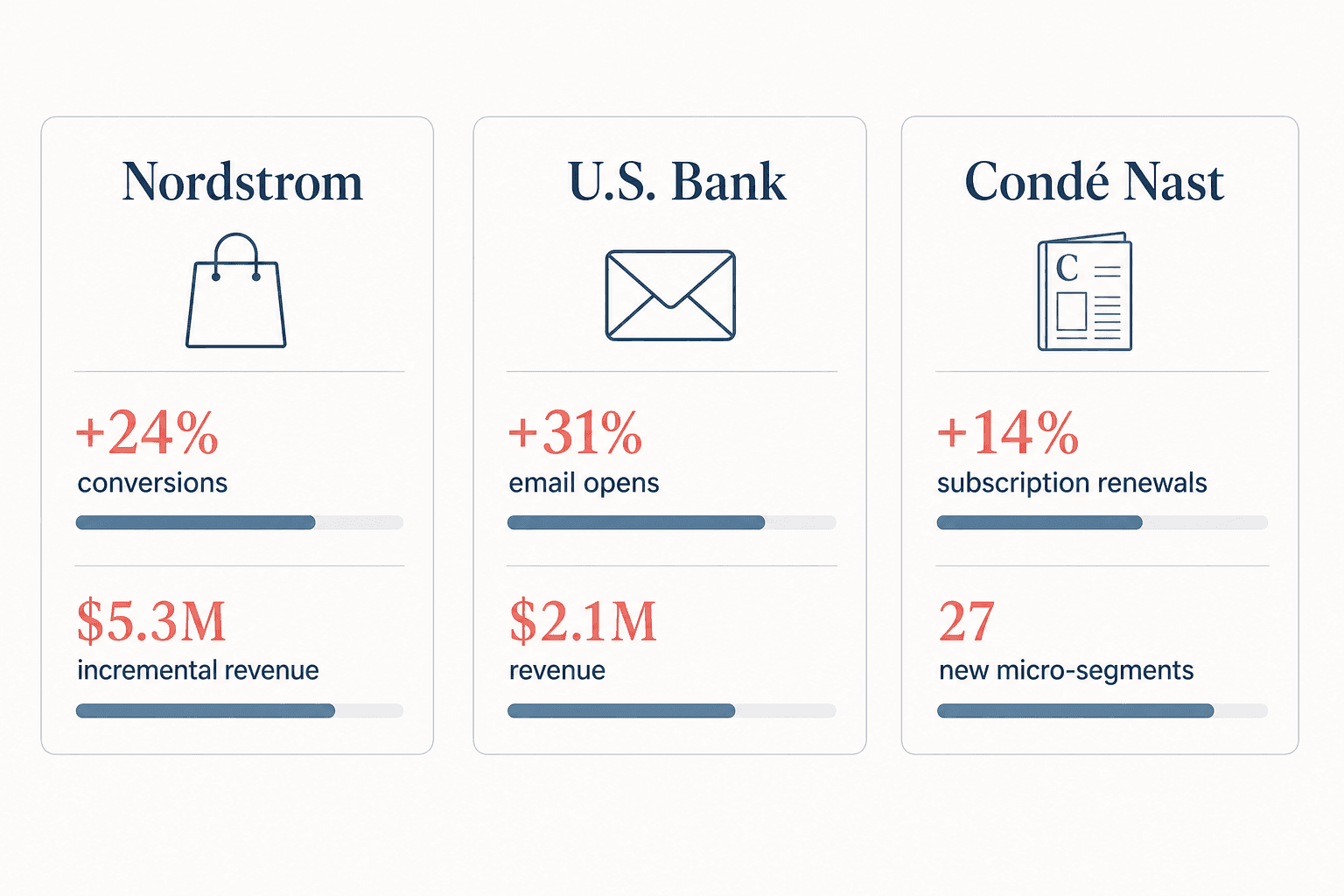
Bluprintx reports that companies using Einstein Engagement Scoring see 25–40% better email open rates. That is a wide range, and the methodology behind it is not fully public. However, the individual brand case studies provide more concrete reference points:
| Brand | AI Application | Key Metrics | Revenue Impact |
|---|---|---|---|
| Nordstrom | Einstein Recommendations | +24% conversion rate | $5.3M incremental revenue (year 1) |
| U.S. Bank | Einstein Engagement Scoring | +31% email opens, +18% CTR, -12% unsubscribes | $2.1M extra revenue |
| Condé Nast | Einstein Analytics | +14% subscription renewals, +22% ad revenue, 27 new micro-segments | Not disclosed |
These are impressive numbers, but they come with caveats. Bluprintx is a consulting partner that sells Salesforce implementation services. The case studies are selected success stories, not a random sample. The Nordstrom and U.S. Bank results are real, but they represent best-case implementations with dedicated partner support, not the typical out-of-box experience.
The Cotera study offers a more modest data point for email insights: Einstein Email Insights improved open rates by about 3 percentage points, from 22% to 25%. That is a 14% relative improvement — meaningful but far below the 25–40% range. The difference likely reflects implementation maturity and the specific features used. Engagement Scoring (predictive) and Email Insights (descriptive analytics) are different capabilities, and they produce different results.
For a deeper look at how Einstein email personalization performs in a B2B SaaS context, see our Salesforce Einstein Email Personalization in B2B SaaS: A Deployment Case Study.
Agentforce Marketing ROI Claims: What Salesforce Says vs. What We Can Verify
Salesforce launched Agentforce at Dreamforce in September 2024, positioning it as a platform of autonomous AI agents that can execute marketing tasks — campaign creation, audience segmentation, content personalization, and web curation — without human intervention. In June 2025, the company introduced Marketing Cloud Next, which embeds these agents natively across the customer funnel.
The ROI claims on Salesforce's marketing page are striking:
| Claimed Metric | Improvement | Source |
|---|---|---|
| Marketing ROI | +32% | Salesforce Customer Success Metrics |
| Customer Lifetime Value | +34% | Salesforce Customer Success Metrics |
| Customer Engagement | +32% | Salesforce Customer Success Metrics |
| Cost to Acquire New Customers | -27% | Salesforce Customer Success Metrics |
What can be independently verified is more limited but still useful. Salesforce claims that agents at help.salesforce.com handle 83% of customer support queries independently, with human escalations dropping by 50%. That is a customer service metric, not a marketing metric, but it demonstrates that the underlying agent technology can handle real volume. The Atlas Reasoning Engine, which powers Agentforce, appears to be a genuine technical advance over earlier Einstein capabilities.
Pricing has also evolved. Agentforce initially launched at $2 per conversation. In May 2025, Salesforce introduced Flex Credits at $0.10 per action, with 100,000 credits available for $500. This shift from per-conversation to per-action pricing suggests Salesforce is adapting to how customers actually use the platform, but it also makes cost forecasting more complex for marketing teams.
For broader context on email marketing ROI benchmarks, see our AI Email Marketing ROI Benchmark Data 2024: What the Numbers Actually Show.
The Gap: From Observation to Action
The pattern across all the data is clear. Einstein is excellent at observing, scoring, and predicting — but it stops at the point of action. It tells you which leads are hot, which deals are at risk, and which contacts are engaged. It does not, on its own, do anything about those insights. A human still has to route the lead, call the at-risk deal, or send the personalized email.
This is the gap that Agentforce and Marketing Cloud Next aim to close. Instead of just scoring a lead and waiting for a rep to act, an autonomous agent can trigger a personalized nurture sequence, adjust a web experience, or create a lookalike audience segment — all without human intervention. The shift is from a recommendation engine to an execution engine.
For marketing teams, the practical implication is that the ROI of Einstein features should be evaluated separately from the ROI of Agentforce features. Einstein Lead Scoring and Activity Capture deliver measurable, independent returns today. Agentforce Marketing ROI claims are promising but unverified. A smart investment strategy enables the proven Einstein features first, then pilots Agentforce in a controlled scope to build your own data before committing to enterprise-wide deployment.
The Cotera study provides a useful framework for thinking about this. The 14% to 19% lead-to-opportunity conversion improvement came from combining Einstein scoring with human-defined routing rules — not from automation alone. The AI identified the signal; the humans designed the response. That hybrid model — AI for observation, humans for action — is the proven approach today. Agentforce promises to automate the action side, but the evidence for that is still being built.
For a practical guide on implementing lead scoring workflows, see our AI-Assisted Lead Scoring Workflow for B2B Marketing.
The bottom line for marketing managers and senior leaders: Salesforce AI marketing delivers real, measurable value in specific areas — lead scoring and activity capture are proven winners. Opportunity insights and engagement scoring add marginal value but should not be the primary investment drivers. Agentforce Marketing ROI claims are exciting but unverified. Build your business case on the data that has been independently tested, and treat vendor-sourced metrics as hypotheses to validate, not guarantees to bank on.

Comments
Join the discussion with an anonymous comment.