
Comparing Streaming Ad Platforms for Marketers in 2026
A head-to-head comparison of the major streaming ad platforms in 2026 — Hulu, Netflix, Amazon, YouTube, Roku, Peacock, Disney+, Paramount+, Max — with CPM ranges, minimum spend, ad load, targeting capabilities, and strategic fit for different campaign objectives and budget levels.
A useful streaming services comparison for marketers in 2026 starts with an uncomfortable planning gap: viewers have already moved faster than budgets. CTV is projected to reach $37.95 billion in ad spend in 2026, and streaming upfront commitments have passed linear TV for the first time, yet CTV represents 43.8% of total TV usage and only about 7.7% of total ad spend.[1] That gap explains why more teams are being pushed into streaming line items this year. It also explains why the buying experience still feels half-mature: more inventory is available, prices are softer in some places, and the platform paths are still uneven.
The decision is not “which streaming brand is biggest?” It is whether the platform’s buying floor, targeting data, ad environment, and measurement model fit the job in front of you. A $31 CPM can be rational if the ad load is light and the completion rate is high. A $15 CPM can get expensive if frequency piles up against the wrong household and no one can explain what happened after the impression.
The Comparison Matrix That Actually Matters
The ranges below are planning inputs, not rate cards. Major streaming platforms do not publish stable public CPMs, and buyer-reported pricing changes by audience, seasonality, geography, commitment, inventory source, and whether the buy is self-serve, managed, or programmatic.[2][3][4][5][6][7]
| Platform | Directional CPM | Minimum spend or buying path | Ad load | Targeting strength | Measurement posture | Best-fit objective |
|---|---|---|---|---|---|---|
| Hulu | $18-$31 | Hulu Ad Manager self-serve from about $500; direct and programmatic paths also available | About 7.3 min/hr | Strong household and entertainment audience targeting, especially within Disney's ad ecosystem | Reasonably mature for CTV, but still needs incrementality or MMM for performance claims | Mid-market CTV entry, broad awareness, local or regional testing |
| Netflix | $25-$60 | Direct buying has been reported around an $18K 7-day flight; inventory also accessible through selected programmatic partners | 4-5 min/hr | Improving; historically more premium-context-led, now expanding through partners including Amazon DSP | High-completion environment; avoid judging only by last-touch conversions | Premium completion, controlled ad experience, high-attention reach |
| Amazon DSP / Prime Video | $20-$40 | Often around $10K-$25K/month for practical DSP entry, depending on partner and setup | Varies by inventory source | Very strong retail, purchase-intent, and Amazon first-party signals | Strong for retail-linked outcomes, but attribution is still inside Amazon's ecosystem | Retail media, purchase-intent targeting, premium streaming plus commerce data |
| YouTube / YouTube TV | $10-$25 | Low-friction Google Ads access; budget floor can be much lower than most CTV platforms | About 8-12 min/hr | Strong Google audience and intent signals; broad reach across YouTube and YouTube TV inventory | More familiar digital reporting, but CTV impressions still should not be evaluated like clicks | Efficient reach, test budgets, video remarketing, low-friction entry |
| Roku | $20-$35 | Roku Ads Manager self-serve from about $500 | Varies by app and inventory source | Strong device-level and platform audience signals | Accessible reporting for smaller advertisers; clean test path | Self-serve CTV testing, household reach, mid-market prospecting |
| Peacock | $18-$35 | Usually direct, managed, or programmatic depending on buyer access | Not consistently public | NBCUniversal audience segments and content-context packages | Brand and reach measurement options; performance proof depends on setup | Sports, live events, NBCU content adjacency, premium awareness |
| Disney+ | Not consistently disclosed in public buyer ranges | Typically bought through Disney advertising relationships, programmatic access, or bundled Disney inventory | Not consistently public | Disney ecosystem data and household entertainment signals | Best read through Disney's reporting plus independent lift or MMM when possible | Family, entertainment, franchise-adjacent reach, premium brand campaigns |
| Paramount+ | Not consistently disclosed in public buyer ranges | Usually direct, managed, or programmatic through Paramount advertising access | Not consistently public | Content, sports, entertainment, and household audience packages | Useful for reach and contextual alignment; outcome reads require test design | Sports, entertainment reach, contextual CTV campaigns |
| Max | Not consistently disclosed in public buyer ranges | Usually direct, managed, or programmatic through Warner Bros. Discovery ad access | Not consistently public | Premium content context and entertainment audience segments | Brand and completion measurement can matter more than click-based reporting | Premium content adjacency, high-value awareness, selective reach |
The table is deliberately uneven because the market is uneven. Hulu and Roku can be bought by a marketer with a few hundred dollars and a practical test plan. Netflix can be bought directly only after a larger commitment, though its inventory is now easier to reach through programmatic channels than it was a few years ago. Amazon DSP is not simply “another streaming app”; it is a buying system that can attach streaming impressions to commerce and purchase-intent signals. YouTube is the easiest way to get video reach into market quickly, but its cheaper CPM comes with a busier ad environment.
Budget Tier Changes the Shortlist
Most comparison articles flatten the decision into platform preference. That is not how the buy usually works. The first cut is budget access: whether the team can actually enter the platform, generate enough impressions to learn anything, and keep measurement from becoming theater.
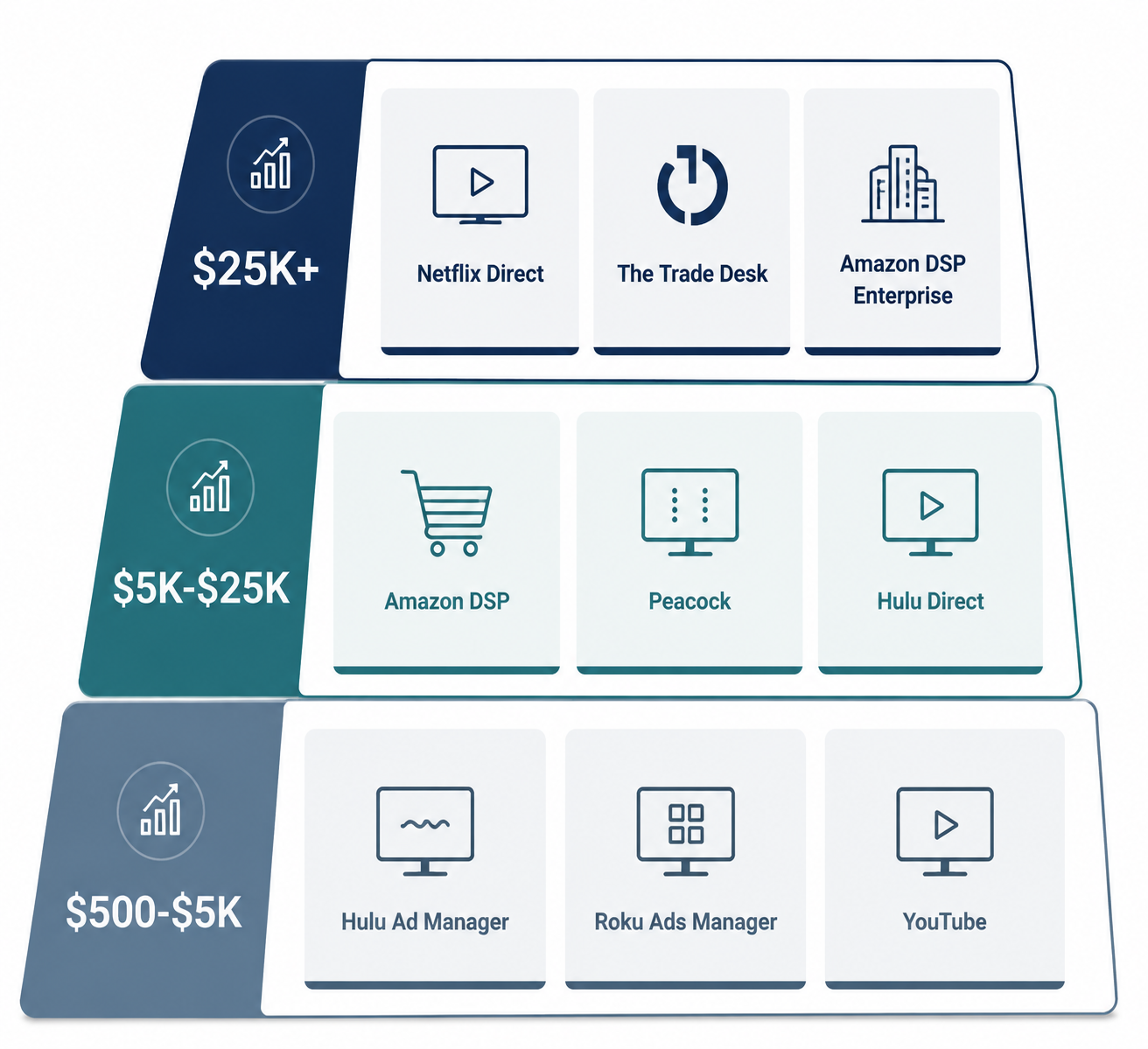
$500-$5K: Prove the Channel Without Pretending It Is a Full CTV Strategy
At this level, the realistic options are self-serve and low-friction platforms: Hulu Ad Manager, Roku Ads Manager, YouTube through Google Ads, and in some cases specialized CTV buying tools with very low daily minimums. Hulu and Roku both have self-serve entry points around $500, while Vibe.co has been reported with a $50/day path.[3][5] That matters more than a prestige content library because a $3,000 test cannot absorb weeks of rep negotiation, custom IOs, or vague managed-service packaging.
The goal here should usually be learning, not declaring victory on CPA. A small advertiser can test creative, geography, audience assumptions, and completion behavior. They probably cannot produce a clean read on incrementality unless the audience is tightly defined and the conversion volume is large enough. If finance wants a hard CPA from this tier, the honest answer is that CTV can support the funnel, but a non-click environment will not behave like paid search.
YouTube is often the easiest first dollar because the workflow is familiar, inventory is broad, and CPMs are commonly reported in the $10-$25 range.[2][6] The tradeoff is ad load and environment. YouTube’s 8-12 minutes of ads per hour is materially heavier than Netflix’s 4-5 minutes and Hulu’s roughly 7.3 minutes.[2] That does not make YouTube a bad buy. It means a cheap CPM should be read as a reach tool, not automatically as a cleaner attention buy.
$5K-$25K: Start Matching Data Advantage to Objective
This is where the decision gets more interesting. A marketer with $10,000 to $20,000 has enough budget to compare platforms by more than access. Hulu can still be a strong self-serve or managed option. Roku can supply household-level CTV reach. Peacock may enter the conversation for NBCUniversal content, sports, or live-event adjacency. Amazon DSP becomes viable for teams that can use retail or purchase-intent data rather than treating streaming as a generic awareness channel.
Amazon DSP deserves special attention because its role changed after Netflix opened inventory to Amazon DSP in September 2025.[7] That does not mean every Amazon buyer is automatically buying Netflix, and it does not make Amazon’s reporting independent. It does mean premium streaming inventory can now be paired with Amazon’s purchase-data targeting in a way that was not previously available at the same scale. For a CPG, consumer electronics, home goods, beauty, grocery, or marketplace-heavy brand, that combination can be more useful than chasing the lowest CPM.
The mid-tier mistake is spreading the budget across too many logos. A $15,000 campaign split across Hulu, Roku, YouTube, Peacock, and Amazon may look diversified in a deck and become unreadable in reporting. A cleaner plan is to pick one primary CTV environment and one contrast: for example, Hulu for accessible premium-ish streaming plus YouTube for efficient reach, or Amazon DSP for purchase-intent audiences plus Roku for broader household reach.
$25K+: Buy for the Constraint You Actually Have
Above $25,000, the question is less “can we get in?” and more “what are we optimizing for?” Netflix direct, Amazon DSP, The Trade Desk, Peacock, Disney+, Paramount+, Max, and larger Hulu commitments may all be possible depending on relationships and timing. The Trade Desk is often discussed with practical minimums around $10,000-$25,000/month, and Amazon DSP is commonly treated as a roughly $10,000/month-and-up environment for meaningful activation.[4][5]
At this level, platform selection should be tied to a measurement plan before the budget is approved. If the objective is incremental reach against light-TV households, buying multiple premium streaming environments may be defensible. If the objective is retail lift, Amazon DSP should be on the short list. If the objective is efficient broad video reach, YouTube may still deserve budget even when more premium options are available. If the objective is a controlled, low-clutter ad experience, Netflix can justify a higher CPM more plausibly than it can justify a vague “prestige” argument.
Why the Cheapest CPM Often Misleads
CPM is still useful. It is just not sufficient. In streaming, the same nominal price can represent very different viewer experiences: a light-load premium show, a crowded ad-supported video session, a living-room TV impression, a mobile impression, a skippable unit, a non-skippable unit, a direct publisher buy, or a programmatic impression assembled through several layers.
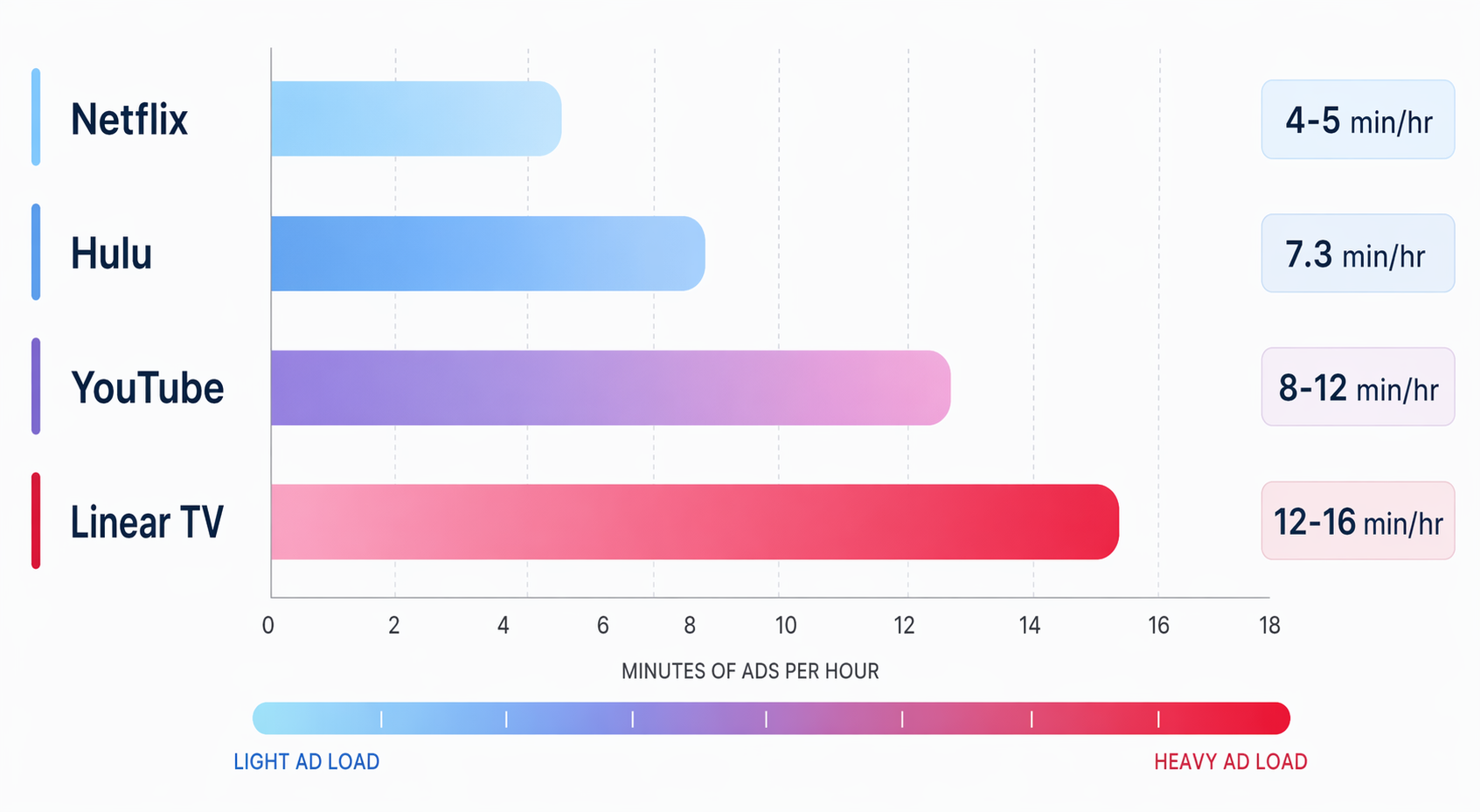
Ad load is the easiest place to see the problem. Netflix runs about 4-5 minutes of ads per hour, Hulu about 7.3 minutes, YouTube about 8-12 minutes, and linear TV about 12-16 minutes.[2][7] A lower-ad-load environment gives each impression more breathing room. It does not guarantee sales lift, but it changes the denominator behind attention, completion, and annoyance.
This is why Netflix’s $25-$60 CPM range is not automatically irrational.[6][7] The platform’s lighter ad load and high-completion environment can make sense for campaigns where the media goal is finished exposure in a premium context. The same buy looks weaker if the plan requires dense retargeting, granular lower-funnel optimization, or cheap frequency against a narrow audience. The platform is expensive when it is used for the wrong job.
Price movement also matters. Buyer-reported market data showed Netflix average CPMs falling from about $42 to about $31 and Prime Video from about $35 to about $28 over 2024.[8] That softening does not turn premium CTV into bargain inventory, but it improves the negotiating context for 2026 planning. If a rep is still pricing every streaming impression as scarce by default, the burden of proof should be on the package, not on the logo.
Objective-Based Shortlists
Once budget access is clear, the platform choice should be made by primary objective. A campaign can have secondary goals, but the media plan usually breaks when awareness, efficient reach, purchase intent, and direct response are all treated as equal priorities.
| Primary objective | Likely shortlist | Reason to consider | Main caveat |
|---|---|---|---|
| Premium completion and low ad clutter | Netflix, Max, Disney+, Peacock | Better fit when ad experience and content context matter more than cheapest reach | Higher CPMs and less straightforward performance attribution |
| Efficient broad video reach | YouTube, Roku, Hulu | Lower-friction buying and broader practical access for mid-market teams | Ad load, inventory mix, and attention quality need closer review |
| Retail or purchase-intent targeting | Amazon DSP, Amazon Prime Video inventory, Netflix through Amazon DSP where available | Amazon commerce signals can make audience selection more commercially relevant | Reporting remains ecosystem-specific and should not be treated as independent proof |
| Accessible CTV test | Hulu Ad Manager, Roku Ads Manager, YouTube, Vibe.co | Lower minimums let teams test creative and audience hypotheses without a large IO | Small tests can be directionally useful without being statistically decisive |
| Sports or live-event adjacency | Peacock, Paramount+, YouTube TV, Disney ecosystem inventory | Content context can matter when timing and co-viewing are part of the plan | Availability and pricing vary heavily by event, package, and sales path |
Brief Platform Notes for the 2026 Plan
Hulu
Hulu is one of the cleaner answers for a mid-market advertiser because it combines recognizable premium streaming inventory with a self-serve path around $500.[3] It also led streaming ad spend at roughly $4.7 billion, which is useful context but not the reason to buy it.[1] The real appeal is operational: a team can get into market, control enough of the setup to learn, and avoid turning a modest test into a managed-service procurement exercise.
Netflix
Netflix is the platform most likely to be oversold with soft words and undersold with hard ones. The soft words are brand safety, prestige, and culture. The harder planning facts are a $25-$60 directional CPM, about 4-5 minutes of ads per hour, reported direct-flight minimums around $18,000 for seven days, and expanded programmatic access through partners including Amazon DSP.[6][7] That mix can be attractive when the goal is completed exposure in a low-clutter environment. For more on how Netflix’s ad business changes the CTV plan, see How Netflix's Stock Decline Reshapes Your CTV Ad Strategy.
Amazon DSP and Prime Video
Amazon should be evaluated as a data and buying layer, not only as a streaming destination. Prime Video inventory matters, but the larger strategic difference is Amazon’s purchase-data targeting and the ability to activate across premium streaming supply through Amazon DSP. The September 2025 Netflix access change makes this more important: advertisers can now think about certain premium streaming impressions through a commerce-data lens, while still being careful about walled-garden measurement.[7]
YouTube and YouTube TV
YouTube is the pragmatic reach machine in the set. It has low-friction access through Google Ads, commonly reported CPMs around $10-$25, and strong audience and intent signals.[2][6] It is also not the same ad experience as a lighter-load premium streamer. That makes it useful for efficient reach, video remarketing, and test-budget entry, especially when the team already has Google measurement discipline. For inventory-pool changes around YouTube TV, see YouTube TV's 2025 Channel Additions Expand Ad Targeting Options.
Roku
Roku’s strength is access to the living-room CTV environment without demanding a large upfront commitment. Roku Ads Manager has been reported with a self-serve minimum around $500, and directional CPMs often sit around $20-$35.[3][5] For a regional advertiser, a category challenger, or a mid-market brand trying to isolate CTV from general video, Roku is often easier to defend than a bundle no one can unpack.
Peacock, Disney+, Paramount+, and Max
These platforms are best treated as premium inventory and audience-context options, not interchangeable self-serve tools. Peacock has more public buyer-reported CPM guidance than some peers, often around $18-$35, while Disney+, Paramount+, and Max are less consistently represented in public directional CPM ranges.[2][6] They can be strong choices when content adjacency, sports, franchises, or premium entertainment context matter. They are weaker choices when the buyer needs transparent low-budget access and fast apples-to-apples reporting.
Measurement Is Where Bad CTV Plans Hide
CTV is mostly a non-click environment. Last-touch attribution will usually undervalue it because the impression happens on a TV screen and the conversion often happens later on another device. That does not excuse vague brand reporting. It means the measurement model has to match the channel.
For smaller budgets, the cleanest read may be operational: completed views, frequency, geography, audience delivery, site traffic lift, branded search movement, or matched-market directional movement. For larger budgets, incrementality testing or MMM is the more honest way to judge whether streaming added value beyond existing paid social, search, linear, or display activity. For teams building more advanced CTV measurement, How AI Powers Connected TV Advertising is the more relevant next layer than another platform logo comparison.
The key is to define the proof standard before launch. If a campaign is bought for premium completion, do not let the post-campaign debate collapse into last-click CPA. If it is bought for retail-intent targeting, require a read that connects exposure to commerce behavior as credibly as the platform allows. If it is bought as a $2,000 test, do not pretend it can answer a $200,000 budget question.
A Practical Allocation Rule
For Q3-Q4 2026 planning, the safest rule is simple: choose the platform whose buying floor, data advantage, ad experience, and measurement model match the campaign’s real constraint.
- If the constraint is minimum viable test budget, start with Hulu Ad Manager, Roku Ads Manager, YouTube, or another low-floor CTV tool.
- If the constraint is efficient reach, YouTube and Roku deserve early consideration, with ad load and frequency watched closely.
- If the constraint is purchase intent or retail relevance, Amazon DSP should be evaluated before generic premium streaming packages.
- If the constraint is premium completion and low clutter, Netflix, Max, Disney+, Peacock, and similar premium environments can justify higher CPMs when measurement is designed accordingly.
- If the constraint is executive explainability, avoid bundles where access path, inventory source, targeting basis, and reporting logic cannot be clearly separated.
No platform wins every version of that exercise. Treat every CPM range as directional until the buying path, audience, dates, inventory source, and measurement plan are confirmed.
References
- Hulu, Amazon, Peacock Top Streaming Ad Spend Rankings — AdTechRadar — April 7, 2026
- How Much Does It Cost To Advertise on Streaming Services? — Strategus
- Streaming Ad Platforms Compared: Hulu, Roku, Amazon, and More — Stackmatix
- Best CTV Ad Platforms: Comparing 8 DSPs, Walled Gardens, and Specialized Platforms — AdRoll
- Best Streaming TV Advertising Platforms in 2026 — Vibe.co
- How Much Streaming Ads Cost on Amazon, Netflix, YouTube, and More — Business Insider — November 2023
- Netflix Advertising: Formats, Costs & Strategy (2026) — AI Digital
- Streaming & Digital Price Trends to Know for 2026 — Compete Everywhere — March 2026

Comments
Join the discussion with an anonymous comment.