
YouTube TV's 2025 Channel Additions Expand Ad Targeting Options
YouTube TV's 2025-2026 channel and plan expansions have created new advertising inventory segments for CTV buyers. This article maps the three key inventory pools and explains how advertisers can access them through Google Ads, including the limitations of programmatic targeting versus reservation buys.
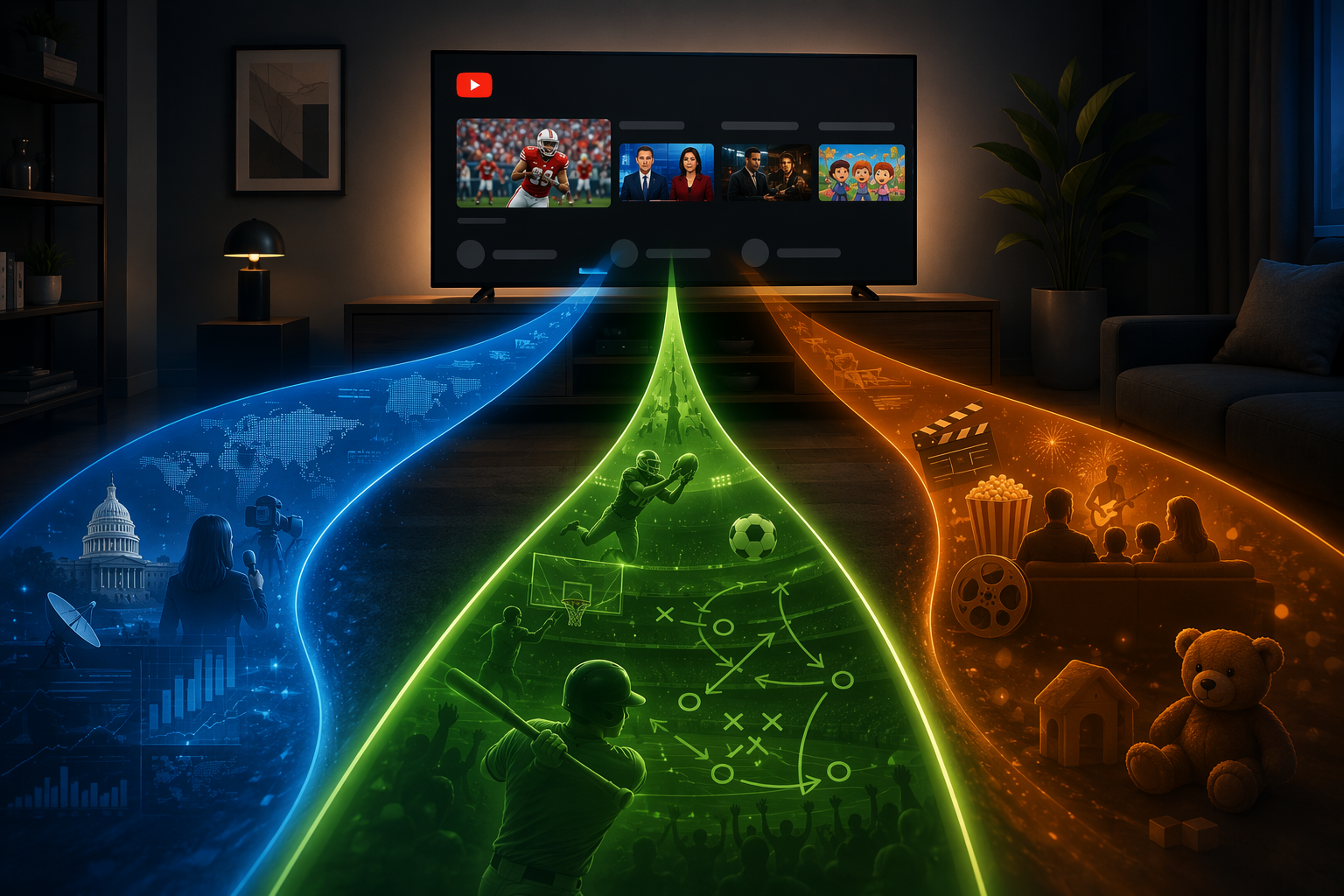
The useful way to read YouTube TV’s 2025-2026 expansion is not “more channels.” It is three different inventory pools with three different levels of buying control: niche linear channels, genre-plan audiences, and a larger base-plan environment. Those pools may all create better CTV signals for advertisers, but they do not all become clean channel-level targeting buttons inside auction buying. Google’s own YouTube TV ads documentation is explicit on the key constraint: advertisers can use YouTube TV inventory in Google Ads, but they cannot programmatically target specific channels on auction buys.[1]
That distinction matters because the inventory is now large enough to deserve planner attention. Omdia estimated YouTube TV at 9.3 million subscribers at the end of 2025 and forecast that it was on track to become the largest U.S. pay-TV operator by 2027; Google does not disclose YouTube TV subscribers as a standalone line item, so that scale should be treated as analyst-estimated rather than company-reported.[2] Nielsen also reported YouTube at 12.7% of total U.S. TV viewing in December 2025, while streaming overall reached 47.5%.[3] The macro trend does not solve the access problem, but it explains why buyers are asking harder questions about YouTube TV placement.
The Three Inventory Pools Buyers Actually Need To Separate
| Inventory pool | What advertisers can infer | How it can be bought | Where control stops |
|---|---|---|---|
| Niche linear channels | Contextual affinity around news, public affairs, sports, African American-focused programming, and other defined content environments | Auction access through eligible YouTube TV inventory, or reservation discussions for guaranteed placement | Auction campaigns cannot guarantee specific channel placement |
| Genre-plan audiences | Self-selection into paid bundles such as sports, entertainment, news, and family-oriented packages | Auction access to YouTube TV inventory, with reservation routes to evaluate when placement certainty is required | A plan subscription signal is not the same thing as an exposed plan-level targeting switch in Google Ads |
| Enhanced base-plan inventory | Broader reach across the 100-plus-channel YouTube TV environment, with some exclusion controls | Google Ads video campaigns using YouTube TV inventory and standard audience, demographic, contextual, and inventory controls | The 10-network block exclusion helps reduce adjacency risk but does not replace channel targeting |
CTV budget is already moving in the direction that makes this map commercially relevant. Tatari, citing Google data, reported that Q1 2025 was the first quarter when YouTube CTV ad spend share surpassed mobile, at 43% versus 42%, up from 24% for CTV a year earlier; the methodology is not fully detailed in the source, so it is best used as directional evidence of buyer momentum rather than a complete market read.[4] Pixability’s survey of 288 U.S. and U.K. agency professionals found that 62% of U.S. agencies planned to include YouTube in CTV ad buys in 2026, and 69% were increasing CTV campaigns year over year.[5]
Those numbers justify a closer look. They do not justify pretending the buying mechanics are simpler than they are.
Niche Channel Additions Change Context, Not Auction Precision
The niche-channel side of the expansion is straightforward from a planning perspective. C-SPAN creates public-affairs and politics-adjacent inventory. NBCSN’s revival adds another sports-context surface. HBCU Go and The Grio add African American-focused programming environments, and the broader Allen Media Group suite widens YouTube TV’s mix of culturally specific and genre-specific content. For political advertisers, sports sponsors, entertainment brands, education marketers, and multicultural media teams, that is real new surface area.
The trap is turning that surface area into false precision. A planner can reasonably say that these channels improve the contextual mix available inside YouTube TV. A planner should not tell a client that a standard auction campaign will run only on C-SPAN, only on HBCU Go, or only on The Grio. In Google Ads, YouTube TV inventory is available through video campaign buying paths, but specific channel targeting is not available programmatically on auction.[1]
That difference is especially important for multicultural planning. HBCU Go and The Grio can be valuable signals because of their programming focus and likely audience relevance, but they should not be used as a lazy proxy for all African American viewers, nor as proof that an auction buy reached a specific cultural audience. If the campaign brief requires guaranteed adjacency to those environments, the buy needs to move out of a generic auction assumption and into reservation evaluation.
Genre Plans Are The Strongest New Segmentation Signal
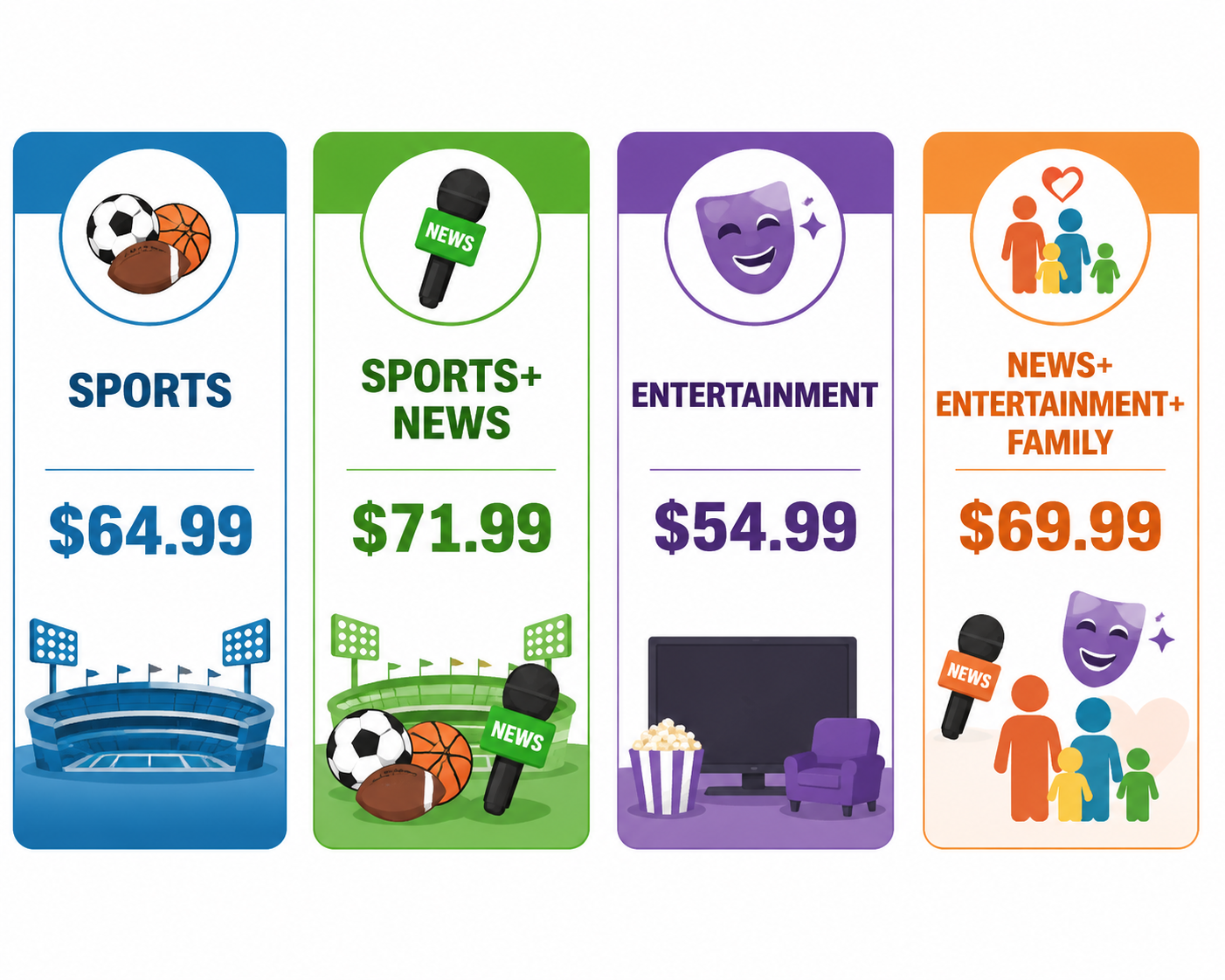
The more interesting development is YouTube TV’s genre-plan structure. YouTube announced genre-based plans for early 2026, then followed with launch details for packages including Sports at $64.99 per month, Sports+News at $71.99 per month, Entertainment at $54.99 per month, and News+Entertainment+Family at $69.99 per month.[6][7] Unlike a single expanded base lineup, these plans introduce an economic choice by the viewer. Someone who pays for sports has selected into sports access. Someone who chooses a lower-cost entertainment package has also selected out of some other programming categories.
That self-selection is useful because it is closer to a paid preference than a casual viewing impression. A sports apparel brand, sportsbook in eligible markets, auto advertiser, wireless carrier, or QSR sponsor may value the Sports Plan audience differently from the broader base-plan audience. Deadline reported that the Sports Plan includes local broadcast affiliates and the ESPN suite, while excluding MLB Network and Tennis Channel.[8] That kind of lineup detail matters because “sports viewer” is not one audience. A plan heavy in live broadcast, ESPN, and league-adjacent programming will not behave exactly like a package built around every niche sports network.
| Plan | Announced monthly price | Planning signal | Buyer caution |
|---|---|---|---|
| Sports | $64.99 | Viewer is paying specifically for sports access | Do not assume every sports network is included; verify current lineup before building sponsorship logic |
| Sports+News | $71.99 | Viewer is selecting both live sports and news/current-events access | Useful for broad interest inference, not a guaranteed targeting segment in auction |
| Entertainment | $54.99 | Viewer may be choosing a lower-cost entertainment-led package without sports and news emphasis | Avoid treating price sensitivity or genre preference as a demographic fact |
| News+Entertainment+Family | $69.99 | Viewer is selecting a mixed household-friendly and information-oriented bundle | The bundle can support planning hypotheses, but placement still depends on buy type |
For a media plan, the genre plans create a better audience story than a generic “YouTube TV viewer” label. They support sharper hypotheses: sports subscribers may over-index for live-event viewing; entertainment-only subscribers may be reachable without paying for sports-heavy environments; family and news bundles may indicate shared-household viewing contexts. Those are planning signals, not guaranteed delivery instructions.
This is where the Monday-morning campaign build gets uncomfortable. If the brief says “reach Sports Plan viewers,” a buyer needs to ask whether the client means sports-interested audiences using Google’s targeting stack, contextual adjacency to sports programming, or guaranteed placement within inventory tied to that plan. Those are not interchangeable asks. The first can often be approached through auction targeting. The second depends on available inventory and exclusions. The third pushes the conversation toward reservation.
Base-Plan Expansion Still Has Value, Especially With Exclusions
The base-plan environment remains important because reach still wins many CTV briefs. YouTube TV’s broader 100-plus-channel footprint gives buyers a premium living-room surface that sits closer to pay TV than to open-web video. Google’s documentation also gives advertisers a limited but useful exclusion tool: they can block up to 10 networks from YouTube TV ads.[1]
That control is worth using, but it should be sized correctly. A 10-network block can help with brand-safety concerns, category conflicts, or obvious contextual mismatches. It cannot turn a broad YouTube TV buy into a handpicked channel list. If a financial services advertiser wants to avoid a few unsuitable networks, the exclusion tool may be enough. If a political advertiser wants guaranteed C-SPAN adjacency, it is not.
There is also a supply-side wrinkle buyers should understand. Deadline reported in May 2025 that YouTube TV keeps unsold ad inventory rather than returning it to programmers, a point that came up in broader upfront-market discussions around streaming and “zen” networks.[9] For advertisers, the practical takeaway is not that all inventory behaves the same. It is that YouTube TV has meaningful platform-controlled supply, and access terms can differ from network-direct assumptions.
Auction Buying: Good Reach, Real Targeting, No Channel Guarantee
Auction buying through Google Ads is still the most natural entry point for many advertisers. It lets teams use Google’s audience, demographic, contextual, and campaign controls across eligible YouTube and YouTube TV inventory. For advertisers already buying YouTube CTV, that means the new channel and plan environment can improve the available impression pool without forcing a separate TV-buying workflow.
But the word “eligible” is doing work. Google’s YouTube TV ads documentation says ads can serve on YouTube TV through Google Ads, including on live and DVR content using Dynamic Ad Insertion, but it also says advertisers cannot target specific channels programmatically on auction.[1] That is the line that should appear in the planning notes, not as a footnote discovered after trafficking.
A clean auction plan might look like this: use YouTube TV inventory for CTV reach, layer audience and content signals where appropriate, apply up to 10 network exclusions if the brand has clear adjacency restrictions, and measure lift or reach outcomes through Google’s available tools. That can be a strong buy. It just should not be sold internally as a guaranteed buy against NBCSN, C-SPAN, HBCU Go, The Grio, or the Sports Plan.
For teams still sorting out the difference between auction-based access and reservation-based control, the mechanics overlap with broader programmatic decisioning: inventory eligibility, audience qualification, bidding, brand-safety controls, and measurement are separate layers. A deeper breakdown of those layers sits in this practical guide to AI in programmatic advertising.
When Guaranteed Placement Matters, Evaluate YouTube Select
If the campaign’s value depends on proving where the ad ran, auction is usually the wrong place to stop. Buyers who need guaranteed placement against specific YouTube TV channels, genre-plan inventory, or premium packages should evaluate reservation options through YouTube Select. That is the practical split: auction for scalable CTV access; reservation when channel or plan certainty is part of the deliverable.
This matters most in briefs with contractual or political sensitivity. A campaign promising adjacency to public-affairs programming needs more than a broad news audience. A sports sponsorship trying to surround live sports needs more than sports-interest targeting. A multicultural campaign that wants to support African American-focused programming should not settle for a plan that merely says the platform carries relevant channels somewhere in the inventory pool.
The trade-off is familiar: reservation can give more certainty, but usually with less flexibility than auction. Auction lets a buyer optimize, scale, and adjust faster. Reservation asks for more upfront definition: which inventory, which audience promise, which flight, which measurement expectation, and which make-good terms if delivery does not match the plan.
Execution Notes: Formats, DAI, Measurement, And Creative
Once the access path is clear, execution is relatively familiar. Google lists YouTube TV ad formats including non-skippable 15-, 30-, and 60-second ads, skippable in-stream ads, and 6-second bumpers.[1] Dynamic Ad Insertion applies to live and DVR content, which is part of the reason YouTube TV can feel more operationally modern than legacy linear inventory.[1]
There are also living-room limitations that affect creative expectations. Google says clickable links and ad timers are disabled on live and DVR YouTube TV content.[1] A direct-response advertiser should not judge those impressions by the same on-screen interaction assumptions used for mobile YouTube. The value is more likely to show up through reach, frequency, brand lift, search response, site activity, or matched-market and incrementality analysis, depending on the measurement setup.
For teams building creative across these placements, format planning should happen before the media plan is locked. A 6-second bumper can support frequency and recall; a 15- or 30-second spot can carry the core message; a 60-second unit needs a reason to exist beyond filling available length. More detail on CTV targeting and incrementality measurement is covered in this companion piece on AI-powered connected TV advertising.
How To Translate The Expansion Into A Real Plan
The fastest way to keep the plan honest is to separate the audience opportunity from the purchasable precision before the budget is assigned.
- If the goal is broad CTV reach with younger, streaming-first viewing behavior, use YouTube TV inventory through Google Ads and optimize around audience, creative, frequency, and measurement.
- If the goal is contextual relevance around politics, sports, African American-focused programming, entertainment, or family viewing, treat the new channels and plans as planning signals first.
- If the goal is guaranteed placement on a named channel or against a specific plan environment, evaluate YouTube Select reservation rather than relying on auction delivery.
- If the concern is adjacency risk, use the 10-network exclusion where it helps, but do not present it as a substitute for positive channel targeting.
- If the plan depends on the February 2026 genre-plan lineups or the 2025-2026 channel additions, verify the current Q3 2026 carriage status before finalizing the buy.
YouTube TV’s 2025 channel additions and 2026 genre plans make CTV planning more segmented and more attractive. They give buyers better context, stronger self-selection signals, and a larger premium streaming-TV surface. The winning buyer is the one who does not confuse that opportunity with automatic channel-level control.
References
- About YouTube TV ads, Google Ads Help
- Omdia: YouTube TV on track to become the largest US pay-TV operator by 2027, Omdia, December 2025
- Streaming reaches historic TV milestone, eclipses combined broadcast and cable viewing for first time, Nielsen, 2025
- What advertisers need to know about YouTube and YouTube TV in 2026, Tatari
- Pixability survey of 288 media agency professionals, Pixability
- Introducing YouTube TV Plans, launching early 2026, YouTube Blog, February 2026
- Flex your options: YouTube TV plans launch this week, YouTube Blog, February 2026
- YouTube TV Sports Bundle Price, Channel Lineup, Deadline, February 2026
- YouTube TV Cord-Cutting Trend Advertising Zen Networks Upfront, Deadline, May 2025
Comments
Join the discussion with an anonymous comment.