
SOXL Dropped 83% But AI Chip Demand Stayed Strong
The 2025 SOXL crash saw an 83% drop, but it was driven by leveraged-ETF mechanics and tariff panic, not falling AI chip demand. This article explains how to distinguish financial market noise from real AI demand signals so you can make confident tool and vendor decisions.
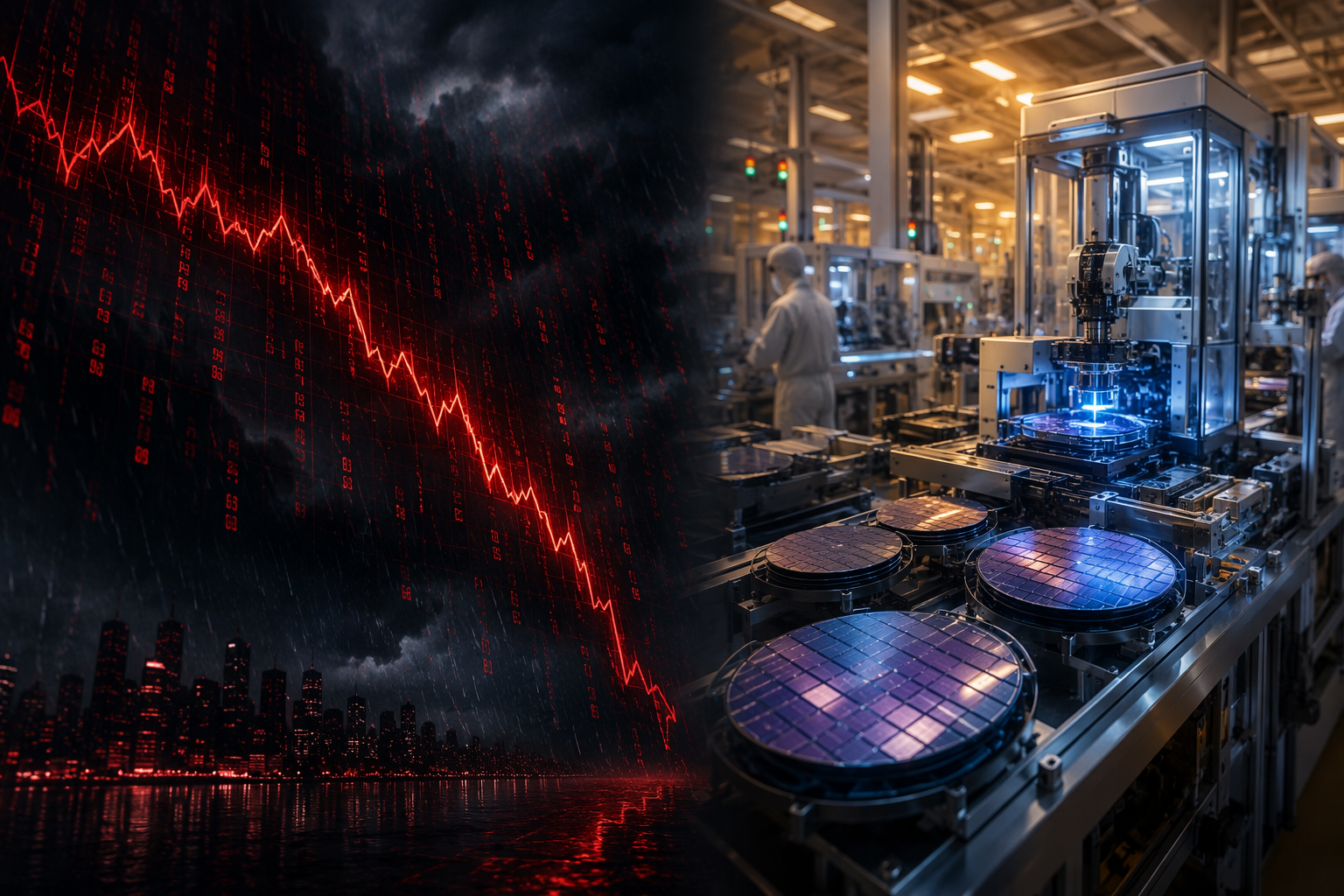
SOXL looked like the kind of chart that gets forwarded into a budget meeting with no context and too many exclamation points. The Direxion Daily Semiconductor Bull 3X Shares fell about 83% from its mid-2024 peak to its April 2025 low near $8, which made it easy to read the move as a collapse in the AI chip market if all you saw was the ticker line.[1]
That is also where the common search memory around “SOXL drop July 2025 AI chip market” needs a small correction. The major break was not a clean July 2025 event. SOXL was much closer to consolidation in July, around $24.97 versus roughly $25.10 in June, after the sharper April drawdown had already happened.[1] Some current semiconductor-selloff coverage also refers to July 2026, which is a different market window and should not be blended into the 2025 crash.
The better question is not whether the chart was dramatic. It was. The useful question is whether the chart was measuring AI chip demand, or whether it was measuring leverage, tariff panic, and forced market plumbing. For marketers deciding whether to renew AI content platforms, defend rising usage costs, or trust a vendor roadmap built on compute-heavy features, that distinction matters more than the ETF itself.
The Crash Was Real; the Signal Was Messier
SOXL is not a semiconductor demand index. It is a 3x leveraged ETF designed to deliver three times the daily performance of its semiconductor benchmark before fees and financing effects. That daily part is not a footnote. It is the mechanism that can turn a rough correction into a chart that looks like a sector funeral.
During the April 2025 tariff panic, chip stocks sold off even though many semiconductor products were described as tariff-exempt. InvestorsObserver’s coverage framed the pressure around broader trade-policy fear and market repricing, not a sudden disappearance of AI chip orders.[2] That matters because a tariff panic can hit valuation, positioning, and risk appetite before it tells you anything reliable about how many accelerators cloud providers still need.
The most expensive mistake is to treat every market price as the same kind of evidence. A normal semiconductor index falling can be a useful signal. A 3x daily reset fund collapsing after volatility spikes is a more complicated object. It can still warn you that investors are stressed, but it cannot be read as a clean proxy for whether enterprise teams are using fewer AI models or whether hyperscalers are canceling data-center orders.
Why SOXL Can Fall Much Harder Than Semiconductors
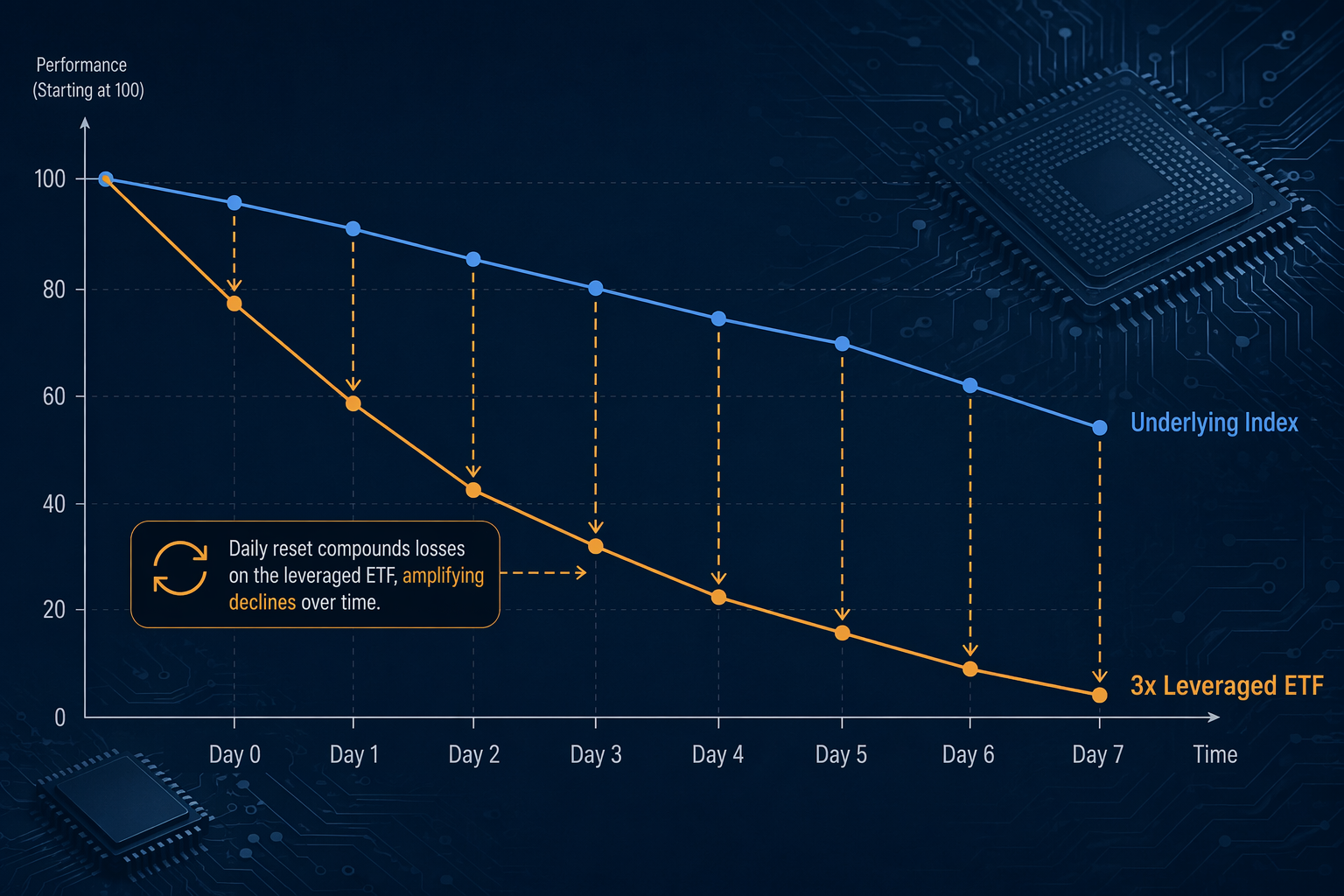
A 3x ETF does not simply triple the long-term move of an index. It resets daily. When the underlying index falls, rebounds, falls again, and trades sideways through volatile sessions, the leveraged product compounds those daily moves. The investor gets path dependency, not a clean three-times version of the beginning-to-end chart.
That is why the 83% drop is useful as a teaching chart but dangerous as a demand chart. 24/7 Wall St. later pointed to SOXL’s daily reset structure and swap-financing costs, including an estimate of about $7.9 billion in hidden swap financing, as part of the cost structure behind the fund’s amplified losses.[3] The practical read is simple: the ETF was carrying mechanics that can make bad semiconductor tape look much worse than the operating market underneath.
This was not the first time the structure behaved that way. In 2022, SOXL lost about 90% while semiconductors themselves fell about 35%, according to another 24/7 Wall St. analysis.[4] That precedent is the reason the 2025 crash should not be treated as a one-off verdict on AI. The same math had already produced a much deeper ETF loss than the underlying semiconductor drawdown before the current AI infrastructure cycle became the dominant boardroom story.
| Signal | What It Measures Better | What It Does Not Prove By Itself |
|---|---|---|
| SOXL price collapse | Leveraged exposure, volatility, financing pressure, investor risk appetite | That AI chip demand has collapsed |
| Underlying semiconductor index move | Broader sector repricing | Which end-market is weakening without company-level evidence |
| Foundry revenue and profit | Actual chip production demand and customer mix | That every AI vendor has healthy economics |
| Hyperscaler capex | Large cloud and AI infrastructure spending intent | That every software tool can absorb compute costs |
| Memory pricing | Supply-demand tightness in a critical AI infrastructure component | That tightness will be painless for buyers |
There was also a contagion path that made the selloff look broader than a simple Nvidia-or-AI-demand story. Investing.com, citing Oppenheimer strategists, described a feedback loop involving memory-linked names such as Micron, Samsung, and SK Hynix, and noted that the Csop SK Hynix 2x ETF fell 23.8% in one session.[5] That kind of move can force selling, hedging, and de-risking across related exposures even when the original pressure is not a direct read on end-user AI demand.
For a marketing team, the point is not to become an ETF technician. It is to avoid importing an ETF technician’s problem into an AI software budget. If a leveraged semiconductor fund breaks, investigate the infrastructure chain. Do not immediately assume your content-generation vendor, sales-assistant platform, or model-hosting provider is about to see cheaper compute.
The Operating Data Did Not Look Like Demand Collapse
The cleanest counterweight to the “AI chip demand is falling apart” interpretation came from the companies closer to actual orders. During the same broader period after SOXL bottomed, TSMC reported Q2 2025 revenue up 33% year over year to $39.4 billion and operating profit up 77% to $21.9 billion, according to Yahoo Finance and The Motley Fool.[6]
TSMC is not every chip company, and one earnings report does not settle every question about valuation. But for the specific claim that AI chip demand had cracked in the spring 2025 window, those numbers are hard to square with a demand-collapse story. A foundry reporting that kind of revenue and operating-profit growth is a stronger operating signal than a leveraged ETF that was built to magnify daily market moves.
The same hierarchy applies when looking at cloud spending. Hyperscaler AI capex was reported at more than $600 billion, up 36% year over year, with 75% tied to AI infrastructure, according to Introl’s discussion of S&P Global data.[7] That figure is not a promise that every AI vendor will win or that every tool renewal should pass without scrutiny. It does show that the largest buyers in the infrastructure chain were still allocating enormous budgets toward AI capacity.
Memory pricing told a similar story from another angle. Deloitte reported that memory chip prices surged roughly fourfold between September and November 2025, and projected global semiconductor sales of $975 billion in 2026, with AI chips approaching $500 billion.[8] Price spikes can be painful, but they are not what weak demand usually looks like. For AI tool buyers, they are more relevant as a cost-pressure warning than as a reason to expect sudden discounting.
That is the operating consequence many budget owners actually feel. If model usage keeps rising while chips, memory, and cloud capacity remain tight, the invoice problem does not disappear just because a semiconductor ETF had a terrible month. Vendors may compress margins, adjust packaging, throttle generous plans, add usage bands, or push customers toward annual commitments. Those behaviors are closer to the marketing budget than the SOXL chart itself.
What the SOXL Recovery Confirms, and What It Does Not
The rebound later made the same lesson in reverse. Benzinga reported that SOXL rallied roughly 2,900% from its April 2025 low near $8 to a June 2026 peak around $302, and that the fund was up more than 445% year to date by mid-2026.[9] If the crash had been used as proof that AI was dead, the recovery would have to be used as proof that AI was invincible. Both readings ask the ETF to do a job it was not designed to do.
The better read is more restrained: SOXL exaggerates the emotional temperature of semiconductor markets. It can surface stress early. It can also amplify relief, momentum, and crowding. That makes it a useful prompt to check the operating data, not a substitute for checking it.
This is also why broad AI-bubble comparisons need careful handling. Fidelity’s February 2026 analysis compared the Magnificent 7’s forward P/E ratio of about 28x with roughly 66x for the top seven stocks at the 1999 dot-com peak, using data from late 2025 and early 2026.[10] That does not mean AI valuations are automatically safe. It does mean the simple “this is exactly 2000 again” analogy is too blunt for vendor and budget planning.
How to Use This in AI Tool and Vendor Decisions
A leveraged ETF crash should change the questions you ask, not automatically change the plan. If an AI platform renewal is on the table, the right move is not to tell the team that chip demand has collapsed because SOXL fell. The right move is to ask whether the vendor’s compute costs, margins, infrastructure partners, and product roadmap still make sense under the current hardware market.
- Check chipmaker earnings before assuming end demand has weakened. Foundry revenue, AI accelerator commentary, and order visibility carry more weight than a leveraged ETF price move.
- Watch hyperscaler capex because cloud buyers sit between chip supply and many AI software vendors. Rising capex can support vendor capacity while also keeping compute costs firm.
- Track memory pricing as a cost signal. Tight memory supply can make AI infrastructure more expensive even when model vendors are competing aggressively for customers.
- Ask vendors how usage-based features are priced, capped, or throttled. A tool that looks affordable at pilot volume can become a different budget conversation after adoption spreads.
- Separate vendor funding risk from infrastructure demand. A stock drop or funding squeeze can hurt a specific provider even while the broader AI chip market remains strong.
That last point matters because financial-market noise is not irrelevant. If a vendor depends on cheap capital, aggressive compute subsidies, or a single infrastructure partner, market stress can still reach the customer. It may arrive as slower feature delivery, stricter usage limits, support cuts, or a push toward higher-commitment contracts. The mistake is not caring about markets. The mistake is treating the loudest chart as the cleanest evidence.
For a deeper bridge between chip volatility and marketing-tool economics, the practical next read is why chip stock volatility matters for AI marketing tools. If the concern is more immediate pricing pressure, Are Your AI Tool Costs About to Rise? CoreWeave vs Applied Digital gets closer to the renewal-call version of the problem.
The practical judgment is narrow and useful: the 2025 SOXL crash was a reason to investigate AI infrastructure risk, not evidence by itself that AI chip demand had broken. Before changing tool budgets or vendor strategy, look for confirmation in chipmaker earnings, cloud capex, memory pricing, and the way vendors are actually changing cost behavior.
References
- SOXL price history, Digrin.
- SOXL: Why Chip Stocks Crashed Even Though They're Tariff Exempt, InvestorsObserver.
- SOXL's 16% Daily Collapse Exposes the Real Cost: $7.9 Billion in Hidden Swap Financing, 24/7 Wall St., July 1, 2026.
- SOXL Lost 90 Percent in 2022 While Semiconductors Themselves Fell 35 Percent and the Daily Reset Math Hasn't Changed, 24/7 Wall St., May 26, 2026.
- The Chip Selloff Is Not Just About AI: There's a Bigger Problem Under the Hood, Investing.com.
- Why Direxion Daily Semiconductor Bull, Yahoo Finance / The Motley Fool.
- Hyperscaler Capex $600B+ in 2026: AI Infrastructure, Debt, and Market Implications, Introl Blog.
- 2026 semiconductor industry outlook, Deloitte.
- SOXL Soars 450% YTD As AI Chip Rally Ignites Leveraged ETF Frenzy, Benzinga.
- Is AI a bubble?, Fidelity.

Comments
Join the discussion with an anonymous comment.