

What SOXL's Volatility Tells Marketers About AI Hardware Risk
The massive AI hardware investment cycle signals both opportunity and risk for marketers. This analysis examines whether the buildout is sustainable and how marketing tool strategies should adapt.
SOXL is a noisy place to look for marketing strategy. It is a leveraged semiconductor ETF, so its swings can exaggerate the daily mood around chips, AI infrastructure, and the companies supplying the buildout. But the useful question for marketers is not whether SOXL is a good long-term holding. The useful question is what semiconductor volatility reveals about the assumptions now buried inside 2026 and 2027 marketing plans.
Those assumptions are practical: inference costs keep falling, AI-native tools keep shipping on schedule, creative and research workflows get cheaper, and vendors survive long enough to justify migration. A volatile semiconductor cycle does not automatically break those assumptions. It does, however, stress-test them.
The AI hardware cycle can be both real and fragile. That is the uncomfortable middle ground. It is not helpful to call every data center a bubble, because AI tools are already changing creative iteration, audience research, media buying, analytics, and reporting. It is equally unhelpful to convert every dollar of infrastructure spending into guaranteed marketing productivity. Hardware spend is a supply-side commitment. Marketing ROI still has to be earned in workflows, contracts, adoption, and measurable business outcomes.
The Buildout Is Too Large To Dismiss
Goldman Sachs Research puts 2026 hyperscaler AI capital expenditure consensus at $527 billion, revised up from $465 billion, and notes that estimates have been too low for two consecutive years.[1] Morgan Stanley frames the broader data center buildout at $2.9 trillion through 2028.[2] Gartner expects global semiconductor revenue to reach $1.3 trillion in 2026, a 64% increase.[3]
For marketers, the first implication is that AI is not a side experiment being funded out of spare budget. The biggest platform companies are building physical capacity at a scale that can influence product roadmaps, ad systems, cloud pricing, model availability, and the economics of the tools sitting inside marketing operations.
That matters because marketing teams rarely buy raw compute directly. They feel the hardware cycle indirectly. A model provider changes pricing. A creative platform changes usage limits. A media platform adds AI-assisted campaign controls. A reporting vendor promises automated insight generation. A procurement team asks whether the new AI stack replaces headcount, accelerates output, or simply adds another subscription line.
Goldman’s comparison cuts both ways: AI capital expenditure is estimated at 0.8% of GDP, while previous technology booms peaked above 1.5%.[1] One reading is that the cycle has room to run. Another is that there is room for overbuild before the market discovers which workloads can support the economics. Both readings are plausible enough that marketing leaders should avoid turning today’s cost curve into a fixed operating assumption.
The cleanest warning signal is not a stock chart. It is free cash flow. Forbes, citing Financial Times analysis, reports that Amazon, Alphabet, Microsoft, and Meta could see combined free cash flow fall to roughly $4 billion in Q3 2026, compared with a post-pandemic quarterly average of about $45 billion.[4] A single quarter does not prove distress. It does show how much cash the buildout can absorb before marketers ever see a cheaper dashboard, faster campaign optimizer, or more reliable content workflow.
That is where infrastructure volatility becomes a marketing planning issue. If the companies funding the capacity have to defend margins, the pressure can move downstream. Cloud discounts may tighten. API pricing may shift. AI features that were bundled to drive adoption may be carved into premium tiers. Vendors that built their roadmaps around cheap, abundant inference may slow feature delivery or consolidate around fewer, higher-margin use cases.
This is also why a companion question such as why AI data center costs are reshaping marketing budgets is not just a finance topic. The cost of capacity becomes the cost of experimentation when it reaches procurement, usage limits, and renewal negotiations.
The Monetization Gap Is The Part Marketing Cannot Ignore
The strongest version of the AI infrastructure thesis says demand will arrive because the tools are useful. In many marketing workflows, that is already true. Teams can generate more creative variants, summarize customer research faster, accelerate first-draft production, enrich reporting, and compress some media operations work. Adoption and usefulness, however, are not the same as measurable P&L impact.

That distinction is what makes Sequoia’s “$600B question” frame relevant to marketing buyers: if infrastructure suppliers and AI platforms require enormous revenue expansion to justify capacity, the enterprise adoption story has to move beyond pilots, internal excitement, and seat growth. It has to show up in costs reduced, revenue influenced, cycle time shortened, or quality improved enough to survive finance scrutiny.[4]
The frequently cited MIT-linked finding that 95% of enterprise generative AI deployments show no measurable P&L impact is a useful warning, but it should not carry the whole argument by itself. The figure appears in coverage through Tom’s Hardware and Forbes, and the original methodology, sample, industry mix, and measurement window should be checked before treating it as a universal law.[4] The narrower conclusion is still important: many organizations are adopting generative AI faster than they are proving financial returns.
Marketing teams are especially exposed to that gap because their AI use cases often begin in visible productivity work: content drafts, creative resizing, meeting summaries, customer segment research, campaign briefs, social variants, analytics summaries. These are easy to demonstrate and hard to value cleanly. If a strategist saves two hours on a brief but the review chain adds three new approval steps because no one trusts the output, the tool has not created operational leverage. It has moved work around.
The right procurement question is therefore not “Does the tool use AI?” or even “Does the team like it?” It is “Which workflow step changes, who stops doing what, and where does the saving or upside appear?” A content platform that cuts first-draft time but increases editing, legal review, or brand QA may still be useful. It should not be sold internally as a clean productivity dividend until the whole workflow is measured.
This is where the supply-side story and the adoption-side story meet. The related piece AI in Sales and Marketing: The 2026 Data on Adoption, ROI, and the Maturity Gap is the companion lens: even if the infrastructure buildout continues, uneven adoption maturity can still make ROI patchy inside marketing organizations.
Circular Financing Is A Fragility Signal, Not A Fraud Thesis
Circular financing deserves careful language. Technology ecosystems often involve strategic investments, preferred partnerships, cloud credits, equity stakes, and supplier-customer relationships. None of that is automatically suspicious. The risk is that the ecosystem can start reinforcing its own demand signals in ways that make end-market quality harder to read.
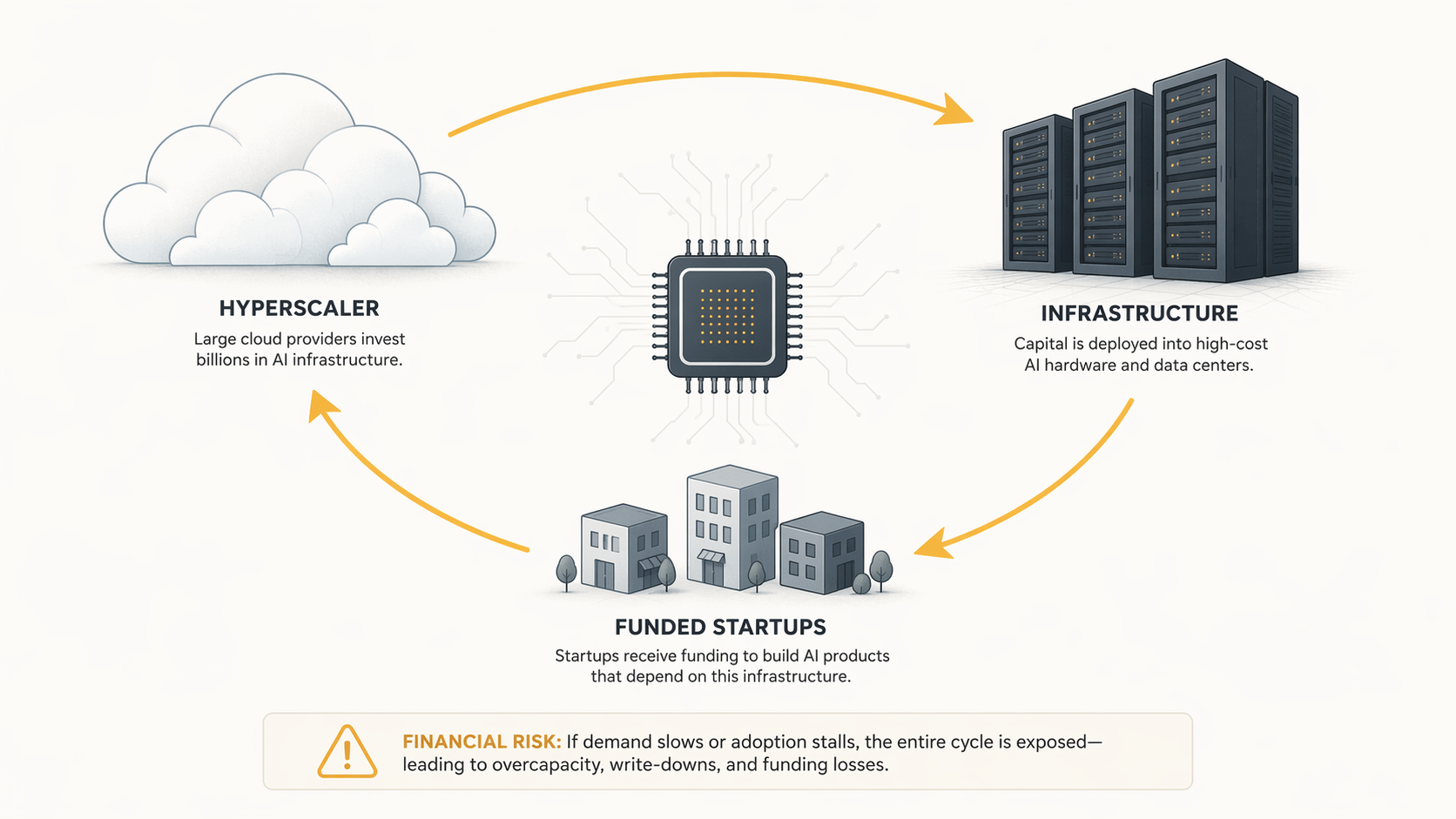
Forbes reports that Nvidia invested about $90 billion across more than 145 companies in 16 months, while its nonmarketable equity rose from $3.2 billion to $42.3 billion. The same analysis notes an IMF warning that circular AI financing could become a systemic risk.[4] That does not prove artificial demand. It does mean marketers should be cautious when vendor momentum is supported by funding announcements, infrastructure partnerships, and valuation signals rather than customer retention, gross margin, and independently proven ROI.
The marketing consequence is vendor risk. AI-native vendors may look durable when capital is abundant, compute partnerships are generous, and growth is rewarded ahead of profitability. If funding tightens or compute costs rise, the same vendor may change packaging, narrow its roadmap, sell to a larger platform, or prioritize enterprise accounts over mid-market customers. Those are not abstract market events when a team has migrated campaign workflows, brand memory, reporting templates, or customer data processes into the product.
Martech Is Already Resetting Around AI
The martech market is not simply adding AI tools on top of the old stack. MarTech.org’s 2026 report says more than 1,300 tools were removed and about 1,500 were added in 2026.[5] That is creative destruction, not smooth expansion.
This matters more than the raw count. A tool category can appear healthy while individual vendors disappear. A platform can add AI features while quietly sunsetting integrations. A startup can ship impressive demos while lacking the balance sheet to support enterprise-grade security, support, and roadmap commitments. A large suite can look safer while locking teams into workflows that are difficult to unwind.
For senior marketers, the operational question is not whether to use AI-native tools. It is how much process dependency to place on any one vendor while the infrastructure economics are still being tested. The difference shows up in contract length, data portability, integration design, approval workflows, and whether the team has a fallback path when a tool changes pricing or loses a feature.
Two Planning Conditions, Not A Market Forecast
A marketing plan does not need a confident call on whether AI infrastructure is a bubble. It needs to survive both plausible conditions.
| Planning condition | What it could mean for marketers | How to prepare |
|---|---|---|
| The buildout remains durable | AI remains central to platform roadmaps, model access improves, and more marketing workflows become partially automated. | Keep testing, but require workflow-level ROI evidence before expanding seats or replacing process capacity. |
| The cycle corrects or slows | Vendor consolidation, pricing changes, slower feature roadmaps, and tighter procurement scrutiny become more likely. | Protect portability, avoid brittle single-vendor dependencies, and maintain fallback workflows for critical processes. |
Under the durable-buildout condition, the main mistake is underinvesting in learning. If model capability keeps improving and capacity keeps expanding, marketing teams that never operationalize AI will lose cycle time in creative development, research synthesis, analytics, and campaign optimization. But disciplined adoption still matters. A durable infrastructure cycle does not make every AI feature worth buying.
Under the correction condition, the main mistake is assuming the product environment remains stable. A vendor may not fail outright to create disruption. It may change price tiers, restrict high-cost features, pause a promised integration, reduce support, or get acquired by a platform with different incentives. Teams that treated the tool as a layer of convenience can adapt. Teams that rebuilt their operating model around it without exits have a harder problem.
The practical posture is straightforward: use AI, but do not confuse usage with dependency readiness. Before a marketing team commits to an AI-native stack for a core workflow, it should know where the data lives, how outputs can be exported, which integrations are replaceable, what happens at renewal, and which business metric will be reviewed at a defined checkpoint.
- Set ROI checkpoints around workflow outcomes, not tool activity: cycle time, approved output, campaign lift, reduced vendor spend, or analyst hours avoided.
- Negotiate contract flexibility where usage costs or feature access could change materially.
- Keep exports, brand rules, reporting templates, and performance history portable enough to move.
- Avoid replacing human review capacity until the AI workflow has survived real approval, compliance, and performance cycles.
- Separate experimentation budgets from operating-model commitments so a failed pilot does not become a stranded process.
The hardware boom is significant enough to keep AI at the center of marketing strategy. The cash flow, monetization, and financing signals are fragile enough to make all-in commitments risky. SOXL’s volatility is only the visible edge of that deeper dependency chain. The marketing decision is not to predict the chip cycle; it is to build AI operations that still work if the cost curve, vendor map, or funding environment arrives less smoothly than the roadmap promised.
References
- Why AI Companies May Invest More than $500 Billion in 2026, Goldman Sachs Research
- AI Market Trends 2026: Global Investment, Risks, and Buildout, Morgan Stanley
- 2026 Global Semiconductor Industry Outlook, Deloitte Insights
- AI Can Change The World And Still Be A Bubble, Forbes, May 26, 2026
- Martech 2026: AI drives a major industry reset, MarTech.org

Comments
Join the discussion with an anonymous comment.