

Implement AI dynamic pricing for concerts without losing trust
AI dynamic pricing can boost concert revenue, but poorly implemented it destroys consumer trust. This guide provides a governance framework—price caps, transparency rules, and a pricing constitution—that lets event marketers capture revenue gains without triggering backlash.
AI dynamic pricing for concert tickets becomes a marketing problem long before the model misprices a seat. It becomes one when a fan joins a queue believing one thing about the price, waits through the emotional build-up of a launch, and then sees a number that feels like a trap.
That is the operating risk. The revenue case is real, but so is the trust baseline: in a 2024 Gartner survey of 303 U.S. consumers, 68% said they feel taken advantage of by dynamic pricing.[1] YouGov found that only 33% of consumers considered dynamic pricing fair for live concerts specifically.[2] CivicScience data cited by Master of Code reported that 56% of consumers abandon purchases when they perceive dynamic pricing as unfair, and 62% associate dynamic pricing with price gouging.[3]
Those numbers do not prove that every variable-based ticketing model will trigger backlash. They do prove that the marketer recommending one walks into the room already behind on trust. The useful question is not whether concert pricing should ever respond to demand. It is what fences need to exist before a brand can responsibly let AI influence the price a fan sees.
The backlash pattern is usually governance failure, not pricing math
The public cases people remember have a family resemblance. A price moves while the buyer is already committed. The movement is not explained before the sale. The label makes the offer sound special when it is mostly a pricing mechanism. There is no visible ceiling. By the time customer service, social, and PR teams are handed talking points, the system has already made the brand look evasive.
Ticketmaster is the obvious cautionary case. A U.S. Senate investigation cited in Fortune reported that dynamically priced tickets rose by more than 700% between 2019 and 2022.[4] The Oasis ticketing controversy then put the same failure pattern into a mass-market frame: hidden price jumps while fans were in the queue, insufficient disclosure, no clearly visible price ceiling, and “platinum” labels that did not give buyers a plain understanding of what they were paying for.
The UK Competition and Markets Authority’s September 2025 intervention is useful because it translates outrage into operating requirements. Ticketmaster agreed to give 24-hour advance notice when tiered pricing would be used, provide real-time price range updates in queues, and stop using misleading “platinum” labels for certain tickets.[5] A marketer should read that less as a legal footnote than as a checklist of disclosures that should not have required a regulator.
Bruce Springsteen’s 2022 tour supplied another version of the same trust break. Platinum tickets reportedly hit $5,000, while comparable seats later fell sharply in price.[6] Even when the economics can be explained as demand capture, the fan experience is harder to defend: the early buyer who paid the peak price is left feeling punished for enthusiasm.
Wendy’s 2024 pricing controversy belongs in this conversation even though it was not concert ticketing. The company was pulled into a “surge pricing” narrative without a pre-positioned fairness story. That is the trap for event brands as well. If the first clear explanation of your pricing model appears after screenshots go viral, communications is no longer explaining the system. It is apologizing for being surprised by it.
Start with a pricing constitution, not a pricing model
The cleanest way to make AI dynamic pricing usable in concert marketing is to separate the model from the rules that govern it. The model estimates demand and recommends movement. The constitution defines what the model is allowed to do, what it is forbidden to touch, when a human must intervene, and which trust signals can override a short-term margin opportunity.
Fortune’s June 2026 discussion of agentic AI pricing, drawing on a Harvard Business School governance framework, describes this as a “pricing constitution”: published rules that define the AI’s boundaries, including permitted variables, off-limits inputs, price variation limits, human-approval triggers, and trust-metric overrides such as churn, complaints, or repeat purchase behavior.[4]
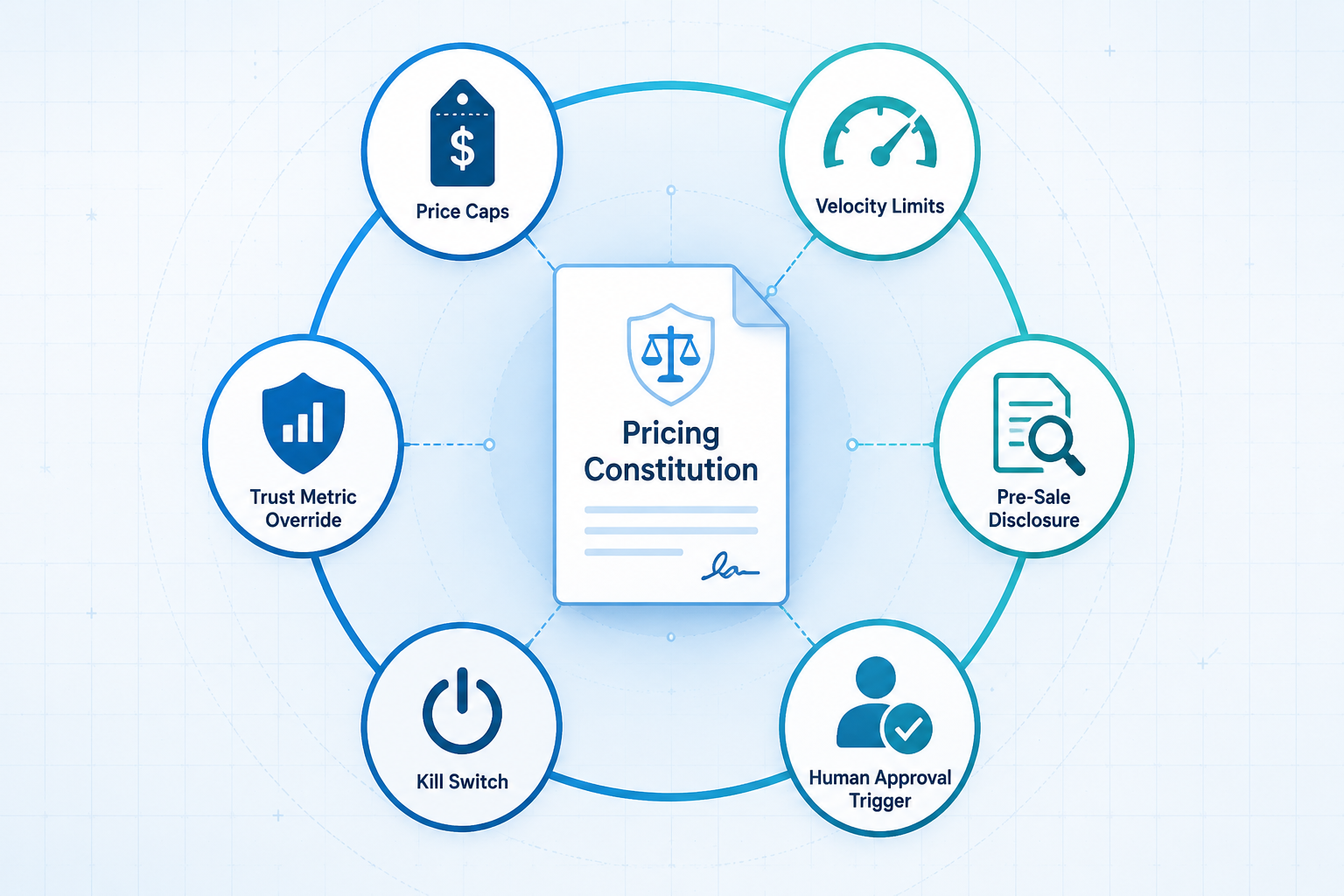
That matters because “the algorithm did it” is not a defensible sentence. The constitution gives marketing, revenue, legal, ticketing, and customer support the same source of truth before launch day. It also forces leadership to make the hard trade-offs while the room is calm, not while fans are posting checkout screenshots.
What the AI may use
For concerts, acceptable pricing variables should be tied to the event and the inventory, not to exploiting a buyer’s vulnerability. Demand velocity, remaining seat supply, section-level availability, time to event, historical demand for comparable shows, day of week, local competing events, and sell-through curves are all easier to explain than individualized desperation signals.
The constitution should name the permitted variables in plain language. If the pricing vendor cannot explain which signals are materially influencing the recommendation, the brand is accepting accountability for a system it cannot defend. That may pass a procurement demo. It will not survive a hostile fan thread or a regulator’s information request.
What the AI may not use
The off-limits list is just as important as the permitted list. A concert pricing system should not raise a price because a specific user has refreshed the event page repeatedly, waited longer in a queue, traveled from farther away, uses a particular device, appears to have higher income, or has a prior purchase history suggesting unusually high willingness to pay.
Some of those signals may be legally sensitive depending on jurisdiction and implementation. Even when they are technically available, they are difficult to defend. A marketer does not need to wait for a legal memo to know that “we charged you more because you looked more eager” is a sentence no brand wants on a help-center page.
Where prices can move, and how fast
Price caps are the most visible trust fence. A model can recommend aggressive increases, but the public sale should operate inside a pre-approved maximum for each ticket class or section. If the organization would be embarrassed to publish the cap, the cap is too loose.
Velocity limits are the quieter but equally important fence. A fan can accept that prices differ by section, date, or demand tier. It is much harder to accept a steep change that happens while they are already in the buying path. The constitution should define how often prices may update, the maximum movement allowed within a defined window, and whether a fan who has entered checkout receives a temporary price hold.
| Governance rule | What it prevents | Marketing implication |
|---|---|---|
| Section-level price caps | Extreme screenshots that define the whole sale | Allows pre-sale messaging to name a real upper boundary |
| Movement-velocity limits | Large jumps while fans are in queue or checkout | Reduces the feeling of being ambushed |
| Checkout price holds | A fan losing the displayed price while entering payment details | Protects the highest-intent buyer from the most frustrating moment |
| Human approval above thresholds | Fully automated escalation during abnormal demand spikes | Gives marketing and customer teams time to prepare or stop the change |
| Trust-metric overrides | Optimizing revenue while complaints, abandonment, or churn spike | Makes fan reaction part of the operating model, not a postmortem |
When humans must approve the recommendation
Human approval should not be reserved for total system failure. It should be required when the recommendation crosses a reputational threshold: a high-demand section reaches its cap, a price increase exceeds the normal movement band, complaints rise faster than sell-through, or queue abandonment spikes after a price update.
This is where marketing needs a real seat in governance. Revenue may see a profitable recommendation. Legal may see a compliant one. Marketing has to ask whether the recommendation can be explained in the language fans will actually see: the event page, the queue notice, the checkout screen, the FAQ, the support reply, and the artist statement if the story breaks wide.
Which trust metrics can override margin
If the system only optimizes revenue per seat, it will eventually find a number that finance likes and fans hate. The pricing constitution should specify which trust metrics can slow, pause, or reverse automated movement. Useful candidates include purchase abandonment after price display, complaint volume by price tier, refund requests, negative support tags, repeat-purchase behavior, fan-club sentiment, and social escalation from verified buyers.
The point is not to let one angry post veto a sale. It is to keep the system from interpreting every completed purchase as consent. Fans sometimes buy the ticket and still leave the experience with less trust in the artist, venue, promoter, or platform. A healthy pricing model needs a way to register that cost.
Disclosure has to happen before the queue
The most damaging dynamic-pricing moments happen when disclosure arrives too late. A notice buried in terms and conditions does not help the fan who waited in a queue under a different expectation. The practical standard should be simple: if prices may change during the sale, say so before the fan joins the queue, repeat it during the queue, and show the current range before checkout.
The CMA’s required Ticketmaster changes point in the same direction: 24-hour advance notice for tiered pricing, real-time price range updates in queues, and clearer labeling.[5] Those are not exotic compliance features. They are the minimum information a buyer needs to decide whether the queue is worth their time.
A defensible disclosure does not need to read like a statute. It needs to answer four questions before emotion and scarcity take over:
- Will prices change during the sale?
- What factors influence movement?
- What is the current price range for the ticket type or section?
- When is the displayed price protected, and for how long?
The language should also avoid labels that imply added value when the difference is really demand-based pricing. “Platinum” became a problem because it sounded like a premium product class to many buyers, not a plain explanation that the price was dynamically adjusted. If the seat does not include a materially different benefit, the label should not make fans infer one.
The operating model: who can stop the system?
A pricing constitution is only useful if it is wired into launch-day authority. The worst version is a slide approved in planning and ignored during the sale. Before tickets go live, the team should know who is watching the model, who receives alerts, who can approve exceptions, who can freeze movement, and who decides whether to revert to fixed pricing.
For a major on-sale, the governance room should include revenue management, ticketing operations, marketing, customer support, legal or compliance, and an artist or promoter representative with actual decision authority. This does not mean every price change requires a committee. It means the automated system has pre-defined escalation paths when the conditions stop being routine.
| Moment | Automated system can act | Human review required |
|---|---|---|
| Normal demand within approved bands | Adjust within cap and velocity limits | No, but dashboard monitoring continues |
| Demand spike pushes a section toward its cap | Recommend movement | Yes, before crossing the threshold |
| Queue abandonment rises after a price update | Pause further upward movement | Yes, marketing and ticketing review |
| Complaint volume increases around price fairness | Trigger trust-metric alert | Yes, support and communications prepare response |
| Displayed prices differ from disclosed ranges | Stop affected movement | Yes, immediate correction or sale pause |
Teams evaluating vendors should ask for governance behavior, not just demand-model accuracy. If the platform cannot support caps, movement limits, audit logs, approval workflows, disclosure feeds, and emergency freezes, it is not ready for a high-visibility concert launch. The same discipline used to evaluate AI marketing analytics tools applies here, but the tolerance for opaque automation should be lower because the fan sees the decision in dollars.
Use the 4Rs before delegating a pricing decision
The Fortune/HBS framework offers a useful delegation test for AI decisions: Is the decision Reversible, Routine, Rule-bound, and Repairable? If any answer is no, the decision should not be fully delegated.[4]
Concert ticketing fails this test more often than executives may want to admit. A small seat-level adjustment inside a published range may be routine and rule-bound. A sudden jump on high-demand inventory during a once-in-years tour is different. It may be hard to reverse without angering either early buyers or later buyers. It may not be repairable if the screenshot becomes the story of the tour.
| 4R question | Concert-ticketing interpretation | Governance response |
|---|---|---|
| Reversible | Can the team undo the decision without creating a new fairness problem? | If not, require approval before the change goes live |
| Routine | Is this a normal movement pattern for this event type and demand level? | If not, treat it as an exception, not an optimization |
| Rule-bound | Is the move clearly allowed by the published pricing constitution? | If not, block it or update governance before the sale, not during it |
| Repairable | Can the brand compensate, explain, or correct the decision if fans object? | If not, keep a human in the loop |
This test is especially useful for marketing managers because it changes the leadership conversation. Instead of arguing that a pricing recommendation “feels risky,” marketing can point to the specific reason it should not be automated: the decision is not reversible, not routine, not rule-bound, or not repairable.
The revenue upside is real, but it should be presented carefully
Leadership cares because pricing has unusual leverage. Revology reports that across research on 2,000 global companies, a 1% improvement in price realization can produce a 6% to 7% lift in operating profit, rising to 10% to 11% in unregulated industries.[7] That does not mean a concert promoter can plug in AI and expect those numbers. It does explain why pricing projects keep coming back to the table.
Sports case studies show the upside, with an important caveat. Playbook Sports, a consultancy, reported that the Golden State Warriors used an AI system analyzing more than 50 variables, including team performance, opponent, day of week, weather, and traffic; the case study says the system predicted demand with 92% accuracy and generated a 27% revenue increase on high-demand games when price fences were in place.[8] The same consultancy reported that Real Madrid’s automated system made up to 3,000 price adjustments per match and increased matchday revenue by 29% in its first season, with an 18% merchandise sales lift.[8] It also reported that Manchester United’s AI detected a 40% slower sales rate after a midweek Champions League loss, adjusted prices, and produced a 22% increase in ticket sales with only a 3% revenue dip versus original projections.[8]
Those are useful directional examples, not promises. The underlying methodology and primary data behind the Playbook Sports figures are not independently verified here. They should be used in leadership conversations as evidence that governed dynamic pricing can create upside, not as a forecast for a concert tour.
That distinction matters. Vendor and consultancy case studies often show what is possible under favorable conditions. A marketer still has to ask whether the venue, artist, ticketing platform, fan base, customer support team, and legal environment can support the same level of automation without creating a visible fairness failure.
A leadership-ready implementation threshold
A concert team does not need a philosophical debate about whether dynamic pricing is good or bad. It needs a go/no-go threshold. Before launch, marketing should be able to take the pricing constitution into a leadership meeting and answer these questions without hedging:
- Can we publish, in plain language, that prices may change and why?
- Can we show fans the relevant price range before and during the queue?
- Have we capped prices by section, tier, or ticket class?
- Have we limited how fast prices can move during the sale?
- Do buyers receive a price hold once they enter checkout?
- Which variables are allowed, and which are explicitly forbidden?
- Which changes require human approval?
- Which trust metrics can pause, slow, or override revenue optimization?
- Who can trigger a kill switch, and under what conditions?
- Can customer support explain the system using the same rules fans saw before the sale?
The kill switch deserves special attention. It should not be an improvised executive decision made after the sale becomes news. The constitution should define the conditions that freeze price movement or revert to fixed pricing: inaccurate disclosed ranges, checkout instability, abnormal abandonment, complaint spikes, unexpected bot activity, or a recommendation that exceeds approved boundaries.
A post-sale correction process also needs to exist before launch. If a rule breaks, the team should know whether it will refund differences, issue credits, reopen inventory, contact affected buyers, or publish an explanation. Not every pricing complaint requires compensation. But if the system violates its own published rules, repair cannot be optional.
What the fan should see
The buyer experience should not expose the complexity of the model. It should expose the rules that protect the buyer from surprise. Before the queue, the event page can state that prices may vary by demand and availability, give the starting and maximum range for relevant ticket categories, and explain that prices are held for a limited time once checkout begins.
During the queue, the interface should update the current available range rather than letting fans discover a changed price only after they reach seat selection. At checkout, the page should make clear when the displayed price expires. If the price changes before the buyer is protected, the screen should say that directly rather than making the buyer infer it from a new total.
The support team should receive the same constitution in a customer-facing version. That version should include the allowed pricing factors, the cap logic, the price-hold rule, and the escalation path for cases where the displayed experience did not match the published rules. If support has to invent the fairness narrative ticket by ticket, governance failed upstream.
When not to use AI dynamic pricing
Some events are poor candidates for full automation. A farewell tour with intense fan emotion, a benefit concert, a fan-club-heavy presale, or an artist with a public affordability position may carry more reputational risk than a regular-season sports game or a multi-night residency with predictable inventory patterns.
That does not mean those events require fixed pricing forever. It may mean using narrower bands, slower movement, human approval for every upward change, or dynamic discounts only on distressed inventory. The implementation should match the fan promise. If the brand has built demand through loyalty, access, or community, it should not price the launch as though the only relationship is willingness to pay.
The simplest test is whether the organization can explain the pricing system before anyone is angry. If the answer is no, the team is not ready to delegate concert pricing to AI. Build the constitution first, cap the extremes, slow the movement, disclose the mechanism, monitor trust signals, and give humans authority to stop the system when fairness breaks.
References
- Dynamic Pricing Risks Eroding Consumer Trust: Gartner, Consumer Goods Technology, 2024
- Fair or unfair? Consumer opinion on dynamic pricing, YouGov, 2023
- AI Dynamic Pricing: A Complete Guide, Master of Code
- Agentic AI pricing optimization Ticketmaster, Fortune, June 12, 2026
- Ticketmaster to advertise tickets differently after Oasis controversy, says CMA, The Guardian, September 25, 2025
- Bruce Springsteen and Ticketmaster anger fans with AI dynamic pricing fiasco, David Meerman Scott
- Dynamic Pricing Strategies, Revology Analytics
- Top 5 AI Marketing Strategies for Dynamic Ticket Pricing, Playbook Sports, 2025

Comments
Join the discussion with an anonymous comment.