

How Eminent Domain for AI Data Centers Creates Brand Liability
Eminent domain for AI data centers is creating an unexpected brand liability for Big Tech, as the public blames the tech company even when utilities execute the land seizure. This article explains why standard crisis PR fails and what marketing leaders can do to manage the attribution problem.
The brand problem starts before the national headline. It starts when a family opens a legal notice, learns that land they did not offer for sale may be condemned, and then hears the reason compressed into one phrase: power infrastructure for an AI data center.
In Georgia, CBS News reported that a family was forced to sell its home to Georgia Power for transmission lines serving AI data center demand. More than 300 parcels were condemned, and one homeowner described the seizure in the plainest possible terms: “It’s theft.”[1]
That sentence is why eminent domain for AI data centers has marketing implications far beyond land acquisition or utility regulation. A company can explain that a utility filed the condemnation. It can explain that transmission upgrades serve a broader grid plan. It can explain that the data center operator did not personally put a signature on the taking. Those distinctions may matter in court, in regulatory filings, and inside partner contracts. They do not travel as cleanly as “It’s theft.”
The Wisconsin fight around the proposed $15 billion Stargate project shows the same attribution trap from another angle. ABC News reported on Tom Uttech’s eminent domain fight involving 600 acres tied to an AI data center project.[2] The legal posture, land history, and local politics are different from Georgia. The communication problem is not. Once the public story becomes “land taken for an AI data center,” the brand attached to the data center becomes part of the harm narrative, even when the executing institution is a utility or local authority.
This is the part many corporate statements still mishandle. They answer the wrong accusation. Residents are often not asking whether a hyperscaler complied with the formal chain of legal responsibility. They are asking why their home, farm, view, road, tax base, electric bill, or local political process is being reorganized around infrastructure they did not request. The name they remember is rarely the special-purpose entity or the docket number. It is the tech company, the AI boom, and the visible evidence that someone else’s growth now has a local footprint.
Why legal responsibility does not control public blame
Infrastructure communications usually try to separate actors: the developer, the utility, the grid operator, the county, the state regulator, the contractor, the economic development office. That separation is operationally real. It is also weak as a public narrative.
Attribution follows the perceived beneficiary. If land is condemned for transmission lines that residents understand as necessary for an AI data center, the public will tend to attach the loss to the AI data center and to the company whose growth made the project necessary. This does not require proof of malicious intent. It does not require the tech company to have directly filed the condemnation action. The reputational chain is simpler: the land was taken because the data center needed power.
That is why the Georgia quote matters so much. “It’s theft” is not a policy white paper. It is a moral frame. Once that frame is established, a response built around procedure can sound evasive, even when it is factually careful. “We are not the condemning authority” may be true. It does not answer the resident’s claim that the project made the taking happen.
The risk is larger than one homeowner interview. Gallup found in March 2026 that 71% of Americans opposed AI data centers in their area.[3] Brookings, citing KRG Advisors, reported that $130 billion in data center projects were blocked or delayed in Q1 2026 alone.[4] Data Center Watch has identified 142 active activist or opposition groups.[5] These numbers measure different things and should not be collapsed into one giant “backlash” statistic. Together, they show enough friction that condemnation stories now enter a market already primed to believe local communities are paying for AI infrastructure with land, water, power, and political patience.
That context changes the marketing job. The issue is no longer whether a company can produce a better fact sheet after opposition begins. It is whether the company has understood that eminent domain makes the project feel coercive before the brand ever gets to explain its benefits.
The weakest messenger is often the brand that most wants to speak
The instinct inside a large technology company is to regain control of the story. Put executives in front of it. Publish the community benefits page. Explain the tax base, the construction jobs, the sustainability commitments, and the long-term infrastructure need. In a normal brand environment, that might be a reasonable first move. In a data center fight, it can put the least credible speaker at the center of the room.
An Escalent/Hahn study conducted March 3-23, 2026, with 3,417 respondents across 13 states, found that data center companies had 15% credibility as messengers on their own infrastructure. Independent experts ranked higher at 30%, and utilities ranked at 24%.[6] The study was commissioned by firms with a professional interest in infrastructure communications, so it should not be treated as neutral government measurement or longitudinal proof. But its core finding fits the public dynamics now visible in local fights: the company most associated with the project is not the company residents are most likely to believe.
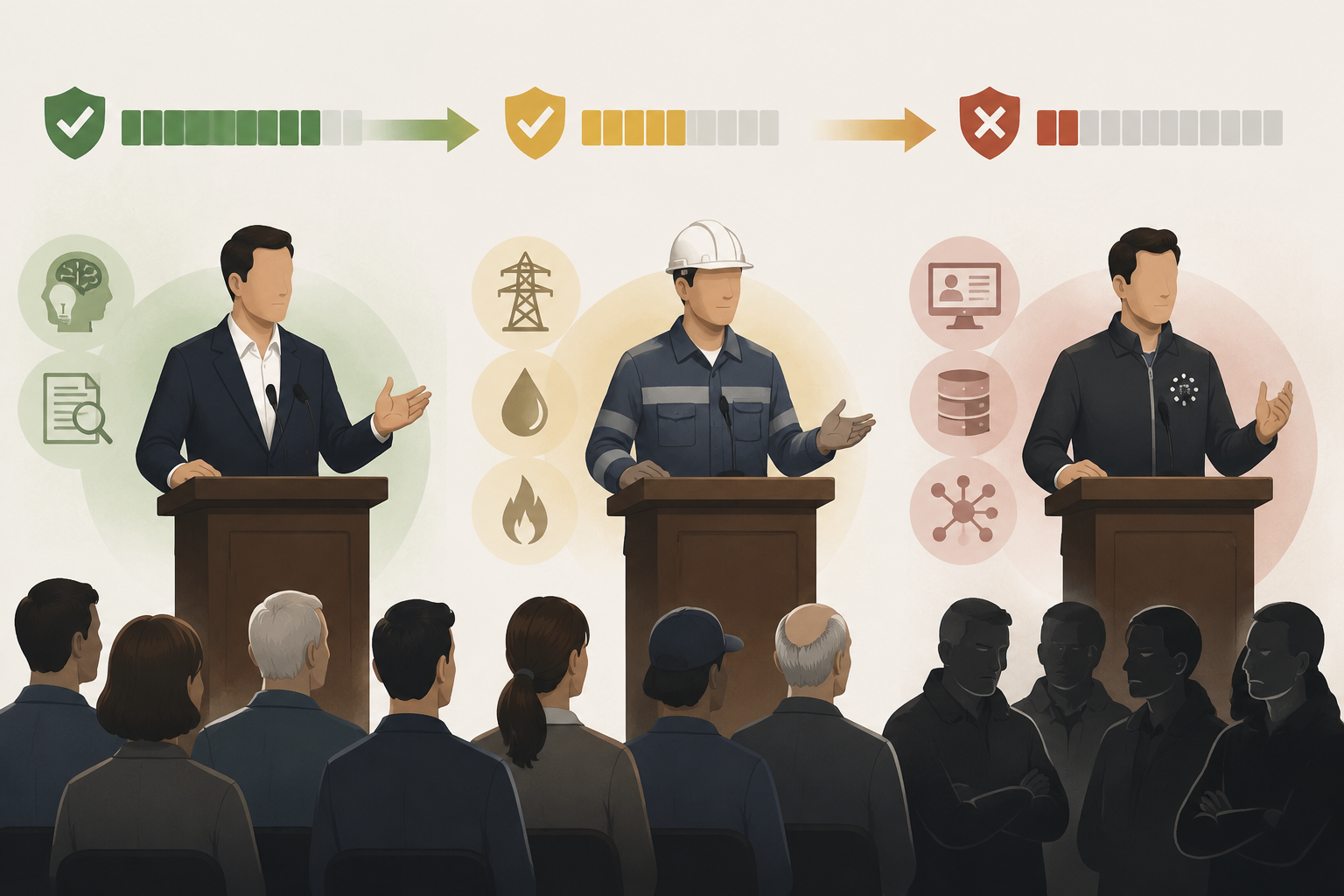
The same research found another uncomfortable result for AI infrastructure marketers: telling residents that a data center supports AI made 25% less supportive.[6] That does not mean companies should hide AI use. It means “this powers AI” is not automatically a local value proposition. For some residents, it clarifies the opposite: their community is being asked to absorb the physical consequences of a technology whose benefits feel remote, uneven, or privately captured.
This is where “more education” becomes a lazy diagnosis. Some opposition may come from misunderstanding. Some may come from accurate understanding and a different weighting of costs. A homeowner facing condemnation does not need an introductory explainer on machine learning to know that the project imposes a loss on them. A county resident worried about power bills does not become irrational because the company has a slide on regional economic development.
Marketing leaders should treat the credibility data as an operating constraint, not a messaging inconvenience. If the company is a weak messenger, then a louder company message may deepen the problem. If the utility is more credible on grid need, the utility should carry the grid explanation. If independent experts are more credible, they need access to enough information to evaluate claims before a public meeting turns into theater. If local institutions are expected to defend the project, they cannot first learn the benefit story from a press release.
This is also where the distinction between legal responsibility and public blame becomes operational. Legal teams ask who has authority, liability, and compliance obligations. Brand teams have to ask who residents will hold responsible when the harm is described at a kitchen table, on a local newscast, or in a county meeting. Those are related questions, but they are not the same question.
For broader context on why standard AI data center messaging can backfire even without eminent domain, see why AI data center marketing makes opposition worse. The eminent domain version is sharper because the local cost is not abstract. It has an address.
The alternative is not better wording. It is a different operating sequence.
A company cannot message its way out of looking like it took something if residents only hear from it after the taking is public. The playbook has to move earlier and distribute the speaking roles differently.
| Operating choice | What changes in practice |
|---|---|
| Reduce the tech brand’s defensive role | The company avoids becoming the sole narrator of land, grid, and community impacts after controversy breaks. |
| Put credible messengers in position before the fight | Utilities, independent experts, and local validators explain what they are actually qualified to explain. |
| Build local value before AI becomes the shorthand | Residents encounter concrete local benefits before the project is framed mainly as land loss for remote compute demand. |
| Separate proof from promise | Long-term benefits are presented with evidence where available, and uncertainty is not disguised as certainty. |
The first move is role discipline. A hyperscaler may be the most visible beneficiary, but it should not automatically be the primary explainer of condemnation, transmission routing, or grid reliability. Those topics carry institutional responsibilities that utilities and regulators are better positioned to discuss. The tech company still has to answer for its demand, site selection, community commitments, and partner standards. It should not pretend to be a neutral grid planner when residents know its growth is driving the need.
The second move is evidence access. Independent validators cannot be decorative. If they are brought in only after opposition hardens, they look recruited. If they have no access to assumptions, load projections, water commitments, workforce plans, or mitigation terms, they can only repeat company claims. Credibility depends on the ability to say where the project is strong, where it is weak, and what remains uncertain.
The third move is local value timing. Benefits introduced after a condemnation notice often sound like compensation for a wound already inflicted. Benefits visible before the legal conflict have a different function: they give local institutions something concrete to evaluate before the project is reduced to a single grievance. That does not guarantee support. It does reduce the odds that AI becomes the only language residents have for what is happening to them.
Microsoft’s January 2026 model is useful, but not yet proven
Microsoft’s Community-First AI Infrastructure initiative is the most visible attempt to turn these lessons into an operating model. Announced in January 2026, it set out five commitments: pay full power costs, reject tax breaks, replenish water, create local jobs, and invest in AI education.[7]
The important part is not that every commitment will satisfy every community. It is that the company is trying to move the conversation from promotional reassurance to terms of local exchange. Paying full power costs speaks to cross-subsidy fears. Rejecting tax breaks addresses resentment over public incentives. Water replenishment answers a resource question. Jobs and education connect the facility to local capability rather than only to global compute demand.
But the timing matters. As of July 2026, the initiative is roughly six months old. It should be treated as an emerging precedent, not a cure. It has not had enough time to prove fulfillment across more than 100 data center regions, and it should not be used as a rhetorical shield against every local objection.[7] The promise is structural; the proof will be local.
Microsoft’s longer-running Quincy, Washington presence gives a better example of what a local value narrative can eventually rest on. The company has cited data showing local poverty falling from 29.4% to 13.1% over roughly 20 years, while county property tax revenue tripled from $60 million to $180 million.[7] Those are the kinds of outcomes that can make a data center feel less like an extractive facility and more like part of a local economic base.
They also cannot be casually borrowed. A 20-year outcome in one Washington community does not prove that a newly contested project in Georgia, Wisconsin, or anywhere else will deliver the same result. The honest use of Quincy is as a proof case for what sustained local value can look like over time, not as a universal answer to a family losing property now.
What marketing leaders should decide before condemnation is public
The hard work has to happen before a utility files, before a parcel map circulates, and before a local reporter finds the family willing to say the thing everyone else will quote. Once the condemnation story is public, the company is no longer introducing itself. It is responding from a credibility deficit.
- Map public attribution, not just legal exposure: identify who residents will believe caused the harm, even if another entity executes the action.
- Assign messengers by credibility: let utilities explain grid need, independent experts test claims, and the tech company answer for demand, commitments, and partner standards.
- Make local value visible early: do not wait until opposition forms to introduce power-cost protections, water commitments, workforce plans, or tax-base effects.
- Keep proof proportional: use long-term success cases carefully, and do not present early commitments as completed outcomes.
- Prepare for the human sentence: assume one resident’s description of the harm will travel farther than the company’s procedural explanation.
This is not an argument against AI infrastructure or against the power upgrades that large-scale computing requires. Land, electricity, water, and permitting all involve tradeoffs. Some projects will be necessary. Some local objections will be overstated. Some utilities will be left defending decisions driven by demand they did not create alone.
That is exactly why the communication standard has to be higher. A company that treats a family’s loss as a routing challenge should expect the public to supply harsher language. A company that waits until condemnation is visible should expect residents to define the project before the brand does. Manage attribution before the legal action, use messengers residents are more likely to believe, and make local value visible before AI becomes the shorthand for what was taken.
References
- Georgia family forced to sell home to Georgia Power for AI data center transmission lines, CBS News.
- Wisconsin's $15B Stargate project — Tom Uttech eminent domain fight over 600 acres for AI data center, ABC News.
- Americans Oppose AI Data Centers in Their Area, Gallup, March 2026.
- Data center backlash signals a fight over AI power, Brookings, July 2026.
- Data Center Watch activist/opposition group tracking, Data Center Watch.
- Data Centers Have an AI Problem, Escalent, 2026.
- Building Community-First AI Infrastructure, Microsoft, January 2026.

Comments
Join the discussion with an anonymous comment.