
Why AI Data Center Marketing Makes Opposition Worse
The AI data center industry has spent millions on advertising to counter public opposition, but the messaging has often backfired. This article diagnoses three specific communication failures and what marketers in trust-challenged sectors can learn from them.
The AI data center industry has not been quiet. It has bought ads, launched coalitions, polished local-benefit messages, and tried to make server farms sound like civic infrastructure. Yet the public permission it needs is getting harder to secure, not easier.
Gallup reported in July 2026 that 71% of Americans oppose data centers in their area, a sharp increase from prior years.[1] Brookings reported that 75 data center projects worth $130 billion were blocked or delayed in the first quarter of 2026 alone, nearly matching the total for all of 2025; some of those projects may still move forward, but delay at that scale is already a cost.[2] Morgan Stanley’s estimate of more than $1 trillion in committed capital at risk puts the issue in the language executives usually understand: this is not a narrative nuisance. It is a permission problem.[2]
That is the uncomfortable starting point for anyone marketing AI data centers amid public opposition. The industry is communicating more, and in some places winning less. The useful question is not whether the ads were pretty enough, whether the talking points were positive enough, or whether the targeting was efficient. The harder question is why more communication appeared to produce less permission.
The Altoona Lesson: A True Claim Can Still Feel Like a Bad Bargain
Meta’s campaign in Altoona, Iowa, is worth lingering over because it shows the failure in miniature. Mother Jones and Grist reported in January 2026 that Meta spent more than $5 million on advertising for a proposed data center in Altoona.[3] The ads promoted a familiar civic bargain: construction work, permanent employment, local investment, technological progress. The headline claim was that the facility would create “at least 400 union construction jobs and 100 permanent jobs.”[3]
That claim is not nothing. Construction jobs matter. Permanent jobs matter. In a town hall, a union hall, or a county budget meeting, 100 ongoing jobs can be a serious figure depending on wages, tax receipts, and the local labor market. But messaging does not land in a spreadsheet. It lands in a place where people are already comparing the promise with the disruption, the land use, the energy demand, the water questions, the road traffic, and the feeling that decisions are being made somewhere else.
That is where Altoona became damaging. State records cited in the reporting showed that the local casino alone employed 1,000 people.[3] Against that context, “100 permanent jobs” could be both factually defensible and politically thin. The problem was not that the number was false. The problem was that the number asked residents to treat a large infrastructure burden as if it had been balanced by a modest employment promise.
Opponents called the campaign “cigarette marketing,” a phrase that stings because it gets at selective framing rather than simple disagreement.[3] The accusation was not merely that the company supported its own project. Everyone expects that. The accusation was that the campaign chose the most flattering slice of the bargain and wrapped it in civic language while leaving residents to wonder about the rest.
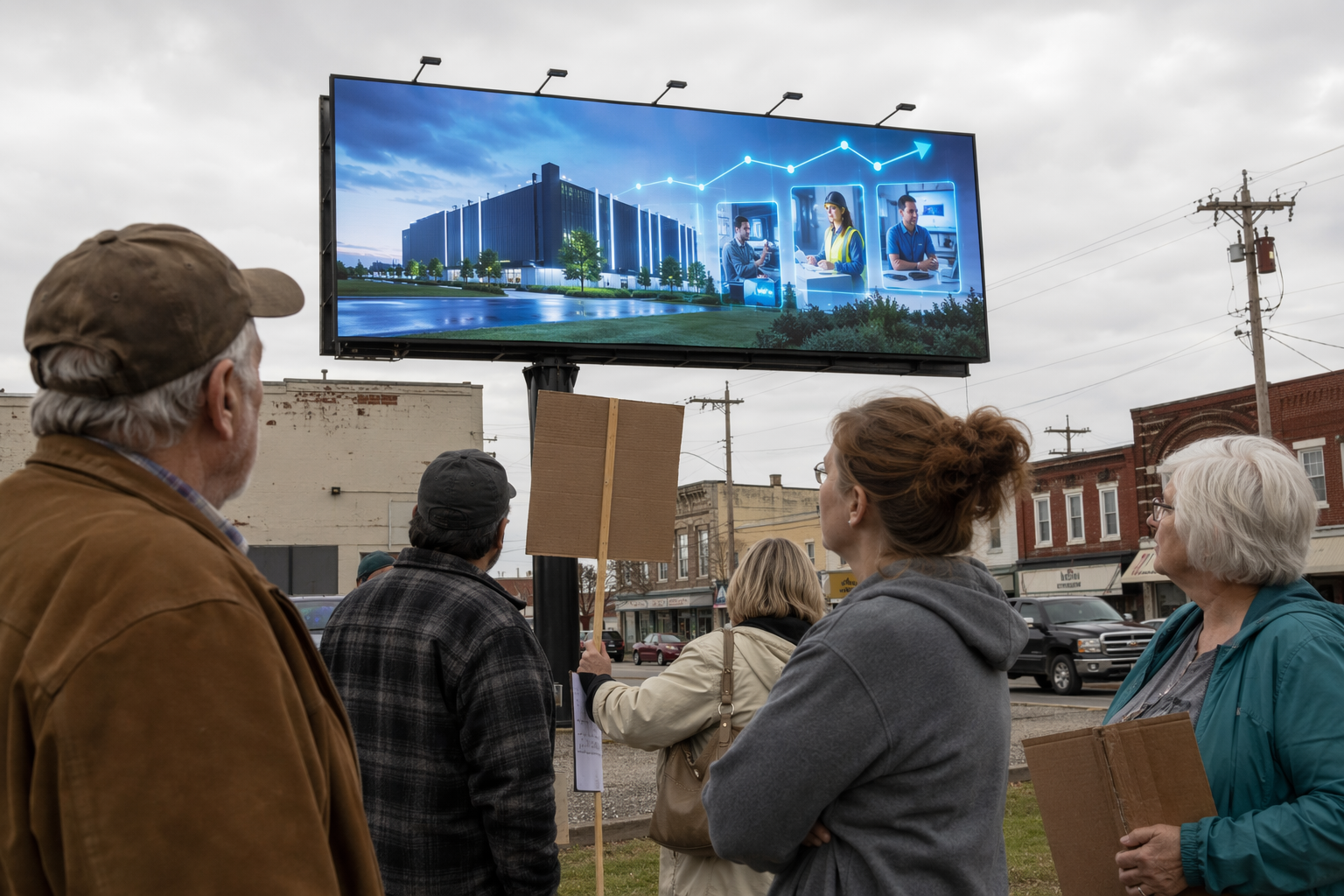
After the campaign, only about 28% supported the project.[3] That figure should make every communications team slow down. A multimillion-dollar local campaign did not merely fail to resolve doubt. It appears to have become part of the evidence residents used to judge the developer. The more polished the message looked, the more it invited a basic question: if the project is so good for us, why does it need this much selling?
There is a practical diagnosis here. Local-benefit advertising fails when it treats benefits as interchangeable with consent. A community can believe the jobs number and still reject the bargain. It can accept that some tax revenue will arrive and still object to who gets the upside, who absorbs the downside, and who had a meaningful voice before the media buy began.
Virginia Shows the Risk of Contradicting the Monthly Bill
The Virginia Connects case is cleaner and, for marketers, more damning. Mother Jones and Grist reported that an industry-backed group spent $700,000 on a digital advertising blitz claiming that data centers lower energy bills.[3] In another state, perhaps that message could have opened a debate about grid investment, tax base effects, or long-term system costs. In Virginia, it collided directly with what many voters believed they were already living through.
Christopher Newport University polling cited in the reporting found that 73% of Virginia voters said data centers are a major cause of rate increases.[3] That does not prove those voters had a full cost-of-service model in their heads, and it does not by itself settle the technical question of how costs should be allocated. But it does establish the communications condition: the campaign was asking people to accept a claim that ran straight into their existing explanation for a painful household expense.
No amount of frequency solves that kind of mismatch. If someone has opened a utility bill, watched a local hearing, read about grid upgrades, and heard neighbors blame data centers for higher rates, an ad saying the opposite does not arrive as helpful information. It arrives as denial.
This is where infrastructure marketing differs from ordinary reputation work. A brand can sometimes reposition a consumer product by changing the frame. It is much harder to reposition a project that people associate with bills, noise, land, water, substations, transmission lines, or tax abatements. Those are not perceptions floating around in the abstract. They are material conditions people discuss at kitchen tables and public meetings.
Failure One: Overpromising Local Benefits
The first failure is not that data center companies mention jobs, taxes, or investment. They should. Those are legitimate parts of the public bargain. The failure is making local benefits carry more persuasive weight than they can bear.
A data center is an unusually large ask for a community because its visible local footprint can feel out of proportion to its ongoing employment footprint. Residents see land conversion, construction activity, backup generators, transmission needs, water concerns in some markets, and a new long-term industrial neighbor. When the answer is “100 permanent jobs,” people do not necessarily hear opportunity. They may hear scale mismatch.
The Altoona campaign exposed that mismatch. The jobs claim was specific enough to be scrutinized but not large enough to settle the bargain. Once opponents could compare it with a familiar local employer, the message became vulnerable. The campaign had invited residents to judge the project on local economic value, then gave them a number many found underwhelming relative to the disruption.
For marketers, the lesson is precise: do not use local-benefit claims as decorative proof points. If the benefit is the argument, the community will test it against local baselines. Who gets the jobs? How many are permanent? What wages? What public costs offset the tax gains? What happens to rates? Who verifies the assumptions? A campaign that cannot tolerate those questions should not lead with the claim.
Failure Two: The Least Trusted Messenger Is Doing Most of the Talking
The second failure is structural. The data center company is often the most visible messenger and, according to the available credibility research, one of the least trusted.
Escalent and Hahn surveyed 3,417 people across 13 states in March 2026 and found that data center companies scored dead last on credibility at 15%, tied with federal agencies.[4] Independent energy experts and environmental or community organizations scored 30%, while local electric utilities scored 24%.[4] The study was commissioned by energy industry stakeholders, including utilities and grid operators, so it should be treated as directional rather than immaculate independent gospel. Even with that caveat, the pattern is hard to ignore: the industry is relying heavily on the messenger people are least inclined to believe.
| Messenger | Credibility in Escalent/Hahn research |
|---|---|
| Independent energy experts | 30% |
| Environmental or community organizations | 30% |
| Local electric utilities | 24% |
| Data center companies | 15% |
| Federal agencies | 15% |
This does not mean developers should disappear from the conversation. They own the project, and hiding behind validators would create its own backlash. But it does mean developer-led persuasion has a ceiling. When the company paying for the project also pays for the message, residents discount the message before the first claim is evaluated.
That discount is especially severe when the message concerns contested public costs. A developer can credibly say what it plans to build. It is less credible when it asks residents to trust its preferred version of what will happen to rates, grid reliability, water use, public finances, or neighborhood quality of life. Those claims need independent pressure before they become public promises, not after.
Failure Three: Teaching People About AI Does Not Necessarily Help
When trust drops, the instinct inside many organizations is to educate the market. If people understood why AI matters, the thinking goes, they would become more accepting of the infrastructure behind it. The data available so far does not reward that confidence.
Pew Research found that adults who had heard “a lot” about data centers were more negative on every measured impact than those who had heard less. Among those who had heard a lot, 67% said data centers are bad for energy costs, compared with 42% among those who had heard less; 35% said they are bad for the local economy, compared with 19% among those who had heard less.[5] This is awareness, not causation. It does not prove that information makes people oppose data centers. People in heavily affected areas may simply hear more because the issue is already local. Still, it should make marketers wary of assuming that more awareness automatically produces more support.
Escalent’s findings point in the same direction. When consumers were told a data center supports AI, 43% said that made no difference to their support, and 25% said it made them less supportive.[4] The AI competitiveness frame may work in national economic speeches, investor decks, or industry conferences. It is much weaker in a locality deciding whether the next large power user belongs on its roads, grid, and water system.
The gap is not mysterious. “AI leadership” is an abstract national benefit. A higher utility bill is a household event. “Innovation” is a broad promise. A zoning change is a local decision. “Competitiveness” has no obvious address. The substation does.
Political Risk Is Catching Up With Communications Risk
It would be too neat to call the backlash a settled national trend with one clear trajectory. Local politics vary, projects differ, and some opposition is likely to soften when agreements change. But there are enough escalation points to treat this as more than a loud comment period.
Two recent examples are New York’s statewide moratorium on July 14, 2026, and the June 2026 ouster of city council members in Festus, Missouri. Those examples should not be inflated into proof that every data center fight will become an election fight. They do show something narrower and still important: when residents believe the public bargain is being managed around them, communications failure can become political accountability.
That is the part polished campaigns often miss. Local officials are not just message carriers. They are the people who have to face residents after the ad flight ends. Utility customers are not just audience segments. They are the people who keep paying bills after the ribbon-cutting. A campaign that ignores those roles may help the sponsor feel visible while making everyone else feel used.
What Better Communication Can and Cannot Promise
There is thinner evidence for what reliably works than for what clearly fails. That matters. It would be convenient to turn the data center backlash into a tidy three-step marketing framework, but the available material does not prove that any one engagement model consistently converts opposition into support.
The most useful direction comes from practitioners treating opposition as a structural risk rather than a late-stage PR problem. DMA’s framework emphasizes transparent fiscal modeling, early independent third-party engagement, and outcome-based communication instead of feature-based messaging.[6] Convergent describes proactive models in which developers pre-fund independent environmental impact studies, engage community organizations as validators before public hearings, and structure benefit agreements around measurable local outcomes.[7]
Those recommendations are not magic. A third-party study can be weak. A community organization can be seen as captured. A benefit agreement can be too small, too vague, or too late. But the direction is more honest than another round of brand-forward reassurance because it changes the credibility conditions before asking people to believe the message.
- Model the local fiscal bargain before promoting the local benefit, including assumptions residents can inspect.
- Use independent experts early enough that their work can affect the project, not merely endorse it.
- Define community benefits as measurable obligations, not atmospheric goodwill.
- Let local concerns change the plan in visible ways before asking local voices to support it.
- Treat developer-paid advertising as the last amplifier, not the first act of engagement.
The distinction is not cosmetic. A campaign says, “Trust us.” A credible process shows who checked the numbers, what changed because of public pressure, who benefits, who pays, and what happens if the promise is missed. In a trust-challenged sector, that evidence has to exist before the media plan asks people to accept the story.
The Decision Rule for Marketers
The AI data center industry’s marketing failures are not mainly a copy problem. Better headlines might avoid a few unforced errors. Better targeting might reduce waste. Softer creative might feel less insulting. None of that solves the core issue when the campaign promise diverges from the lived impact.
Altoona shows how a defensible jobs claim can fail when residents read it as disproportionate to the ask. Virginia shows how a rate message can backfire when it contradicts what voters believe is happening on their bills. The credibility research shows why developer-led persuasion starts at a disadvantage. Pew’s awareness findings and Escalent’s AI-support findings challenge the comforting idea that communities simply need to be educated into acceptance.
For marketers in AI, infrastructure, energy, housing, logistics, or any other sector where public permission is material to growth, the standard should be stricter than “Can we make the message more persuasive?” The better question is: “What would have to be true locally for this message to deserve belief?”
If the answer is missing, more reach will not fix it. It will spread the weakness faster. Do not buy more exposure for a claim the community has no reason to trust. Change the credibility conditions first.
References
- Americans Oppose AI Data Centers in Their Area, Gallup, July 2026.
- Data Center Backlash Signals a Fight Over AI Power, Brookings.
- People Hate Data Centers, so the Industry Is Spending Millions to Rebrand Them, Mother Jones, January 2026.
- Data Centers Have an AI Problem, Escalent, March 2026.
- How Americans View Data Centers' Impact in Key Areas, Pew Research.
- Data Center Community Opposition is Now a Structural Risk, Not a PR Issue, DMA.
- Proactive Communication for Data Center Projects in a Shifting Political Landscape, Convergent Nonprofit.

Comments
Join the discussion with an anonymous comment.