

How CoreWeave's stock drop could affect AI marketing budgets
The CoreWeave stock drop after Meta announced plans to sell excess AI compute capacity has marketers wondering whether tool costs will fall. This article examines the indirect transmission from neocloud infrastructure to marketing budgets and offers a three-signal monitoring framework for planning.
AI compute has stopped being a technical footnote in marketing budgets. In April 2026, Forbes cited Nvidia VP Bryan Catanzaro saying AI compute costs had surpassed human labor costs in enterprise budgets, alongside examples of Uber blowing through its 2026 AI budget by March and Swan AI using its entire AI budget in two months.[1] That does not mean every marketing department has crossed the same threshold. It does mean the line item many teams used to treat as "software" is increasingly behaving like metered infrastructure.
That is why the CoreWeave stock drop after Meta's AI compute news matters beyond investors. CoreWeave shares fell about 14% on July 1, 2026, after reports that Meta planned to sell excess AI compute capacity, and the stock was around $73 by July 18, roughly 52% below its 52-week high.[2][3] The practical question is not whether CoreWeave is cheap at that price. The question is whether a looser GPU market can travel far enough downstream to change what a content, ads, analytics, or automation vendor charges at renewal.
What Actually Happened
The market reaction was straightforward on the surface: Meta, already one of the largest buyers and builders of AI infrastructure, appeared ready to monetize unused capacity instead of letting it sit idle. CNBC reported that Meta's cloud idea had been "on the table" since a May 2026 Zuckerberg comment, while TechCrunch framed the move as Meta looking to turn excess AI compute into cash.[2][3]
For CoreWeave, that news landed in an uncomfortable place. The company sells GPU cloud capacity into a market that has been defined by scarcity. If a hyperscale buyer like Meta becomes a seller, investors have to ask whether premium GPU pricing can hold, especially for neocloud providers that built their story around tight supply.
But a stock drop is not a procurement memo. Meta has not published a mature cloud SKU sheet for marketing software vendors to compare against AWS, Azure, or Google Cloud. CNBC's reported phrasing that a cloud business was "on the table" is a signal of intent, not a launched marketplace with committed prices, regions, service levels, and enterprise support.[2]
Why This Is a Signal, Not a Savings Line
The mistake is to jump from "CoreWeave stock dropped" to "AI tools will get cheaper." Most marketing teams are not buying directly from CoreWeave. Their AI tools usually sit on top of larger cloud platforms, model providers, data vendors, workflow vendors, and application-layer SaaS companies. Each layer can absorb, delay, repackage, or keep any infrastructure savings.
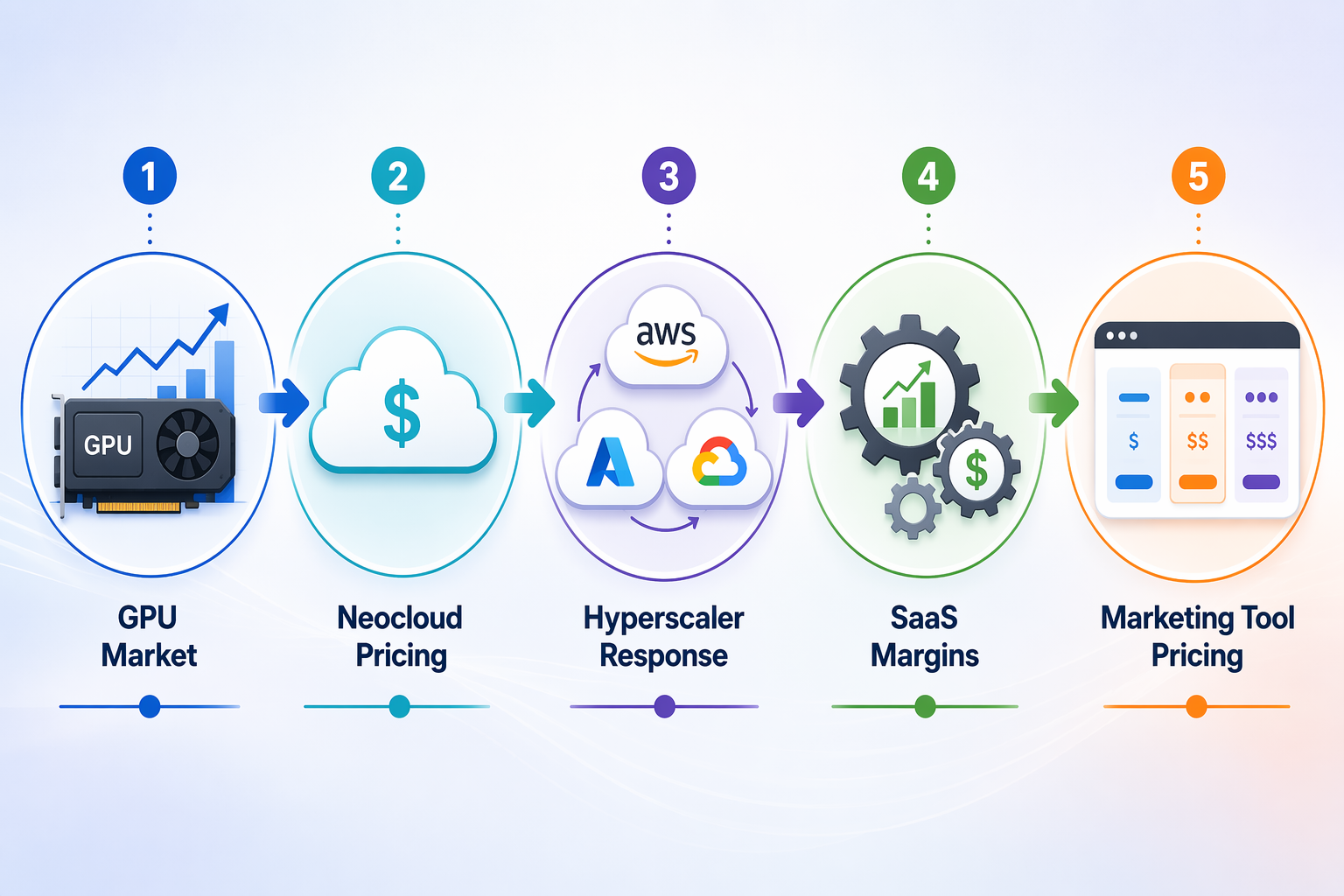
For cheaper GPU supply to show up in a marketing invoice, several things have to happen in order. Meta has to make capacity available in a usable cloud product. That product has to be priced aggressively enough to pressure AWS, Azure, and Google Cloud. Those hyperscalers or model providers then have to lower the cost basis for the SaaS vendors marketers actually buy from. Finally, those vendors have to pass some of the savings through instead of using them to protect margins, fund new features, or offset earlier losses.
| Market Event | What Has To Happen Next | Why Marketers Should Care |
|---|---|---|
| Meta offers excess AI compute | Pricing, availability, reliability, and enterprise support become clear | A press report does not change a renewal quote |
| GPU cloud competition increases | AWS, Azure, and Google Cloud respond or lose enough demand to matter | Most AI marketing tools depend on those platforms directly or indirectly |
| Infrastructure costs fall for vendors | SaaS companies decide whether to lower prices, raise limits, or keep margin | The invoice changes only at the application layer |
This is also where renewal timing matters. A vendor that negotiated expensive capacity during the shortage may not be able to cut prices quickly even if spot GPU pricing softens. A vendor with annual enterprise contracts may wait until packaging changes are commercially useful. A vendor with strong demand may simply offer more usage at the same price instead of lowering the subscription fee.
That is the same downstream logic behind why infrastructure cost pressure has already shown up in AI tool pricing. Compute can move SaaS economics, but the movement is rarely clean or immediate.
CoreWeave's Own Numbers Make the Story Less Simple
CoreWeave is not just a fragile spot-market reseller suddenly exposed to one competitor. The company reported a $99.4 billion backlog in Q1 2026.[4] It also has a $21 billion Meta contract running through 2032, with take-or-pay structures that limit how quickly Meta can walk away from committed demand.[5]
Those numbers matter because they keep the July selloff from meaning "demand disappeared." A backlog and long-term commitments can cushion revenue visibility. They also mean the compute market does not instantly reset just because a buyer starts exploring a seller role.
The pressure sits in the economics. Motley Fool reported CoreWeave had $50.8 billion in liabilities against $4.76 billion in equity, and that quarterly interest expense had doubled to $536 million.[5] In a market where GPU capacity is scarce and pricing is high, leverage can amplify growth. If large new supply starts pressuring margins, the same leverage makes investors more sensitive to contract quality, utilization, refinancing costs, and customer concentration.
That is what the stock movement is really pricing: the possibility of structural margin compression in neocloud economics. It is not yet evidence that AI marketing vendors are about to receive cheaper cloud invoices.
Meta Can Matter Without Changing 2026 Budgets
Meta's scale makes the signal credible. The company had planned $145 billion in 2026 capital expenditure and disclosed $182.9 billion in committed AI infrastructure spending across future years in its March 31, 2026 10-Q.[2] A company building at that scale can create excess capacity, and excess capacity naturally looks for a revenue outlet.
Still, there is a wide gap between capacity and a cloud business that can discipline the market. AWS, Azure, and Google Cloud are not just GPU shelves. They bundle identity, networking, compliance, support, procurement relationships, marketplace billing, observability, security controls, and long-standing enterprise contracts. Marketing SaaS vendors choose platforms for operational reasons as much as raw compute price.
Meta does not need to become a full hyperscaler overnight to affect pricing. It only needs to become credible enough in GPU-heavy workloads that existing cloud providers feel pressure on AI instance pricing. But that kind of pressure usually shows up first in published instance rates, private cloud discounts, model-provider gross margins, or higher included usage tiers. It does not usually arrive first as a cheerful email from a marketing SaaS vendor saying next year's renewal is lower.
Where Marketing Tools Are Most Likely To Feel It
If relief comes, it is more likely to show up in inference-heavy tools than in every AI product category. Inference-heavy tools run many repeated generation, scoring, routing, summarization, or classification tasks after models are already trained. That includes content generation at scale, ad variant creation, conversational agents, lead enrichment, social listening summarization, and analytics copilots.
Training-heavy or deeply customized enterprise AI work is different. Those projects depend on data pipelines, tuning labor, security review, evaluation, governance, and integration work, not just raw GPU hours. Even if compute gets cheaper, the vendor may still price around implementation complexity or business value.
For a marketing team, the practical distinction is not the vendor's AI branding. It is whether the invoice rises mainly because usage rises. If the vendor charges by credits, seats plus usage, generated assets, analyzed contacts, API calls, tokens, or automation runs, infrastructure costs are closer to the surface. If the vendor charges a broad platform fee with AI bundled in, compute savings can disappear into packaging.
This is where procurement should ask more specific questions than "will AI get cheaper?" Ask which model provider is used, whether the vendor runs on hyperscaler infrastructure, whether overage pricing is tied to model costs, and whether the contract allows usage-tier adjustments before renewal. The better comparison is often between credits and API economics, not between AI and non-AI software. For teams buying directly, AI compute deal structures for marketing are already becoming a separate procurement skill.
The Market Is Big Enough for the Signal To Matter
The neocloud market is no longer a niche subplot. TheStreet cited Mordor Intelligence projecting neocloud total addressable market at $236.5 billion by 2031.[6] Castle Rock Digital cited Gartner's estimate of $6.31 trillion in global IT spending in 2026 and IDC's projection that AI infrastructure spending would exceed $900 billion by 2029.[7]
Those are scale markers, not budget guarantees. A large market can attract more supply and competition. It can also attract locked-in contracts, financing complexity, power constraints, data center bottlenecks, and vendor behavior that keeps application prices sticky. Anyone who has watched a SaaS category mature knows that lower unit costs do not automatically produce lower list prices.
The analyst spread around CoreWeave shows the uncertainty. 24/7 Wall St. reported a low CoreWeave price target of $32, a high of $303, and an average around $140 before the July selloff.[8] Invezz argued the Meta-driven selloff made little sense, pointing to CoreWeave's contractual protections and demand backdrop.[9] That disagreement is useful for marketers only because it confirms how unsettled neocloud economics remain. It is not a reason to build a 2026 savings target into the budget.
Three Signals To Watch Before Changing the Budget
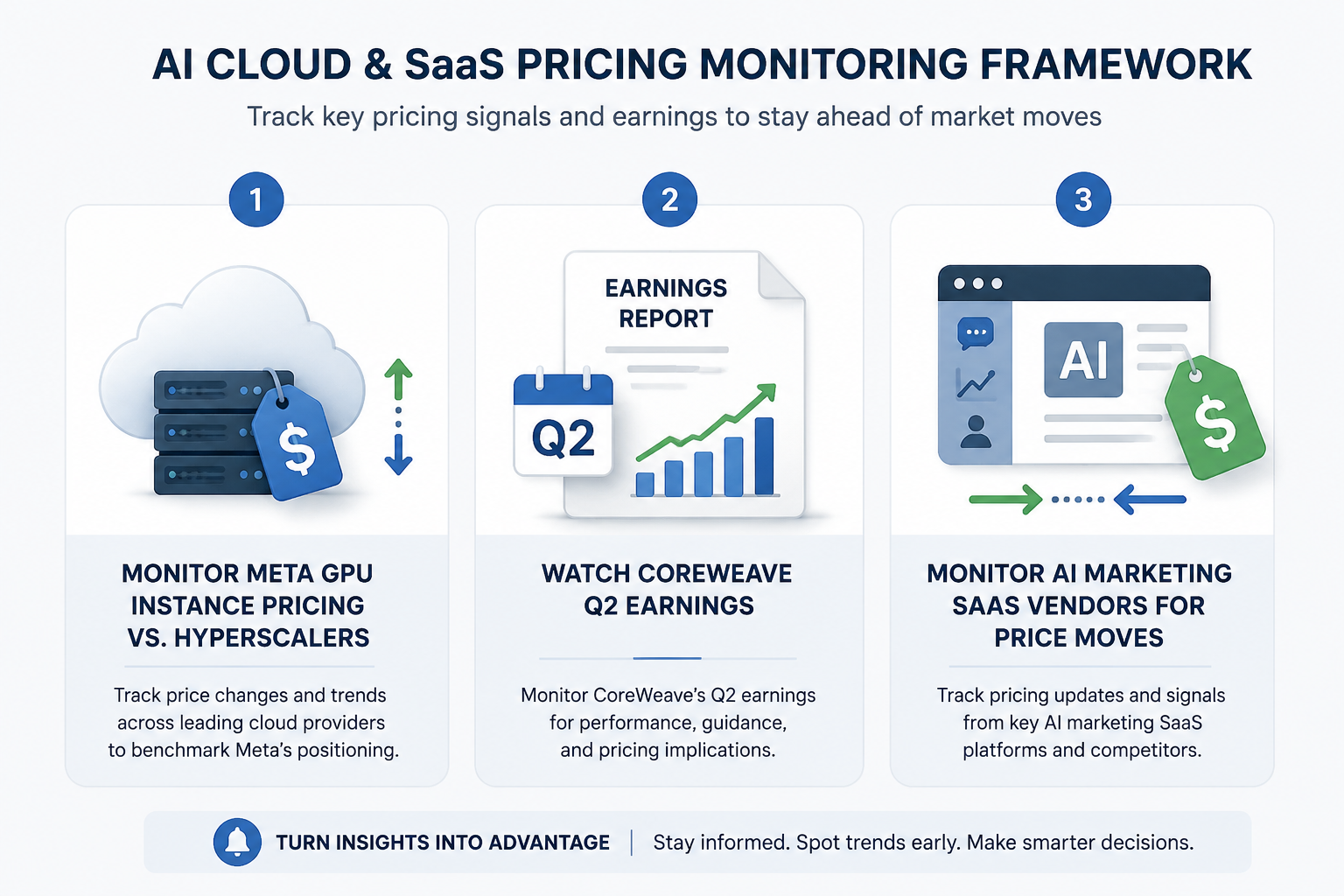
1. Meta GPU Pricing Against AWS, Azure, and Google Cloud
The first real procurement signal is not another comment about excess capacity. It is published or credibly reported Meta GPU instance pricing compared with AWS, Azure, and Google Cloud. Watch whether Meta prices only for a narrow technical audience or whether it offers enterprise terms that AI vendors can actually use.
The useful question is whether Meta creates a reference price. If a vendor can take Meta's rate card into a hyperscaler negotiation, the pressure can start before workloads actually move. If Meta's offering stays experimental, region-limited, or operationally awkward, SaaS vendors will have little reason to change their own pricing.
2. CoreWeave's Q2 Earnings on Backlog and Guidance
CoreWeave's Q2 2026 earnings, scheduled for July 30, 2026, matter because they can separate contract comfort from margin pressure. The items to watch are backlog conversion, utilization commentary, customer concentration, capital cost, and any guidance change.
If backlog converts cleanly and guidance holds, the July stock drop looks more like fear about future competition than evidence of near-term demand weakness. If management talks more cautiously about pricing, utilization, or financing costs, it strengthens the case that GPU cloud economics are beginning to compress. Either way, the read-through to marketing budgets remains indirect.
3. AI Marketing SaaS Vendors Changing Prices Because of Infrastructure
The third signal is the one that actually hits the budget: vendors explicitly tying price moves to infrastructure costs. That can go in either direction. A vendor might lower overage rates, increase included credits, or introduce cheaper high-volume tiers. It might also raise prices because usage has outrun assumptions or because premium models remain expensive.
This is where teams should watch contract language closely. A vendor saying "AI usage is expanding" is not the same as saying "our compute costs went down." A vendor adding more AI features at the same platform price is not necessarily passing through savings. A vendor changing credit conversion rates may be changing the economics without changing the headline subscription fee.
What To Assume for 2026 and 2027 Planning
For the rest of 2026, the safe planning assumption is no meaningful decline in AI marketing tool costs. Usage growth is still the more immediate budget risk. If a team is generating more copy variants, analyzing more calls, enriching more records, or routing more campaigns through AI workflows, the bill can rise even in a slightly better compute market.
For 2027, modest relief is plausible for inference-heavy tools if Meta launches competitive pricing and hyperscalers respond. The timeline that fits the evidence is 12 to 18 months, not next quarter. That window gives time for cloud price pressure, vendor renegotiation, packaging changes, and renewal cycles to work through the stack.
The budget posture is simple enough: do not promise savings from the CoreWeave-Meta shakeup, but do use it in renewal conversations. Ask vendors whether their AI costs are rising or falling, whether they expect usage caps to change, and whether they will commit to revisiting overage pricing if infrastructure rates decline. If they claim compute is the reason for a price increase, they should be willing to explain which part of compute is driving it.
The CoreWeave stock drop after Meta's AI compute news is an early planning signal. It suggests the GPU scarcity story may be entering a more competitive phase. It does not yet give marketing teams permission to reduce 2026 AI software budgets. Watch Meta's actual GPU pricing, CoreWeave's Q2 numbers, and the first SaaS vendors willing to put infrastructure-driven price changes into contract terms.
References
- AI Compute Surpasses Human Costs: Enterprise Budgets Shift, Forbes, April 29, 2026
- Meta stock cloud AI compute, CNBC, July 1, 2026
- Meta, like SpaceX, looks to turn excess AI compute into cash, TechCrunch, July 1, 2026
- CoreWeave Reports Strong First Quarter 2026 Results, CoreWeave
- Why CoreWeave Stock Keeps Falling, Motley Fool, July 18, 2026
- Meta AI cloud competitor CoreWeave CRWV, TheStreet
- AI Infrastructure Market Landscape 2026, Castle Rock Digital
- CoreWeave Price Prediction: The Case for 70% Upside, 24/7 Wall St., June 29, 2026
- Meta-driven sell-off in CoreWeave stock makes no sense. Here's why, Invezz, July 1, 2026

Comments
Join the discussion with an anonymous comment.