

Why Google Search Console Isn't Enough for AI Overviews and What to Measure Instead
Google Search Console cannot segment impressions by AI Overview presence or show whether your brand is cited inside an AIO. This framework introduces a two-layer measurement model that tracks traditional ranking signals and AI Overview citation status independently, so SEO teams can report accurately and make informed optimization decisions.
The uncomfortable part of reporting on AI Overview visibility is not that Google Search Console became useless. It did not. The uncomfortable part is that GSC still shows the numbers everyone recognizes—impressions, clicks, CTR, average position—while leaving out the context now needed to interpret them.
If a query generated an AI Overview, GSC does not separate that impression from a standard SERP impression. If your page was cited inside the AI Overview, GSC does not show that either. A monthly report can therefore show a CTR decline, a ranking gain, and flat clicks without telling the team which search surface changed.
That gap matters because the decision attached to the chart changes. A CTR drop can justify rewriting title tags, cutting investment in a query class, shifting budget to paid search, or building content designed to earn citations. Those are not interchangeable moves. The report has to separate the causes before leadership is asked to approve the remedy.
The Same GSC Chart Can Now Describe Different Realities
In the pre-AIO reporting habit, a query-level GSC view often worked well enough. More impressions with stable position suggested growing demand or broader eligibility. Lower CTR with stable position suggested a SERP layout issue, weaker snippet appeal, or changing intent. Higher position with lower traffic raised questions about demand, personalization, or cannibalization.
AI Overviews add another surface to that same query. The page can rank in the blue-link results, appear as a cited source in the AI Overview, do both, or do neither. GSC still aggregates the resulting clicks and impressions into one familiar table. Rank trackers can show organic position. Neither, by default, tells the reporting team whether the brand was present inside the AI answer.
That is how a dashboard becomes too clean. It removes exactly the distinction the business needs: did our traditional organic result lose appeal, or did the SERP change around it? Did we gain AI Overview visibility, or did a competitor become the cited authority while we kept a conventional ranking?
The Citation Premium Is the Metric That Changes the Meeting
The strongest reason to track AI Overview citations separately is not aesthetic completeness. It is that citation status appears to change click performance in a way traditional position reporting cannot explain.
Seer Interactive’s 2026 update analyzed 2.43 billion impressions across 53 brands and found that pages cited inside an AI Overview earned 120% more organic clicks per impression than uncited pages appearing on the same SERP.[1] That is the citation premium: not merely being exposed to an AIO SERP, but being named as a source inside it.
For reporting, this is the useful distinction. AIO presence alone can depress or reshape organic behavior. Citation status tells you whether the brand participated in the answer. Without that field, the SEO team is left averaging together pages that were reinforced by the AI Overview and pages that were pushed into a less visible supporting role.
The awkward part is that the premium can be hidden by the denominator. Seer also describes the CTR misinterpretation trap: when impressions for brand-cited queries expand faster than clicks, CTR can fall even though citation visibility improved.[1] In a leadership meeting, that looks like underperformance unless someone can explain that the brand entered more AI Overview SERPs and widened its impression base.
| What the report shows | What may actually be happening | Wrong decision if citation status is missing |
|---|---|---|
| CTR falls while clicks stay flat | AIO-cited impressions expanded faster than clicks | Treat citation visibility as ineffective |
| Average position improves but clicks decline | The traditional result improved while the AIO absorbed attention or cited competitors | Keep optimizing for rank only |
| Clicks rise without a ranking gain | The page may have earned citation visibility on AIO-present SERPs | Attribute gains only to title, snippet, or demand changes |
| Non-AIO queries outperform AIO queries | AIO segmentation may reveal a separate opportunity class | Blend both query types into one misleading CTR benchmark |
This is where conventional SEO reporting starts to break under executive pressure. Leadership does not usually ask whether a metric is theoretically complete. They ask whether investment is working. If the team cannot distinguish cited impressions from uncited impressions, it may understate gains, overstate losses, or defend the wrong work.
Ranking and Citation Are Separate Dimensions
The replacement model starts with an unpopular admission for anyone who has spent years polishing rank reports: organic position is no longer a reliable proxy for AI Overview visibility.
BrightEdge reported that, after Gemini 3, citation-organic overlap sat in a 17% to 38% range in its early-2026 snapshot, with a broader 17% to 54% range appearing across methodological differences.[2] That does not mean rankings do not matter. It means a rank tracker and an AIO citation tracker are measuring related but different outcomes.
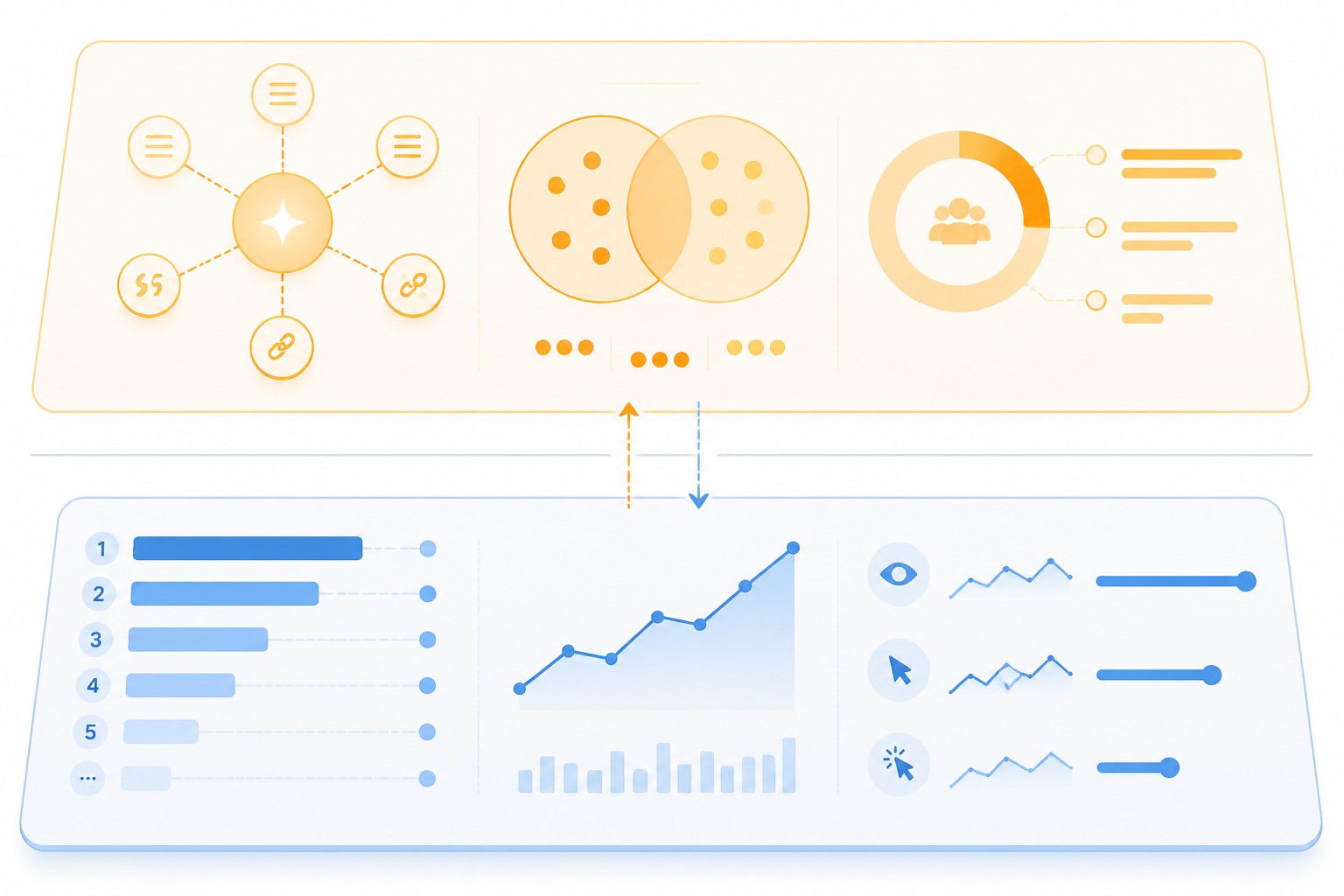
The practical model has two layers:
- Traditional Ranking Layer: queries, landing pages, average position, impressions, clicks, CTR, indexed pages, snippets, and non-AIO SERP features.
- AIO Citation Layer: AI Overview presence, cited or not cited status, cited URL, cited domain, citation frequency, citation competitors, and query type.
The layers should be joined by query, landing page, market, device where available, and date. They should not be collapsed into a single visibility score too early. The whole point is to preserve the differences long enough to make different decisions.
Citation Overlap Ratio
Citation overlap ratio asks a simple question: when we rank organically for AIO-present queries, how often are we also cited in the AI Overview?
Citation overlap ratio = queries where your ranking URL or domain is cited in the AIO / queries where you rank organically and an AIO is presentA low overlap ratio points to a citation problem, not necessarily a ranking problem. A high ranking position with low citation overlap means the content may satisfy conventional ranking systems while failing to become a source for the generated answer. That can lead to a different optimization brief: clearer factual support, stronger topical authority, more directly answerable passages, or improved source credibility rather than another round of title tag testing.
For teams already working on citation-first optimization, the measurement layer should connect to the tactical work rather than replace it. A practical next read is citation-first SEO for AI Overviews, but the reporting question comes first: are we being cited when we already have a right to compete?
AIO-Present Versus AIO-Absent CTR
A blended CTR benchmark is now a weak benchmark. The same position on an AIO-present SERP and an AIO-absent SERP may carry different click expectations. Segmenting them does not require a philosophical stance on whether AI Overviews are good or bad for the web. It only requires admitting that the layout is different.
AIO-present CTR = clicks from queries where an AIO was detected / impressions from queries where an AIO was detected
AIO-absent CTR = clicks from queries where no AIO was detected / impressions from queries where no AIO was detected
The comparison helps prevent a common reporting error: using non-AIO CTR expectations to judge AIO-present queries. It also keeps teams from assuming every CTR decline is an AIO problem. Seer found that informational queries with no AI Overview saw organic CTR improve from 2.93% to 3.97% across 901 million impressions.[1] That does not prove every site should chase non-AIO informational content. It does show that non-AIO query classes can contain real opportunity that a blended report may hide.
Citation Share of Voice
Citation share of voice measures how often your brand or domain is cited across a tracked AIO query set compared with the sources that appear alongside or instead of you.
Citation share of voice = your AIO citations / total tracked AIO citations in the query setThis metric is most useful when the query set is intentionally narrow. A broad industry-wide number can make a dashboard look mature while hiding the decision. Segment it by product category, funnel stage, brand versus non-brand, comparison intent, question intent, and market. If the same competitors keep appearing as cited sources, that is a content and authority signal. If citations come from forums, publishers, review sites, or partner content, the work may extend beyond the owned website. For teams looking at that wider authority layer, Reddit citations in AI platforms is a useful companion topic.
Impression Decomposition
Impression decomposition is the discipline of breaking a GSC impression total into more decision-ready buckets. The exact implementation will be imperfect unless Google exposes more native segmentation, but the conceptual split is straightforward.
| Bucket | What it isolates | Likely decision |
|---|---|---|
| AIO present + cited | Queries where the brand participates in the AI answer | Defend or expand citation-oriented work |
| AIO present + not cited | Queries where competitors or other sources shape the AI answer | Investigate citation gaps and source eligibility |
| AIO absent + ranking | Traditional organic opportunities without AIO interference | Optimize conventional SEO and snippet performance |
| AIO absent + no meaningful ranking | Demand not currently reached through either layer | Decide whether the query is worth pursuing |
This is the reporting move that keeps a team honest. Instead of saying, “Organic impressions rose,” the report can say which kind of impressions rose. Instead of saying, “CTR fell,” it can show whether the decline came from cited AIO expansion, uncited AIO exposure, or traditional SERP behavior.
Query Type Should Drive the Segments, Not the Story
AI Overview prevalence numbers are tempting because they look like the headline. They are also easy to misuse. Prevalence varies by keyword set, geography, device mix, detection method, and date. A single number can be directionally interesting and operationally weak.
What matters for measurement is whether certain query types need separate expectations. BrightEdge reported that comparison queries triggered AI Overviews at 95.4%, while question-format queries triggered them at 85.9% in its analysis.[2] Those figures should not be treated as universal rates for every site. They are useful because they support a segmentation rule: comparison and question queries should not be judged with the same CTR and visibility assumptions as all other informational queries.
A workable query taxonomy does not need to be elaborate at first. It needs to separate cases that lead to different actions. Brand, non-brand, comparison, question, definition, troubleshooting, pricing, and local or transactional modifiers are usually enough to reveal whether the issue is demand, rank, citation, or SERP layout.
Treat CTR Reduction Studies as Guardrails, Not Laws
The Ahrefs 2026 update is useful because it puts a hard edge on a concern many teams already feel: AI Overviews can reduce clicks. Ahrefs reported a 58% CTR reduction using desktop-only GSC data and keyword-level analysis across branded and non-branded terms.[3]
That finding belongs in the dashboard conversation, but not as a universal multiplier. Desktop-only data is not the same as all-device behavior. Keyword-level analysis is not the same as session-level user behavior. A reported reduction across a studied set does not tell an individual brand which queries are cited, which are uncited, or which have no AI Overview at all.
Used well, the study argues for segmentation. Used poorly, it becomes another blunt explanation for every organic miss. The better reporting question is not “Did AI Overviews reduce CTR by a fixed amount?” It is “Which parts of our query set behave like AIO-affected SERPs, and are we cited when they do?”
Paid Search Can Anchor the Dashboard, But It Cannot Explain Organic
Paid search deserves a place in the same leadership view because it can provide a stability anchor. Seer reported that paid CTR with AI Overviews present stayed within a 13.34% to 16.21% band throughout 2025, while organic CTR was two to ten times more volatile.[1]
That does not make paid search a replacement for organic. It makes paid useful as a comparison line. If paid CTR remains stable while organic CTR swings sharply on AIO-present queries, the discussion can move away from broad demand panic and toward organic surface changes. If both channels move together, the team has a different investigation.
For executives, this is often easier to absorb than a long explanation of SERP mechanics. Paid gives the room a familiar control surface. Organic still needs its own AIO citation layer.
Do Not Let AIO Measurement Turn Into AEO Theater
A measurement gap tends to attract tactics that sound precise because the reporting is not. Google’s own AI optimization guidance says that familiar Search fundamentals still apply and specifically pushes back on supposed shortcuts such as chunking content into tiny pieces or creating llms.txt files for Google Search optimization.[4]
That guidance should narrow the work. If the metric is citation overlap, the response is not to invent a separate ritual for the crawler. It is to investigate why the page, domain, or source ecosystem is not being selected as support for the answer. Sometimes that will lead to content structure. Sometimes it will lead to evidence quality, authoritativeness, freshness, or third-party source presence. The metric should point to the diagnosis, not decorate the dashboard.
A Reporting Workflow Teams Can Start Without Waiting for a Perfect Tool
Specialized AIO tracking tools can make this cleaner, especially at scale. They are not a prerequisite for starting. The first version of the workflow can be assembled from GSC exports, a query taxonomy, manual SERP checks, and SERP-feature filters in tools that already detect AI Overview presence.
- Choose the query set that actually drives decisions. Start with priority product, comparison, question, and high-impression informational queries rather than the entire keyword universe.
- Export GSC query, page, country, device, impressions, clicks, CTR, and position for the reporting period.
- Tag query intent manually or with a lightweight ruleset. Keep the categories few enough that someone will maintain them.
- Check AIO presence for the priority query set using manual SERP testing, SE Ranking or Semrush SERP-feature filters, or a dedicated AIO tracker if available.
- Record citation status: cited domain, cited URL when visible, competitor citations, and whether your ranking URL is the cited URL.
- Join the AIO fields back to GSC data and report CTR, clicks, impressions, and position by AIO-present/cited, AIO-present/not cited, and AIO-absent segments.
Manual checks will be noisy. Location, personalization, device, and timing can change what a tester sees. That is a reason to label the dataset carefully, not a reason to keep presenting blended CTR as if it were more honest. A small, consistently tracked query set can be more useful than a large export with the decisive fields missing.
A monthly dashboard can stay compact:
| Dashboard view | Metric | Decision it supports |
|---|---|---|
| Traditional organic | Clicks, impressions, CTR, average position | Whether conventional SEO visibility and traffic are moving |
| AIO exposure | Share of tracked queries with AIO present | Whether the query set is shifting into a different SERP layout |
| AIO citation | Citation overlap ratio and citation share of voice | Whether the brand is participating in AI answers |
| Segmented CTR | AIO-present cited CTR, AIO-present uncited CTR, AIO-absent CTR | Whether click behavior is changing by surface |
| Competitive citations | Most-cited competing domains or source types | Where authority or content gaps may exist |
| Paid comparison | Paid CTR and CPC trend on overlapping query themes | Whether volatility is organic-specific or broader |
For teams building a broader KPI system around AI-assisted content and search, this can connect to a wider measurement plan for AI content marketing performance. The important thing is to keep the AIO layer distinct enough that it does not disappear inside a general organic traffic trend.
What This Changes in the Monthly Performance Conversation
A two-layer model changes the meeting because it changes the verbs. The team no longer has to say only that rankings improved or CTR declined. It can say that comparison queries increasingly triggered AI Overviews, that the brand ranked but was not cited, that cited queries expanded impressions faster than clicks, or that non-AIO informational queries became a better conventional SEO opportunity.
Those statements lead to different budget decisions. Ranking work is still appropriate when the page lacks baseline organic visibility. Citation work is appropriate when the page ranks but is absent from the AI Overview. Content pruning or repositioning may be appropriate when impressions grow in low-click AIO surfaces without strategic value. Conventional snippet and page optimization still matter where AIOs are absent.
GSC remains necessary because it is still the most accessible first-party view of Google Search performance. It belongs in the traditional ranking layer. It should not be asked to answer questions it does not expose: whether an AI Overview appeared, whether the brand was cited, and whether a CTR movement came from AIO citation dynamics or ordinary organic behavior.
The honest measurement stack for AI Overviews is not a dramatic replacement for SEO reporting. It is an added layer that prevents familiar metrics from being overread. Track rankings and GSC performance. Track AIO presence and citation status separately. Join them only after the differences are visible enough to guide the next decision.
References
- AIO Impact on Google CTR: 2026 Update, Seer Interactive
- AI Overviews at the One-Year Mark: Presence, Size, and What Gets Cited, BrightEdge
- AI Overviews Reduce Clicks by 58% (2026 Update), Ahrefs
- AI features and your website, Google Search Central

Comments
Join the discussion with an anonymous comment.