
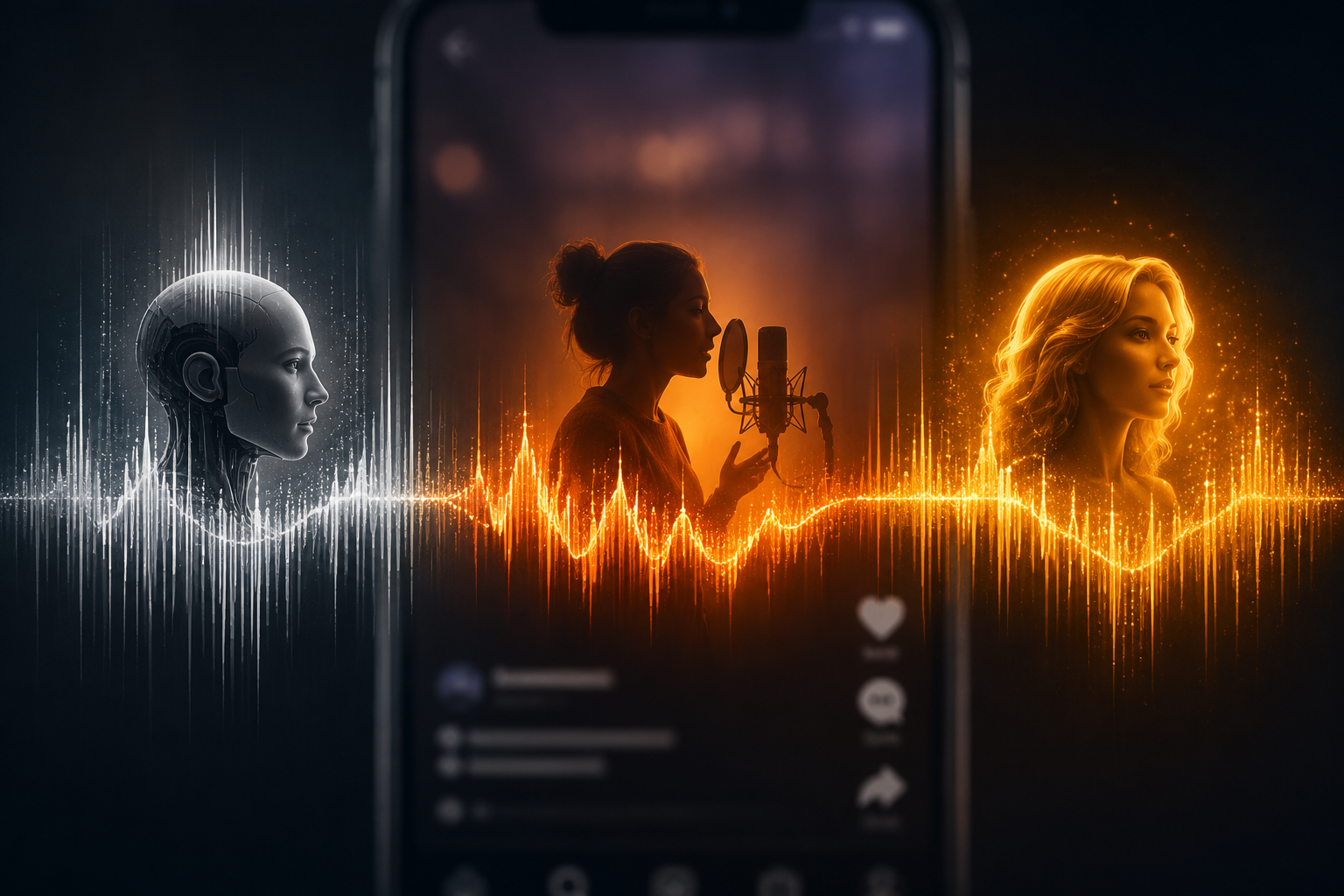
AI Celebrity Voices Outperform Generic AI in Short-Video Ads
Two peer-reviewed studies from 2025-2026 provide the first independent benchmarks for AI celebrity voice performance in advertising. This article breaks down the data to help you decide if the investment in celebrity voice cloning is justified for your campaigns.
Generic AI narration is not yet a clean budget replacement for human voiceover in short-video ads. The best available independent evidence points in a more specific direction: generic AI voices underperform human narration on engagement, while AI-generated celebrity voices appear to close that penalty and perform at statistically comparable levels to human voices in the tested short-video ad context.[1]
That matters for anyone considering AI-generated celebrity voice for marketing, because the decision is not simply “AI voice or human voice.” It is whether a recognizable, licensed, strategically relevant voice is worth the extra money, approvals, disclosure work, and brand-safety review compared with a cheaper synthetic narrator.
The Benchmark: Generic AI Voice Still Carries an Engagement Penalty
The most useful starting point is the 2025 ScienceDirect paper “Voices that captivate,” because it looks at the actual creative problem: short-video ads competing for attention in feeds. Across three empirical studies, including real TikTok ad data and more than 300 participants, the authors found that AI-generated voiceovers drove lower engagement than human voiceovers.[1]
For a paid-social team, the important word is not “voiceover.” It is “engagement.” A synthetic narrator can be cheaper, faster, and easier to revise, but those advantages only hold if the finished asset does not depress the metric the campaign is buying against. If a lower-cost voice reduces interaction, completion, or other engagement signals enough to hurt delivery or learning, the savings can move from the production line into media inefficiency.
The available abstract and highlights do not give enough detail to price that penalty into every campaign model. They do, however, separate a claim marketers often collapse too quickly. “AI voice” is not proven equivalent to human narration just because it sounds passable in a review meeting. In the tested short-video ad setting, generic AI voice was worse at driving engagement than human voice.[1]
| Voice choice | What the available evidence supports | Campaign implication |
|---|---|---|
| Generic AI voice | Lower engagement than human voiceovers in the ScienceDirect short-video ad studies | Treat savings as a hypothesis, not automatic ROI |
| Human narration | Stronger benchmark than generic AI voice in the same research | Use as a control when testing synthetic narration |
| AI-generated celebrity voice | Comparable engagement to human voice in Study 3 of the ScienceDirect paper | Consider when the voice itself carries creative or strategic value |
The Practical Finding Hiding in the Pitch Result
The same paper offers one finding that is useful even when a celebrity clone is out of scope: lowering the pitch of AI-generated voices can narrow the engagement gap with human voiceovers.[1] That is not a full replacement for casting, performance direction, or brand fit, but it is the kind of lever a creative team can actually test.
This is where generic AI voice should be handled like a creative variable, not an infrastructure decision. A team can produce several narrated versions quickly, but the useful test is not “AI voice versus no AI voice.” It is closer to: the same script, the same edit, the same opening frame, with human narration, default synthetic narration, and a lower-pitched synthetic version tested against the same audience segment.
That kind of setup keeps the conversation with finance cleaner. If the lower-pitched AI voice narrows the performance loss enough, the production savings may justify using it for low-risk variants, localization, or fast iteration. If it still trails the human read, the team has evidence before scaling a cheaper asset into a more expensive media buy.
Where Celebrity Voice Changes the Calculation
Study 3 of “Voices that captivate” is the result that changes the buying question. The authors found that AI-generated celebrity voices achieved engagement levels comparable to human voices, closing the gap observed with generic AI voiceovers.[1]
That does not mean every celebrity clone beats every narrator. It means that, in this research, celebrity AI voice was not carrying the same engagement penalty as generic AI voice. For marketers, that is a much narrower and more useful claim. The value of the celebrity voice is not that it makes production automatically stronger; it may restore performance parity while preserving some of the speed and variation benefits that made synthetic voice attractive in the first place.
The budget question then becomes sharper. If the campaign only needs cheap narration for disposable variants, a celebrity voice may be procurement theater. If the campaign depends on trust, recognition, cultural proximity, or fast localization around a known public figure, the voice can become part of the creative idea rather than decoration.
- Use generic AI voice cautiously when the asset is low-risk, low-spend, or exploratory.
- Use human narration as the benchmark when engagement matters and synthetic voice is unproven for the audience.
- Consider AI celebrity voice when recognition, familiarity, or localized endorsement is central to the ad’s job.
- Do not price celebrity AI voice like a guaranteed lift; price it like a way to avoid the generic-AI penalty under the right conditions.
Why Familiar Voices May Persuade Better
The ScienceDirect study gives the ad-performance benchmark. A separate 2026 Journal of Marketing Research study, summarized by the University of Cincinnati, helps explain the mechanism without requiring celebrity fame to do all the work. The researchers analyzed more than 7,000 Shark Tank pitches across 14 seasons and more than 2,000 Kickstarter campaigns, finding that vocal timbre similarity — voices closer to the target audience’s average voice — meaningfully boosted persuasion.[2]
The Kickstarter result is especially useful because it connects voice qualities to economic behavior rather than only to stated preference. The university summary reports that greater vocal timbre similarity was associated with “hundreds of dollars more per contributor” on Kickstarter.[2] That is not a license to treat timbre as a universal conversion switch, but it does support a more grounded theory: people may respond differently when a voice feels socially closer, more familiar, or more compatible with the audience they imagine themselves to be part of.
This helps explain why an AI celebrity voice may perform differently from a generic AI narrator. Celebrity recognition adds more than a famous name in the headline. If the voice is familiar, trusted, culturally specific, or strongly associated with a category, it can change how the ad is processed before the viewer has consciously evaluated the offer.
There is a useful restraint here. The UC/Hyun research is about vocal timbre similarity and persuasion across pitching and crowdfunding contexts, not a direct test of every celebrity voice in paid social. It supports the mechanism behind familiar-voice effects; it does not prove that a celebrity clone will outperform in every ad, category, or audience segment.
What Scale Looks Like When the Voice Is Load-Bearing
The Cadbury/Mondelez Diwali campaign is a useful production example because the celebrity voice was not a garnish added after the media plan. Respeecher says the campaign used Shah Rukh Khan’s AI-generated voice, with Rephrase.ai video generation, to create personalized endorsements for more than 1,800 local stores across four retail categories.[3]
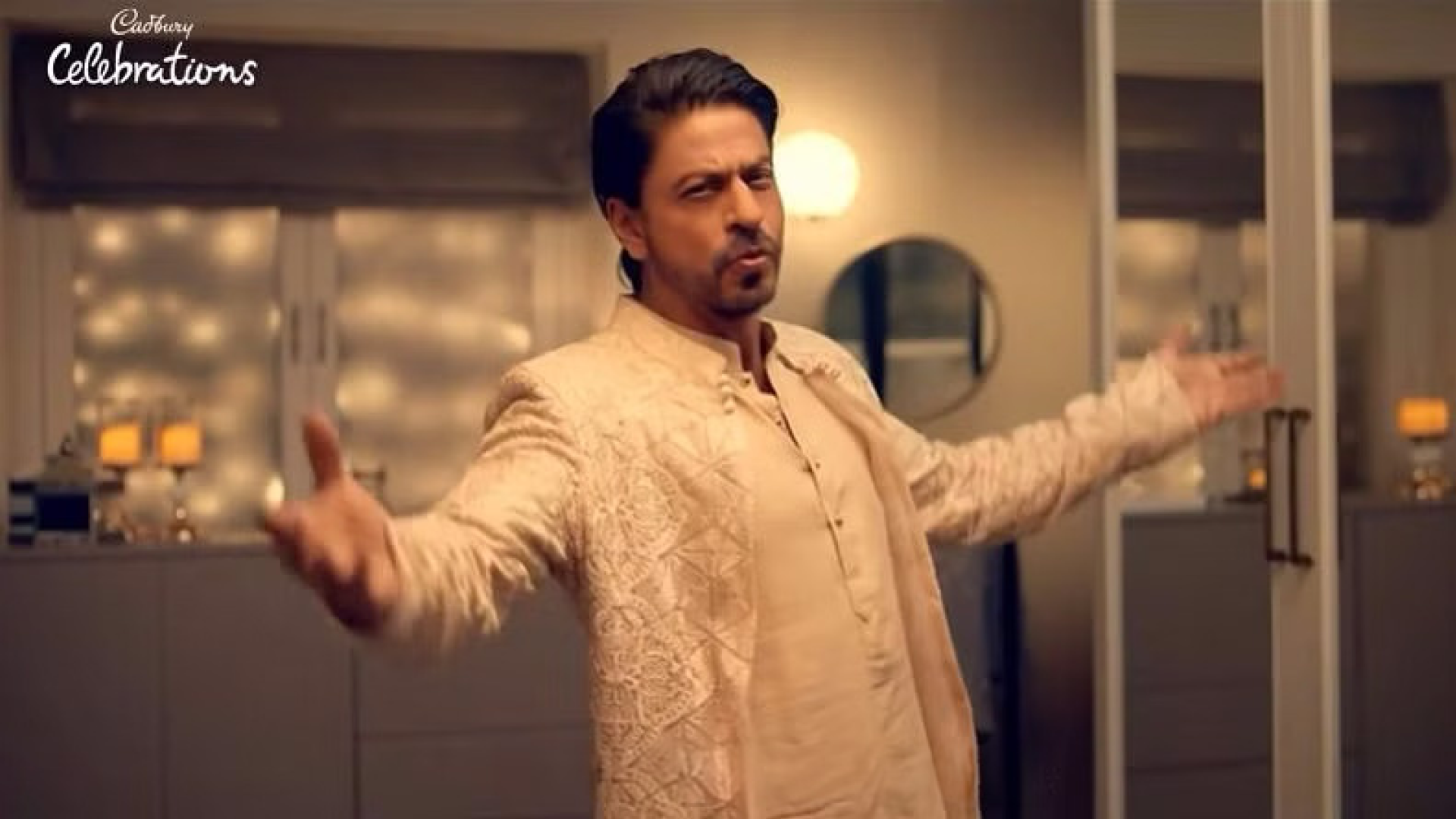
The production logic is obvious. A traditional celebrity endorsement can create one national asset, maybe a manageable set of cutdowns. It cannot easily create thousands of localized store mentions without blowing up scheduling, usage rights, approvals, editing, and delivery. In this case, the AI celebrity voice made the personalization concept operational at a scale that would be difficult to execute through conventional recording.
The same source says production was 10 times faster and notes that the campaign won a Clio Gold Award.[3] Those are meaningful production and industry-recognition signals, but they are not the same as independent proof of incremental engagement lift. The source is a vendor case study, so it belongs in the “what this can make possible” column, not the “what always outperforms” column.
That distinction matters when the tactic moves from a case-study deck into a media budget. A scaled celebrity voice campaign may justify itself because it unlocks localized creative, compresses production timelines, or makes a market-specific endorsement viable. Those are not the same business case as “AI voice is cheaper.”
How to Frame ROI Without Pretending the Legal Work Is Free
Respeecher’s ROI analysis compares traditional celebrity endorsement with AI celebrity voice across production time, cost per asset, and scalability.[4] That framing is useful, especially for teams trying to model why a synthetic celebrity workflow might be cheaper per finished asset once rights, recording, localization, and editing are spread across many variants.
But vendor ROI material should not be treated as an independent benchmark. It can help structure the spreadsheet; it should not fill in every assumption. The missing line items are often the ones that determine whether the idea survives: celebrity rights, consent documentation, disclosure language, legal review, brand-safety review, crisis planning, and the operational cost of making sure every localized asset stays inside the approved use.
A practical ROI model should compare the AI celebrity voice against the real alternative, not against an imaginary perfect campaign. If the alternative is one national human-recorded ad, the AI version needs to justify extra complexity. If the alternative is dozens or hundreds of localized assets that would never be produced under a traditional workflow, the synthetic celebrity voice is solving a different problem.
| Decision question | Why it matters |
|---|---|
| Does the campaign need engagement parity with human narration? | The independent evidence supports celebrity AI voice as a way to close the generic-AI engagement gap in the tested short-video context. |
| Is the celebrity voice central to the idea? | If the voice is only a novelty layer, legal and production complexity may outrun the creative value. |
| Does scale change the economics? | Localization, market-specific variants, and high asset volume are where synthetic celebrity production can become more defensible. |
| Can the brand secure rights and disclose appropriately? | Performance evidence does not remove consent, privacy, or disclosure obligations. |
| Will the test include a human or familiar-voice control? | Without a control, cost savings can be mistaken for ROI. |
For teams building a broader business case, an internal marketing AI tools ROI framework can keep production savings, media performance, review costs, and workflow changes in the same model. Once a campaign is likely to go live, the disclosure and compliance questions belong in a separate review path, such as an FTC AI disclosure checklist.
When AI Celebrity Voice Is Worth Testing
The cleanest case for AI celebrity voice is a campaign where the voice does real work: it makes the endorsement recognizable, makes localization feasible, or gives the audience a familiar signal that a generic narrator cannot provide. In that situation, the ScienceDirect finding is commercially relevant because the AI celebrity voice did not show the same engagement penalty as generic AI narration in the tested short-video ads.[1]
The weaker case is a campaign looking for a cheaper substitute for production discipline. If the script is thin, the edit is slow, the audience does not care about the celebrity, or the disclosure will make the asset feel gimmicky, a famous synthetic voice is unlikely to rescue the creative. Audience reactions to AI-generated advertising can also become an authenticity problem when the execution feels evasive or misaligned; that risk deserves attention before the media spend is committed, not after comments turn sour. The authenticity gap in AI advertising is a separate but adjacent creative risk.
A sensible paid-social test would not launch with only one synthetic version. It would compare a human narrator, a generic AI narrator, and the licensed AI celebrity voice under the same creative conditions. If generic AI is included, pitch should be treated as a testable variable because the ScienceDirect paper identifies lower pitch as one way to narrow the gap.[1] If the celebrity voice wins or matches the human control while enabling variants the team could not otherwise produce, the investment has a real argument.
The decision standard is narrow, which is what makes it useful: consider AI celebrity voice when engagement parity with human narration matters, when scale or localization makes traditional celebrity production impractical, and when the brand can secure consent, rights, disclosure, and review without turning the workflow into a liability. Use generic AI voice where speed and cost matter, but test it against human or familiar-voice alternatives before calling the savings ROI.
References
- Voices that captivate, ScienceDirect, December 2025.
- AI voice cloning, vocal similarity UC study, UC News, June 2026.
- Mondelez, Ogilvy & Wavemaker Revolutionary Ad Campaign Indian Market, Respeecher.
- AI Voice Advertising ROI, Respeecher.

Comments
Join the discussion with an anonymous comment.