

Disney
Disney launched a 12-month campaign turning ESPN's first Super Bowl broadcast into a sustained cross-company marketing effort spanning sports, film, and streaming. This case study examines the sequencing, creative coordination, and structural partnerships behind the 'Year of the Super Bowl' — and what the model implies for brands considering year-round event marketing.
Outcome
Launched a 12-month cross-company campaign with sequenced creative drops across ESPN, Disney, Pixar, Marvel, and Star Wars — source: ESPN Press Room, 2026
This outcome is independently verified via the primary source linked above.
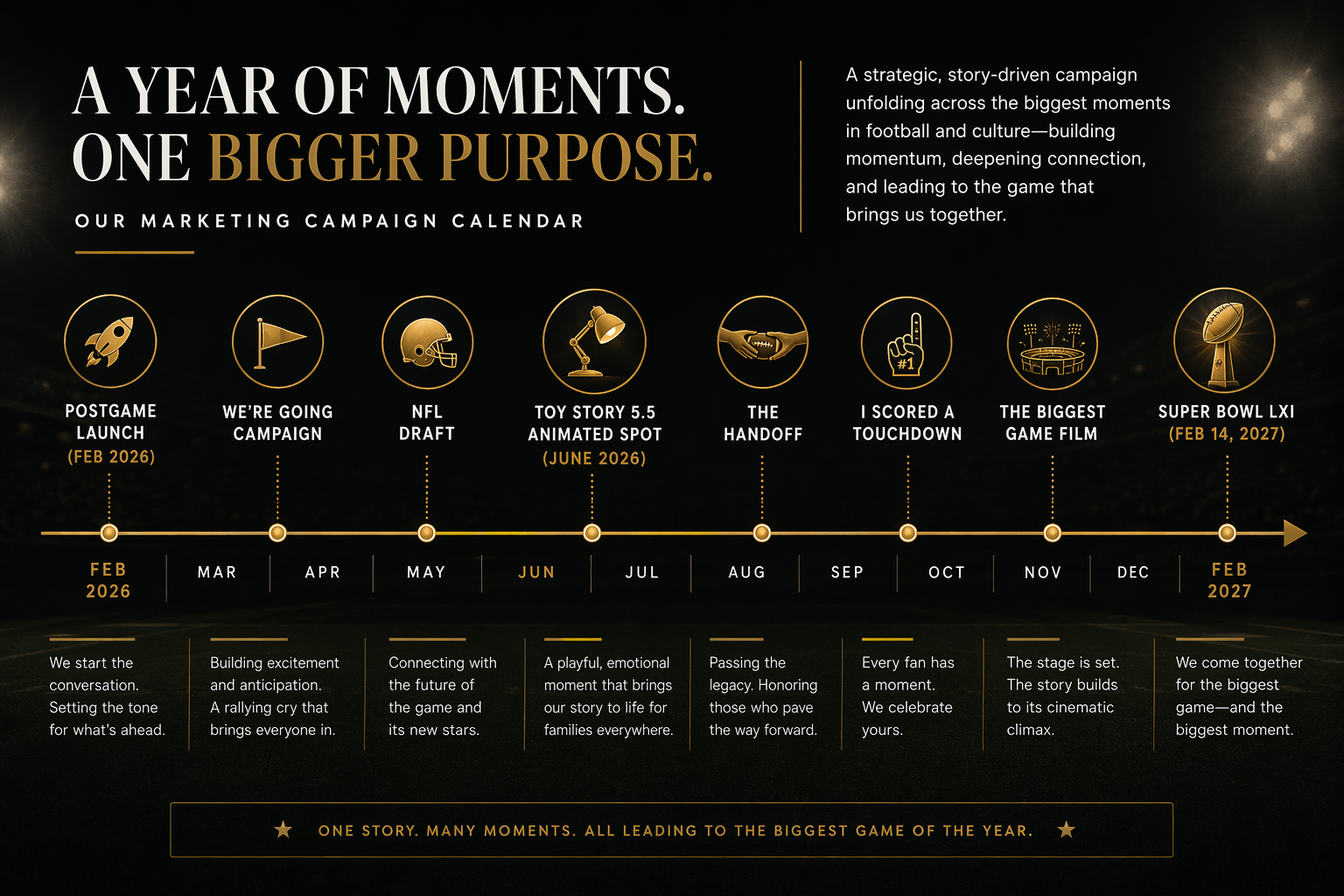
Disney did not wait for the 2027 NFL season to begin selling ESPN’s first Super Bowl. It started the next Super Bowl story in the postgame window of the previous one, while the football audience was still gathered and before the industry had fully moved on from Super Bowl LX. The first public move was not a finale-style trailer or a celebrity reveal. It was an umbrella: ESPN and Disney’s "Year of the Super Bowl," introduced in February 2026 as a 12-month companywide build toward Super Bowl LXI on February 14, 2027.[1]
That timing is the first serious clue to the campaign's logic. The campaign is not simply using Disney characters to decorate football inventory. It is trying to turn one immovable broadcast date into a yearlong operating rhythm across sports, film, streaming, parks-adjacent brand memory, and ad sales. The Super Bowl remains the fixed endpoint. The marketing value is being built in the months before anyone knows the teams, the matchup, or the final audience.
The Calendar Move Came Before the Creative Showcase
Most Super Bowl marketing starts to feel public when the market can see the ad marketplace heating up: teaser clips, celebrity leaks, advertiser announcements, media chatter, and eventually the broadcast itself. Disney inverted that instinct. Its first job was to establish that Super Bowl LXI would not be treated as one night of ESPN programming. It would be treated as a companywide publishing calendar.
The postgame launch mattered because it borrowed attention at the moment when the next host network usually has a narrow handoff opportunity. ESPN’s first Super Bowl broadcast gave Disney a legitimate reason to claim that handoff early, but the company still had to decide what to do with it. A single "see you next year" message would have used the slot. A yearlong umbrella gave every later drop a place to land.
The language of "Year of the Super Bowl" also solved an internal problem. It created a container broad enough to hold ESPN, ABC, Disney studios, Pixar, Marvel, Star Wars, animation, streaming inventory, NFL personalities, and future programming without making each asset explain itself from scratch. That is easy to underestimate. Cross-company campaigns often fail less because the parts are weak than because the parts look like they were assembled after the fact.
A Yearlong Engine Needs Drops With Different Jobs
The "We’re Going" campaign gave Disney a familiar emotional mechanism to adapt. It reworked the company’s long-running "I’m Going to Disney World" Super Bowl tradition, which dates to 1987, into a forward-looking invitation built around ESPN’s coming Super Bowl moment.[2] The important part is not nostalgia alone. The line gave Disney a repeatable structure: different characters, sports moments, and release windows could all say, in effect, that they were headed toward the same event.
The first "We’re Going" spot ran as a 60-second postgame launch after Super Bowl LX and featured more than 60 Disney, Pixar, Marvel, and Star Wars characters.[2][3] In a weaker version of this idea, that would have been the whole campaign: put as much IP as possible into the first spot, collect the headlines, and hope the memory lasts. Disney instead treated the spot as an opening chapter. It established the breadth of the portfolio, then left room for later executions to become more specific.
| Campaign moment | Main job in the sequence |
|---|---|
| Postgame "We’re Going" launch | Claim the yearlong umbrella while the football audience is still assembled |
| NFL Draft "On the Clock" version | Reconnect the Super Bowl message to the next major NFL attention window |
| Toy Story 5.5 animated spot | Use a studio release window to carry the football story into family and film contexts |
| "The Handoff" | Make the transfer from one Super Bowl cycle to the next feel like a staged live-event moment |
| "I Scored a Touchdown" player stories | Layer individual NFL player narratives onto the number and mythology of Super Bowl LXI |
| "The Biggest Game" film | Extend the campaign into longer-form story content before the broadcast endpoint |
The April NFL Draft version, "On the Clock," shows the practical discipline of the system. The Draft is not the Super Bowl, and it would be a mistake to treat it as if it carried the same emotional stakes. But it is a legitimate NFL calendar peak, and it gave Disney a reason to refresh the campaign without pretending kickoff was imminent. The drop’s role was continuity, not climax.
The June Toy Story 5.5 animated version did a different job. ESPN described the campaign as turning animated, with the spot bringing ESPN broadcast personalities together with Pixar’s Toy Story characters in a football-themed execution tied to the broader "We’re Going" platform.[4] Its timing also coincided with the Toy Story 5 theatrical release window, which makes it strategically useful and analytically messy. The spot cannot be read only as Super Bowl marketing; it also served film marketing. That dual purpose is precisely why Disney could justify the creative lift.

That distinction matters for any marketer trying to learn from the model. A yearlong campaign cannot survive on repeated reminders. Each appearance has to earn its place in the calendar. Sometimes the job is audience capture, as with the postgame launch. Sometimes it is relevance maintenance, as with the Draft. Sometimes it is cost sharing across business priorities, as with Toy Story 5.5. The campaign works as an engine only if the drops are not all trying to be the same kind of spark.
The Handoff Makes the Calendar Visible
"The Handoff" added a staged transition layer at SoFi Stadium and Disneyland, turning the movement from one Super Bowl cycle to the next into something audiences could see rather than infer.[5] For a campaign this long, that kind of visible relay is useful. It gives the organization another reason to speak before the actual season stakes are available.
There is a production-side benefit too. A live or eventized handoff can align sports media, entertainment press, talent logistics, and owned-channel distribution around one date. It converts an internal coordination checkpoint into an external story beat. That is not glamorous strategy language, but it is often where large campaigns either hold together or start to fray.
The 61-Player Layer Gives the Number Something to Do
The "I Scored a Touchdown" story layer extends the campaign through 61 NFL players, a direct nod to Super Bowl LXI.[5] This is the sort of detail that can look cute from the outside and useful from the inside. It turns the Roman numeral into a content architecture. Instead of relying only on corporate IP, Disney and ESPN can distribute attention across player stories, team markets, social channels, and NFL conversation without forcing every piece of content to carry the full burden of the Super Bowl message.
The player layer also helps correct a common weakness in entertainment-led sports campaigns. Characters can attract attention, but the NFL audience still expects football credibility. Player stories keep the campaign close to the people who actually define the season. They also give ESPN more modular material to deploy before the final matchup exists.
The Biggest Game Is a Late-Sequence Asset, Not the Whole Bet
The forthcoming "The Biggest Game" film gives the campaign another planned content form before Super Bowl LXI.[5] The existence of a longer-form asset is less interesting than its placement. Disney did not need the film to introduce the campaign. By the time it arrives, the audience should already have seen the umbrella, the character universe, the Draft adaptation, the animated studio tie-in, and the player layer. The film can deepen the world instead of carrying the launch burden.
Cross-IP Marketing Is an Approval System Before It Is a Creative Idea
The easy version of this case study says Disney used its IP. That is true, and not nearly specific enough. The hard part is that ESPN Creative Studio, ESPN Marketing, ESPN Synergy, Disney’s The Hive, ILM, Pixar, Disney Animation, Marvel Studios, and agency Arts & Letters were among the teams involved in the campaign architecture.[1][5] That many groups do not simply pass around a tagline and send files to finishing.
Each studio asset carries rules: character integrity, animation standards, release timing, talent considerations, franchise priorities, and approvals from teams that are not primarily measured on ESPN’s Super Bowl promotion. Marvel character usage is not interchangeable with Toy Story usage. Pixar’s involvement in an animated football spot is not the same operational challenge as placing a legacy Disney character in a montage. Even when the audience experiences the result as a light, polished piece of entertainment, the campaign underneath is a rights-and-approvals machine.
That is why Toy Story 5.5 is one of the more revealing pieces of the sequence. It needed to feel like a credible Pixar-adjacent animated execution, a Super Bowl LXI message, an ESPN brand asset, and a timely companion to a theatrical release window.[4] If any one of those jobs overwhelmed the others, the spot could have looked like either a sports promo wearing a Pixar costume or a film ad with football pasted onto it.
The campaign’s scale also creates a brand-governance problem. Disney can place ESPN, Pixar, Marvel, Star Wars, and Disney Animation into the same marketing ecosystem, but proximity alone does not create coherence. Someone has to decide which asset appears when, which audience is being addressed, which business unit benefits, and what each drop is allowed to ask from the viewer. The cleaner the final spot looks, the more invisible that negotiation becomes.
The Rights Structure Makes the Runway Rational
Disney’s 12-month Super Bowl build is easier to understand against the ESPN-NFL relationship announced in August 2025. Under that deal framework, the NFL would receive a 10% stake in ESPN, while ESPN would receive NFL Network, RedZone, and NFL Fantasy assets.[6] The financial terms were still described as non-binding in the announcement context, and valuation figures reported around the market should be treated as estimates rather than confirmed transaction values.[6]
Still, the strategic implication is clear enough: this is not a one-off media buy wrapped in characters. A deeper NFL-ESPN structure gives Disney more reason to invest in a long runway because the campaign supports a broader sports platform, not only a single broadcast night. NFL Network, RedZone, and Fantasy assets matter because they expand the surfaces where football attention can be cultivated and monetized beyond one game window.[6]
That structure separates Disney from most brands that admire the campaign from the outside. A brand can sponsor a tentpole. It can build a content calendar. It can license talent or buy media. But it usually cannot combine broadcast rights, league partnership assets, studio IP, streaming scale, and internal creative production under one operating roof. The transferability question starts there.
Ad Sales Context Explains the Ambition, Not the Outcome
The commercial backdrop is substantial. Disney Advertising has said sports advertising volume across its portfolio is near $4 billion annually, and streaming now accounts for more than 40% of Disney’s upfront volume.[7] Marketing Dive also connected Disney’s NFL and WWE deal activity to the company’s larger streaming advertising ambitions.[8] That helps explain why a yearlong Super Bowl build is worth organizational attention: the event can be sold and packaged across a larger portfolio than a traditional linear-only broadcast frame.
Reported Super Bowl spot pricing adds another layer of context. Market reports have placed Super Bowl ad spots in the $8 million to $10 million range.[9] Those figures do not prove Disney’s campaign will generate incremental revenue or command a particular premium for Super Bowl LXI. They do show why the company would want to begin shaping demand early, especially when ad sales teams are selling against an event whose final audience, teams, and cultural temperature are still unknown.
The viewership ambition should be handled with the same restraint. Disney has been reported as wanting ESPN’s first Super Bowl to become the most-watched ever, which means surpassing Fox’s 127.71 million viewer record.[9] As of Q3 2026, that is an aspiration, not a result. The campaign can be judged on structure, sequencing, and organizational clarity now. Its final audience impact cannot be known before the game is played.
What Non-Disney Marketers Can Actually Take
The least useful lesson is "start early." Plenty of campaigns start early and become background noise. Disney’s more practical lesson is that early only works when the first move creates a durable container for later moves. The "Year of the Super Bowl" umbrella did that. It made the campaign legible before every asset was ready.
The second lesson is to assign different jobs to different drops. A launch drop can claim the territory. A calendar-adjacent drop can maintain relevance. A partner or IP drop can share costs and reach a different audience. A story layer can create modular content. A film or long-form asset can deepen attention later. When every drop tries to be the big reveal, the campaign burns through its own oxygen.
The third lesson is less glamorous: audit the infrastructure before promising the engine. Disney can attempt this because it has ESPN, ABC, streaming inventory, studio relationships, major character libraries, creative teams, and an expanded NFL partnership architecture. A marketer without those assets may still build a yearlong event strategy, but the model has to be narrower. That could mean fewer drops, fewer approvals, one strong partner, and a clearer division between awareness, sales, content, and retention moments.
There is also a useful warning inside the Disney case. Cross-portfolio campaigns create many reasons to say yes. A studio wants release support. A sports network wants anticipation. Ad sales wants inventory narrative. A streaming team wants addressable demand. A league partner wants year-round relevance. Those incentives can reinforce one another, but they can also produce a pileup. The sequencing discipline is what keeps synergy from becoming clutter.
The Conditional Value of the Model
Disney’s Super Bowl LXI campaign is still unfinished, which makes any victory lap premature. It has not yet proven a viewership record, final ad revenue impact, or long-term lift for ESPN’s NFL position. What it has shown by Q3 2026 is a disciplined attempt to convert a single broadcast event into a portfolio rhythm: immediate umbrella launch, paced creative drops, IP-specific approvals, NFL calendar alignment, player-led story layers, live-event staging, and advertising inventory that can be sold across more than one screen.
That is the real shape of the campaign. It is not a universal instruction to create a "year of" anything. It is a reminder that year-round event marketing works best when the organization has the rights, assets, media surfaces, creative capacity, and internal patience to give each drop a job. Disney’s scale makes the campaign possible. The sequencing is what makes it worth studying.
References
- ESPN Unveils The Year of the Super Bowl, ESPN Press Room, Feb 2026, link
- ESPN and Disney Launch We're Going, The Walt Disney Company, link
- ESPN drops first ad for 2027 Super Bowl, Marketing Brew, Feb 2026, link
- ESPN's We're Going campaign turns animated, ESPN Press Room, June 2026, link
- ESPN, Disney, NFL roll out Year of the Super Bowl, Sports Business Journal, Feb 2026, link
- Why Disney Was Willing to Relinquish a 10% Stake in ESPN to the NFL, Investopedia, link
- From Stadiums to Screens — Disney Scores Big with Sports and Streaming, Disney Advertising, link
- What Disney's NFL, WWE deals mean for the future of streaming ads, Marketing Dive, link
- ESPN Wants Its First Super Bowl to Be the Most-Watched Ever, Front Office Sports, link


Comments
Join the discussion with an anonymous comment.