
NVIDIA
NVIDIA's China AI GPU market share fell from 95% to 55% in 2025, but AMD only captured about 4%—domestic players like Huawei, Alibaba, and Baidu took the rest. This case study explains the real competitive landscape and what it signals for AI tool costs, model availability, and marketing strategy.
Outcome
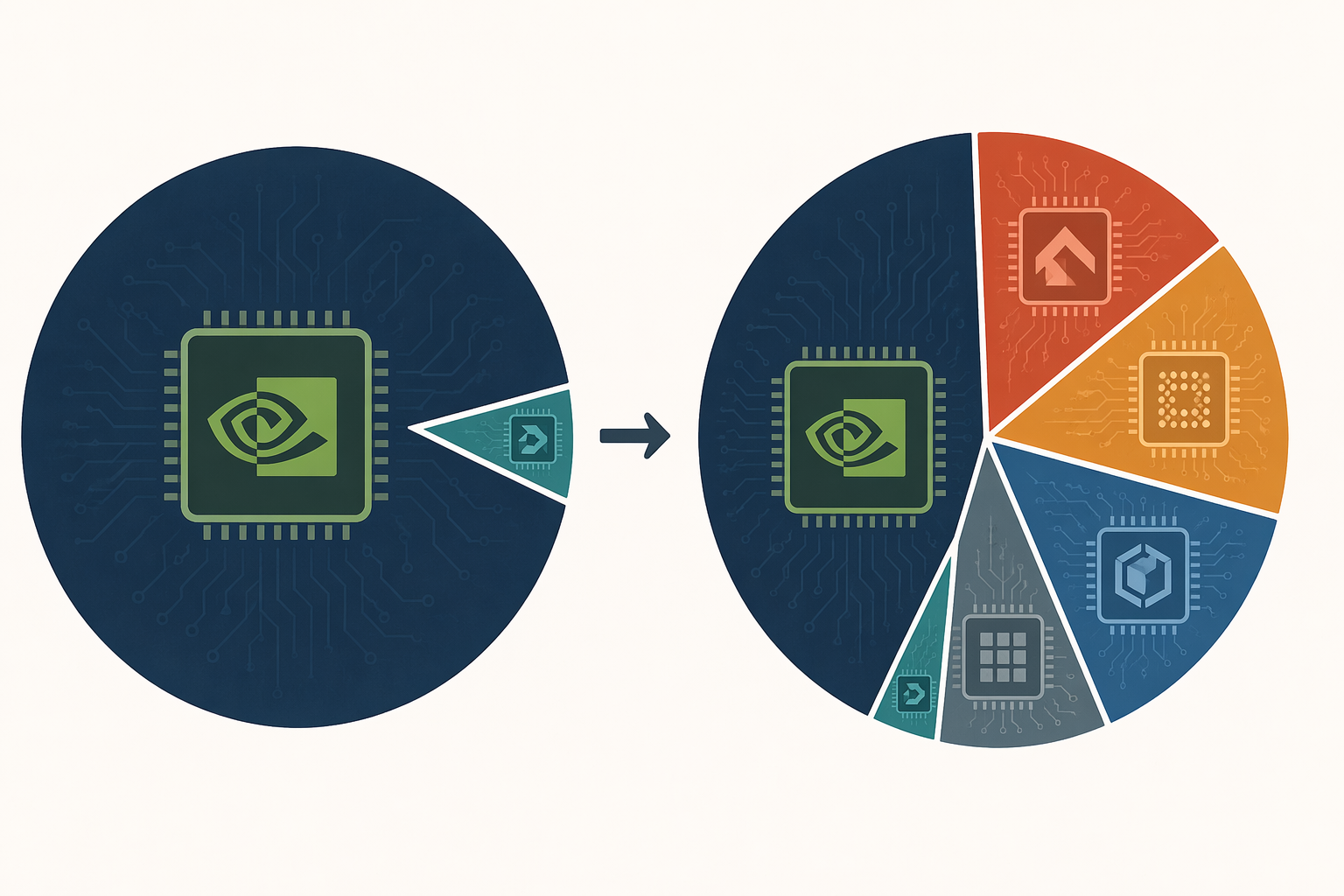
NVIDIA's China AI GPU market share fell from 95% to 55% in 2025, while domestic players captured 41% — source: IDC via Reuters/Tom's Hardware, 2025
This outcome is independently verified via the primary source linked above.
The usual NVIDIA vs AMD GPU China market share story breaks at the first serious number. NVIDIA did lose the near-monopoly position it once had in China’s AI accelerator market. Its share fell from roughly 95% before tighter export controls to about 55% in 2025. But AMD did not become the main replacement. IDC data reported through Reuters and Tom’s Hardware puts AMD at about 160,000 units, or roughly 4% of the China AI accelerator market, while Huawei reached about 812,000 units, or roughly 20%.[1]
That is the part marketers should notice. The market did not simply rotate from one U.S. GPU vendor to another. A growing share of China’s AI compute stack moved toward domestic suppliers, and that changes the assumptions underneath model availability, inference pricing, and regional AI tool strategy.
| Supplier or group | Reported 2025 China AI accelerator position | Why it matters |
|---|---|---|
| NVIDIA | About 2.2M units; about 55% share | Still the largest supplier, but no longer the near-monopoly baseline |
| Huawei | About 812K units; about 20% share | The clearest domestic beneficiary in reported unit terms |
| AMD | About 160K units; about 4% share | Present, but not the main destination for NVIDIA’s lost share |
| Alibaba T-Head | More than 256K units | Reported ahead of AMD in units, which complicates the two-vendor framing |
| Chinese domestic players collectively | About 41% share | The real market-share story is localization, not AMD substitution |
Why AMD Did Not Inherit NVIDIA’s China Loss
In a U.S. data center discussion, it is easy to treat NVIDIA weakness as AMD opportunity. That frame does not travel cleanly to China. The reported 2025 unit picture places AMD behind Huawei and behind Alibaba T-Head, not in a close second-place fight with NVIDIA.[1]
AMD also faced its own restriction problem. Silicon Analysts reported that AMD took a $1.5 billion revenue hit tied to China export restrictions, including an $800 million MI308 China-specific inventory write-down.[2] That is not the profile of a vendor smoothly absorbing demand that NVIDIA could no longer serve.
The better comparison is NVIDIA versus a domesticizing supply chain. Bernstein estimates cited by CNBC put Chinese domestic players at 41% of the country’s AI chip market in 2025, up from 17% in 2023.[3] That shift is too large to treat as a rounding error, and too broad to attribute to one chip company’s sales execution.
For downstream teams, the distinction matters because a second U.S. supplier and a domestic supplier ecosystem create different operating conditions. A procurement team can compare two U.S. vendors on price, performance, and availability. A split infrastructure market forces different questions: which models are optimized for which hardware, which APIs are cheap in which region, which providers may become harder to access, and which tool contracts quietly assume a globally uniform compute layer.
The Market Reconfigured Because Access Kept Moving
Export policy did not create a single clean before-and-after moment. Semiconductors Insight describes four U.S. policy shifts in roughly 12 months: a ban in April 2025, an unban in July 2025, H200 access allowed in December 2025, and then a 25% tariff plus volume cap in January 2026.[4] The exact commercial effects are still contested, but the operational message is not: China-specific access to high-end U.S. AI chips became unstable.
That instability gives customers a reason to redesign around alternatives even when those alternatives are imperfect. A model provider, cloud platform, or enterprise AI team does not need to believe domestic chips have already matched the best global GPUs in every benchmark. It only needs to believe that supply, compliance, and pricing risk are large enough to justify engineering work.
Huawei’s reported trajectory shows why that work is no longer theoretical. Tom’s Hardware, citing Financial Times and Bloomberg reporting, said Huawei expects AI chip revenue to reach about $12 billion in 2026, up from about $7.5 billion in 2025, and is on track to become China’s largest AI chip supplier.[5] Forecasts are not shipments, and vendor momentum is not the same as technical parity. Still, a revenue base at that scale gives developers and buyers a commercial reason to take the platform seriously.
The same is visible at the model layer. Reuters reported that DeepSeek adapted its V4-Pro model to run on Huawei Ascend 910C chips.[6] One model adaptation does not prove that every Chinese frontier model can move easily off NVIDIA hardware. It does show that the software stack is being adjusted around domestic accelerators rather than waiting for export policy to settle.

There are still hard constraints under the localization story. CEIAS analysis describes China’s domestic AI chip supply chain as facing a three-to-five-year fabrication gap versus TSMC, along with HBM constraints and EUV lithography limitations.[7] Those constraints are why the market-share shift should not be read as a simple victory lap for domestic chips. It is more useful to read it as a forced and funded adaptation, with enough commercial traction to affect the services built on top of it.
What Changes for AI Tools When Compute Stops Being Uniform
Most marketing teams do not buy accelerators directly. They buy the layer above them: writing tools, image tools, analytics copilots, workflow agents, enrichment services, call summaries, translation APIs, and model access through cloud or SaaS contracts. The chip market shows up later, as a price sheet, a regional availability note, a latency problem, or a model-selection menu that looks different from one market to another.
Inference pricing is the easiest signal to watch, even though it moves quickly. One mid-2026 example puts DeepSeek V4-Pro at $0.87 per million tokens, below many frontier U.S. model prices and partly tied to different GPU infrastructure economics. That number should not be treated as a permanent benchmark. It is more useful as evidence that regional compute economics can surface in the API bill rather than staying hidden inside the data center.
Model availability is the second signal. If a tool vendor relies heavily on one provider’s model in North America but uses a different stack for China, the feature list may look similar while the behavior differs. Summarization quality, supported languages, latency, context window, moderation behavior, and multimodal features can all diverge when the underlying model and accelerator stack diverge.
Contract risk is the third signal. A team choosing an AI workflow in 2026 should ask less glamorous questions than “which model is best?” For example: does the vendor disclose model routing by region, can it switch providers without breaking automations, does the contract protect access to a specific model class, and does pricing float with API cost changes? These questions are not semiconductor questions. They are marketing operations questions created by semiconductor fragmentation.
A Practical Read on the China Numbers
The cleanest interpretation of the available data is narrow: NVIDIA remains the largest reported AI accelerator supplier in China, AMD remains a small player there, and domestic Chinese suppliers have taken enough share to change the market’s structure. The data does not prove that domestic chips have closed every performance gap. It also does not support a simple “NVIDIA lost, AMD won” headline.
It is also worth being careful about source quality. Several of the most useful market-share and revenue figures come from IDC, Reuters, FT, Bloomberg, Bernstein, and CNBC reporting that is available to many readers only through secondary summaries. That does not make the numbers unusable, but it does mean they should be handled as reported estimates, not as a live audited dashboard.
The marketer’s version of this story is not about picking a chip winner. It is about dropping the assumption that AI infrastructure is globally interchangeable. A campaign workflow that depends on one model provider, one API price curve, or one region’s cloud availability can become brittle when compute ecosystems separate.
What to Track Instead of the Vendor Horse Race
For marketing and agency teams, the useful dashboard is smaller than the chip-war debate. Watch the inputs that can change a tool decision:
- Regional model access: whether the same AI feature uses the same model family in China, the U.S., and other priority markets.
- API repricing: whether token costs, rate limits, or committed-use discounts diverge by region.
- Provider substitution: whether a vendor can switch from one model or cloud provider to another without changing workflow outputs.
- Data-residency and compliance routing: whether regional infrastructure choices affect where prompts, files, and outputs are processed.
- Feature parity: whether multimodal, agentic, long-context, or fine-tuning features arrive at the same time across markets.
That lens keeps the NVIDIA number in perspective. A fall from roughly 95% to about 55% is significant, but the downstream consequence is not simply “buy AMD exposure” or “expect AMD-powered tools.” Read China AI compute as a market moving from a mostly NVIDIA baseline toward multiple infrastructure ecosystems, then watch where that split becomes visible to marketers: tool pricing, model access, regional reliability, and the cost of keeping one workflow consistent across markets.
References
- Chinese chipmakers claim nearly half of local market as Nvidia's lead shrinks, Reuters/IDC via Tom's Hardware
- AMD vs NVIDIA AI GPU Market Share 2026, Silicon Analysts
- Nvidia might not recover its market share in China, CNBC / Bernstein
- US China Chip Export Controls H200 2026: The Policy Shift Explained, Semiconductors Insight
- Huawei expects AI chip revenue to hit ~$12B in 2026, Tom's Hardware / FT / Bloomberg
- DeepSeek unveils new AI model tailored for Huawei chips, Reuters
- Where China's AI chip supply chain stands in 2026, CEIAS


Comments
Join the discussion with an anonymous comment.