

Netflix
Netflix's $587M acquisition of InterPositive, an AI startup founded by Ben Affleck, offers a replicable playbook for brands navigating AI adoption without eroding stakeholder trust. This case study breaks down the three narrative pillars that allowed Netflix to sidestep the backlash that hit competitors like Disney and Amazon.
Outcome
Produced a 17-minute AI-enhanced segment twice as fast and at half the cost — source: Netflix Q2 2026 earnings call
AI Tools Used
This outcome is independently verified via the primary source linked above.
The strangest part of Netflix’s InterPositive deal was not the price. It was the quiet.
By mid-2026, entertainment companies had learned to expect a rough reception whenever AI touched writers, performers, characters, or production labor. Disney’s OpenAI licensing deal put beloved IP at the center of the argument. Particle6 became a shorthand for AI actor backlash. Amazon’s AI production work looked, to outside observers, like another internal efficiency engine. Netflix, meanwhile, paid $587 million in cash for InterPositive, one of the most visible AI production startups in Hollywood, and the story did not turn into a week-long referendum on whether the company was replacing filmmakers.[1]
That does not mean everyone approved. Silence is not consent, and IATSE’s refusal to comment is not the same as labor endorsement. But for marketers and brand strategists studying the marketing implications of Netflix’s AI startup acquisition, the useful question is narrower: how did Netflix make a high-priced Hollywood AI acquisition feel less like a threat and more like a production capability?
Netflix Framed The Deal Before Its Critics Could
Netflix’s announcement did not lead with model capability, compute advantage, or an inevitability argument about AI. It led with the title “Innovation for Filmmaking, By Filmmakers,” then described InterPositive around practical production work: relighting, visual effects, continuity fixes, and production optimization.[2]
The most important sentence came from Elizabeth Stone, Netflix’s chief product and technology officer: “We believe innovation should empower storytellers, not replace them.”[2] That line is easy to dismiss as corporate reassurance. What made it work harder was the boundary around it. Netflix was not asking the industry to bless synthetic stars, machine-written franchises, or AI exploitation of character likenesses. It was asking for permission to use AI in parts of the workflow that already sound technical, iterative, and often invisible to the viewer.
That difference matters. A brand can say “human-centered AI” all day and still trigger distrust if the visible use case suggests replacement. Netflix’s language had a better chance because the stated use cases lowered the emotional temperature. The promise was not that AI would become the creative author. The promise was that AI would help production teams solve expensive, time-consuming problems after creative intent already existed.
This is where the deal becomes more than entertainment news. In AI-Generated Marketing and the Trust Gap: What the Data Says, the trust problem shows up as a consumer perception issue: people often react less to the technical fact of AI than to what they think AI says about a brand’s motives. Netflix’s InterPositive announcement treated motive as the core product message.
The Affleck Permission Structure
Ben Affleck’s role in the story was not ornamental. It changed who appeared to be asking for trust.
If Netflix had simply announced that it bought an AI vendor for post-production efficiency, the default interpretation would have been familiar: a platform imposing new tools on creative labor. InterPositive gave Netflix a different face for the same category of technology. Affleck is not just a celebrity founder. He is an Oscar-winning working filmmaker with enough industry credibility to make the deal read, at least initially, as a toolmaker’s bet rather than a platform’s labor strategy.
That credibility had already been placed in a public AI context. Variety reported Affleck’s statement around the Creators Coalition pledge: “This is a commitment to responsible, human-centered innovation.”[3] For Netflix, that history supplied a permission structure its own executives could not have created by assertion. A streamer saying “trust us” is one thing. A filmmaker associated with a responsible AI pledge joining the story makes the claim harder to flatten into pure cost-cutting.
There is a marketing lesson here, but it is often applied badly. Practitioner credibility is not the same as influencer endorsement. It works only when the practitioner has standing with the people who bear the consequences of the technology. A famous person who has never dealt with the workflow would have made the announcement glossier, not safer. Affleck helped because he belonged to the world being asked to accept the tool.
The caveat is important: Affleck’s post-acquisition role is senior advisor, not day-to-day operator. His value is credibility and endorsement, not evidence that he will personally manage integration. That still matters. In a trust-sensitive AI launch, the first question is rarely “who wrote the model?” It is “who will understand what this changes for us?”
Optimization Was The Safer Word Than Automation
The cleanest strategic distinction came from eMarketer, which characterized the Netflix-InterPositive deal as one that “favors optimization over automation.”[4] That phrase is doing a lot of work. It separates AI that improves an existing production process from AI that substitutes for the people or assets audiences care about.
The InterPositive use cases Netflix chose to emphasize sit on the lower-voltage side of the AI debate. Relighting can preserve a shot. VFX assistance can reduce production friction. Continuity fixes can prevent reshoots or cleanup delays. Production optimization can make a schedule less brittle. None of those claims require Netflix to argue that audiences want AI-generated performers or that creative teams should hand authorship to a system.
That is the difference between a boundary and a vibe. Many brands announce AI principles. Fewer describe what the technology will not be used to do. Netflix’s line was not airtight, and future projects could test it. But at announcement time, the company gave stakeholders a practical map: this is for production execution, not for replacing the creative center.
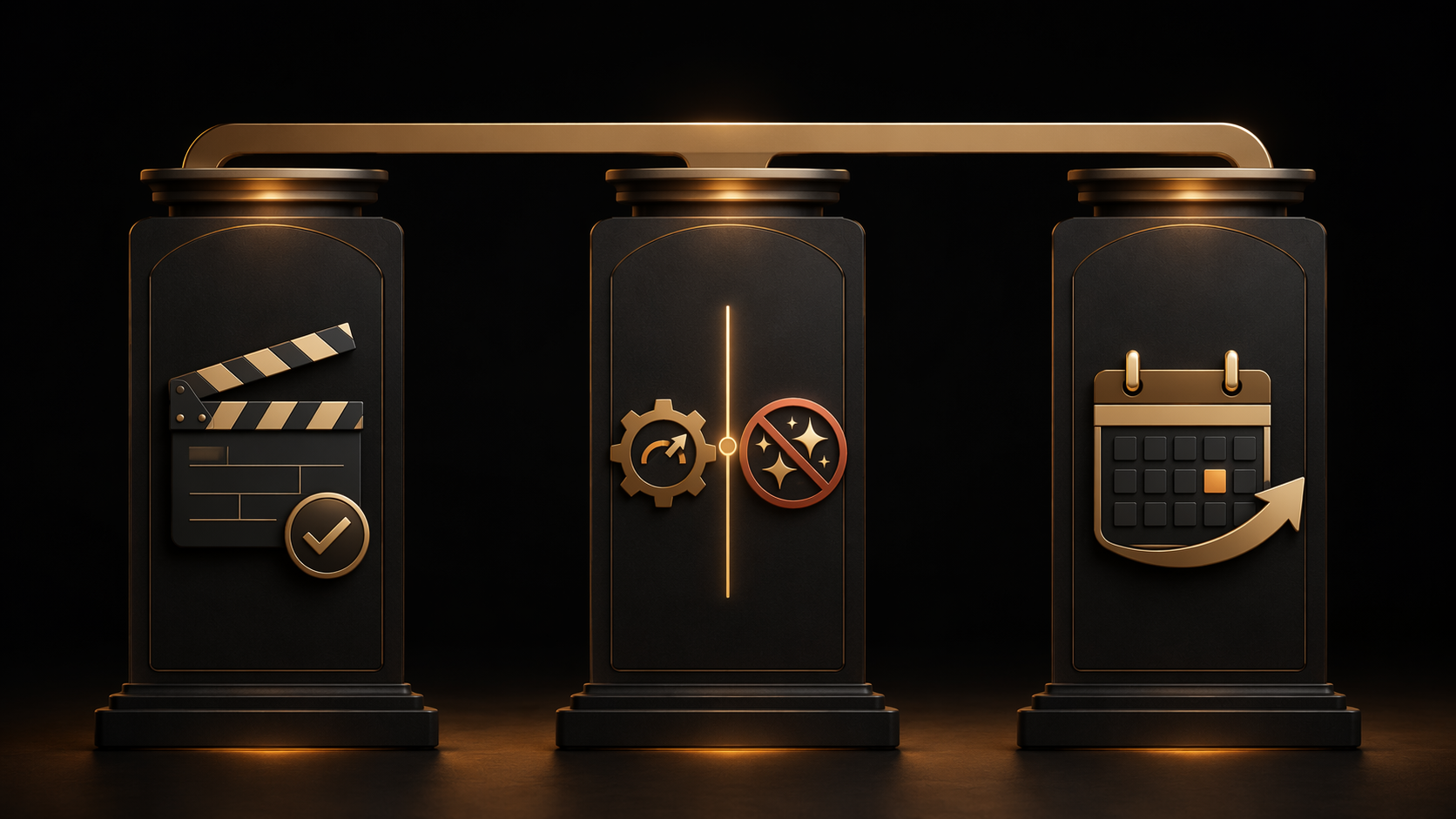
| AI narrative choice | Why it changed the risk profile |
|---|---|
| Practitioner credibility | Affleck made the deal easier to read as filmmaker-led rather than platform-imposed. |
| Production optimization | The stated use cases stayed close to workflow improvements instead of synthetic performers or generative IP. |
| Corporate timing | The announcement redirected attention from Netflix’s exit from the WBD bidding war toward a more focused technology story. |
The contrast cases show why that map mattered. Disney’s OpenAI character licensing deal placed Marvel, Star Wars, and Pixar characters near the center of the AI conversation, making the debate inseparable from beloved IP and ownership. Particle6’s AI actor controversy pushed directly into performer replacement anxiety. Amazon’s in-house AI build offered less of an external creative permission structure. Netflix’s route avoided all three exposed surfaces: beloved character licensing, AI performers as headline, and an entirely internal efficiency story.
The Price Made It Strategic, Not Experimental
The $587 million cash price, confirmed in Netflix’s SEC filing and reported by The Hollywood Reporter, matters because it puts the acquisition beyond the realm of a minor AI trial.[1] Netflix was not buying a small feature to tuck into a product roadmap. It was buying a capability it was prepared to explain to investors, creators, labor groups, and competitors.
That scale also raises the standard for the narrative. A small pilot can hide inside innovation theater. A half-billion-dollar acquisition cannot. The more serious the investment, the less tolerance stakeholders have for vague promises about transformation. They want to know what changes, who is affected, and who remains in control.
Fortune framed the deal as part of a broader AI talent acquisition story, which is useful but incomplete for marketers.[5] Talent mattered. Technology mattered. But in a labor-sensitive industry, a company also has to acquire the right to be believed. InterPositive gave Netflix a way to make an AI capability look culturally admissible before it had to defend every operational implication.
The Timing Helped Repair The Corporate Story
The acquisition also arrived at a convenient narrative moment. Forbes reported that Netflix bought Affleck’s AI company shortly after stepping away from the Warner Bros. Discovery bidding process.[6] That timing made the deal more than a technology announcement. It gave Netflix a cleaner answer to a strategic question: if the company was not buying the old studio machine, what was it buying instead?
The answer was smaller than a studio and easier to defend: a filmmaker-associated AI company aimed at production improvement. After exiting a high-profile studio pursuit, Netflix could have looked like it had lost access to legacy scale. InterPositive let the company point toward a different kind of leverage: better tools for making and finishing content.
This is not a claim that the announcement was only a distraction. The acquisition had its own strategic logic. But timing changes how a market hears a message. In this case, Netflix’s story shifted from “no WBD” to “different path forward” before the weaker frame had much room to settle.
Early Proof, Carefully Sized
Netflix did have operational evidence to point to, but it should not be inflated into a universal ROI claim. On the company’s Q2 2026 earnings discussion, Ted Sarandos said roughly 300 Netflix titles had used GenAI in some form. That figure signals broad experimentation across the pipeline, not proof that InterPositive alone drove the work.
The more concrete example was “The American Experiment,” where a 17-minute AI-enhanced segment was produced “twice as fast and at half the cost.” That is meaningful because it ties AI to a specific production result. It is also narrow: one segment, in one docuseries, under conditions that may not repeat across genres, teams, unions, budgets, or creative expectations.
Sarandos’s older framing helps explain why Netflix could discuss those gains without sounding as if cheapness was the whole point. His 2024 line was that “there’s a better business and a bigger business in making content 10% better than it is making it 50% cheaper.” That philosophy is not a guarantee of labor comfort, but it gives the company a more durable way to discuss efficiency: savings are acceptable when they serve better work, not when they become the brand’s visible obsession.
For teams building the internal business case, this is where Where AI Marketing ROI Actually Pays Off (and Two Places It Doesn't) becomes relevant. The Netflix example is not an invitation to claim every AI deployment will cut costs in half. It is a reminder that credible ROI stories are attached to use cases, not to the category label “AI.”
What Marketers Can Actually Borrow
The lesson is not “hire a celebrity founder.” It is that AI adoption needs a permission structure before it needs a victory lap.
- Put a credible practitioner near the front of the story, especially someone trusted by the people whose work will change.
- Name the bounded use case early, in operational language, so stakeholders can see what the tool does and does not touch.
- Avoid making replacement the headline, even indirectly, unless replacement is truly the strategy and the company is prepared to defend it.
- Time the announcement with the broader corporate narrative in mind, because AI news rarely lands in isolation.
- Use early proof precisely. A useful case can build confidence; an overgeneralized benchmark can destroy it.
The part many brands will want to copy is the language: empower, human-centered, filmmaker-led, optimization. The part they need to copy is the discipline behind the language. If the actual deployment reaches into synthetic talent, customer deception, creative authorship, or labor displacement, a softer announcement will not hold up in a hostile stakeholder meeting.
Netflix bought itself a better starting position than many peers. It did not buy immunity. InterPositive integration was still described as early days, AI terms remained active terrain for SAG-AFTRA and WGA negotiations, and Affleck’s advisory role gave the deal credibility without making him the operational owner. The acquisition worked, at least at this point in time, because Netflix made a large AI bet feel bounded, practitioner-endorsed, and strategically timed before opponents could define it for them.
References
- Netflix Price for Ben Affleck AI Company Revealed, The Hollywood Reporter, https://www.hollywoodreporter.com/business/business-news/netflix-price-ben-affleck-ai-company-revealed-1236651217/
- Why InterPositive Is Joining Netflix, Netflix, https://about.netflix.com/news/why-interpositive-is-joining-netflix
- Netflix Acquires Ben Affleck AI Filmmaking Startup InterPositive, Variety, https://variety.com/2026/film/news/netflix-acquires-ben-affleck-ai-filmmaking-startup-interpositive-1236679498/
- Netflix-InterPositive AI Deal Favors Optimization Over Automation, eMarketer, https://www.emarketer.com/content/netflix-interpositive-ai-deal-favors-optimization-over-automation
- What Netflix’s Acquisition of Ben Affleck’s AI Filmmaking Company Really Shows, Fortune, https://fortune.com/2026/03/06/what-netflixs-acquisition-of-ben-afflecks-ai-filmmaking-company-really-shows/
- Netflix Buys Ben Affleck’s AI Company Shortly After Ditching Warner Bros. Acquisition, Forbes, https://www.forbes.com/sites/conormurray/2026/03/05/netflix-buys-ben-afflecks-ai-company-shortly-after-ditching-warner-bros-acquisition/

Comments
Join the discussion with an anonymous comment.