
ESPN
A sourced case study on ESPN's Monsters Funday Football alt-cast, showing how IP cross-pollination across linear, streaming, and social platforms drove 563K viewers and a 20% increase in under-18 audience for Monday Night Football.
Outcome
Monsters Funday Football alt-cast attracted 563,000 combined averaged viewers across eight platforms — source: ESPN Press Room, 2025
This outcome is independently verified via the primary source linked above.
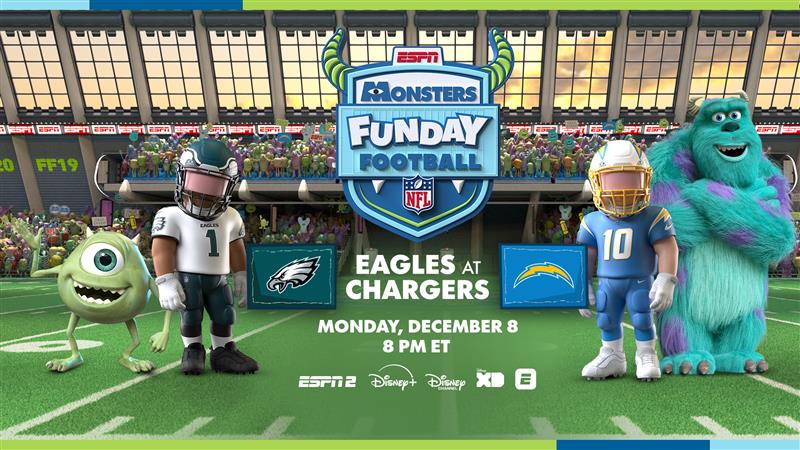
The useful number in ESPN's Monsters Inc. NFL altcast marketing case is not the size of Monday Night Football's main audience. It is the 563,000 viewers who watched Monsters Funday Football as an averaged presentation across platforms, a small figure beside the flagship broadcast but a real audience for a parallel product built from rights Disney already controlled, characters Disney already owned, and ad inventory Disney could sell separately.[1]
That matters because the business shape was unusually clear. ESPN's 2025 Monday Night Football regular season was the second-most-watched in the network's 20-year MNF history, while viewers ages 2-17 were up 20% year over year and viewers ages 18-24 were up 17% for the season.[2] Those demographic gains should not be credited to one Monsters Inc. telecast. They describe the full MNF season. But they do explain why an alternate presentation aimed at younger and family co-viewing audiences had strategic value inside the larger football package.
The stronger signal came from the sell side. Colgate and Volkswagen bought dedicated Monsters Funday Football sponsorships through Disney Ad Sales, separate from the main MNF broadcast inventory.[3] That is the difference between a themed stunt and a monetizable content layer. The main game remained the main game; the alt-cast became its own package.
What ESPN Actually Put On The Air
Monsters Funday Football was a real-time animated alternate presentation of an NFL game, not a highlight package with Pixar wrappers. The game action was translated into the Monsters, Inc. world while the conventional Monday Night Football broadcast continued to serve the core audience. For a marketing team, that distinction is important: ESPN was not asking existing football viewers to trade down into a children's product. It was building a second doorway into the same live rights.
The 2025 version aired across a much broader footprint than a niche streaming experiment. Disney said the presentation was available across eight platforms, including ESPN2, Disney Channel, Disney XD, Disney+, the ESPN App, and NFL+, and reached more than 155 international markets.[4] It was also the first animated NFL alt-cast to air on linear television, according to Disney's announcement.[4]
That distribution mix is doing a lot of work. ESPN2 gives the format sports-network legitimacy. Disney Channel and Disney XD put it where family and younger audiences are more plausible. Disney+ and the ESPN App make it available to streaming households that may not be sitting inside the traditional cable habit. NFL+ keeps it connected to the league's own direct-to-consumer environment. International distribution turns a domestic creative experiment into a global rights-extension asset.
| Business layer | What Monsters Funday Football added |
|---|---|
| Audience development | A youth- and family-facing presentation adjacent to the main MNF broadcast |
| Distribution | Linear, streaming, app, league, and international access points |
| Advertising | Dedicated sponsorship inventory sold separately from the main broadcast |
| IP strategy | A familiar Pixar world used to make the alternate format legible before kickoff |
| Measurement | A reported 563,000 combined averaged viewers across platforms |
Why Monsters, Inc. Was More Than A Cute Skin
The easy version of this case is that beloved characters make sports more accessible. That is not wrong, but it is too soft to be useful in a budget meeting. Monsters, Inc. worked because it gave ESPN a world that could absorb football without requiring the actual NFL product to become childish. A stadium full of monsters, doors, noise, motion, and elastic character design fits live animation better than a quieter story universe would.
The IP choice was not a last-minute overlay. The Hollywood Reporter reported that selecting Monsters, Inc. was an eight-month decision process and that the franchise had been on ESPN's wish list for "a couple of years."[5] That timeline is a useful guardrail. Strong IP does not automatically solve distribution, production, or sponsorship strategy. It gives those teams a shared creative territory that can survive the operational demands of a live event.
It also gave advertisers a cleaner environment to buy. A toothpaste brand and an auto brand are not buying the same emotional proposition, but both can understand the family-safe surface area of Monsters, Inc. better than they can underwrite an abstract "animated football innovation." The IP made the inventory easier to describe without making the audience claim broader than the data supports.
The Franchise Had To Earn Its Way To Linear TV
Monsters Funday Football looks less like a one-off if it is placed behind Toy Story Funday Football. The 2023 Toy Story presentation was the biggest live event on Disney+ by peak concurrency and won three Sports Emmys.[6] That did not prove every Pixar-football hybrid would work. It did prove that Disney, ESPN, Pixar, and their technology partners could turn a live game into a coherent animated event without embarrassing the core sports product.

The recognition also mattered commercially. Sports Video Group reported that the live animation effort around Toy Story helped establish ESPN's latest animation work as a serious production capability, not just a novelty feed.[6] The franchise later earned the 2024 George Wensel Technical Achievement Sports Emmy, another credibility marker for a format that asks sponsors and distributors to trust a complicated live pipeline.[5]
That maturity arc is the quiet center of the case. First, Disney and ESPN proved that a fully animated NFL presentation could draw major Disney+ live-event engagement. Then they earned industry validation for the technical execution. By 2025, they had enough confidence to move the concept across linear networks, streaming products, apps, league channels, social extensions, and international markets while selling dedicated advertiser packages.
Distribution Was The Growth Mechanism
For marketers, the most portable part of the Monsters Funday Football model is not the animation. It is the sequencing of access points. The same live rights event was reframed for several audience contexts at once: sports viewers who might sample ESPN2, children and families encountering the game through Disney networks, streaming households entering through Disney+, mobile users on the ESPN App, NFL fans inside NFL+, and international viewers in markets where the Disney and ESPN brands can travel differently.[4]
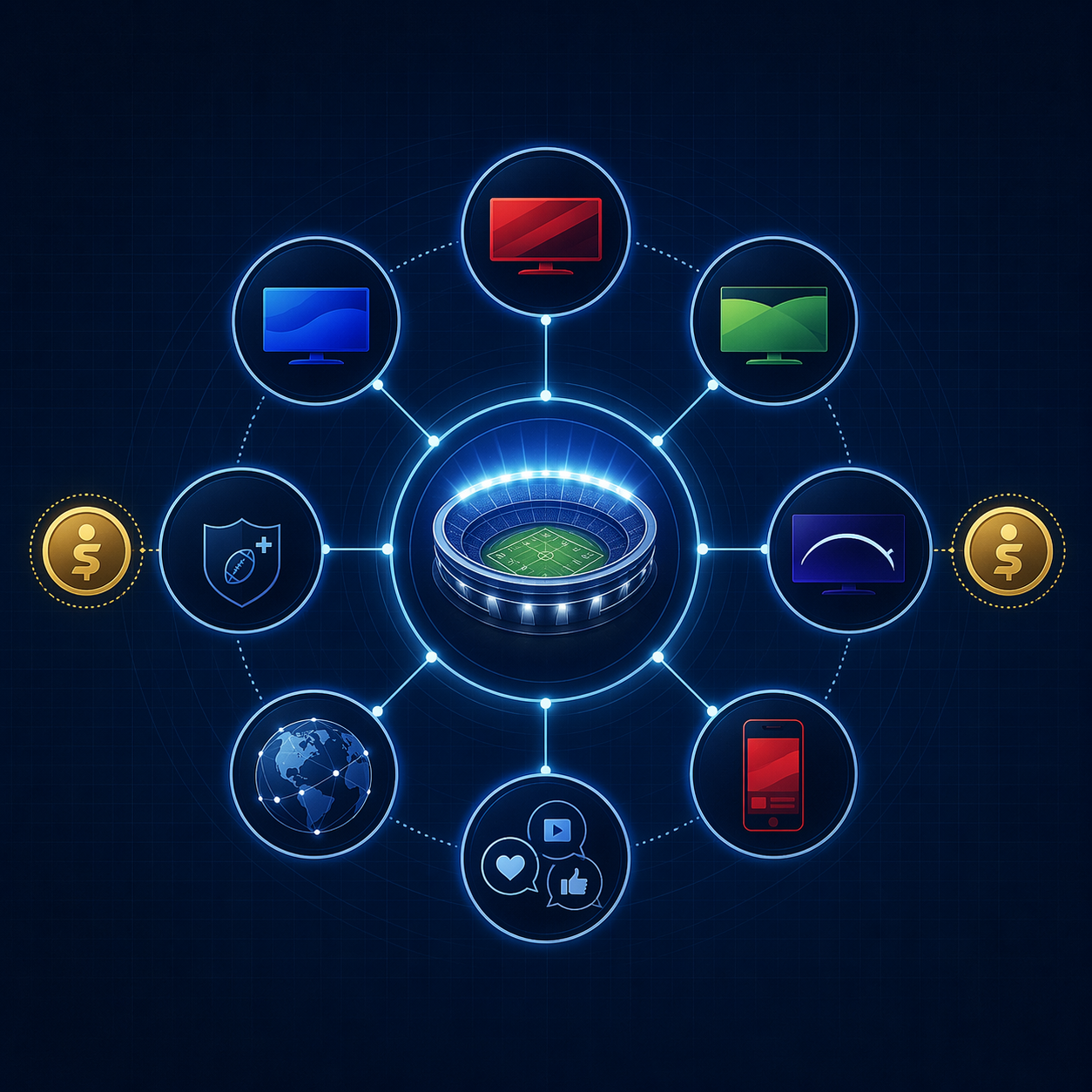
The reported 563,000 viewers should be read in that context. It is a combined averaged presentation number across platforms, not proof that any one platform individually delivered scale.[1] Without a platform-by-platform breakout, no one outside ESPN can say whether Disney Channel, Disney+, ESPN2, or another access point carried the load. The honest read is narrower: the total package created a measurable audience around an alternate presentation that would not exist inside the standard MNF telecast alone.
That is still valuable. Incremental audience products often fail because they are distributed like side projects. Monsters Funday Football was distributed like an asset that several parts of Disney could use at once. The footprint made the alt-cast easier to promote, easier to sample, and easier to package for sponsors who wanted family-safe reach without buying only the main broadcast.
Separate Sponsorships Changed The Revenue Logic
The Colgate and Volkswagen deals are more revealing than a generic statement about brand engagement. Sports Business Journal reported that the Monsters Inc. alt-cast would have unique advertisers, with Colgate and Volkswagen buying dedicated sponsorships through Disney Ad Sales, separate from the main MNF broadcast.[3] That means the format created inventory with its own commercial identity.
Separate inventory matters because it lets the publisher price the alternate experience according to its own audience promise. The main broadcast can continue to sell reach, live sports urgency, and adult football scale. The Monsters version can sell a different mix: family co-viewing, younger audience development, brand safety, Disney IP adjacency, and social-friendly creative moments. Those are related products, but they are not the same product.
The full advertiser roster was not disclosed, so the evidence should stop with the named buyers. Still, the fact that two brands bought dedicated alt-cast sponsorships is enough to show that Disney Ad Sales had something more concrete than a sponsorship slide saying "Pixar plus NFL." It had a defined media environment, a distribution plan, and a differentiated audience proposition.
That fits a broader advertising diversification backdrop. Sports Business Journal reported that Disney upfront ad revenue grew 5% in 2025 and that ESPN ad revenue climbed 8% in one quarter.[3] Monsters Funday Football should not be treated as the cause of those companywide ad trends. It is better understood as one example of the kind of sellable format Disney can build when sports rights, entertainment IP, and ad packaging are planned together.
The Production Stack Was A Credibility Signal, Not The Takeaway
The production details are impressive, but they are easy to overuse. ESPN's live animation efforts involved 30 minutes of new Pixar animation, roughly 5,000 animated monsters, a dedicated sound design room, and 29-point body tracking across NFL venues, according to production reporting on the effort.[6] Those details explain why the campaign could be sold and distributed confidently. They do not create a realistic template for most brands.
A less disciplined reading would turn this into a checklist: find famous IP, animate a live event, sell new ads. That skips the expensive middle. ESPN had live sports rights, Disney had Pixar IP, the organizations had distribution across linear and streaming, and the production teams had already tested the technical system through earlier animated alt-casts. Most brands do not have that stack.
The more adaptable lesson is structural. A brand with licensed content, a live or recurring flagship product, and multiple distribution surfaces can ask whether a secondary presentation can be built for a different audience without weakening the primary product. The answer might be a companion stream, an educational version, a creator-led simulcast, a localized feed, or a sponsor-backed experience. It does not have to be a real-time animated football game.
What The Case Proves, And What It Does Not
Monsters Funday Football proves that an alternate broadcast can become measurable enough to evaluate as a business product. It produced a reported 563,000 combined averaged viewers, extended the NFL event across Disney's platform map, and attracted named sponsors into separate inventory.[1][3][4] Those are concrete outcomes.
It does not prove that Monsters, Inc. alone drove ESPN's younger-audience growth for the season. The 20% lift among viewers ages 2-17 and 17% lift among viewers ages 18-24 apply to the 2025 Monday Night Football season overall.[2] The alt-cast belongs inside that audience-development strategy, but the available data does not isolate its causal effect.
It also does not prove that alternate broadcasts should chase the same scale as the flagship telecast. A secondary presentation can be commercially useful precisely because it is different: different audience composition, different creative rules, different sponsor fit, different distribution touchpoints. If it had to beat the main feed, it would be judged by the wrong job.
The case is useful because the ambition stayed bounded. Monsters Funday Football did not try to replace Monday Night Football. It made the existing rights package work harder by adding a youth-facing, brand-safe, separately monetized layer across linear, streaming, social, and international distribution. For marketers looking at licensed IP, that is the part worth taking seriously: not the monster fur, not the novelty of animated linemen, but the commercial discipline underneath the fun.
References
- Monday Night Football Week 14: Monsters Funday Football on ESPN2, Disney and More, ESPN Press Room, December 2025
- ESPN's Monday Night Football Records Second-Most-Watched Regular Season, ESPN Press Room, January 2026
- MNF alt-cast around Monsters Inc. will see broader distribution, unique advertisers, Sports Business Journal, December 8, 2025
- Monsters Funday Football, The Walt Disney Company
- Monsters Inc. Funday Football Glitches Billy Crystal Voice, The Hollywood Reporter
- Monsters Funday Football: ESPN's Latest Live Animation Effort, Sports Video Group, December 8, 2025


Comments
Join the discussion with an anonymous comment.