
McDonald's
McDonald's limited-time menu marketing has driven over 30% systemwide sales growth since 2019. This case study breaks down the three strategic principles behind the 'share the pen' philosophy and shows how marketers can build their own repeatable LTO program with verifiable outcomes.
Outcome
Generated approximately $50 million in incremental revenue during the four-week Travis Scott Meal campaign — source: Ad Age
This outcome is independently verified via the primary source linked above.
McDonald's limited time menu marketing looks, from a distance, like a run of celebrity drops: Travis Scott, BTS, J Balvin, Saweetie, Grimace, Angel Reese, Shania Twain. That surface read is not wrong. It is just incomplete. The more useful case is that McDonald's turned limited-time offers into a repeatable revenue system: culture supplies the heat, the core menu supplies the operational stability, and the app and loyalty program capture demand that would otherwise disappear when the promotion ends.
The $10 billion number attached to the Travis Scott Meal is the loudest proof point, and it should be handled carefully. McDonald's market capitalization rose by approximately $10 billion during the campaign period, but that is a directional, correlational signal rather than a clean causal claim. The firmer evidence sits closer to the restaurant: the Travis Scott Meal generated about $50 million in incremental revenue over four weeks, Quarter Pounder sales doubled in the first week, and app installs rose 11% during the campaign period.[1][2]
That is where the McDonald's case becomes more interesting for marketers. The company did not discover that famous people can sell food. Everyone already knew that. It built an offer architecture that lets famous people, creators, and fans add meaning while the restaurants keep making food they already know how to make.
The Offer Was Famous, but the System Was Ordinary on Purpose
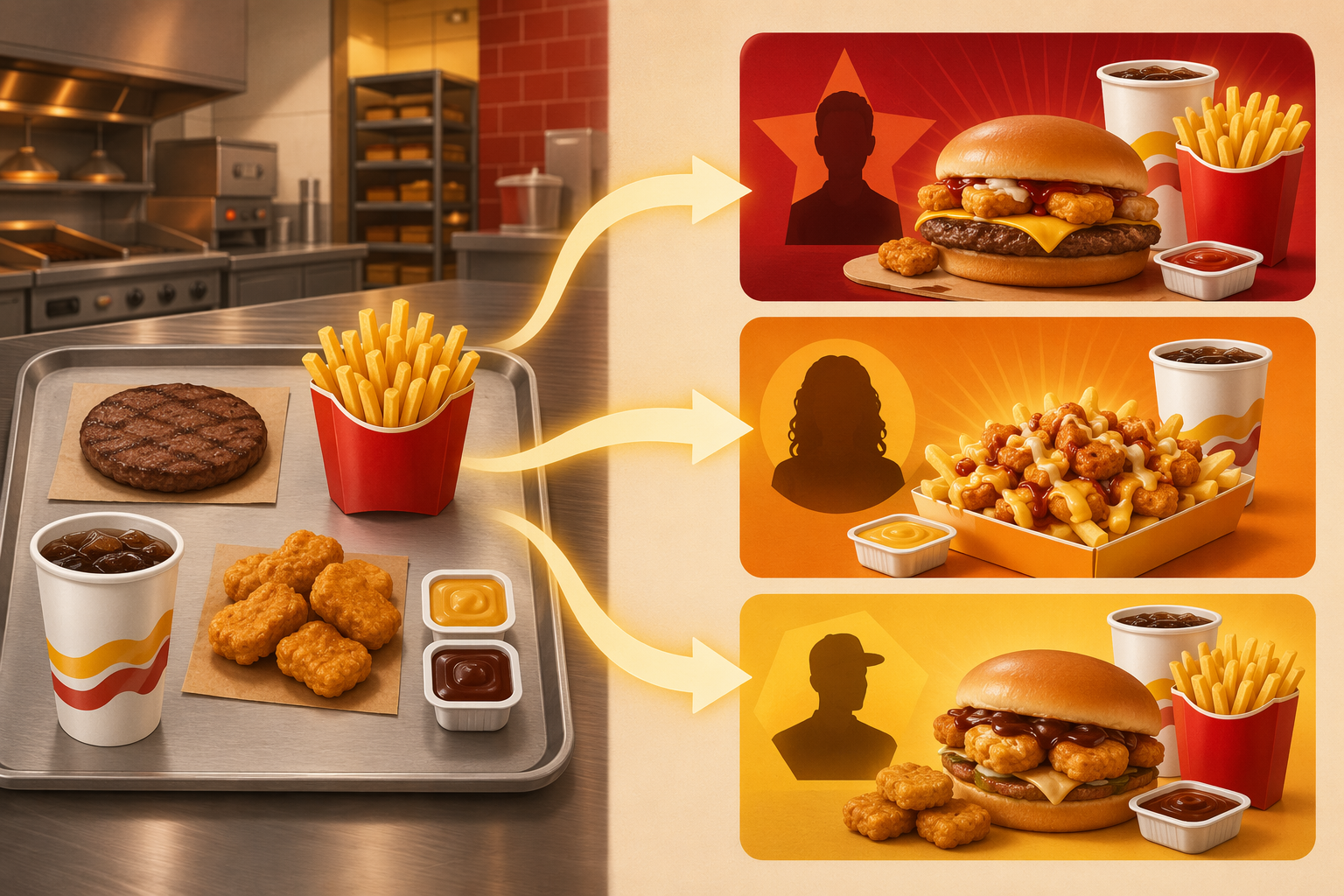
The Travis Scott Meal was not a culinary invention. It was a Quarter Pounder with cheese, bacon, and lettuce, medium fries with BBQ sauce, and a Sprite. The operational story is almost stubbornly plain: no unfamiliar equipment, no fragile ingredient pipeline, no training burden that would make franchisees pay for a marketing department's imagination.
That plainness is what made the cultural layer portable. Fans were not responding to a new burger in the abstract. They were responding to the idea that a global celebrity's personal McDonald's order had become available as a named meal. The product was familiar enough to execute at scale and culturally specific enough to feel like participation.
The campaign also solved a familiar LTO problem. Many limited-time offers create attention by adding complexity: a new flavor, new packaging, a new preparation, a new operational exception. McDonald's moved the novelty away from the kitchen and into the meaning system around the order. For a franchise network, that distinction matters. A restaurant can absorb a rush more easily when the order is built from known items, even if the demand spike is anything but normal.
| Campaign layer | What changed | What stayed stable |
|---|---|---|
| Customer meaning | A celebrity or fandom gave the order cultural context | The meal remained easy to understand |
| Restaurant execution | Demand increased around a named bundle | Core ingredients and preparation routines remained familiar |
| Data capture | Campaign interest pushed users toward app behavior | The brand kept the transaction inside owned channels where possible |
What “Share the Pen” Actually Changes
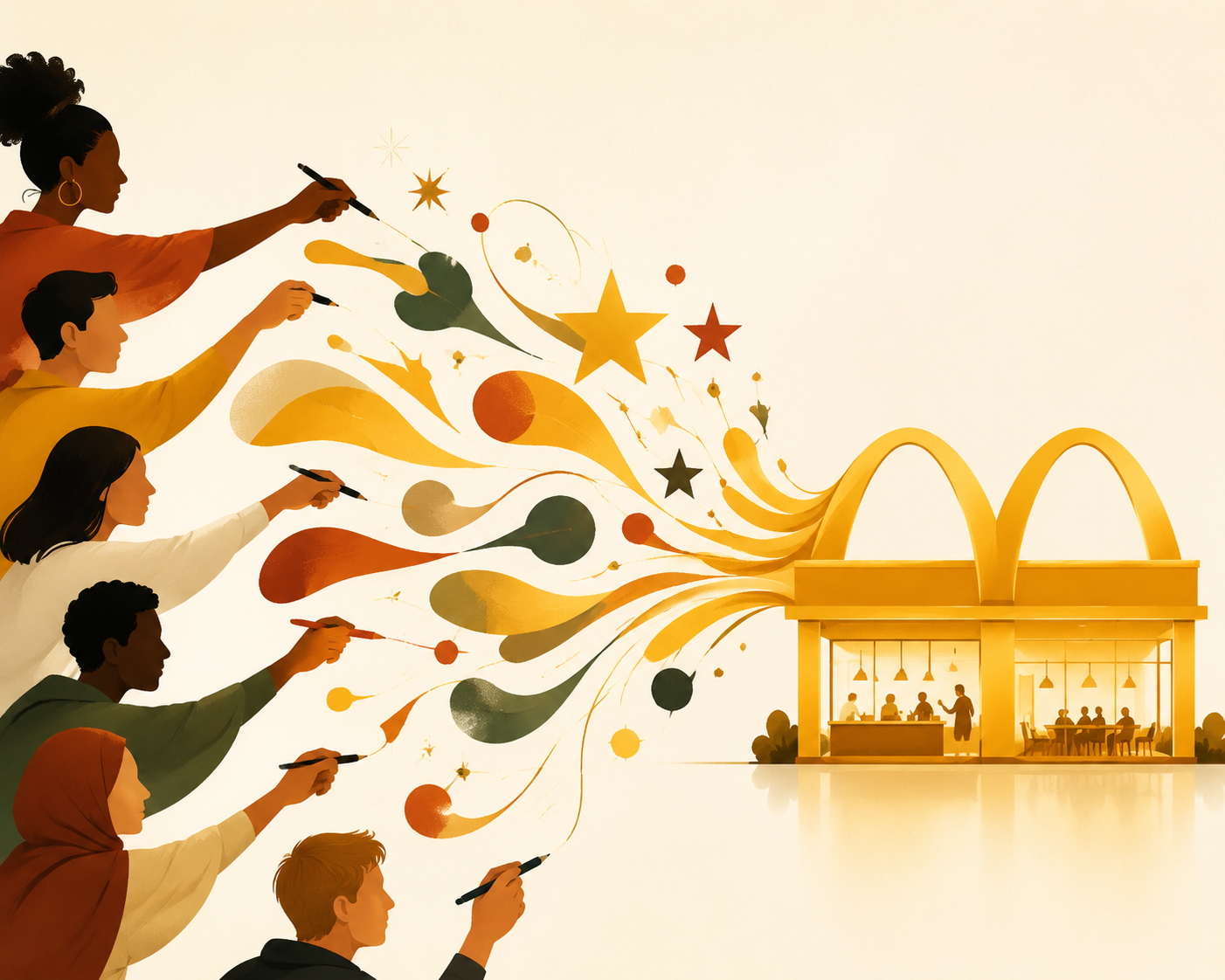
Tariq Hassan, McDonald's U.S. chief marketing and customer experience officer, has described the company's approach as a “share the pen” philosophy. In the Famous Orders context, the framework has been described through three guidelines: fan truth, listening, and bravery.[3] Those words can sound soft until they are tied to campaign decisions.
Fan truth is the discipline of starting with what fans already do, not what the brand wishes they would do. The Famous Orders platform came from a simple cultural observation: people already talk about what celebrities eat, and many people already have a personal McDonald's order. The brand did not need to invent an elaborate fictional universe. It needed to recognize a behavior that was already legible.
Listening is the harder part inside a large company. It means knowing when the brand should stop producing more branded content and start amplifying the language, jokes, edits, and rituals that fans are already generating. In a conventional approval culture, this is uncomfortable because the best-performing expression may not look like the safest deck. McDonald's advantage was not that it abandoned control. It chose where control mattered: menu architecture, offer terms, channels, and operational execution.
Bravery, in this case, is not corporate recklessness. It is the willingness to let someone outside the brand supply the cultural authorship while the company protects the system underneath it. The celebrity does not need to redesign the restaurant. The fan does not need to understand the CRM objective. Their job is to make the offer matter. McDonald's job is to make that attention transact, register, repeat, and scale.
Travis Scott Proved Demand Could Move Through the Funnel
The Travis Scott Meal is still the cleanest opening case because it connected cultural attention to multiple business signals at once. It did not only generate press. It moved a core product. It produced incremental revenue. It increased app installs. It created scarcity and social circulation without requiring McDonald's to behave like a fashion brand operationally.[1][2]
The Quarter Pounder lift is especially important. A celebrity campaign that sells only the celebrity's aura is hard to repeat; a campaign that lifts an existing core item gives the business something more durable to work with. When Quarter Pounder sales doubled in the first week, the campaign was not merely borrowing attention from a fan base. It was pushing that attention into a product line the system could continue to support after the campaign window closed.[1]
The app install increase matters for the same reason. Limited-time demand is often wasted because it arrives as a temporary crowd. McDonald's had a stronger outcome available: if the promotion encouraged app registration or app usage, the company could turn a campaign visit into a reachable customer. That does not guarantee loyalty, but it creates the conditions for measured follow-up rather than hoping the customer remembers the brand next week.
BTS Tested Whether the Platform Could Travel
A single U.S. celebrity hit can be dismissed as timing. BTS made that harder. The BTS Meal launched in 49 countries, and McDonald's reported U.S. same-store sales growth of 25.9% in Q2 2021, with net sales up 57% to $5.89 billion. Restaurant visits rose 12% in the first seven days of the BTS Meal, according to reported campaign analysis.[4]
The BTS campaign also revealed why the Famous Orders idea was more scalable than a typical celebrity endorsement. BTS did not need a radically different food product to make the offer feel distinctive. The meal's cultural value came from the connection between the fandom, the members' association with the order, packaging and sauce cues, social sharing, and the sense of participating in a global moment.
For operators, that is the difference between a campaign that sounds exciting in a boardroom and one that survives a lunch rush. International scale punishes unnecessary complexity. If the offer has to work across markets, the system needs room for local execution and fan expression without turning every restaurant into a test kitchen.
The CRM Data Shows the Platform Was Built to Capture Demand
The most useful evidence for marketers is not the celebrity list. It is the customer movement behind the campaigns. Epsilon's case study of the Famous Orders campaign reported a 49% increase in new customers, a 39% increase in guest counts, 3 billion traditional media impressions, and 23 billion social impressions. It also reported that McDonald's achieved its app registration goal in a record three days.[5]
Those are different types of outcomes, and they should not be blurred together. Impressions show reach. Guest counts show traffic. New customers suggest the campaign expanded the buyer base. App registration creates a first-party relationship the brand can use later. The platform's strength is that it could touch all of those at once, not that any one metric tells the whole story.
This is where a lot of LTO programs underperform. They treat the offer as the campaign's end point: sell the item, count the sales, move on. McDonald's treated the offer as a conversion surface. A culturally charged meal could drive a store visit, a digital order, an app registration, a loyalty interaction, or a social post. Each of those actions has different value, but together they make the promotion more than a temporary sales bump.
Operational Simplicity Is the Hidden Creative Constraint
The Famous Orders platform works because the creative constraint is tight. McDonald's can invite cultural partners to shape the story, but the meal architecture stays close to existing operations. That is not a lack of ambition. It is the condition that lets ambition travel through more than 40,000 restaurants.
There is a useful lesson here for brands that envy McDonald's reach but cannot copy its scale. The adaptive move is not “find a celebrity.” It is to identify which parts of the offer can carry cultural novelty without damaging fulfillment. In some businesses, that may be naming, bundling, access, sequencing, creator participation, packaging, or community rituals. In others, the offer itself can change, but only if the supply chain and service model can absorb it.
A marketer can share creative control without surrendering the operating model. In fact, the McDonald's case suggests the opposite: the more participation a brand wants from fans and partners, the more disciplined the offer architecture needs to be. If every cultural idea creates a new operational exception, the system will eventually reject the marketing.
Cadence Turned the Idea Into a Platform
Repeatability does not mean every campaign is equally proven. Travis Scott and BTS carry the strongest public performance data. J Balvin and Saweetie matter more as continuity signals: they showed that Famous Orders was not a one-off stunt attached to one artist or one fan culture. Grimace's birthday campaign showed how owned brand characters could also become participatory internet material. Angel Reese and Shania Twain, as of mid-2026, are better understood as emerging examples of the same cadence than as fully documented sales cases.
Cadence is what changes the internal conversation. A single LTO is easy to attack as a stunt. A platform with repeated mechanics, known operational limits, measurable digital behaviors, and a rotating cast of cultural partners is easier to manage, forecast, and defend. The marketing team can brief against a system instead of reinventing the rationale every time.
McDonald's broader results give that system more context. The company has grown systemwide sales by more than 30% since 2019, and in Q1 2026 reported global comparable sales up 3.8%, systemwide sales up 11% to more than $34 billion, and loyalty sales of more than $9 billion for the quarter.[6] Those numbers are not attributable to celebrity meals alone. They do show that limited-time menu marketing is operating inside a larger commercial machine where loyalty, digital ordering, pricing, traffic, and brand activity reinforce one another.
What Marketers Can Adapt Without Pretending to Be McDonald's
The wrong takeaway is that every brand needs a celebrity meal. Most do not have the media gravity, franchise footprint, or fandom access to make that move efficient. The transferable lesson is more practical: build a limited-time offer system where cultural relevance, operational feasibility, and customer capture are designed together before the campaign goes live.
- Start with a real customer behavior, not a campaign theme. McDonald's had personal orders and fan curiosity to work with before it had a Famous Orders platform.
- Decide what outsiders can shape. Partners and fans can influence naming, storytelling, rituals, bundles, and media expression without changing the parts of the business that must remain stable.
- Keep the operational burden visible. If the offer requires new training, new inventory, or slower service, the campaign has to earn that cost before launch.
- Define the capture mechanism. A traffic spike is weaker than a traffic spike that also produces app registrations, email signups, loyalty enrollment, repeat purchase data, or known customer behavior.
- Measure different outcomes separately. Reach, sales, guest counts, new customers, and app registrations do not prove the same thing.
A smaller brand can run this logic without celebrity scale. A regional restaurant group might build a limited-time bundle around a local creator's actual order, keep the ingredients inside the existing prep system, require app redemption, and measure new customer rate against a normal promotion period. A software company might use a limited-time onboarding package shaped by power users, but keep delivery inside existing support capacity. The principle is not the meal. The principle is controlled participation.
The Discipline Behind the $10B Story
McDonald's did not build a $10 billion engine because limited-time menu items are inherently magical. The market cap movement around Travis Scott was a signal, not a laboratory result. The stronger case is visible in the mechanics that kept repeating: existing menu items became culturally charged bundles; fan participation created reach the brand could not fully script; app and loyalty systems captured demand; franchise restaurants could execute the offer without being asked to become something else.
That is why McDonald's limited time menu marketing deserves attention beyond the celebrity names. The company found a way to let culture write part of the campaign while operations held the line. For a brand of that size, that balance is not a creative footnote. It is the strategy.
References
- McDonald's soared with Travis Scott meal, Ad Age
- Travis Scott's Partnership With McDonald's Boosted Their Sales, Billboard
- McDonald's 'share the pen' philosophy has driven business results, Nation's Restaurant News
- CASE STUDY: Celebrity-Backed Limited Time Offerings Boost McDonald's Revenue, The Food Institute
- Igniting appetites and engagement with McDonald's star-studded, multichannel campaign, Epsilon
- McDonald's Reports First Quarter 2026 Results, McDonald's Corporation

Comments
Join the discussion with an anonymous comment.