

Magnum
See how Magnum combined AI, real-time weather data, and retail sales signals to drive a 30% sales lift in underperforming regions for National Ice Cream Day — and why blanket seasonal media buys fall short.
Outcome
30% incremental sales lift in prioritized geo-segments — source: The Trade Desk case study
AI Tools Used
This outcome is independently verified via the primary source linked above.
Most marketing campaigns for national ice cream day start from a safe assumption: when summer peaks, ice cream demand rises, so reach as many warm-weather consumers as the budget allows. That assumption is directionally useful and operationally blunt. It treats July demand as if every region, retailer, and store catchment were moving together.
Magnum’s Germany campaign is worth studying because it asked a better set of questions before buying media: where is the brand underperforming, what does the near-term weather suggest, and where can incremental spend realistically change demand? The headline result was a 30% incremental sales lift in prioritized geo-segments, alongside a 19% national sales lift at REWE, a 9% overall lift across Magnum Ice Cream Company brands in Germany, and 65% more efficient media spend compared with the previous non-optimized approach.[1]
The 30% figure should not be read as a national average or as proof that AI can manufacture impulse demand anywhere. It was tied to geo-segments that the campaign deliberately prioritized. That distinction matters because it is the difference between a useful operating model and a slide-friendly exaggeration.
The problem with buying summer as one market
Ice cream has broad appeal, which is exactly why seasonal planning can get lazy. A mass-reach campaign may still make sense for a premium bar with national distribution and strong creative assets. The waste appears when “summer” becomes the targeting logic by itself.
A warm week does not mean the same thing in every zip code. One area may already be selling through well, making additional impressions less likely to produce incremental volume. Another may have the weather conditions for impulse purchase but weaker product-level sales at a key retailer. A third may look promising in media engagement but not in retail response. If all three receive the same seasonal pressure, the plan is convenient for the media calendar, not necessarily for the business.
Magnum’s campaign, developed with The Trade Desk and REWE Germany, treated those differences as the starting point. The system divided Germany into 434 micro-regions and scored them weekly using a custom KPI that combined weather forecasts, REWE product-level sales data indexed by zip code, and media performance metrics.[1]
That is the important move. The campaign did not simply chase sunshine. It looked for places where the conditions, sales signal, and media signal together suggested that spend had a job to do.
How the demand system worked
The strongest part of the case is the operating loop. It is specific enough for a budget owner to interrogate, and practical enough to move beyond a generic “AI targeting” story.
| Input | What it contributed | Why it mattered |
|---|---|---|
| Real-time weather forecasts | A near-term read on conditions likely to affect ice cream demand | The campaign could react to local triggers instead of relying only on the calendar |
| REWE Germany product-level sales data indexed by zip code | A local view of where Magnum was stronger or weaker at retail | Spend could be aimed at underperforming areas rather than only at places with obvious category demand |
| Media performance metrics | A signal on how audiences and placements were responding | The weekly score could account for delivery and engagement, not just external demand |
| Machine-learning-refined KPI | A recurring score across 434 micro-regions | Budget could be reprioritized weekly instead of locked into a blanket seasonal plan |
The custom KPI was recalculated weekly, which is where the campaign becomes operationally interesting. A one-time segmentation exercise would have produced a smarter map, but still a static one. Weekly recalibration meant the campaign could keep asking whether the previous week’s assumptions still held: had the weather shifted, had retail sales moved, had media performance changed enough to alter the priority list?
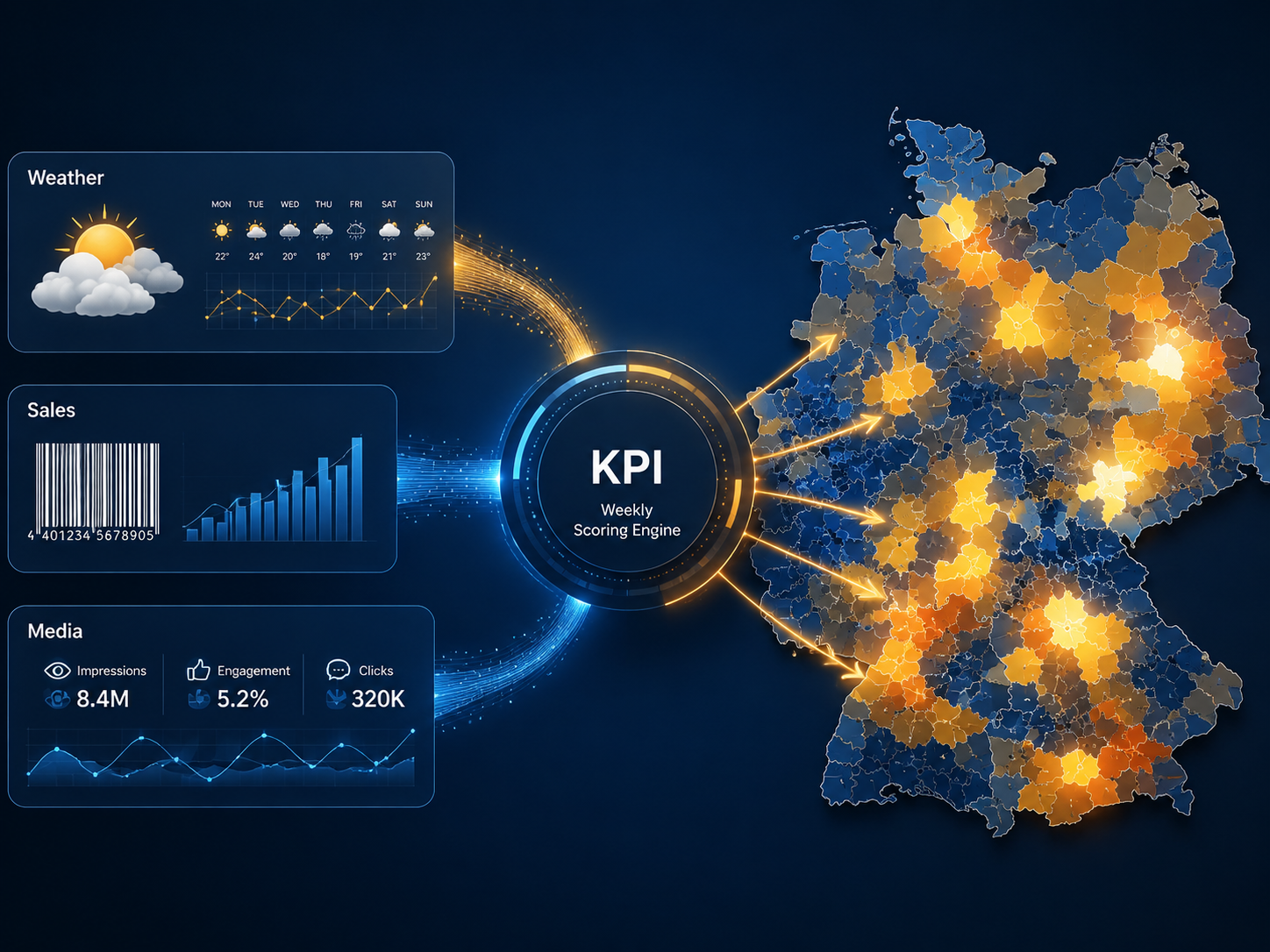
The Internationalist Awards write-up describes the KPI as a blend of weather, sales, and media data that was recalibrated every week, with the approach later used as a broader blueprint for precision retail media execution.[2] That is useful context, but it should be read as industry recognition rather than independent validation. The award write-up reinforces the mechanics; it does not remove the need to examine scope.
The Trade Desk case study says the algorithm directed 65% more investment into prioritized regions.[1] That detail matters because optimization is not only about finding an audience. It is about changing the allocation of money. If a model produces attractive insights but the media plan cannot shift spend quickly, the system remains mostly diagnostic.
What “underperforming” changes
The most common lazy version of this case would be: AI found people who wanted ice cream when it was hot. That misses the retail logic. A weather-only campaign would tend to reward obvious demand. Magnum’s model used weather as one input among others, then connected it to product-level sales signals from REWE Germany.
That changes the planning conversation. If an area is hot and already selling well, more media may still help, but the incremental case has to be proven. If another area has favorable weather and weaker retail sales, the question becomes whether awareness, reminder frequency, or offer-adjacent exposure can close the gap. The campaign’s prioritized regions were not just “good weather” regions; they were regions where the blended score suggested stronger business upside.
This is why the REWE relationship is central to the case. Product-level sales data indexed by zip code gave the campaign a demand signal closer to the shelf than standard demographic or interest targeting.[1] Without that retailer-level evidence, the model would have had a harder time distinguishing between broad category propensity and actual local sales weakness.
The results are strong, but they are not interchangeable
The campaign produced several outcome claims, and they should stay in their lanes. The 30% incremental sales lift refers to prioritized geo-segments. The 19% sales lift refers to national sales at REWE. The 9% overall lift refers to all Magnum Ice Cream Company brands in Germany. The 65% efficiency improvement compares the optimized approach with the previous non-optimized approach.[1]
| Claim | Scope | How to read it |
|---|---|---|
| +30% incremental sales | Prioritized geo-segments | The strongest proof point for the regional prioritization model |
| +19% sales | National sales at REWE | A retailer-specific national result, not the same as total-market Germany |
| +9% overall lift | All Magnum Ice Cream Company brands in Germany | A broader blended brand-family result |
| 65% more efficient media spend | Compared with the previous non-optimized approach | Evidence that allocation changed materially, not just targeting language |
Keeping those scopes separate does not weaken the case. It makes it more usable. A manager defending a shift away from blanket seasonal media needs to know exactly which number belongs in which argument. The 30% lift is the case for prioritizing underperforming regions. The REWE result is the case for linking media to retailer-level sales data. The efficiency result is the case for reallocating spend through a live operating loop instead of treating the plan as fixed once summer begins.
There are also limits. The available materials do not specify a full campaign timeline, so it would be too neat to present the result as a universal National Ice Cream Day playbook. The evidence comes from Germany, through a specific retailer partnership with REWE, and through a media platform that has a commercial stake in the case study.[1] No independent third-party verification was found in the provided research.
What seasonal marketers can actually take from it
The lesson is not that every ice cream brand should bolt AI onto National Ice Cream Day. The lesson is that seasonal demand should be treated as a measurable condition, not a mood. If the team can observe local demand, external triggers, and media response at a useful cadence, then the media plan can become more than a calendar-shaped spend curve.
For weather-dependent categories, that distinction is practical. Sunscreen, beverages, grilling products, allergy remedies, and frozen treats all have moments when the external environment changes consumer urgency. But the external trigger alone is not enough. Weather can tell a marketer where demand may rise; retail sales can show where the brand is capturing or missing that demand; media performance can show whether the current message and placement are earning enough response to justify more budget.
Magnum’s case also points to a different role for machine learning in retail media. The useful part was not a mysterious audience prediction. It was a recurring scoring system that helped decide where money should move next. That is a much easier idea to defend in a planning meeting: the model does not replace commercial judgment; it forces the team to update that judgment with fresher evidence.
- Can the team access localized sales data close enough to the retailer, product, and geography that media decisions can change?
- Is there an external trigger, such as weather, that plausibly affects near-term demand and can be observed in time to act?
- Can media spend be reallocated weekly or faster, rather than merely reported after the campaign ends?
- Is the KPI tied to a business outcome, not only to impressions, clicks, or reach?
- Will results be reported by the same scope used to optimize: region, retailer, brand family, or national total?
Those questions are less glamorous than “How are we using AI?” They are also harder to dodge. If a campaign cannot connect local demand signals, external triggers, media response, and measurement discipline, then AI becomes a label on top of the same old seasonal buy.
A credible case, not a universal promise
Magnum’s Germany campaign is a strong case for precision retail media under the right conditions. The brand had weather sensitivity, retailer-level product sales data, granular geography, weekly KPI recalibration, and a buying environment capable of shifting investment toward higher-priority regions. Put together, those conditions produced a materially better result than the previous non-optimized approach.[1]
That does not mean every seasonal campaign can claim a 30% lift by adding AI. It means blanket summer media deserves a tougher standard. Before replacing broad seasonal buys, ask whether the team can combine localized demand signals, external triggers, weekly KPI recalibration, and disciplined measurement. If those pieces are present, the campaign can stop treating summer as one big audience and start treating demand as something that varies by market, week, and retailer.
References
- How Magnum lifted sales by 30% in underperforming areas, The Trade Desk, https://www.thetradedesk.com/case-studies/magnum-drives-30-incremental-sales-retail-data
- Magnum's AI Strategy Drove 30% Sales Lift by Turning Data into Demand, Internationalist Awards, https://www.internationalist-awards.world/magnums-ai-strategy-drove-30-sales-lift-by-turning-data-into-demand/


Comments
Join the discussion with an anonymous comment.