

Gigi Hadid
This case study traces how Gigi Hadid's handbag choices generate consumer demand that dupe influencers capture through affiliate-driven comparison content, and explains why original brands miss out on attribution and brand equity in this pipeline.
Outcome
Over 15,000 influencers joined Pandabuy's affiliate program in 2023 — source: WIRED, 2023
This outcome is independently verified via the primary source linked above.
A photographed Gigi Hadid handbag look does not need a media plan to start behaving like one. Lifestyle coverage names the silhouette, social users save the image, shoppers search for the shape, and then a different set of creators steps in with the content that actually answers the buying question: which version can I get, how close does it look, and is it worth the money? That is the real pipeline behind Gigi Hadid handbag dupe reviews and influencer marketing: celebrity visibility at the top, comparison content in the middle, affiliate capture at the bottom.
Hadid’s documented handbag choices give the pipeline recognizable inputs rather than abstract “celebrity style.” E! News has covered top-handle bags framed around her look, and other lifestyle coverage has repeatedly turned her Coach, Ferragamo, and structured mini-bag moments into shoppable style cues.[1] The important point is not that one sighting can be cleanly tied to one dupe sale. The more defensible version is narrower: her public bag choices become legible aesthetic signals, and the market around them is ready to translate those signals into cheaper, searchable alternatives.
The Value Moves After the Photo
Celebrity style coverage is good at creating desire, but it is not always built to close the sale. A shopper may like the Hadid-coded bag, then immediately hit the usual friction: the original is expensive, sold out, hard to justify, or simply more commitment than the shopper wanted from a trend. That gap is where dupe creators operate.
The scale of the incentive layer is not small. In WIRED’s investigation into designer knockoffs promoted through social platforms, Pandabuy claimed that more than 15,000 influencers joined its affiliate program in 2023.[2] That reporting centers on replicas, not legal dupes, so it should not be lazily used as a proxy for the entire affordable-alternative market. Still, it shows that a large creator-affiliate apparatus exists to catch fashion demand the moment it becomes searchable and socially validated.
That is the part many brand-side recaps underplay. The celebrity image may start the demand, but the last persuasive asset before purchase is often not the original brand’s product page. It is a TikTok comparison, an Instagram Reel, a haul, a comment reply, or a link-in-bio storefront run by someone who understands the shopper’s hesitation better than the brand’s campaign deck does.
Why Dupe Reviews Convert
Dupe content works because it does not ask the shopper to admire taste from a distance. It performs evaluation. The creator holds the bag, opens it, checks the strap drop, compares the hardware, tests what fits inside, and says the quiet part out loud: this gives a similar effect without the original price.
That format lines up with what consumers say they value from influencers. Sprout Social reported in 2026 that 64% of consumers say genuine reviews are the most effective form of influencer content.[3] For a handbag dupe, “genuine review” does not mean neutral journalism. It means the shopper can watch someone translate a visual desire into a practical decision: how it looks on the body, whether it feels flimsy, whether the color reads expensive, whether the clasp is annoying, whether the cheaper version is close enough.
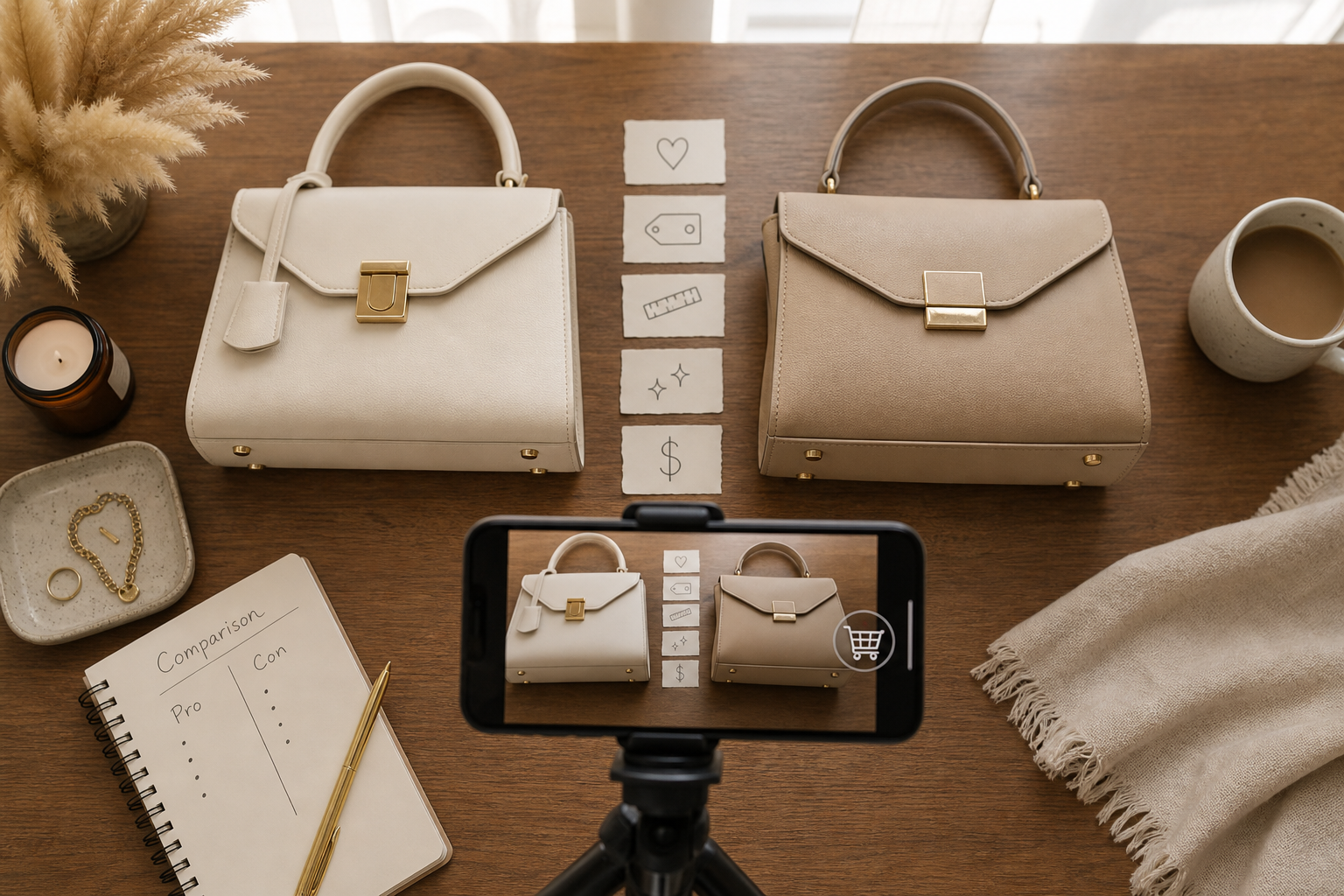
Academic work on counterfeit and luxury-adjacent promotion has also identified unboxing videos and haul promotions as formats that help influencers build trust through a performance of authenticity.[4] That performance matters commercially. A product grid can show price and color. A haul can make the buyer feel that someone has already taken the social risk for them.
The creator’s job is not only to say “this is cheaper.” It is to reduce decision anxiety. In a typical dupe review, the conversion work happens in small, cumulative checks:
- Visual proximity: Does the silhouette read like the reference style at a glance?
- Use case: Does it fit a phone, wallet, keys, and daily extras?
- Material expectation: Does it look acceptable on camera and in natural light?
- Social permission: Can the buyer wear the look without feeling like they made an embarrassing compromise?
- Purchase path: Is there a link available at the exact moment interest peaks?
That last step is where the economics change. The creator who answers the buyer’s objections also owns the click. If the link is affiliate-enabled, the creator and platform can monetize demand that the original brand helped create but did not capture.
Where Attribution Breaks
From a dashboard perspective, the original brand may see a halo it cannot fully explain. Search interest rises around a silhouette. Social mentions increase. Earned media circulates. But the purchase may happen through an Amazon storefront, a marketplace listing, a TikTok Shop product, or a third-party affiliate link attached to a review that never names the original brand in a way the brand can measure.
| Pipeline Moment | Who Creates Value | Who Often Captures It |
|---|---|---|
| Celebrity sighting | The celebrity, stylist, photographer, and lifestyle media create visibility | Media publishers and social platforms capture attention |
| Consumer search | The original brand or silhouette supplies the reference point | Search platforms and marketplaces capture intent |
| Dupe comparison | The creator reduces uncertainty with review, haul, and side-by-side content | The creator captures trust and often the affiliate click |
| Purchase | The consumer buys the accessible alternative | The marketplace, affiliate network, seller, and creator capture revenue |
This is why “free exposure” can be a lazy comfort metric. Exposure is useful only if the brand has a path to turn it into owned demand, retail sell-through, first-party audience growth, or at least durable brand preference. If the most useful content in the journey is produced by someone selling a cheaper alternative, the original brand is subsidizing the reference point while someone else monetizes the resolution.
The mechanics are especially uncomfortable for luxury and premium accessories because the dupe review often borrows the equity of the original while arguing against the original purchase. The creator does not need to prove that the affordable bag is better in any absolute sense. The creator only needs to prove that it is close enough for the buyer’s intended social setting.
Dupes and Replicas Are Not the Same Strategy Problem
A legal dupe and a trademark-infringing replica should not be collapsed into one category. A dupe imitates a general look, trend, proportion, color story, or styling effect while using its own branding. A replica attempts to pass as the original or uses protected marks. The shopper may use the same casual language for both, but a brand cannot respond to them the same way.
WIRED’s Pandabuy reporting is useful because it exposes how organized replica promotion can become, but it is not clean evidence that all dupe creators are promoting illegal goods.[2] That distinction matters for marketers. A legal lookalike may call for assortment strategy, accessible line architecture, creator seeding, or stronger comparison content from the brand itself. A replica may require trademark enforcement, platform escalation, and tighter monitoring of affiliate-driven promotion.
The reputational risk also differs. With legal dupes, the danger is dilution: the original look becomes a generalized market shape, and the brand loses some control over what made it distinctive. With replicas, the risk moves into consumer deception, quality confusion, and illegal use of brand assets. Treating both as one moral panic may feel satisfying, but it produces bad channel strategy.
The Momentum Is Real, Even If Some Numbers Need Caution
There is directional evidence that dupe content is becoming more commercially important. Amra & Elma reported in 2026 that Instagram engagement for dupe posts was up 350% year over year and that more than 60% of consumers prefer affordable alternatives to high-end designer items.[5] Those figures are attention-grabbing, but the published page does not disclose enough methodology to treat them as a hard market benchmark. They are better used as a signal that the format is gaining momentum, not as a planning-grade forecast.
That caution is not academic fussiness. If a paid media team uses a 350% engagement claim without knowing sample size, post selection, category mix, geography, or how “dupe post” was defined, the number can quickly become a slide-deck ornament. The stronger planning case comes from the mechanism: visible celebrity style creates desire, creators convert hesitation through review formats, and affiliate links attach monetization to the moment of confidence.
The same restraint applies to Gigi Hadid specifically. There is no authoritative tracker proving that a particular Hadid handbag sighting caused a measured spike in dupe sales. The better claim is that her bag choices are the kind of visible, editorially repeated style inputs that dupe creators can translate into comparison content. That is still commercially meaningful. It is just not the same as causal proof.
What Brand Marketers Should Actually Watch
The strategic question is not whether brands can stop consumers from wanting affordable alternatives. They cannot. The useful question is which parts of the pipeline they are currently leaving unmonitored or underbuilt.
A premium handbag brand tracking a celebrity-driven style moment should not stop at press pickup and social reach. It should also watch the downstream language consumers use when they defect from aspiration into evaluation: “dupe,” “similar,” “affordable alternative,” “worth it,” “what fits,” “real leather,” “looks expensive,” “under $100,” and “Amazon find.” Those queries reveal where the original campaign, placement, or earned moment is turning into someone else’s conversion opportunity.
The response does not have to be one-size-fits-all. A brand can choose different actions depending on price architecture, legal exposure, and how much equity the dupe content is extracting from the original.
- Monitor dupe-driven search and social language after celebrity or editorial visibility, not only branded mentions.
- Build comparison-friendly content before creators define the value equation alone.
- Create accessible alternatives only when they protect the brand’s codes instead of flattening them.
- Seed creators who can explain craftsmanship, use case, and longevity without sounding like a catalog.
- Separate legal lookalike competition from replica promotion so enforcement resources do not replace marketing judgment.
- Audit affiliate and marketplace paths to understand who captures demand after high-visibility style moments.
Some brands will decide not to chase the dupe shopper. That can be a rational choice, especially for luxury houses that would rather protect scarcity than broaden conversion. But even then, the brand should know how much of its visibility is being used as free creative for another seller’s affiliate funnel.
Gigi Hadid’s handbag looks are useful as a case trigger because they show the pipeline clearly. The celebrity creates the aesthetic signal. Lifestyle media makes it legible. Consumers search for a version they can justify. Dupe creators review, compare, reassure, and link. The original brand may still gain awareness, but awareness is not the same as captured value.
References
- Top-Handle Bags Like Gigi Hadid’s, E! News
- Influencers Are Being Paid to Promote Designer Knockoffs From China, WIRED, 2023
- Influencer Marketing Statistics, Sprout Social, 2026
- Social media and the counterfeit goods trade: A threat to intellectual property rights?, Business Horizons, 2022
- Influencers Doing Dupes vs Designer Series, Amra & Elma, 2026

Comments
Join the discussion with an anonymous comment.