
:max_bytes(150000):strip_icc():focal(749x492:751x494)/crew-gaines-farm-stand-71726-ae641fa0fb6f49d5b7d5e332c0e3b214.jpg)
Crew Gaines Farm Stand
Extracts five specific, evidence-backed marketing tactics from Crew Gaines' sold-out farm stand and pairs each with independent research data to show these strategies work for any micro-business, not just a celebrity brand.
Outcome
Sold out produce stand within first hour of operation — source: People, 2026
This outcome is independently verified via the primary source linked above.
Crew Gaines’ farm stand did the small-business thing everyone hopes for: it made people stop, buy, and tell someone else. On July 16, 2026, the stand was shown as a bright blue setup with a homemade “open for business” sign, baskets and crates of produce, Magnolia team members buying early, and Joanna Gaines filming the moment in a raw Instagram post; the stand sold out in its first hour. [1]
That is the useful entry point, but it needs a clean boundary. Crew was 8 years old, and the available coverage does not support pretending he was running a deliberate campaign. [2] What can be analyzed is more modest and more useful: the visible mechanics of a simple retail setup that worked quickly in public.
The Gaines name mattered. Joanna’s audience, Magnolia’s staff, and the family’s long-built lifestyle brand all made attention travel faster than it would for a table at an ordinary neighborhood market. Magnolia describes itself as a company built around home, story, and gathered community, and Chip Gaines’ background includes a marketing degree from Baylor University’s Hankamer School of Business. [3] That context explains reach; it does not erase the retail cues sitting right in front of the camera.
What Was Actually Visible at the Stand
The stand had five observable pieces that small operators can copy without celebrity access: a high-contrast visual setup, trusted first buyers, a sellout that became part of the story, a clear expectation that the produce had value, and a human origin story. Parade also reported that the produce was farm-sourced and hand-arranged, which matters because the display did not read like a random pile of extras from the garden. [2]
| Observed cue | Repeatable tactic | What a small business can copy |
|---|---|---|
| Bright blue stand, handwritten sign, arranged produce | Visual merchandising | Make the offer legible from several steps away |
| Magnolia team members as early customers | Community seeding | Invite trusted first buyers before relying on strangers |
| Sold out in the first hour | Scarcity signaling | Let limited supply be visible when it is real |
| Produce presented as worth buying, not as leftovers | Confident pricing | Price around value, freshness, and convenience rather than apology |
| Child, farm, family, hand-arranged setup | Product storytelling | Attach the product to a believable human source |
The important question is not whether those cues guarantee a sellout. They do not. The question is whether they line up with farm-direct evidence outside this one celebrity-adjacent moment. On that narrower question, the answer is stronger.
1. Visual Merchandising Made the Offer Easy to Trust
Before anyone cared about the backstory, they could read the scene. The stand was painted a saturated blue, the sign was handmade, and the produce sat in visible containers instead of disappearing into a low, flat spread. That kind of setup does a small but important job: it reduces the hesitation of being the person who has to lean in, decode the offer, and ask whether anything is for sale.
Rodale Institute’s farm stand guidance comes from more than 25 years of farm stand data and puts unusual weight on the physical presentation of produce: abundance, freshness, clean displays, signage, and the way items are grouped for shoppers. [4] The examples are not about making a stand look expensive. They are about helping a passerby understand quality and choice in seconds.
That is why the blue paint matters less as a color choice than as contrast. A roadside table, pop-up booth, craft market setup, or bakery case needs one visual anchor that tells people where to look. The handwritten sign then answers the next question: is this active, open, and meant for me? The arranged produce answers the third: is this cared for?
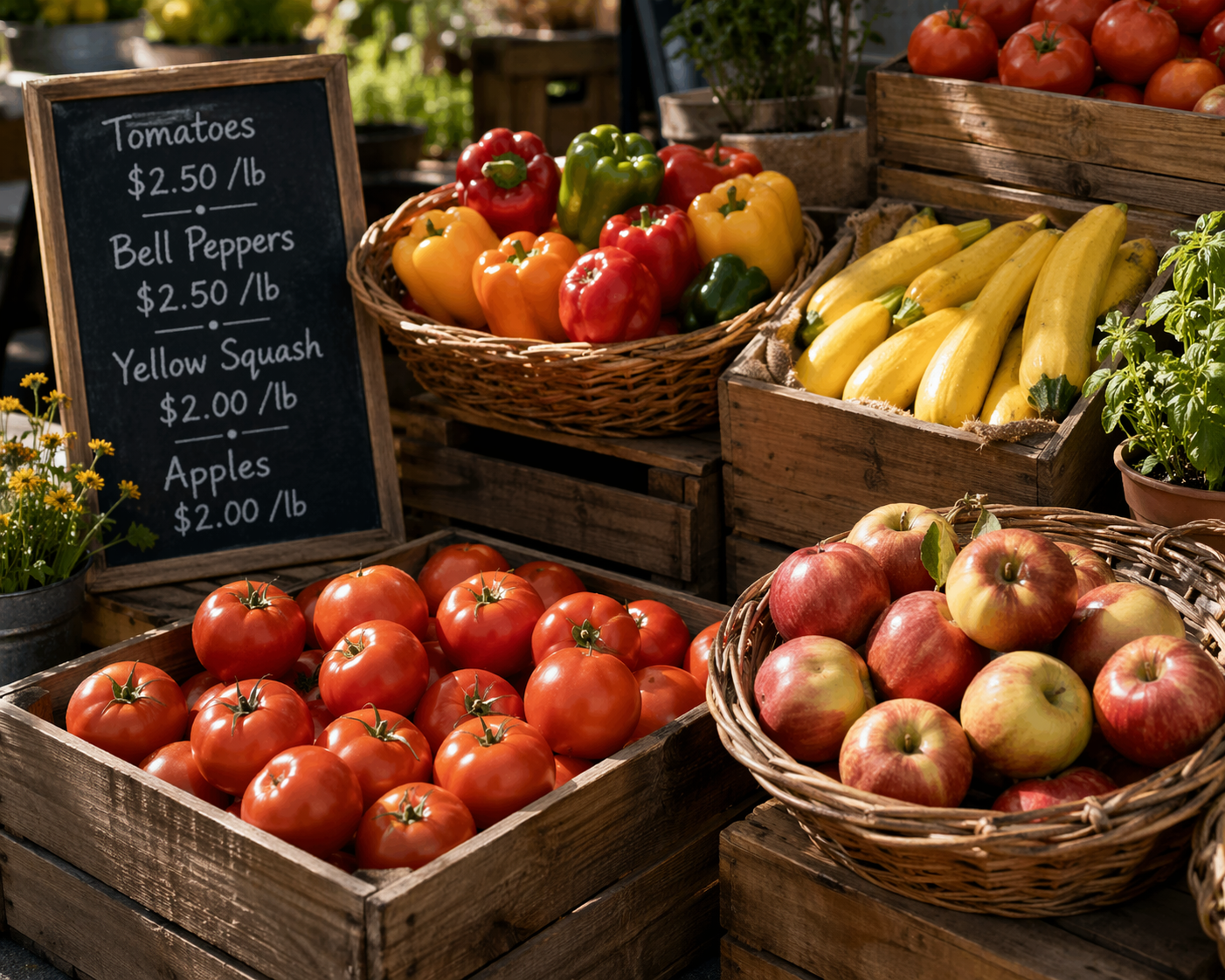
A micro-business can copy this quickly. Put the most recognizable product at eye level or front edge. Use containers to create height. Remove damaged or confusing items. Write one direct sign that names the offer and price. Leave enough quantity visible to suggest abundance, but not so much that the display looks unattended. None of that needs a brand studio; it needs someone willing to treat the table as part of the product.
What this does not prove is that visual merchandising alone sold out Crew’s stand. It proves something narrower: the stand used visual cues that farm-direct operators have long treated as commercially important, and those cues are portable.
2. Community Seeding Gave Strangers Permission to Stop
The first customers were not anonymous foot traffic. People reported Magnolia team members showing up to support the stand, and that detail is more than a sweet workplace moment. [1] Early buyers change the social temperature around a tiny retail setup. A booth with no one near it asks a stranger to take the first social risk. A booth with friendly early activity tells the next person that stopping is normal.
Barn2Door’s national farmer survey, covering farms across all 50 states, identifies local partnerships and customer-led promotion among the creative marketing tactics used by successful farms. [5] Those tactics are not identical to Magnolia staff buying from Crew, but they point to the same behavior: trusted people nearby can help an offer cross the first-attention gap.
For a small operator, community seeding is not the same as asking friends to fake demand. It is making sure the first people most likely to understand the product are present early enough to create motion. A jam maker can invite newsletter subscribers to the first hour of a market. A ceramics seller can tell past buyers when a limited glaze is on the table. A local service business can ask existing clients to comment on a launch post before paid promotion begins.
The line is important. Community seeding works when the early buyers are real buyers or real supporters, not props. Crew’s stand had a built-in community because of Magnolia. Most businesses have a smaller version: customers, neighbors, collaborators, suppliers, school families, vendors, or list subscribers. The mechanism is portable; the scale of the initial audience is not.
3. The Sellout Became a Scarcity Signal Because It Was Concrete
“Sold out in 60 minutes” traveled because it is easy to understand. TV Insider also reported that the stand cleared out within 60 minutes, reinforcing the scarcity narrative across coverage. [6] That does not tell us how many units were available, how many buyers came from Magnolia, or whether the result would repeat the next weekend. It does tell us that the public story had a clean proof point: the offer disappeared.
Barn2Door identifies subscription FOMO and customer-as-marketer behavior among the tactics used by successful farms. [5] Scarcity in that context is not just a pressure trick. Farm products are often genuinely limited by harvest windows, labor, weather, shelf life, and production capacity. When the limit is real, naming it can help customers act before the chance passes.
That is the difference between useful scarcity and cheap urgency. A farm stand that says “today’s tomatoes are from this morning’s harvest” is giving the buyer meaningful information. A baker who says “24 loaves available Saturday” is explaining production reality. A newsletter writer who opens 10 consult slots is setting a capacity boundary. Scarcity becomes trustworthy when the customer can see why the limit exists.
Crew’s sellout was especially easy for media to repeat because it had a short time window and a visible product. Small businesses can use the same structure without exaggeration: state the quantity, state the window, update when supply changes, and avoid turning every ordinary offer into a once-in-a-lifetime event.
4. Confident Pricing Works Better When the Display Has Already Built Value
The public coverage of Crew’s stand does not provide a full price list, so this is the one tactic that has to be handled carefully. The visible lesson is not “charge more because Crew did.” It is that the stand presented the produce as a product worth buying, not as a child’s favor or a pile of surplus. That distinction matters because pricing confidence depends on the value cues surrounding the price.
Rodale’s strongest concrete example is from the Planck family’s farm stand experience. In the 2004 write-up, Rodale reported that the family priced corn at $2 per pound when the market average was $1.50 per pound and did not see sales volume decrease. [4] The same source reports $4,800 earned in a single four-hour market and $350,000 in annual sales during the Planck family’s 1998–2003 farm stand period. [4]
Those dollar figures should not be lifted into 2026 as if the economics are unchanged. They are not inflation-adjusted, and they come from a specific family business in a specific period. Their value here is narrower: they show that, in at least one documented farm-direct case, above-average pricing did not automatically suppress demand when customers perceived freshness, quality, and convenience.
For a micro-business, confident pricing starts before the number appears. The table has to look tended. The product needs to be easy to compare, choose, and carry away. The sign should remove awkwardness. The seller should be able to explain what makes the item worth the price in plain language: picked this morning, made in small batches, grown without shortcuts, delivered locally, customized by hand, or available only this week.
Discounting is sometimes useful, especially when inventory is perishable or cash flow is tight. But apologetic pricing teaches customers to look for the markdown first. Crew’s stand, as shown publicly, did the better thing: it made the product feel like something selected and presented, not something pushed.
5. Product Storytelling Made the Produce Feel Human
The story around the stand was simple enough to carry: Crew, summer, farm produce, a handmade stand, his mother proud enough to post the raw moment. People’s coverage centered Joanna calling herself a “proud mama,” and Parade added that the produce was farm-sourced and hand-arranged. [1][2] The product had a source and a person attached to it before anyone needed a brand manifesto.
Barn2Door’s survey identifies interactive marketing and customer-as-marketer behavior as farm marketing tactics, which fits the way this moment traveled. [5] Joanna’s post turned buyers and viewers into distributors of the story. Lifestyle outlets then repeated the clearest pieces: the child, the stand, the produce, the sellout.
Small businesses often overcomplicate this part. Product storytelling does not require a founder essay for every SKU. It can be one card that says where the peaches came from, one photo of the morning batch, one sentence about why the soap scent exists, one note explaining that the flowers were cut before sunrise. The story should help the customer understand care, origin, or use. If it only decorates the product with sentiment, it becomes noise.
Crew’s story had an obvious advantage because the Gaines family already has an audience trained to care about home, family, renovation, food, and local texture. A regular seller will not get the same media chain from one post. But the underlying action is still available: show the human work close to the product, then make it easy for customers to repeat the story accurately.
The Part Celebrity Reach Explains, and the Part It Does Not
It would be silly to pretend the Gaines name was incidental. Magnolia has spent more than 20 years building a brand around home, retail, media, hospitality, and community, and that history gave this small farm stand a much larger launch surface than a normal child’s roadside table. [3] Joanna’s Instagram post also gave the moment a distribution channel most micro-businesses do not have. [1]
But celebrity reach mainly explains speed and scale. It does not make a messy, illegible, awkward offer automatically trustworthy. The reason this moment is useful for operators is that the visible cues are familiar from non-celebrity farm-direct selling: clear displays, local trust, real limits, value-based pricing, and a story customers can carry.
The available evidence is also short-term. Coverage confirms a fast sellout and a viral-looking media moment, not repeat purchase rates, margin, customer acquisition cost, or whether the stand would perform without Joanna posting it. A serious reading keeps those limits intact.
How to Adapt the Tactics This Week
For a booth, pop-up, small product launch, or local offer, the practical version is plain:
- Make the offer visible before conversation starts: color, height, containers, signage, and a front-facing hero product.
- Seed the first customers with people who already trust you, then let their real activity make the space easier for strangers to enter.
- Use scarcity only when it comes from true supply, time, harvest, labor, or capacity limits.
- Price with confidence when freshness, convenience, craft, or source is clear enough for the buyer to understand.
- Attach the product to a human story that customers can repeat without needing a script.
Crew Gaines’ farm stand likely sold out faster because the Gaines and Magnolia ecosystem accelerated attention. The useful lesson is not that every small seller can recreate that reach. It is that the stand’s mechanics are recognizable in farm-direct marketing research and small enough to adapt: make the offer visible, seed the first customers, let scarcity be real, price with confidence when value is clear, and keep the product attached to a person.
References
- “Joanna Gaines Says She's a 'Proud Mama' as She Supports Son Crew's Farm Stand,” People
- “Joanna Gaines' Son Crew, 8, Sells Out His Own Farm Stand,” Parade
- “About” and “About Chip and Joanna,” Magnolia
- “So You Want to Run a Farm Stand,” Rodale Institute, 2004
- “4 Creative Marketing Tactics from Successful Farms,” Barn2Door
- “Joanna Gaines Gushes Over Son Crew's Summer Business Venture,” TV Insider


Comments
Join the discussion with an anonymous comment.