

Bethesda
Bethesda's compressed marketing window — announcing games just months before release — is a deliberate strategy that protects development focus and converts announcement energy directly into demand. This case study examines how the approach worked across Fallout 4 and Starfield, and how it continues under the July 2026 roadmap.
Outcome
Achieved over 10 million players and nearly 1 billion hours of playtime within two weeks of launch — source: Liquid Advertising case study.
This outcome is independently verified via the primary source linked above.
Pete Hines was unusually direct about why Bethesda keeps its marketing windows so short: "When we go out and do marketing, that pulls developers away from working on the game to go get video captures or sit for interviews." [1] That is the core mechanism here. Bethesda does not seem interested in stretching a reveal into a year-long performance; it wants the marketing spike close enough to release that attention can convert while the team is still focused on finishing the game.
Fallout 4 made that pattern visible early. Bethesda announced it and opened pre-orders in the same move, then shipped a few months later instead of spending a long season asking the audience to wait. That compressed cadence is the point: the company front-loads certainty, then spends the remaining window pushing people from awareness to intent while the product is already near the finish line.
A Short Window By Design
The value of this approach is structural, not theatrical. A long campaign keeps developers feeding the machine with captures, interviews, demos, and appearances. A short one limits that drain and reduces the chance that momentum decays before the product is ready. It also avoids the more familiar launch problem in games: asking the audience to stay emotionally engaged for so long that the reveal stops feeling like a reveal.
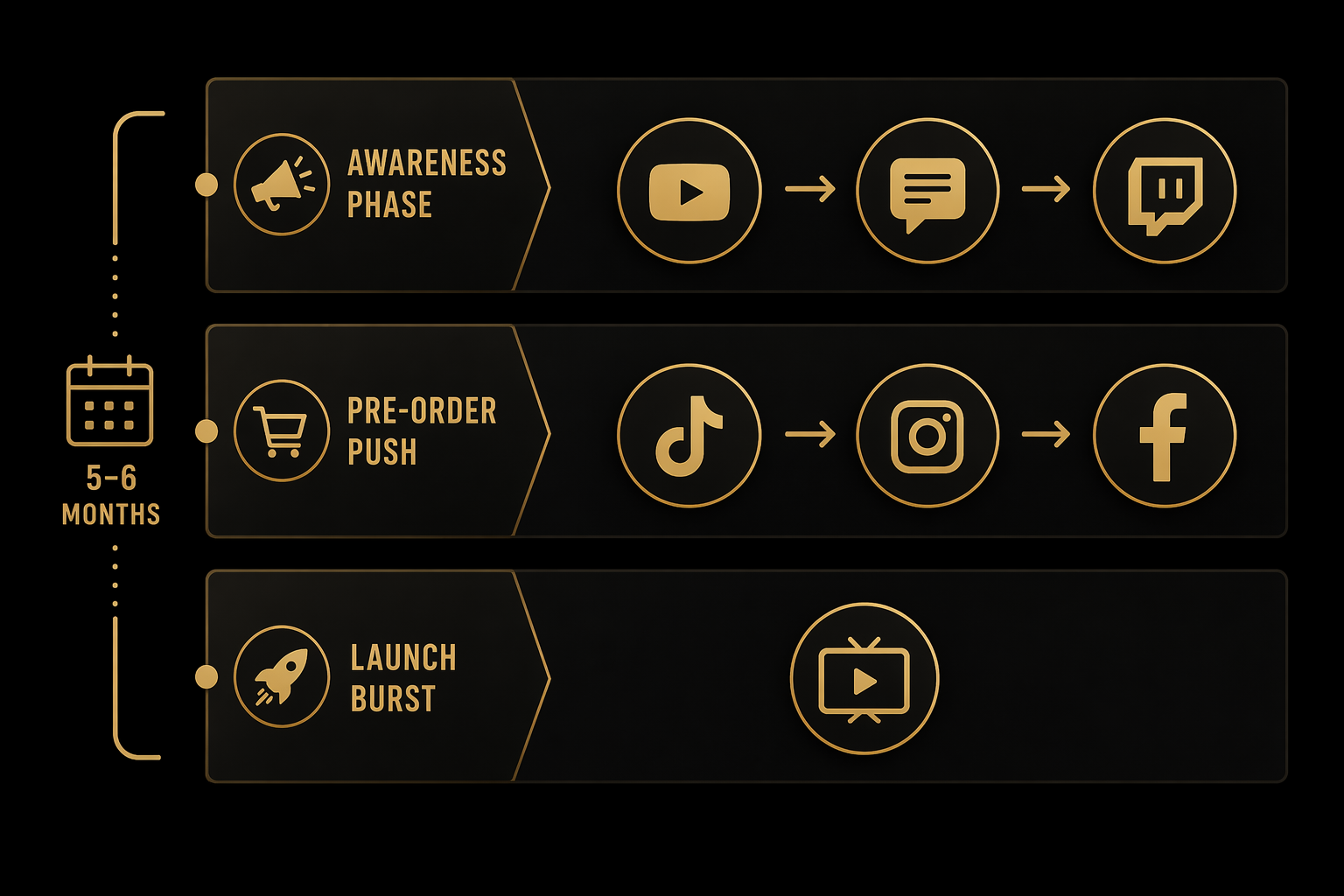
Bethesda's compressed window still has stages, but it uses them tightly. The awareness phase happens first, then a harder conversion push, then a concentrated release burst.
- Early awareness leans on channels that can hold curiosity without demanding immediate conversion, especially YouTube, Reddit, and Twitch.
- The middle phase turns sharper, using TikTok, Instagram, and Facebook to drive preorder intent instead of just broad discussion.
- The launch burst then concentrates on OTT and other high-reach placements so the message lands when the game is actually close enough to buy or play.
That sequencing matters because it shows the window is short without being thin. Bethesda is not skipping demand generation; it is compressing it into a tighter bracket and switching channels as the objective changes from awareness to conversion.
Starfield Scales The Pattern
Starfield is the cleaner stress test because the company had to launch a new IP into a louder market and still keep the window tight. Liquid Advertising's case study says the game reached more than 10 million players within two weeks and logged nearly 1 billion hours of playtime, while also landing between Baldur's Gate 3 and Cyberpunk 2077: Phantom Liberty. [2] Those are not the numbers of a campaign that had to shout for a year to find demand; they are the numbers of a launch that pushed hard when the product was close enough to absorb attention.
The important nuance is that Starfield is not just a unit-sales story. Game Pass changes the demand picture because some of that player volume sits inside a subscription bundle rather than a direct purchase funnel. That matters for marketers: the outcome is not only sell-through, but also subscriber engagement and reach inside an installed base Bethesda could activate immediately.
The channel plan underneath that launch shows the same compression working at larger scale. Bethesda used 2021 and 2022 to build awareness on YouTube, Reddit, and Twitch, then shifted in 2023 into a more direct pre-order push on TikTok, Instagram, and Facebook. Sensor Tower said Starfield's Steam wishlists reached No. 1 during that stretch. [3] At launch, OTT closed the loop rather than starting it.
Pete Hines described Bethesda's operating model as unusually self-contained: "We greenlight, we develop, we sell, we market our own titles." [4] That kind of ownership is what makes the compressed window repeatable. The same organization is not waiting on a separate marketing calendar to dictate the pace, so the reveal date, the preorder date, and the release date can be aligned to the state of the game instead of to a generic hype cycle.
Why The Pattern Still Holds
The July 2026 roadmap suggests this is still the house style, not a one-off habit. The same compressed logic is being carried forward for The Elder Scrolls VI and Fallout 5, which is the clearest sign that Bethesda sees the short window as an operating choice rather than a lucky exception.
That does not make it a universal template. The trade-off is obvious: this approach depends on an organization that can keep development, approvals, and marketing disciplined enough to move quickly without breaking the build. Starfield also shows the limit of the method: even a disciplined launch can still ship with bugs, because a short window protects focus but does not eliminate production risk.
References
- Bethesda Long Marketing Campaigns Are a Distraction From Game Dev — Game Developer — https://www.gamedeveloper.com/business/bethesda-long-marketing-campaigns-are-a-distraction-from-game-dev
- Starfield Case Study — Liquid Advertising — https://liquidadvertising.com/work/starfield-case-study/
- Starfield: Bethesda's Epic Entry Into a Fierce Market — Sensor Tower — https://sensortower.com/blog/starfield-bethesdas-epic-entry-into-a-fierce-market
- Pete Hines on Starfield, Bethesda and bugs: 'We embrace chaos' — GamesIndustry.biz — https://www.gamesindustry.biz/pete-hines-on-starfield-bethesda-and-bugs-we-embrace-chaos

Comments
Join the discussion with an anonymous comment.