
Salesforce
A multi-brand case study of how Salesforce, Jasper, and Webflow deployed AI Slack bots to automate campaign workflows and accelerate approvals, with sourced outcomes including faster response times and higher productivity.
Outcome
36% faster responses and 37% faster decision-making for marketing teams using Slackbot and workflow builder — source: Slack customer story
AI Tools Used
This outcome is independently verified via the primary source linked above.
The useful question in an AI Slack bot for marketing automation case study is not whether a bot can answer a campaign manager in chat. Most can. The harder question is whether the bot can pick up the pieces that normally sit across channels, CRM records, approval rules, account notes, and meeting prep, then turn them into the next action without asking a coordinator to become the new integration layer.
That is where the strongest current examples sit. Salesforce, Jasper, and Webflow are not using Slack simply as a place to summon an AI assistant. Their reported use cases put Slack closer to an operating layer for marketing work: approvals route from the same place where campaign discussion happens, account-channel conversations become structured briefs, blockers are pulled out before leadership meetings, and CRM context shows up before someone has to ask for it.
What Counts as an AI Slack Bot for Marketing Automation Here
In these cases, the bot is not just a conversational front end. It is useful because it sits at a trigger point in the workflow. A campaign approval is ready to route. A strategy brief needs to be assembled from an account channel. A blocker has appeared in a team conversation. A leader needs a formatted report before a recurring meeting. The Slack interface matters because the work is already happening there, but the automation only becomes meaningful when Slack can reach the systems and context behind the conversation.
That distinction matters for marketing teams evaluating the category. A Slack bot that summarizes a thread may reduce reading time. A Slack bot connected to campaign workflows, Salesforce data, account channels, approval rules, and meeting routines can change who waits, who reviews, and which handoff happens without a status chase.
| Brand | Marketing workflow pattern | What the bot or Slack workflow connects | Reported outcome |
|---|---|---|---|
| Salesforce | Campaign approvals, cross-functional coordination, and broader Slackbot-assisted work | Slack workflow builder, Slackbot, team channels, and adjacent customer-success coordination workflows | 36% faster responses and 37% faster decision-making reported for marketing teams; broader Slackbot adoption metrics were also reported across Salesforce employees [1][2] |
| Jasper | Account-channel conversations turned into structured strategy briefs | Slack MCP and RTS API integrations tied to Jasper's marketing agents | 36% faster decisions and 49% higher productivity reported [3] |
| Webflow | Blocker reporting and leader-ready updates | Slackbot, real-time channel context, and Salesforce data | Leaders reportedly save more than 30 minutes per day [4] |
| Zipcar | Channel-based campaign coordination before AI agents enter the picture | Slack channels and workflows for a cross-departmental campaign team | A 45-person team coordinated a campaign that generated 1,000+ contest entries [5] |
Salesforce: The Fullest Case for Slack as the Marketing Work Layer
Salesforce is the most complete case because the reported outcomes cover both specific marketing workflows and broader employee adoption. Slack's customer story says Salesforce marketing teams use Slack's workflow builder and Slackbot to automate campaign approvals and cross-functional coordination, with 36% faster responses and 37% faster decision-making reported for those teams [1]. Those numbers are the part marketing operations leaders will care about first, because they attach to recognizable execution debt: approvals, handoffs, and decisions that usually live in scattered threads.
The stronger point is not that Slackbot answered questions faster. It is that the workflow builder and bot were positioned around the moments when campaign work tends to stall. A request needs approval. A cross-functional team needs the same context. A campaign decision waits for the right person to review it. If those steps are routed inside Slack, the gain is less about novelty and more about removing the hidden labor of remembering who needs to be nudged next.
Salesforce's broader Slackbot metrics need to be handled more carefully. Salesforce announced general availability of Slackbot in 2026 and reported that more than 85,000 employees were using it, with up to 20 hours per week saved per user, 96% satisfaction, and 80% daily active usage; Salesforce also described Slackbot as the fastest-adopted tool in Slack's history [2]. Those figures are useful as adoption context, not as proof that every marketing automation workflow delivered the same savings. They come from Salesforce and Slack materials, not an independent audit.
That caveat does not make the case unhelpful. It makes the read more precise. The marketing-specific claim is about faster responses and decision-making around campaign approvals and coordination. The companywide claim is about Slackbot adoption, satisfaction, daily usage, and potential time savings across employees. A marketing manager building an internal case should not collapse those into one blended ROI number.
There is also an adjacent Salesforce example that sharpens the operating-layer pattern. Customer Success teams built AI-powered Customer Success HQs that reportedly reduced engagement coordination time by 75% and cut per-meeting time by 25 to 35 minutes [1]. This is not a marketing campaign approval workflow, but it shows the same underlying mechanism: Slack becomes the place where scattered account activity, meeting preparation, and coordination are organized into a ready-to-use workspace.
For marketing operations, the lesson is concrete. If campaign work already depends on Slack channels, a bot can be evaluated by whether it has access to approval states, stakeholder roles, CRM context, and the campaign record. If it only has access to the latest thread, it may summarize the noise without changing the workflow.
Jasper: Turning Account-Channel Noise Into Strategy Briefs
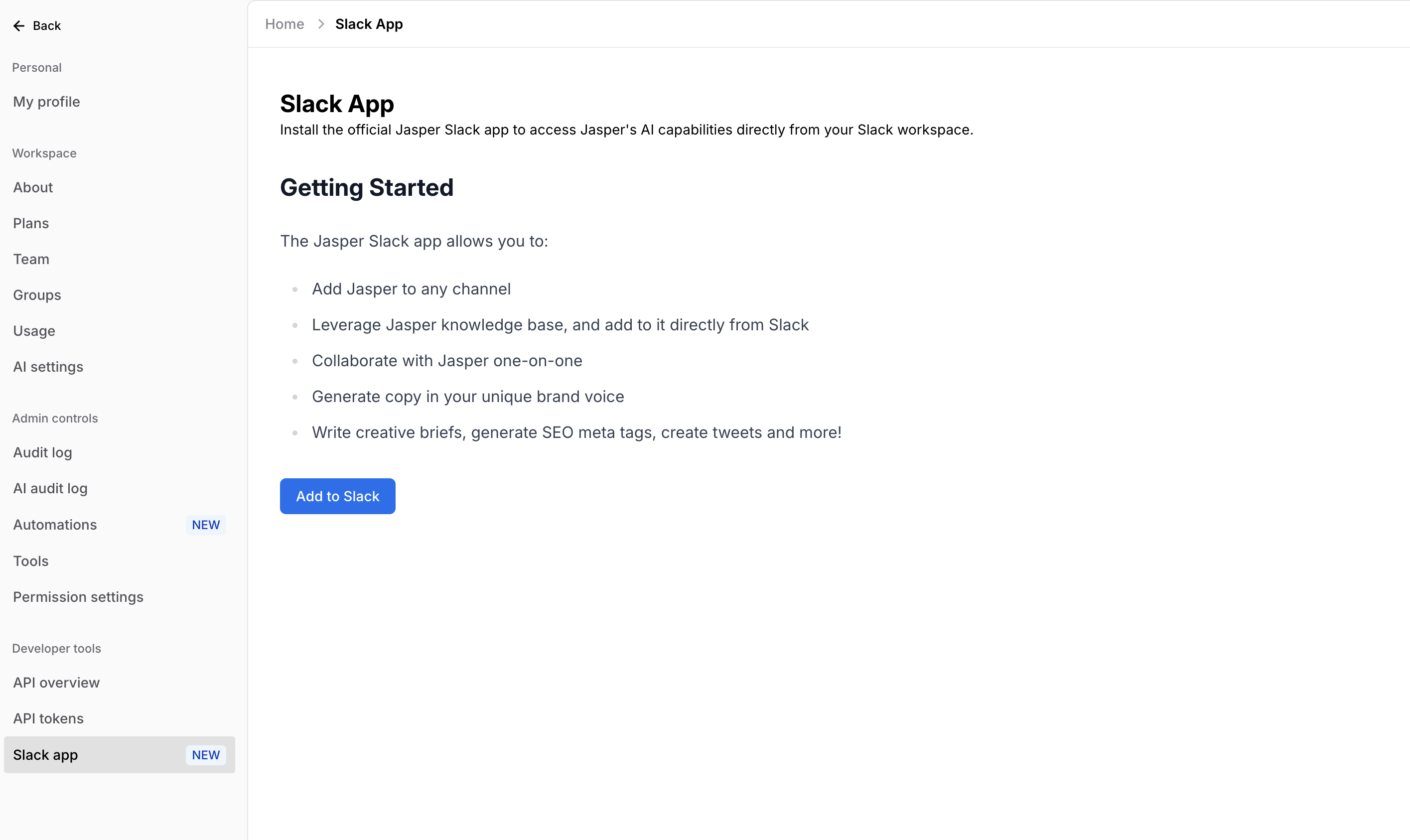
Jasper's case is different because it is more explicitly agentic. Slack's customer story says Jasper, a 300+ person AI marketing platform, integrated Slack's MCP and RTS APIs so its marketing agents could transform account-channel conversations into structured strategy briefs without manual compilation [3]. The reported outcomes were 36% faster decisions and 49% higher productivity [3].
This is the kind of marketing automation that can be missed if the category is framed too narrowly as chatbot support. The input is not a neat form. It is an account channel: comments, customer context, stakeholder updates, open questions, and informal judgment. The output is not merely a summary. It is a strategy brief that a marketing or revenue team can use as a starting point for a decision.
The operational value sits in the conversion step. Before the bot, someone has to read the thread, decide what matters, pull out the customer context, format it, and make the next meeting or campaign discussion usable. After the integration, the agent can assemble that working artifact inside Slack. The person still has to judge the brief, but the manual compilation step shrinks.
Jasper's example also shows why access design matters. A generic assistant with no account-channel context would ask for the material to be pasted in. A Slack-integrated agent can start where the account conversation already lives. The difference sounds small until it is the tenth brief of the week and the same demand generation lead is still copying thread fragments into a document before every planning discussion.
Webflow: The Chief-of-Staff Pattern
Webflow's case makes a quieter but very practical pattern visible. Slack's customer story describes Slackbot as Webflow's most-used AI tool across marketing, with leaders saving more than 30 minutes per day [4]. The bot is described as working like a chief of staff: it pulls real-time blockers from channels, cross-references Salesforce data, and delivers formatted reports in seconds [4].
That use case is less glamorous than autonomous campaign creation, and probably more relevant to most marketing teams. Status reporting is rarely one task. It is a series of interruptions: check the launch channel, scan the regional channel, confirm pipeline context, ask whether the blocker is still real, format the update, and hope nothing changed while the report was being assembled.
The Webflow pattern works because the bot is not only reading Slack. It is also cross-referencing Salesforce data. That matters for marketing leaders because channel urgency and business impact are not the same thing. A loud blocker in Slack may not be the highest-risk issue if it affects a small audience or a low-priority account. A quieter issue tied to a high-value opportunity or campaign milestone may deserve attention first.
Here, the measurable gain is daily time back for leaders, but the more durable workflow change is earlier surfacing. A blocker that appears in a channel can be carried into a formatted report before the meeting begins. That changes the meeting from discovery to decision, which is where many marketing operating rhythms quietly lose hours.
Zipcar Shows the Infrastructure Came First
Zipcar belongs in this story, but not as an AI Slack bot example. Slack's customer story describes Zipcar using Slack channels and workflows to orchestrate a 45-person cross-departmental campaign team, moving away from email-heavy coordination and generating more than 1,000 contest entries [5]. The case is useful because it shows the collaboration substrate that later AI agents depend on.
Before a bot can summarize a launch channel, route an approval, or surface a blocker, the work has to be visible somewhere. Zipcar's case is the pre-AI version of that migration: campaign coordination moves from inboxes into shared channels and lightweight workflows. Once the campaign record is already accumulating inside Slack, an AI layer has something to read, structure, and trigger from.
The Conditions Behind the Reported Gains
Across the Salesforce, Jasper, and Webflow cases, the strongest results share a pattern. The bot is connected to a real workflow, not parked beside it. It has access to the material needed to make a useful judgment. It appears at a trigger point where work would otherwise stall. And the output has a destination: an approval, a brief, a blocker report, a meeting update, or a decision.
- Slack is already the working surface, so adoption does not depend on convincing campaign teams to maintain another dashboard.
- The bot can reach structured systems such as Salesforce or account data, instead of relying only on unstructured chat history.
- The automation is tied to a clear trigger, such as approval routing, brief generation, blocker reporting, or meeting preparation.
- The output reduces a handoff, not just a reading task.
- The reported metric attaches to a workflow someone can name, rather than to a broad claim that AI made the team faster.
This is also where weaker internal proposals tend to fall apart. If a marketing team cannot identify which approvals are delayed, which status updates are manually compiled, which campaign decisions wait on missing context, or which meetings begin with preventable discovery, an AI Slack bot may still feel useful but remain hard to justify. The cases above are strongest when the coordination problem is already measurable.
A Decision Frame for Marketing Managers
The practical takeaway is not that every marketing organization should deploy an AI Slack bot. The better conclusion is narrower: these cases justify evaluation when Slack is already where campaign work happens and when coordination delays, approval loops, or scattered campaign intelligence are visible enough to measure.
For a marketing operations team, the first assessment should be workflow-specific. Pick one recurring process. Campaign approval routing. Account-based campaign brief generation. Weekly launch blocker reporting. Executive meeting preparation. Then map the inputs the bot would need, the systems it must access, the trigger that starts the automation, and the output a human will review.
Salesforce's case supports the approval and coordination argument. Jasper supports the account-channel-to-brief pattern. Webflow supports blocker reporting and leader-ready updates. Zipcar reminds us that the channel-based operating layer usually has to exist before AI can improve it. The credible business case starts there, with a named workflow and a measurable delay, not with a general promise that faster chat will make marketing faster.
References
- Slackbot, Slack
- Salesforce Announces the General Availability of Slackbot — Your Personal Agent for Work, Salesforce Investor Relations, 2026
- Jasper, Slack
- Webflow, Slack
- Revving up marketing campaigns at Zipcar, Slack

Comments
Join the discussion with an anonymous comment.