
Can Meta AI agents really automate paid campaigns?
Sorts the claims that Meta AI agents automate paid campaigns into three evidentiary grades — dated Meta disclosures, untraceable vendor percentages, and named practitioner observations — and gives media buyers a checklist for verifying each claim before changing how they run accounts.
- Platform
- Meta Ads
- Bid strategy
- Advantage+ end-to-end
- Last reviewed
- 0-08-28
Grounded in benchmark case file: Advantage+ benchmark record

Last reviewed: August 28, 2026. The short answer to whether Meta AI agents can automate paid advertising campaigns is yes—but that sentence hides several different products, control layers, and standards of evidence. The useful question is which claim is being made, who made it, and what an account operator would actually be changing.
The claim ledger: three grades of evidence
Before treating a percentage as a benchmark, place it in the ledger. The entries below are deliberately kept at their original scope. They should be read alongside the site's Benchmarks records and Tracker precedents, where dates and the distinction between confirmed and inferred changes matter just as much.

Grade 1 — dated Meta disclosures
Meta said in its July 29, 2026 Q2 prepared remarks that Advantage+ end-to-end solutions had passed a $75 billion annual revenue run-rate.[1] That is a meaningful scale disclosure. It means the reported pace, annualized, had crossed that level; it does not mean Meta recorded $75 billion of quarterly revenue, nor does it establish that Advantage+ caused a particular advertiser's lift.
The distinction is easy to lose when the figure is copied into an article about campaign performance. Revenue run-rate measures the scale of business flowing through a product or solution. It does not tell a buyer whether a particular placement, budget decision, creative recommendation, or campaign structure improved an account. The infrastructure and revenue context belongs in the Advantage+ benchmark record; it should not be relabeled as a conversion benchmark.
Meta's December 2, 2024 engineering disclosure about Andromeda is more specific. On selected segments, Meta reported a 6% increase in recall and an 8% increase in ads quality. It also reported a 22% ROAS increase for advertisers newly using Advantage+ creative AI targeting and a 7% conversion increase among image-generation users. The same disclosure said more than 1 million advertisers were generating more than 15 million ads per month with generative AI tools.[2]
Those numbers do not describe one universal campaign result. Recall and ads quality describe a retrieval system's performance on selected segments. The ROAS figure is tied to advertisers newly using a specified Advantage+ creative AI targeting capability. The conversion figure is tied to image-generation users. Each has a product, population, metric, and condition attached. Remove those qualifiers and a systems disclosure becomes an unsupported promise about every Advantage+ account.
Meta's Q2 remarks also attributed a 1% Instagram app-event conversion lift to early large-language-model preference pilots. On Facebook, Meta reported an 8.3% click uplift and a 15.7% conversion uplift from user-understanding advances combined with the GEM model.[1] The last figure is therefore a multi-factor attribution. It is not evidence that a generative recommender, acting alone, produced a 15.7% improvement.
The taxonomy matters before the performance claim is even assessed. In 2026, “Meta AI agent” can refer to Meta Business Agent, a messaging sales agent; the Advantage+ suite, which automates parts of campaign setup and delivery; delivery and ranking systems such as Andromeda or Generative Recommender; or a third-party agent operating through the Marketing API. Meta said more than 1 million businesses were using Business Agent on WhatsApp and Messenger as of its June 3, 2026 announcement.[5] That adoption figure establishes the reach of a messaging product, not autonomous paid-campaign execution.
Grade 2 — vendor percentages without a traceable primary source
Ryze AI's May 2026 article is a useful example of how this category compounds. It presents claims including 23% lower CPA, 43% higher ROAS, $12 billion in Advantage+ annual spend, 4 million advertisers, and 2.3 billion ad variants.[3] Those figures could not be traced to Meta's primary documentation.
That does not prove every figure is false. It means the figures cannot do the work commonly assigned to them. Without the earliest source, publication date, test population, comparison condition, metric definition, and attribution method, a buyer cannot know whether a number describes an experiment, a vendor's modeled estimate, an adoption count, or a result repeated from another vendor page. It should remain vendor-claimed and untraceable—not become a benchmark through repetition.
The reported ambition for fully automated ad creation by the end of 2026 belongs in the same provisional area. The Wall Street Journal described the plan in June 2025 as reporting based on people familiar with Meta's plans.[6] That is evidence of a reported internal ambition, not a confirmed product commitment or proof that a buyer can currently hand over full account execution. The paywalled coverage, along with related reporting, should be re-verified before publication or operational use.
Grade 3 — named practitioner observations
Practitioner accounts do not replace controlled testing, but they reveal the work that platform disclosures often leave out. Marketing Brew reported that Hawke Media was directing 60% to 70% of its Meta spend through Advantage+, while still seeing overspend in low-quality placements and no replacement of the full account structure. We Scale Startups reported worse results from Meta's creative AI than from third-party systems. Deutsch described repeatedly dealing with default opt-ins as “Whac-A-Mole.”[4]
These observations support narrower conclusions. Advantage+ can carry a substantial share of spend without replacing every account decision. Creative automation can be available without being preferred by every operator. Default settings can create recurring review work even when the underlying feature is useful. None of those statements provides a general CPA or ROAS benchmark, because the accounts, spend levels, objectives, attribution windows, and comparison periods are not documented as a controlled sample.
The same report records Meta's position that advertisers can opt out of AI features without a penalty and that Advantage+ creative opt-out preferences had persisted across campaigns since March 2026.[4] That information belongs beside the field observations. It explains the available control; it does not erase the reported placement-quality or creative-quality problems.
A separate Manus data point should not be used to fill the gap. Reuters reported on August 11, 2026 that Meta was unwinding Manus-related changes after its December 2025 acquisition, following observations in Ads Manager by Jon Loomer. The status is disputed and time-sensitive, so it is non-evidence for a claim about current native automation unless the product behavior and primary documentation are re-verified.
What to verify before changing an account
A claim should reach the account only after it survives a short provenance check. The point is not to reject automation by default. It is to avoid changing bidding, creative, placement, or budget controls because a number has been detached from the system and test that produced it.
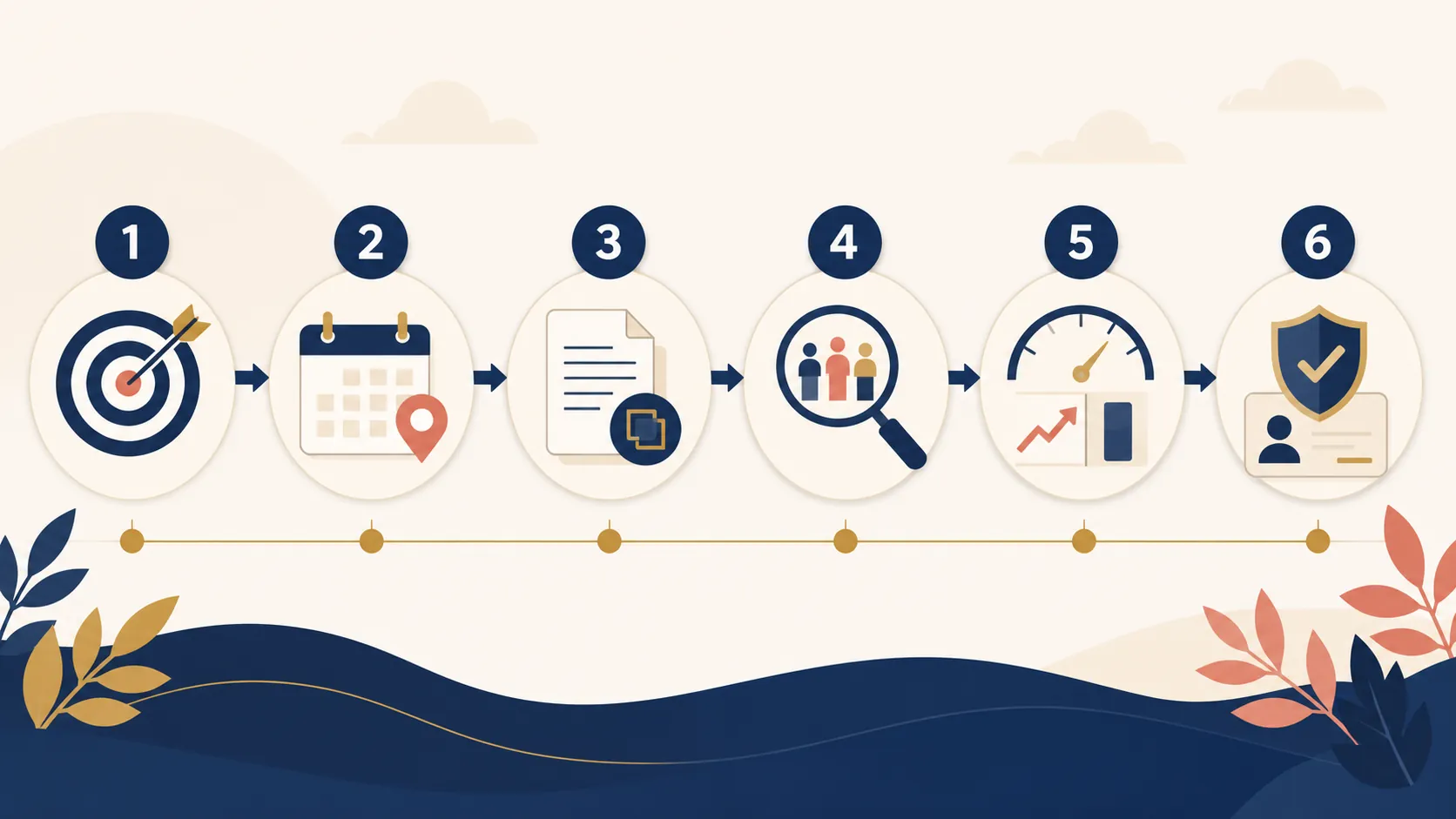
- Name the agent or system precisely. Record whether the claim concerns Business Agent, Advantage+, Andromeda, Generative Recommender, a creative-generation feature, or a third-party Marketing API agent. If the source uses “Meta AI” as a catch-all, stop there and resolve the product name.
- Find the earliest dated source. Prefer a dated Meta engineering post, prepared remark, product announcement, or documented experiment. A vendor article that cites another vendor article is still one unverified chain, not two independent sources.
- Copy the claim at its original scope. Keep the segment, geography, advertiser group, campaign objective, test period, comparison group, and metric. The Andromeda figures are a useful model: selected-segment retrieval results should not be rewritten as an all-account ROAS guarantee.
- Check attribution. Ask whether the result belongs to one model, a product bundle, a user-understanding change, a delivery system, or several changes at once. The 15.7% Facebook conversion figure was attributed to user-understanding advances combined with GEM, so it cannot be assigned to Generative Recommender alone.
- Separate adoption, scale, and performance. A $75 billion annual revenue run-rate, a count of advertisers, and a count of generated ads can show product scale. They do not by themselves show lower CPA, higher ROAS, or better placement quality. This distinction is also useful when reviewing budget flowing through opaque campaign types.
- Look for an account-level record before changing operations. A named practitioner's observation can identify a placement or workflow problem worth investigating, but it is not a universal benchmark. Capture the account conditions, the before-and-after period, the feature setting, and the consequence for spend before treating it as a reason to expand or restrict automation. The same verification-first filter applies to other AI tools, including the site's law-firm paid-ads precedent.
For the same reason, the site's claim-grading framework for platform and vendor lift claims is a useful companion: a lift claim remains unaudited marketing until its date, product, measurement, and named-account or controlled-test basis are visible.
The resulting judgment is narrow. Automation is already operating across messaging, campaign configuration, creative generation, delivery, retrieval, and ranking. The evidence assembled here supports changing account practice when a dated Meta disclosure confirms the particular capability and conditions under discussion. It does not support turning a run-rate into performance proof, a vendor percentage into a benchmark, or one practitioner's account experience into a universal rule. Paywalled and disputed items should be re-verified as of August 28, 2026.
References
- Meta Boosts Advertising In Q2, Tries To Reassure Investors — MediaPost, July 29, 2026
- Meta Andromeda: Supercharging Advantage+ automation with the next-gen personalized ads retrieval engine — Meta Engineering, December 2, 2024
- Meta Ads Automation: AI Agents & Advantage+ in 2026 — Ryze AI, May 2026
- How Meta's AI push is changing ad creation — Marketing Brew, April 7, 2026
- Conversations 2026: Introducing Meta Business Agent — Meta for Business, June 3, 2026
- Meta Aims to Fully Automate Ad Creation Using AI — The Wall Street Journal, June 2025