
Does AI actually threaten paid media jobs?
Paid media tops AI exposure lists, but the measured evidence does not support the claim that AI is coming for media buyer jobs. The strongest data from AMA, Anthropic, PwC, and CMI points to execution automating, verification becoming the scarce skill, and the real hiring squeeze landing on junior entry-level roles.
- Platform
- Cross-platform
- Bid strategy
- Automated bidding
- Last reviewed
- 0-08-26
Grounded in benchmark case file: AI creative testing record
Paid media deserves its place near the top of the AI exposure list. The American Marketing Association’s 2026 career report applied Stanford’s Human Agency Scale to 35 marketing skills and placed paid media, SEO, email marketing, performance analytics, copywriting, lead generation, market research, and graphic design in the H1–H2 tier: work where AI can act with minimal human agency or where the human mainly supervises the system. The survey covered 1,412 marketers between December 2025 and January 2026, and the marketing-specific placement is AMA’s application of the Stanford scale, not a Stanford finding about marketing occupations themselves. [1]
That is the honest starting point for any discussion of the AI productivity impact on marketing and advertising jobs. If a media buyer spends the day building campaign shells, generating asset variants, pulling weekly reports, rewriting ad copy, or accepting platform recommendations, AI can touch a lot of that work. The mistake is jumping from “AI can touch this” to “the role disappears.” Exposure measures task contact. It does not, by itself, measure layoffs, hiring cuts, account accountability, or whether anyone trusts the number the platform says it improved.

Exposure is real; displacement is not proven
Anthropic’s 2026 labor-market research also supports the high-exposure view. Its usage-based report found that some occupations have a large share of tasks where AI is already being used, and it named computer programmers, customer service representatives, and data entry keyers among the most exposed examples. The report also found no systematic unemployment increase for exposed workers since late 2022, while identifying a roughly 14% drop in job-finding rates for 22-to-25-year-olds entering exposed occupations. [2]
Marketing-specific interpretations of Anthropic’s work should be handled carefully. Mark Ritson’s Adweek column reads the Anthropic report as especially severe for marketing, including the argument that market research and marketing specialists rank near the top of exposed occupations and that a large share of marketing tasks may be replaceable. That is Adweek’s interpretation of Anthropic’s data, not Anthropic’s own headline wording. [3]
The distinction matters because paid media is full of tasks that look replaceable in isolation but behave differently inside an account. A campaign build can be automated. A keyword or audience expansion can be recommended by the platform. A report can be assembled by an agent. None of that answers whether the account is spending against incrementality, whether the attribution window is flattering the system, whether the audience mix shifted, or whether the platform’s “lift” came from a change the buyer would have rejected if it had been surfaced plainly.
Layoff data is an equally weak shortcut. Challenger data cited by CNBC showed AI mentioned in only about 55,000 of 1.17 million U.S. layoffs in 2025, or roughly 5%. The same CNBC piece included the Oxford Internet Institute critique that AI is often used as a post-hoc explanation for cuts that may have other causes. [4]
That does not make AI harmless. It means the clean story — AI arrives, paid media headcount vanishes — is not what the strongest evidence currently shows. The tighter story is about where work is compressed, who loses the entry path, and which parts of media buying become harder to delegate.
The real pressure is showing up at the bottom of the ladder
The most useful labor-market signal is not the dramatic forecast. It is the entry-level squeeze. Content Marketing Institute’s 2026 outlook found that one in three companies were cutting entry-level marketing hiring. Its net score for entry-level hiring was −19.8, while the net score for overall team growth was +22.3. The same report found that 76% of marketers were doing more than one job, while only 4% expected AI to fully replace marketers and 53% expected augmentation. [5]
That is a familiar staffing pattern in paid media. The team may not remove the senior buyer who knows which conversion event is dirty, which product feed breaks every promotion cycle, or why the branded campaign is masking retention demand. The team may instead stop hiring the junior person who would have built campaign drafts, pulled pacing screenshots, cloned ad sets, refreshed UTMs, wrote first-pass copy variants, and assembled the weekly deck.

PwC’s 2026 AI Jobs Barometer points in the same direction from a different angle. In AI-exposed occupations, junior roles were seven times more likely to demand senior skills, and “seniorised” entry roles were up 35% since 2019. [6]
That is the ladder problem. Paid media used to have a lot of low-risk repetition where a junior buyer could learn the account. Build the campaign. QA the naming convention. Pull spend and CPA. Notice that the numbers in Ads Manager do not match the source of truth. Ask why Performance Max is taking credit for branded demand. Break one thing, fix it, and remember it forever.
Automation removes some of that repetition, which is good for productivity and bad for apprenticeship if teams do not redesign the path. The junior buyer is no longer protected by button work. The job starts closer to diagnosis: checking whether the automated build matches the brief, whether generated assets are safe to ship, whether the budget allocation makes commercial sense, and whether a platform recommendation is improving profit or just improving the platform-reported metric.
AMA’s own hiring signal adds pressure to the same reading. Its 2026 report, using Indeed-based findings, said marketing jobs remained 27% below pre-pandemic levels, while role-level shifts from 2024 to 2025 were uneven: content marketer down 11%, SEO down 15%, and influencer roles up 18%. [1]
Those numbers do not isolate paid media. They do show a marketing labor market that is not simply expanding into every AI-enabled efficiency gain. Employers can want more output, keep experienced people, and still narrow the entry gate.
Productivity studies show faster work, not automatic headcount collapse
The productivity evidence is real enough to change staffing plans. Noy and Zhang’s randomized experiment with 453 professionals found that access to generative AI cut task time by 40% and improved output quality by 18%. It is strong evidence for faster completion of certain writing tasks, not proof that marketing departments can remove 40% of people. [7]
The BCG and MIT “jagged frontier” study is more useful for paid media than a simple automation headline because it shows that AI performance depends on whether the task sits inside or outside the system’s competence. Workers gained about 38% performance on tasks inside the frontier, while performance fell by 13 to 24 percentage points on tasks outside it. [8]
That maps cleanly to account work. Drafting a first version of ad copy, summarizing a search query report, or turning a brief into structured campaign documentation may sit inside the frontier. Deciding whether an automated bidding change is cannibalizing profitable demand, whether an AI-generated creative angle violates brand constraints, or whether a Meta holdout test is contaminated by other changes may sit outside it. The more the work depends on messy context and independent measurement, the less useful it is to treat AI output as finished work.
The St. Louis Fed’s 2025 analysis also points toward output gains rather than a clean replacement ratio. It reported 5.4% self-reported time saved, with an estimated roughly 33% productivity gain per AI-assisted hour as the authors’ model inference from self-reported data. [9]
McKinsey’s estimate is broader and more forward-looking: generative AI could create value equal to 5% to 15% of marketing spend. That is an expert projection of potential value, not a measured employment outcome. [10]
| Evidence | What it supports | What it does not prove |
|---|---|---|
| AMA H1–H2 marketing skill placement | Paid media and adjacent marketing skills are highly exposed to AI automation and supervision. | That paid media roles are being eliminated at the same rate as task exposure. |
| Anthropic labor-market research | Exposed occupations show meaningful AI contact, with a young-worker job-finding decline in exposed occupations. | A systematic unemployment increase for exposed workers since late 2022. |
| CMI and PwC hiring evidence | Entry-level marketing paths are narrowing and junior roles are demanding more senior skills. | That experienced paid media roles are broadly disappearing. |
| Noy & Zhang, BCG/MIT, St. Louis Fed, McKinsey | AI can raise output per worker and improve performance on suitable tasks. | A direct headcount-reduction formula for media teams. |
What changes inside paid media teams
Paid media has been moving in this direction for years. The platforms did not wait for generative AI to start automating bidding, targeting, placements, creative assembly, and budget allocation. Performance Max, Advantage+, AI Max, and TikTok Symphony are the current names around a familiar shift: fewer visible levers, more bundled optimization, more defaults, and cleaner lift claims than the average account can accept without checking.
That platform layer is where the employment question becomes practical. A buyer who only traffics what the interface tells them to traffic is easier to compress. A buyer who can audit whether the system’s recommendation is incrementally profitable is harder to replace. The site’s platform automation tracker keeps returning to the same operating problem: the more automated the buying layer becomes, the more the human job shifts toward verification, not ceremonial approval.
That does not mean every manual task is noble. A lot of it never deserved to be protected. If AI writes the first five ad variants, formats the naming convention, drafts the weekly summary, checks broken links, flags a spend anomaly, or builds a campaign draft from a brief, take the win. The issue is what the team stops learning if nobody has to understand how those pieces connect.
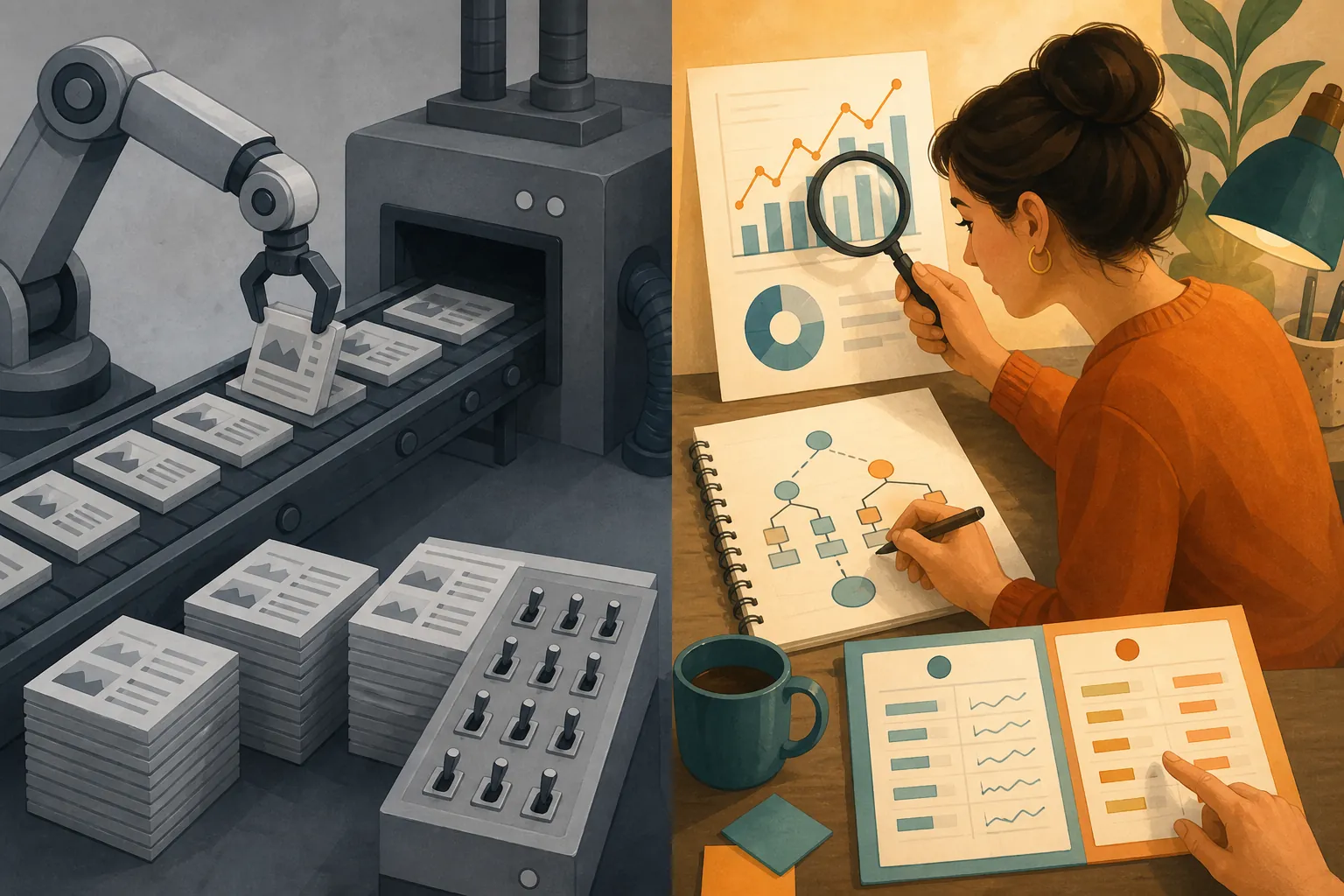
The vulnerable work clusters around repetitive setup, first-pass reporting, asset variation, and routine optimization. These are the tasks most likely to be bundled into platform tools or handled by general-purpose AI. The durable work clusters around deciding what should be measured, designing tests, checking platform claims against independent data, interpreting ugly results, and telling a client or finance lead what the account actually did.
That is why automation-versus-control is not a philosophical debate for media buyers. It is a staffing model. If the team treats AI as a cheaper production layer, it can reduce hours spent on trafficking and reporting. If it treats AI as a replacement for judgment, it risks leaving the platform as both the actor and the scorekeeper. The automation-versus-control framework is useful here because the question is not whether PMax or AI Max can optimize. It is what proof the buyer requires before handing over more control.
Verification becomes the scarce skill
The safest paid media role is not the person who refuses automation and manually rebuilds every campaign to prove a point. That person will lose hours to work the machine can do well enough. The safer role is the person who knows where the machine is likely to overclaim.
Verification starts before launch. It asks whether the conversion event is worth optimizing toward, whether the feed is clean, whether the budget split gives the test enough room, whether audience exclusions matter, whether creative variants isolate one meaningful change, and whether the platform setting being tested is actually the only material variable changing.
It continues after launch. If Meta says Advantage+ Creative improved results, the buyer needs to know whether the comparison isolated the creative enhancement or mixed it with delivery changes. The holdout-test protocol in the site’s AI creative testing record is the practical version of that standard: do not let platform enhancements hide inside the result you are trying to attribute.
It also changes how creative claims are handled. “AI creative worked” is not a finding unless the account can say what changed, what stayed constant, what population saw the test, how long the test ran, and which source of truth decided the outcome. Treating AI claims as measurable account variables, rather than as a style debate, is the useful habit in the site’s AI ad creative backlash analysis.
This is where junior staffing gets uncomfortable. The industry still needs people who can learn this verification work. But if the old entry tasks are automated away without a replacement apprenticeship, teams end up asking early-career buyers to perform senior judgment before they have seen enough account failure to recognize it.
A healthier staffing plan separates work by consequence, not by whether AI can technically do it. Let AI draft, summarize, assemble, and flag. Give junior buyers structured QA, controlled test reading, naming and tracking ownership, anomaly investigation, and post-launch checks where mistakes are visible and correctable. Keep senior buyers accountable for test design, budget-risk decisions, platform-trust boundaries, and the final interpretation of performance.
The staffing answer
The evidence does not show broad, proven displacement of experienced paid media roles. It does show high exposure, real productivity gains on suitable tasks, and a measurable hiring squeeze at the junior end of marketing. That is enough to change how teams hire, but not enough to claim that AI is simply coming for every media buyer.
The exposed half of the role is execution: repetitive setup, first-pass reporting, asset variation, and routine optimization. The more durable half is verification: designing tests, auditing platform claims, interpreting messy results, and deciding when automation is helping versus hiding waste.
If AI changes the job, the safer media buyer is not the one who manually does every task. It is the one who can verify what the machine and the platform say happened.
References
- 2026 Career Report, American Marketing Association, 2026.
- Labor Market Impacts of AI, Anthropic, March 2026.
- 65% of Marketing Jobs May Not Survive AI, Adweek.
- AI job cuts: Amazon, Microsoft and more cite AI for 2025 layoffs, CNBC, December 21, 2025.
- Content Marketing Salary & Career Outlook, Content Marketing Institute, 2026.
- 2026 Global AI Jobs Barometer, PwC, 2026.
- Experimental evidence on the productivity effects of generative artificial intelligence, Science, July 2023.
- How generative AI can boost highly skilled workers’ productivity, MIT Sloan, 2023.
- The Impact of Generative AI on Work Productivity, Federal Reserve Bank of St. Louis, February 2025.
- The economic potential of generative AI: The next productivity frontier, McKinsey.