
What Car Accident Attorney Paid Search Ads Actually Cost
Car accident attorney paid search CPL figures range from $131 to $1,500 because published benchmarks measure different funnel stages and samples. Build a cost-per-signed-case framework with call tracking and offline conversion imports so you can judge whether the channel is actually profitable.
- Platform
- Google Ads
- Bid strategy
- Smart Bidding
- Difficulty
- Advanced
- Last reviewed
- 0-08-26
Grounded in benchmark case file: LocaliQ Accidents & Personal Injury Law benchmark
The published numbers for car accident attorney paid search ads do not line up because they are not trying to measure the same thing. WordStream’s 2025 legal benchmark puts Attorneys & Legal Services at a $131.63 cost per lead. LocaliQ’s accidents and personal injury category reports a $159.17 median CPL. Majux, looking at injury-law campaigns from an agency operator’s seat, says genuinely good car-accident leads often sit closer to $500–$1,500. Then the conversation shifts again when LucrativeLegal and Cufinder talk about cost per signed case rather than cost per lead, with ranges that conflict too sharply to blend into one comforting average.[1][2][3][4][5]
| Source | Published figure | What the number is really measuring | How useful it is for planning |
|---|---|---|---|
| WordStream, Google Ads Benchmarks 2025 | $131.63 CPL for Attorneys & Legal Services; highest CPL among 23 industries.[1] | A blended legal-services lead benchmark, not a car-accident-only signed-client metric. | Useful as a boardroom reference point. Weak as a bid or budget number for auto-accident terms. |
| LocaliQ, Legal Search Advertising Benchmarks | Accidents & Personal Injury Law medians from 256 U.S. campaigns, Apr. 2022–Mar. 2023: $9.30 CPC, $159.17 CPL, 4.56% CTR, 5.45% conversion rate.[2] | A category median across campaign data. The reported medians should not be recomputed as if they came from one identical campaign. | Better than a generic legal number, but still a lead-stage benchmark. |
| Majux, injury-law PPC benchmark article | $500–$700 described as “extremely well” for car-accident leads; $800–$1,500 as “quite good”; up to $2,000 acceptable in some markets.[3] | Practitioner ranges for quality car-accident leads, based on first-party agency experience. | Operationally recognizable, but still not universal and still not a signed-case number. |
| LucrativeLegal agency page | CPA per signed case: $2,000–$5,000 in urban areas and $1,000–$3,000 in smaller markets; includes a directional example of $200 CPC × 10 clicks = $2,000 CPA against $50,000 case revenue.[4] | Signed-case economics from a commercially motivated agency page. | Useful as directional math, not as an independent market benchmark. |
| Cufinder, Personal Injury Lawyers Industry Marketing Benchmarks 2026 | National PI CPC $215, 4.10% conversion rate, roughly 24 clicks per lead ≈ $5,160 per lead, and CPA per signed case $850–$1,200.[5] | A synthesis of 40+ firm audits plus third-party reports, with definitions that need to be read carefully because its lead and signed-case figures do not reconcile cleanly. | Worth seeing beside other signed-case claims, but not something to average with them. |
This is where a lot of paid-search reporting goes wrong. The disagreement is not simply that one source is “too low” and another is “too high.” A lead can mean a form fill from someone with no injury, a routed phone call, a chatbot contact, a qualified accident inquiry, a consultation request, or a person who eventually signs a retainer. If those are all called conversions in different reports, the CPL column will look precise while the business question remains unanswered.

The person who pays for that confusion is usually not the partner asking for the benchmark. It is the operator defending spend and the intake team dealing with the fallout: missed calls, duplicate inquiries, no-injury calls, jurisdiction mismatches, people who wanted a tow truck, and platform conversions that looked clean in Google Ads but never became a viable file.
A CPL is only useful after you know which funnel stage it names
WordStream’s $131.63 legal CPL is the kind of number that survives in executive decks because it is simple and recognizable.[1] It also collapses too much. Attorneys & Legal Services is not the same market as car accident attorney paid search ads. Estate planning, immigration, criminal defense, family law, mass tort, and injury terms do not carry the same click prices, urgency, screening criteria, or case economics.
LocaliQ gets closer by breaking out Accidents & Personal Injury Law and reporting medians from 256 U.S. campaigns over the Apr. 2022–Mar. 2023 window: $9.30 CPC, $159.17 CPL, 4.56% CTR, and 5.45% conversion rate.[2] That is a more relevant category than blended legal, but it still does not tell a firm whether the leads were screened, whether calls were answered, whether consultations happened, or whether retainers came back signed.
Majux’s ranges sound less tidy because they are closer to the intake floor. It argues that blended legal benchmarks from sources like WordStream and LocaliQ are too low for quality injury leads, and places strong car-accident lead performance around $500–$700, good performance around $800–$1,500, and acceptable performance up to $2,000 in certain markets.[3] That is not a national planning answer either. It is a warning that a low reported CPL may be buying something other than the lead type a PI firm actually wants.
The signed-case sources create a different problem. LucrativeLegal gives directional CPA-per-signed-case ranges of $2,000–$5,000 in urban areas and $1,000–$3,000 in smaller markets, while Cufinder’s 2026 synthesis reports a $215 national PI CPC, a 4.10% conversion rate, roughly 24 clicks per lead, about $5,160 per lead, and $850–$1,200 CPA per signed case.[4][5] Those figures should sit side by side, not be averaged. They come from different source types, appear to use different definitions, and in Cufinder’s case the lead and signed-case figures do not behave like one clean funnel.
That does not make the sources useless. It makes them contextual. A benchmark can tell you what someone else counted. It cannot tell you whether your account is counting the right thing.
The working number is cost per signed case
For a car-accident campaign, the budget question is not “Can we beat the published CPL?” It is: what would have to be true between click, lead, consultation, retainer, and case value for this spend to make sense?
Cost per signed case = ad spend ÷ signed cases

Or, if the stages are measured cleanly:

Cost per signed case = CPC ÷ (click-to-lead rate × inquiry-to-consultation rate × consultation-to-retainer rate)

Cost per signed case = CPL ÷ (inquiry-to-consultation rate × consultation-to-retainer rate)
The formula is simple. Getting honest inputs is the hard part. A search account can report a conversion rate without knowing whether the call was answered. Intake can report signed clients without knowing which keyword or campaign produced the first contact. Finance can report fees without knowing whether the case came from branded search, nonbrand “car accident lawyer” terms, a referral, or a retargeted click after an organic visit.
Walker Advertising’s 2026 legal marketing review gives the missing bridge between ad-platform leads and retained clients: plan from cost per signed case and channel-level ROI, respond in under five minutes, keep missed calls under 10%, expect inquiry-to-consultation rates around 40–60%, and consultation-to-retainer rates around 50–70%.[6] Those are intake-stage numbers, not keyword metrics. They are also where a lot of paid-search economics are won or lost.
| Lead-stage input | Downstream assumption | Implied cost per signed case | What this proves |
|---|---|---|---|
| LocaliQ’s $159.17 Accidents & PI median CPL.[2] | If every reported conversion behaved like a real inquiry and Walker’s 40–60% inquiry-to-consultation and 50–70% consultation-to-retainer ranges applied.[6] | Roughly $379–$796. | The math looks attractive only because the lead definition is doing a lot of work. |
| Majux’s $500–$1,500 quality car-accident lead range.[3] | Using the same Walker downstream ranges as a sensitivity check.[6] | Roughly $1,190–$7,500. | A higher CPL can still be viable if it represents a materially better inquiry pool and if case values support it. |
| LucrativeLegal’s directional signed-case ranges.[4] | $1,000–$3,000 in smaller markets and $2,000–$5,000 in urban areas. | Already stated as signed-case CPA. | This is closer to the business metric, but the source is commercially motivated and should be treated as directional. |
| Cufinder’s 2026 synthesis.[5] | $215 CPC, 4.10% conversion rate, about $5,160 per lead, and $850–$1,200 CPA per signed case. | Not safely recomputed as one funnel. | Conflicting definitions make this a cautionary comparison point, not a planning base. |
Those calculations are not a recommendation to use Walker’s ranges mechanically in every market. They are a stress test. If a firm quotes a $159 CPL but cannot say how many of those conversions became consultations, the number is unfinished. If an agency quotes a $1,200 signed-case cost but cannot show which calls, forms, consultations, and retainers were matched back to campaigns, the number may be a story rather than a measurement system.
CPC is not irrelevant, but it is the wrong place to stop
Click cost still matters. LocaliQ reports a $9.30 median CPC for Accidents & Personal Injury Law, while Cufinder’s 2026 synthesis reports a $215 national PI CPC, and LucrativeLegal uses a $200 CPC in its directional signed-case example.[2][4][5] Those figures are so far apart that treating “PI CPC” as one category would be lazy. Query mix, geography, device, match type, brand presence, auction pressure, and the definition of “personal injury” can all change what that click represents.
The practical issue is sequence. CPC should feed a signed-case model; it should not become the model. A $200 click can be rational if it has enough probability of becoming a valuable retained case. A $9 click can be waste if it reliably produces low-intent contacts, out-of-market calls, or leads intake will reject.
This becomes sharper as search auctions absorb more automation and more advertiser demand. The broader Alphabet and AI Max cost-pressure discussion is relevant here because higher auction costs punish sloppy conversion definitions. When the system is allowed to bid aggressively, it needs something better than a raw call or form fill as its success event.
The tracking gap is the budgeting failure mode
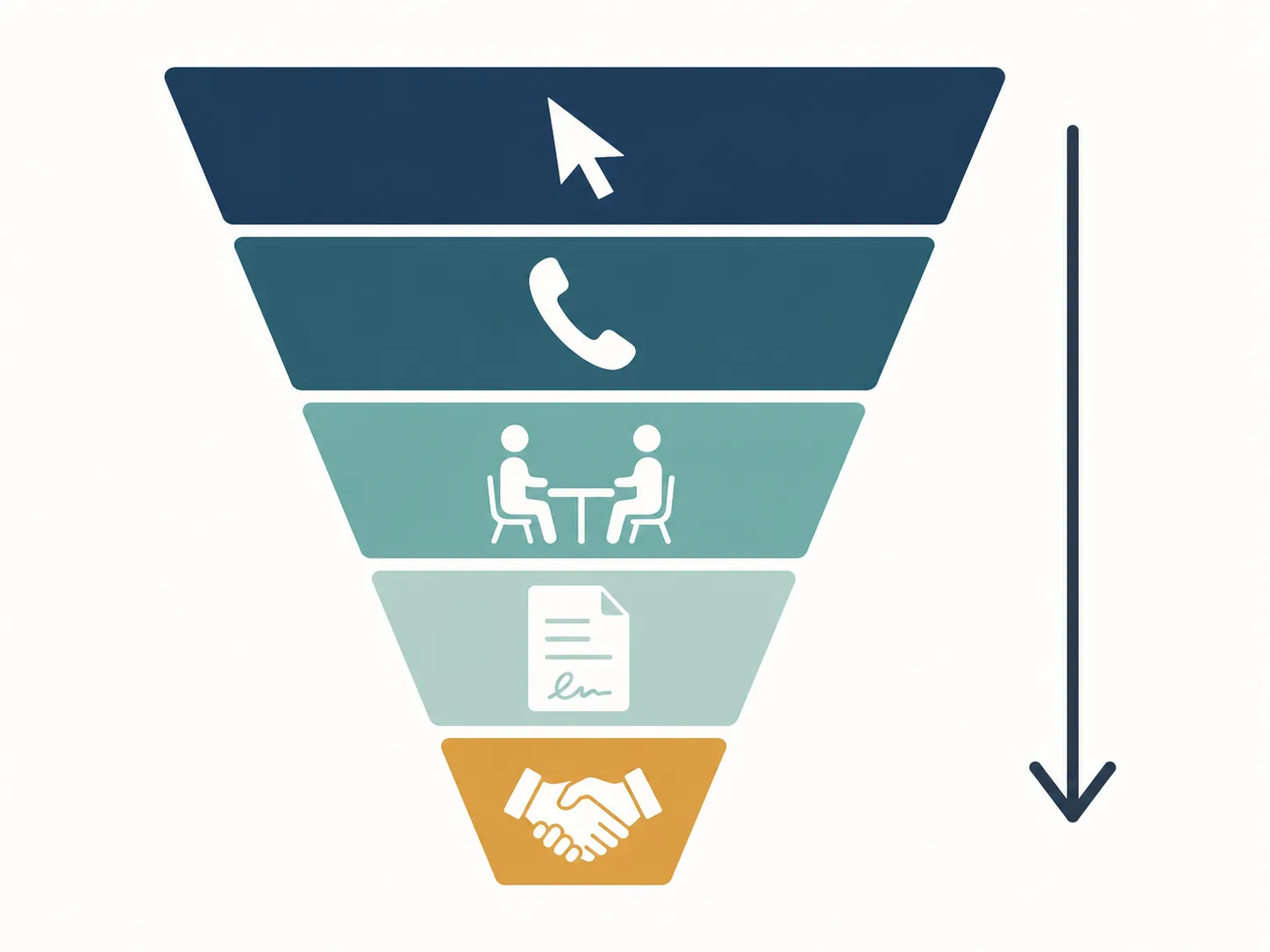
A car-accident paid-search account should be able to follow an inquiry through at least five stages: click, call or form, qualified inquiry, consultation, and signed retainer. If it cannot, the firm is not really buying “car accident cases.” It is buying platform-reported conversions and hoping the downstream ratio behaves.
- Call tracking should separate first-time callers from repeat callers and should preserve campaign, ad group, keyword, match type, device, and landing-page context where possible.
- Calls should be classified after the fact: qualified accident inquiry, no injury, wrong geography, existing client, vendor, duplicate, spam, or another category that intake actually uses.
- Missed calls should not be hidden inside the same conversion bucket as answered calls.
- Consultation outcomes should be pushed back to the media team, not trapped in the case-management system.
- Signed retainers should be imported as offline conversions so bidding can learn from retained cases, not just cheap inquiries.
The missing import is not a technical footnote. If Google Ads sees every call over a duration threshold as equally valuable, Smart Bidding can learn to find more of the calls that are easiest to generate. That may lower CPL while starving the campaign of the cases the firm actually wants. The same dirty-signal problem shows up in Sacramento auto-accident campaigns where platform conversions and signed-case signals diverge.

This is also why intake benchmarks belong in the paid-search budget conversation. Walker’s under-five-minute first-response benchmark and under-10% missed-call target are not generic service standards; for paid search, they change the denominator in the signed-case calculation.[6] A firm that misses calls after paying for high-intent accident clicks is not experiencing a media-buying problem alone. It is leaking the inventory it already bought.
A budget should be built backward from retained cases
A cleaner planning model starts with the firm’s acceptable cost per signed case, not with someone else’s CPL. That acceptable number depends on case value, gross margin, attorney capacity, settlement timing, referral fees where applicable, and the firm’s appetite for variance. The paid-search team does not need to pretend those business inputs are all media metrics. It does need to know the ceiling they create.
From there, the account can work backward:
- Define the maximum acceptable cost per signed car-accident case.
- Measure actual inquiry-to-consultation and consultation-to-retainer rates by source, not across the whole firm.
- Translate the signed-case target into an allowable qualified-lead cost.
- Use click-to-qualified-lead rate to estimate the CPC ceiling by query group and market.
- Import qualified inquiries, consultations, and signed retainers back into the ad platform with different values.
The same backward-budget discipline is easier to see in local examples because geography strips away some of the false comfort of national averages. The Las Vegas pedestrian-accident budget model and the Albuquerque pedestrian-accident budget model both use the same basic move: start with retained-case economics, then decide what the account can afford to pay upstream.
That backward model also gives the media buyer a defensible answer when a partner asks why the campaign did not chase a cheaper CPL. If the cheaper lead source produces fewer consultations or fewer retainers, it is not cheaper. It is just earlier in the funnel.
What to ask before treating any benchmark as a budget
Before a firm commits spend around a published car-accident or PI benchmark, the useful questions are narrower than “Is this source reputable?” They are the questions that determine whether the number can survive contact with intake.
- Does the figure measure a click, platform conversion, qualified lead, consultation, signed retainer, or case revenue?
- Is the sample blended legal, personal injury, accidents and PI, or specifically car accidents?
- Is the source first-party agency data, a platform benchmark, a commercial landing page, or a synthesis of audits and third-party reports?
- Are phone calls and forms deduplicated before CPL is reported?
- Are missed calls, spam, wrong-market contacts, and no-injury inquiries excluded from qualified-lead counts?
- Are consultations and signed retainers imported back into the ad platform as offline conversions?
- Can the firm calculate cost per signed case by campaign, market, and query class?
If the answer to the last question is no, the account is still upstream of the metric that matters. Published CPLs can frame expectations. They cannot set the budget. For car accident attorney paid search ads, the working number is cost per signed case, and any account that cannot connect calls, intake outcomes, consultations, retainers, and offline imports is not yet measuring the channel it thinks it is buying.
References
- Google Ads Benchmarks 2025 — WordStream.
- Legal Search Advertising Benchmarks — LocaliQ.
- Cost-per-Lead, CTR and Conversion % for Injury Lawyers — Majux.
- LucrativeLegal agency page — LucrativeLegal.
- Personal Injury Lawyers Industry Marketing Benchmarks 2026 — Cufinder.
- Year-End Legal Marketing Review — Walker Advertising, Jan. 2026.