
The double-sided AI impact on YouTube ad economics
A data-led analysis of how AI-generated content flooding YouTube inventory and AI bidding automation are pulling CPM economics in opposite directions, and what verifiable signals media buyers should monitor in Q3 2026.
- Platform
- Google Ads
- Bid strategy
- Automated bidding
- Difficulty
- Intermediate
- Last reviewed
- 2026-08-03
No specific Benchmarks record is cited for this tactic yet — treat it as directional, not evidence-backed.
In Q3 2026, the practical question for buyers running paid ads across YouTube creator inventory is not whether AI is “good” or “bad” for YouTube. It is whether the buyer can still tell the difference between a campaign that is performing and an inventory pool that is getting worse.
Those two signals now move independently. A Demand Gen or Performance Max campaign can show a cleaner CPA while its YouTube placement report fills with low-effort, repetitive, or oddly templated channels. The opposite can happen too: an ugly placement review can sit under an account that is still finding efficient conversions because automated bidding is good at harvesting the pockets that work. CTR does not settle the argument. Neither does a green status message telling the buyer the campaign is out of learning.

The pressure is coming from both sides of the auction. On the supply side, cheap AI and template production can increase the volume of monetizable-looking video inventory faster than human review norms can absorb. On the demand side, Google is pushing more AI into campaign construction, feed-driven creative, creator discovery, and bidding. The buyer’s job is not to pick one narrative. It is to separate the dashboard that measures account performance from the one that measures placement risk.
The evidence register: what is actually measured, and what is only claimed
The useful evidence is narrower than the industry argument around “AI slop” usually suggests. Some numbers describe feed density in a specific test. Some describe YouTube policy language. Some describe media-reported enforcement. Some are Google product claims. They should not be blended into one generic statement about YouTube quality.
| Side of the auction | Dated signal | What it supports | What it does not prove |
|---|---|---|---|
| Supply | Kapwing reported that, in a single new-account experiment using the first 500 recommended Shorts, 21% were AI-generated and 33% qualified as “brainrot,” with data as of October 2025. [1] | A buyer should treat low-quality AI/template density as an observable placement-risk signal, especially in Shorts-heavy environments. | It is not a platform-wide census of YouTube inventory and should not be used as if 21% of all Shorts are AI-generated. |
| Supply / policy | YouTube’s channel monetization policy renamed “repetitious content” to “inauthentic content” effective July 15, 2025. [2] | The policy concern is pattern-based: mass-produced, repetitive, or low-originality formats can lose monetization eligibility. | The rename does not mean YouTube bans AI content as a category. |
| Supply / enforcement | In July 2026 coverage, YouTube clarified three problem categories: generic/repetitive or template content, unsatisfying or off-putting content, and AI personas on sensitive topics. [3][4] | The enforcement frame is about viewer experience, repetition, and authenticity signals rather than AI provenance alone. | The clarification does not remove ambiguity for faceless channels or prove consistent enforcement across all channels. |
| Supply / enforcement | January 2026 reporting described 16 channel terminations tied to inauthentic-content enforcement, with roughly 35 million combined subscribers, 4.7 billion lifetime views, and an estimated $10 million per year in ad revenue. Those are media estimates, not platform-confirmed figures. [5] | Large, monetized channels can be affected, so this is not only a long-tail spam issue. | It does not establish the overall frequency of termination or the share of AI channels affected. |
| Demand | Google said on May 20, 2026 that advertisers using product feeds in Demand Gen saw 33% more conversions on average at a similar cost per action. [6] | Google is positioning YouTube and Demand Gen as more shoppable, feed-driven performance inventory. | It is a platform claim with no published sample size or methodology in the cited announcement; buyers should verify it against their own accounts. |
| Demand | Search Engine Land’s coverage of the 2026 Demand Gen updates emphasized faster YouTube conversion tools, while separate March 2026 coverage described AI creator matching and new creator-partnership formats. [7][8] | The buy side is becoming more automated across targeting, creative packaging, creator discovery, and conversion paths. | Product adoption is not the same as incremental lift. |
| Demand / creative | Google’s Asset Studio updates described Gemini-powered creative systems, including Gemini Omni. [9] | Ad asset production is being pulled into the same automation stack as targeting and bidding. | Creative generation does not by itself prove better inventory quality or better business outcomes. |
| Macro | PPC Land, citing Ian Whittaker’s analysis, described YouTube ad revenue growth decelerating from a 45.9% peak in 2021 to about 12.5% year-to-date 2025, while noting YouTube ad revenue of $36.1 billion in 2024. [10] | YouTube is still huge, but its growth story is under pressure. | Macro revenue growth does not identify which placements are safe, efficient, or incremental for a specific advertiser. |
| Macro / creator economy | Neal Mohan’s January 21, 2026 letter said YouTube paid more than $100 billion to creators, artists, and media companies over the prior four years, and that more than 1 million channels were using AI tools daily in December 2025. [11] | AI tool use is already mainstream inside the creator economy, not a fringe production method. | Daily use of AI tools does not mean the resulting channels are low quality or policy-violating. |
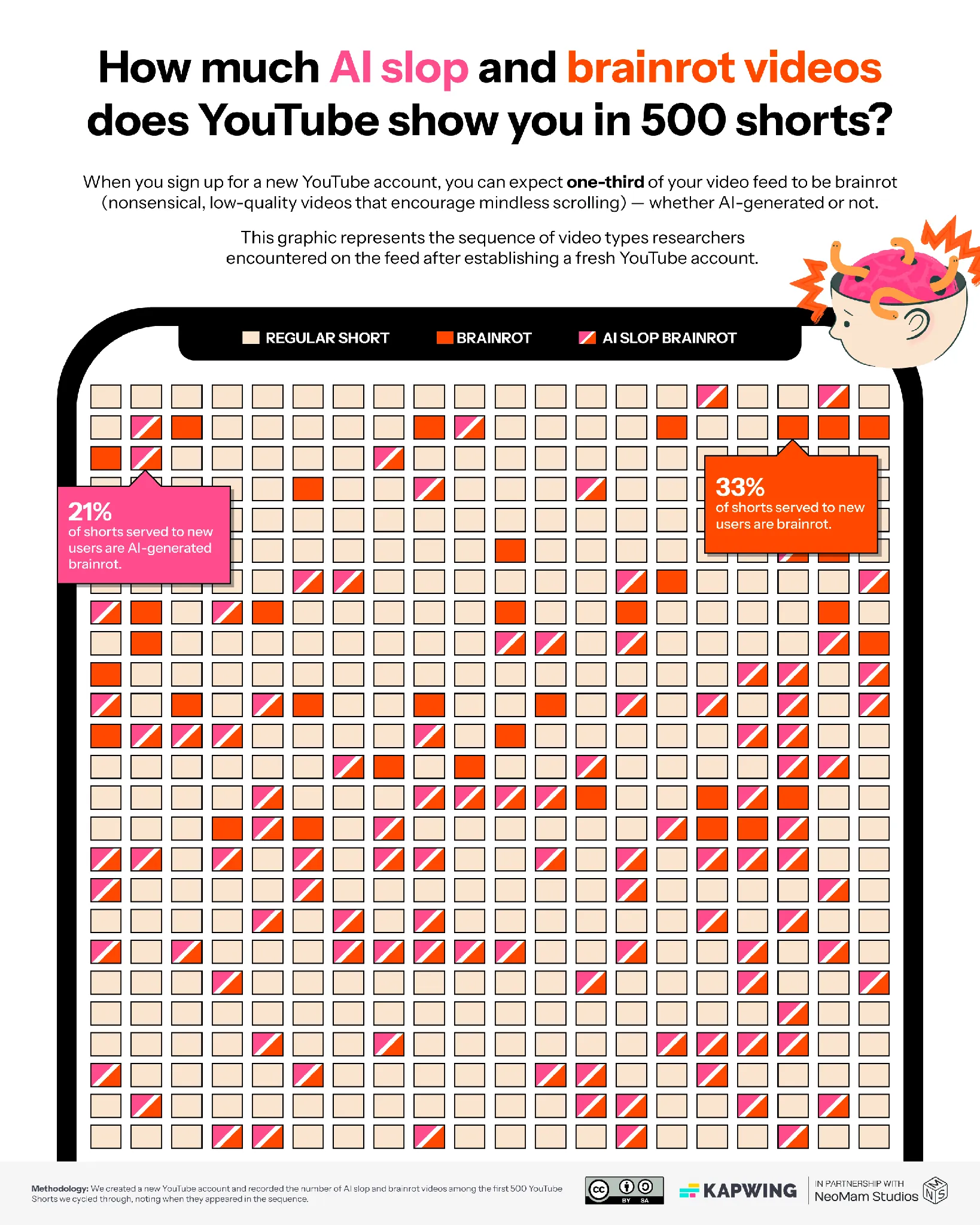
The important split is visible in that table. Kapwing’s finding is valuable because it is concrete and inspectable: first 500 Shorts, new account, October 2025, category breakdown. It is also easy to misuse. It supports a directional concern about feed density and repeatable low-quality formats. It does not support a clean platform-wide percentage, and it certainly does not tell a buyer whether a specific campaign’s conversions came from bad inventory.
The Google Demand Gen number has the opposite problem. It is directly relevant to buyers, because product feeds can change how YouTube traffic behaves inside a performance campaign. But the 33% conversion increase is a vendor claim without a published sample size or methodology in the announcement, so it belongs in the test-plan column, not the forecast column. If the account’s own pre/post or split evidence does not reproduce the lift, the platform average does not pay the invoice.
How low-cost AI and template production change the supply side
The supply-side issue is not that a video used an AI tool. YouTube’s own creator economy now includes large-scale daily AI-tool usage, and the company’s policy language does not make AI provenance the decisive test. The real inventory problem is the production pattern: low-originality scripts, repeated visual templates, synthetic narration, recycled hooks, volume-first posting, and channels that look different at the thumbnail level but feel identical once watched.
That matters for paid ads because YouTube inventory is not just a number of available impressions. It is a set of contexts in which a brand appears, a set of attention states, and a set of users arriving through different recommendation loops. A buyer can tolerate a cheap impression if it is cheap for a reason the account can measure. The problem is the impression that looks efficient in aggregate because the campaign found a low-cost pocket, while the placement report shows the brand repeatedly appearing beside interchangeable channels a client would not have approved manually.
Template content can also make placement review slower. A normal channel review asks whether the creator, audience, and surrounding content make sense. A template network forces a different question: is this one channel an isolated oddity, or one node in a repeatable production pattern? The channel name, avatar, language, and topic may vary while the format, pacing, synthetic voice, recycled stock visuals, and narrative structure stay nearly the same.
This is where blunt enforcement creates a second problem. The Next Web’s collateral-damage angle matters because some legitimate creators deliberately produce without an on-camera host. Faceless documentary, animation, screen-recording, essay, and compilation styles can be human-led and high-effort. If enforcement systems or marketplace heuristics lean too heavily on proxies such as on-camera presence, buyers and platforms can punish real production styles while still missing mass-produced low-quality formats. The risk signal is not “no face.” It is repeated low-originality construction.
For CPM economics, this supply pressure does not point in one clean direction. More available monetizable inventory can relieve price pressure in some auctions. More low-quality inventory can also make buyers tighten exclusions, shift budgets, or pay more for cleaner pools. If the only number being watched is blended CPM, both effects can cancel each other out while placement quality changes underneath.
Why AI bidding can improve CPA while hiding placement deterioration
Automated bidding does not need a beautiful placement report to improve an account-level CPA. It needs enough conversion signal, enough eligible inventory, and enough freedom to move spend toward users and contexts that satisfy the objective. If the conversion event is clean, that machinery can rescue accounts that a manual buyer would struggle to stabilize.

The tradeoff is visibility. A buyer looking at a blended Demand Gen line may see improving CTR, CPA, or conversion volume. That does not automatically mean the ad ran in healthy environments. It may mean the system found cheap users in high-click surfaces, remarketing-adjacent paths, feed-driven units, or Shorts contexts where the behavior is efficient but the surrounding content deserves a separate review.
Product feeds sharpen that tension. Google’s May 2026 claim says Demand Gen advertisers using product feeds saw 33% more conversions at a similar CPA, and the commercial logic is obvious: put product information closer to the YouTube impression, reduce the distance between interest and action, and give the bidding system more structured signals to work with. But if product-feed adoption coincides with a shift into cheaper or less controlled placements, the buyer has to separate the conversion gain from the inventory mix change.
The same caution applies as Google expands creator matching and Gemini-powered asset systems. Better matching can help buyers find creators faster. Faster asset generation can help accounts test more variants. Neither tells the buyer whether the resulting YouTube placements are clean, incremental, or brand-suitable. For a practical verification approach, the buyer needs the same discipline used in a broader Google Ads marketing-claims verification protocol: label the platform claim, define the account-level counterfactual, and check whether the lift survives outside the sales deck.
The July 2026 Demand Gen CPM billing change makes that separation more important, not less. When buying mechanics, creative assembly, and conversion optimization all become more automated, the account summary becomes a worse substitute for placement review. It may still be an excellent performance dashboard. It is just not an inventory-quality dashboard.
What to verify inside the account
The audit should start with a simple split: performance movement on one side, inventory movement on the other. Do not let one overwrite the other.
| Question | Performance dashboard | Inventory-risk dashboard |
|---|---|---|
| Did the campaign get more efficient? | CPA, conversion volume, conversion rate, value per conversion, feed-assisted conversion movement, new versus returning customer mix where available. | Do not answer this from placements alone. A strange placement report can coexist with real efficiency. |
| Did the placement mix get worse? | Do not answer this from CTR alone. High CTR can come from format behavior, cheap attention, or accidental interaction. | Placement report by channel and video, repeated channel patterns, Shorts share, excluded placement recurrences, sensitive-topic adjacency, low-originality templates, synthetic narration clusters. |
| Did product feeds create real lift? | Compare against the account’s own baseline or a controlled structure where possible. Watch CPA and conversion quality, not just conversion count. | Check whether feed adoption changed the inventory pool, format mix, or concentration of spend in placements the client would reject manually. |
| Did exclusions help or only move the problem? | Measure CPA and volume after exclusions, with enough time for the campaign to restabilize. | Look for replacement patterns: new channels with the same format, language, cadence, or synthetic production style. |
| Is a faceless channel actually low quality? | Do not infer quality from creator visibility. | Review originality, sourcing, editing effort, topic sensitivity, repetition, and whether the channel appears to be part of a scaled template pattern. |
The placement review needs sampling discipline. Sort by spend and impressions, but also sample the long tail. Low spend placements can become the next concentration once exclusions are applied. Look for repeated structures: identical hooks, near-identical thumbnails, the same synthetic voice across unrelated channels, rapid posting cadence, or videos that appear designed to satisfy a topic trend rather than a viewer need.
Channel-level review is usually more useful than arguing about whether a single video is AI-generated. A single AI-assisted video on a credible channel is a different risk from a channel whose whole output is generic, repetitive, and low-effort. YouTube’s July 2026 clarification points in that direction: the categories are about patterns and viewer experience, not a clean AI detector.
The buyer should also keep an exclusion log that records why a placement was removed. “AI” is too vague to be useful. Better labels include repetitive template, synthetic sensitive-topic persona, off-putting content, misleading thumbnail pattern, low-originality narration, made-for-feed compilation, or client-specific brand unsuitability. That log becomes more valuable when the same pattern reappears under new channel names.
Where AI-content disclosure or provenance rules affect the campaign, keep that in a separate compliance note rather than mixing it into performance interpretation. A regulation tracker such as the site’s AI regulation and ad-targeting optimization tracker is useful for that boundary. Provenance is one question. Placement quality is another. Conversion efficiency is a third.
Where the macro story helps, and where it does not
The macro numbers explain why this tension is showing up now. YouTube remains a massive ad business, with PPC Land citing $36.1 billion in 2024 ad revenue, while also describing growth deceleration from the 2021 peak to about 12.5% year-to-date 2025. YouTube’s own January 2026 letter framed the creator economy at a different scale: more than $100 billion paid to creators, artists, and media companies over the prior four years, and more than 1 million channels using AI tools daily in December 2025. [10][11]
Those facts support the pressure picture. YouTube has a large creator payout system to protect, rising AI-assisted production inside that system, and a demand-side ad product roadmap built around automation. They do not tell a media buyer whether next month’s YouTube CPM will rise or fall. They do not identify whether a specific Demand Gen campaign is buying cleaner inventory. They do not prove that AI-assisted creators are lower quality than human-only creators.
Cost collapse on the production side is still relevant. As AI video generation gets cheaper, the economic threshold for producing another variant drops. That makes provenance checks and pattern detection more important for buyers reviewing channels at scale; the site’s AI video cost and provenance analysis is the right adjacent audit trail. But the buying decision still lands in the account: what did this campaign buy, where did it run, and what changed when automation was added?
The buyer’s Q3 2026 operating rule
Treat every major YouTube automation change as two tests, not one. The first test is whether performance improved: CPA, conversion quality, volume, value, and stability after the learning period. The second is whether the campaign bought a placement mix the advertiser can defend.
That means product feeds, AI-generated assets, creator matching, and bidding changes should be logged alongside placement movement. If CPA improves after product feeds launch, check whether YouTube format mix changed. If CTR jumps, check whether the jump came from a healthier audience or a more volatile surface. If exclusions reduce questionable placements, check whether the system replaced them with the same template pattern under different channel names.
None of this requires rejecting automation. It requires refusing to let automation grade its own inventory context. In Q3 2026, YouTube buyers need two dashboards in their head: one for performance and one for inventory risk, because AI is now acting on both sides of the auction at once.
References
- AI Slop Report: The Global Rise of Low-Quality AI Videos, Kapwing
- YouTube channel monetization policies, YouTube Help
- YouTube inauthentic content monetization policy update, Tubefilter, July 13, 2026
- YouTube clarifies policies around AI slop and upsetting videos, TechCrunch, July 20, 2026
- YouTube’s AI slop crackdown has faceless creators fearing collateral damage, The Next Web
- YouTube Demand Gen updates, Google Blog, May 20, 2026
- Google expands Demand Gen tools to drive faster YouTube conversions, Search Engine Land
- YouTube adds AI creator matching and new ad formats to its partnerships platform, Search Engine Land, March 2026
- Asset Studio updates, Google Blog
- YouTube’s ad revenue dominance challenged despite dwarfing TV budgets, PPC Land
- The future of YouTube 2026, YouTube Blog, January 21, 2026