
What Nothing Bundt Cakes Franchise Marketing Actually Costs
A detailed breakdown of every marketing fee in the Nothing Bundt Cakes franchise — national fund, local requirement, opening spend, and technology costs — benchmarked against industry averages with an honest assessment of what the combined 7% fee delivers and whether it makes sense for different revenue tiers.
The Nothing Bundt Cakes franchise marketing cost is not one line item. It is four: a 5% National Marketing Fund contribution, a 2% local advertising requirement, a one-time opening advertising spend of $10,000 to $15,000, and ongoing technology or platform fees of about $200 to $400 per month, based on FDD analyses for the 2024-2025 period.[1]
| Marketing-related cost | Amount | How it behaves |
|---|---|---|
| National Marketing Fund | 5% of gross sales | Recurring percentage fee paid into the systemwide fund |
| Local advertising requirement | 2% of gross sales | Recurring local spend on approved market-level tactics |
| Opening advertising | $10,000-$15,000 | One-time launch spend tied to the grand opening period |
| Technology/platform fees | $200-$400 per month | Recurring platform cost tied to POS, digital ordering, and customer data infrastructure |
Using the 2024 average franchised bakery net revenue of $1.48 million across 459 units, the 5% national fund translates to roughly $74,000 per year. The 2% local requirement adds about $29,600. Before the technology fee, that is approximately $103,600 a year in ongoing marketing burden for an average bakery.[1]
That number matters more than the percentage. A candidate can nod through “5% brand fund” in a franchise presentation. It feels different when the spreadsheet shows more than $8,600 a month leaving gross sales before rent, labor, cake ingredients, packaging, utilities, debt service, owner salary, or the 6% royalty are considered.

The 7% Fee Is Above The Usual Franchise Range
A combined 7% marketing obligation sits above the common franchise marketing range of about 2% to 5%, and above many QSR-style structures that pair a lower national fund with a smaller local advertising requirement.[2] Nothing Bundt Cakes is not charging a token brand contribution. It is asking franchisees to fund a full marketing machine.
The more important combined figure is 11%. Add the 6% royalty to the 5% national marketing fund, and the franchisor-controlled recurring percentage charges already claim 11% of gross sales before the franchisee spends the required 2% locally. If the local requirement is treated as an operating obligation rather than a brand-level fee, the practical marketing-and-royalty load becomes even more visible: 13% of gross sales is already spoken for before store-level costs.
That does not automatically make the fee unreasonable. It does mean the fee has to buy more than name recognition. A 7% combined marketing structure needs to produce capabilities that a single bakery owner could not sensibly build alone.
What The National Fund Appears To Buy
The national fund is where the case for the fee becomes more serious. It supports brand creative, national campaigns, paid media, data infrastructure, digital ordering, customer relationship management, and cross-channel measurement. Those are not small-business marketing chores. They are shared-system assets.
One visible piece is the Zeta Marketing Platform, which Nothing Bundt Cakes has used for identity-based audience targeting, occasion-based personalization, and cross-channel measurement. Zeta’s own case material reports 4x to 6x return-on-ad-spend goals and doubled in-store traffic, but those results should be read as vendor-reported case-study outcomes, not as a guaranteed franchisee-level return.[3]
That distinction matters. A platform can improve targeting and measurement across a system, but a bakery operator still has to turn that demand into orders, repeat visits, email capture, local relationships, and clean execution during peak seasons. The national fund can create the campaign architecture. It cannot make a weak location, thin staffing plan, or poor follow-up disappear.
The eClub is another practical asset because it gives stores a recurring audience instead of forcing every visit to be reacquired through paid media. FDD analysis shows the average bakery had about 20,000 eClub members, with top-third bakeries averaging about 31,000 and bottom-third bakeries about 11,000.[1] That gap is not just a marketing vanity metric. It points to how much owned demand a store has available when birthdays, holidays, office gifting, and seasonal limited-time products come around.
For a deeper look at the brand’s data-driven product launch work, the internal breakdown of how Nothing Bundt Cakes uses AI for new product launches is useful context. The point for franchise due diligence is narrower: the national marketing fund is paying for systemwide capability, not simply reimbursing headquarters for generic advertising.
The Local 2% Is Where Operators Prove Or Waste The System
The local advertising requirement is the part candidates should inspect most carefully in the current FDD. The 2% requirement appears in FDD analysis, while the official franchise marketing materials may not present it the same way. The operating question is simple: what counts, who approves it, how is compliance measured, and whether unused or misdirected spend still leaves the franchisee exposed.
Approved local spend can include channels such as local SEO, community partnerships, local social media, sponsorships, and hyper-local paid media. The strongest example in the available material is a Waze campaign that delivered 391% ROAS, a 52% navigation-to-visit conversion rate, and 90,253 in-store visitors over seven months across the system.[4]
Those are good numbers, but they belong to that campaign scope. They do not prove that every bakery, every local channel, or every two-percent budget will produce the same return. They do show why the local requirement should not be dismissed as a pure tax. When the franchisor provides approved channels, creative standards, campaign learning, and measurement, a local owner is not starting with a blank page.
The better operators will still have work to do. Local marketing for this concept is not only placing ads. It is collecting emails at the counter, building relationships with schools and offices, keeping hours aligned with demand, answering local search intent, and making sure seasonal traffic does not collapse into one-time transactions.
The Same 7% Feels Very Different By Revenue Tier
The cleanest way to judge the fee is not to ask whether 7% is high. It is high. The better question is what happens when the same structure is applied to a strong bakery, an average bakery, and a weaker bakery.
| Revenue tier | Average annual revenue | 5% national fund | 2% local advertising | 7% combined marketing |
|---|---|---|---|---|
| Top third | $2.08M | $104,000 | $41,600 | $145,600 |
| Average franchised bakery | $1.48M | $74,000 | $29,600 | $103,600 |
| Middle third | $1.43M | $71,500 | $28,600 | $100,100 |
| Bottom third | $985,000 | $49,250 | $19,700 | $68,950 |
Top-third bakeries average about $2.08 million in revenue.[1] At that level, the combined 7% marketing burden is about $145,600 a year. Add the 6% royalty, and the 11% national-fund-plus-royalty drag is about $228,800 before local advertising. That is a large check, but the revenue base gives the operator more room to absorb it if labor, rent, COGS, and manager payroll are under control.
The middle third, at about $1.43 million, is closer to the system average and less forgiving.[1] The 7% marketing load is about $100,100. The 11% royalty-plus-national-fund load is about $157,300. A few points of labor slippage, a bad lease, or a weaker local calendar can turn the marketing fee from a manageable growth input into a monthly pressure point.
The bottom third is where the structure becomes hardest to defend without a credible improvement plan. At $985,000 in average revenue, the 7% marketing load is about $68,950, and the 11% royalty-plus-national-fund load is about $108,350.[1] The percentage is the same as the top third, but the fixed realities of store management, rent, equipment, staffing coverage, and owner compensation do not shrink neatly with revenue.
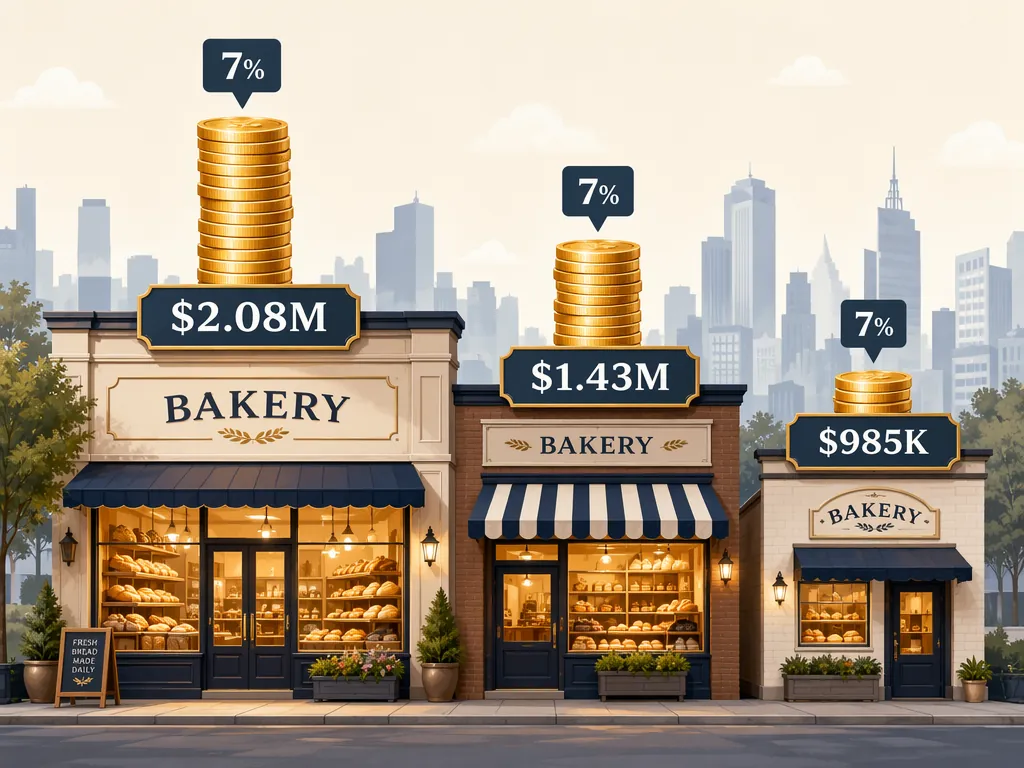
That is the regressive feature of percentage fees in a franchise system. A high-volume bakery can treat the marketing structure as the cost of access to demand generation. A lower-volume bakery may experience the same structure as an off-the-top claim on cash it badly needs elsewhere.
Marketing Execution Shows Up In Operations, Not Just Ads
The resale analysis is useful because it moves the discussion away from abstract brand support. In a sample of 40 bakeries, average revenue increased from $1.14 million to $1.28 million after new owners prioritized operating levers such as hours, Sunday service, and email collection.[1]
That does not prove marketing caused the increase by itself. It suggests something more operational and more actionable: the marketing infrastructure works better when the store is open when customers want to buy, captures customer data, and gives the system more chances to turn occasional cake buyers into repeat customers.
A bakery that treats eClub collection as a counter habit, prepares for holiday surges, keeps local search listings clean, and builds office gifting relationships is using the 7% structure differently from a bakery that simply pays the invoice and waits for national media to create traffic. The fee is the same. The operating conversion is not.
Opening Advertising Is A Smaller Due-Diligence Problem
The $10,000 to $15,000 opening advertising spend is still real cash, but it is not the same kind of burden as the recurring 7% structure.[1] It is a launch cost. A buyer should confirm timing, required vendors, approval rules, and whether the spend is coordinated with the franchisor’s grand opening process.
For operators focused specifically on the launch window, The Nothing Bundt Cakes Grand Opening Playbook is the more natural place to evaluate the 60-day opening sequence. In the broader franchise economics model, the recurring percentage fees deserve more attention because they scale with every dollar of gross sales.
System Strength Helps, But It Does Not Erase Unit-Level Math
The brand context is strong enough to matter. Nothing Bundt Cakes reached $982 million in systemwide sales in FY2025, up 15.5% year over year, and grew from 779 locations to more than 800 by April 2026.[5] KKR acquired the company in March 2026 at a reported valuation above $2 billion, with about $120 million in implied EBITDA and an approximately 17x multiple.[5]
Those are confidence signals. They show investor belief in the system and consumer demand behind the concept. They do not answer whether a specific lease, market, manager, debt structure, and local operator can support a 7% combined marketing obligation.
The same restraint applies to low closure data. Only one closure over four years is encouraging system-level information.[5] It is not a substitute for modeling conservative revenue, checking nearby-store risk, and understanding that the marketing fund does not create exclusive territory protection.
How To Model The Fee Before Signing
A serious model should not stop at the $1.48 million average. It should run at least three cases: a conservative case around bottom-third performance, a middle case around system average, and an upside case closer to the top third. The question is not whether the brand can produce high-volume stores. It is whether the proposed location and operator plan can plausibly reach the revenue band where the fee structure works.
- Verify the current FDD language for the 5% National Marketing Fund, the 2% local advertising requirement, approved local channels, and any audit or documentation rules.
- Model 7% marketing, 6% royalty, and technology fees at conservative revenue levels, not only at system average revenue.
- Ask existing franchisees how much they spend above the 2% local floor and which tactics actually produce measurable orders or visits.
- Compare eClub size, local email capture habits, hours, Sunday service, catering or gifting relationships, and seasonal execution across stronger and weaker operators.
- Check whether nearby existing or planned bakeries could limit the revenue base needed to absorb the fee structure.
The practical answer is that Nothing Bundt Cakes’ marketing fee is expensive, and it can create real margin pressure for lower-revenue stores. It is also not just a vague brand tax. The money appears to fund national creative, data infrastructure, digital ordering, CRM, approved local activation, and measurable campaign capability that most individual bakery owners could not recreate on their own.
The fee makes the most sense when the bakery can convert that infrastructure into local demand and sustain enough revenue to absorb the off-the-top load. If the conservative case only works when revenue quickly approaches average or top-third performance, the marketing fee is not the only concern. It is the line item that exposes the weakness in the whole unit-level model.
References
- Nothing Bundt Cakes Franchise Costs, Fees, Revenues, Profits — Franchise Chatter/1851 Franchise, 2024-2025 FDD analysis
- Typical Franchise Marketing Fund Range — FMS Franchise/Accurate Franchising
- Nothing Bundt Cakes Case Study — Zeta Global Resource Center
- Nothing Bundt Cakes Waze Campaign Case Study — Ansira/Waze
- Nothing Bundt Cakes Growth And Acquisition Data — KKR acquisition and FY2025 system growth reporting, March 2026
Built on this evidence
No Bidding tactic or Creative record currently cites this case file. Compare it against other results in Benchmarks.
Related benchmark reading
Report a corroborating or contradicting result
Seeing something different in your own account? Feed the data-integrity loop instead of leaving an open comment.