
Fix Claude 529 Error Without Risking Your Meta Ads Account
Learn how to fix the Claude 529 overloaded error in your AI ad tooling without triggering Meta's fraud detection. This guide covers failover chains, circuit breakers, and ad-account safety gates for media buyers.
- Platform
- Meta Ads
- Campaign type
- Advantage+
- Spend range
- All budgets
- Timeframe
- 2026-07
- Optimization events
- 50
- Verdict
- win
- Last reviewed
- 2026-07-30
When your AI ad tool starts returning Claude 529 in the middle of a Meta launch, the wrong fix is to make the loop louder. A 529 overloaded error means Anthropic is at capacity across the platform; it is not the same thing as a 429 rate-limit response on your key or workspace.[1][2] Treating it like a quota problem wastes time. Treating it like a transient hiccup that deserves unlimited retries can create a second problem inside Meta Ads.
The immediate fix is: stop aggressive retries, classify the error correctly, keep read-only monitoring alive where possible, and block automated Meta write actions until the system is stable again. In practical terms, that means bounded backoff with jitter, a circuit breaker, conditional failover, and a separate ad-account safety gate before anything touches budgets, bids, statuses, audiences, or campaign structure.

529 Is Capacity Failure, Not an Account-Level Throttle
The distinction matters because the recovery path is different. A 429 tells you that your usage is being throttled. A 529 tells you the service is overloaded. Asking for more rate limit does not solve a platform-wide capacity event, and retrying harder does not create more Claude capacity.
Claude 529 has also not been a theoretical edge case in 2026. Third-party outage tracking and operator writeups described multiple platform-wide 529 incidents on March 2, March 18, March 19, and June 2, and BleepingComputer reported that Anthropic confirmed Claude was down worldwide on July 29, 2026, one day before this article’s publication date.[1][3] The operating assumption for ad tooling should be that this can happen during business-critical windows, not only during harmless overnight analysis jobs.
For a normal internal chatbot, a few minutes of degraded service is annoying. For an AI loop that is reading Meta delivery, scoring creative, or deciding whether to shift spend, the same outage can interrupt a sequence that other systems are depending on. Meta’s learning phase depends on optimization-event accumulation; commonly cited guidance uses a floor of 50 optimization events per week per ad set, so a launch-window interruption can affect more than the duration of the Claude outage itself.[4]
The Meta Risk Starts After the Claude Call Fails
There is no public source proving a specific chain where Claude 529 retries directly caused a Meta Ads ban. That uncertainty matters. The documented pieces are narrower: Claude 529 can produce overload failures, and Meta automation specialists warn that uncontrolled API behavior, retry storms, parallel account activity, and opaque automation can increase account-integrity risk.[5][6]
The reconstructed risk mechanism is straightforward enough to design against: Claude fails, the ad tool retries the model call, upstream jobs pile up, recovery logic tries to catch up, and the Meta Marketing API sees a burst of repeated reads or writes. If those writes include budget edits, status flips, creative changes, or campaign creation attempts across multiple accounts, the problem is no longer just Anthropic availability. It is now behavior that may look abnormal to the ad platform.
That is why “eventual success” is the wrong success metric. A retry that finally gets a model answer after hundreds of failed attempts may still leave behind duplicated decisions, lost context, missing approvals, or an API trail that is hard to defend if the account is reviewed.
Triage the Workflow Before You Touch Retry Settings
Start by separating what the AI tool is allowed to continue doing from what must stop. The safest recovery plan does not treat every automation task as equally urgent.
| Automation task | During Claude 529 | Reason |
|---|---|---|
| Read-only delivery monitoring | Continue if API volume is bounded | Useful for visibility and less dangerous than write automation |
| Creative-fatigue analysis | Route to fallback or batch processing if latency allows | Usually does not need instant live mutation |
| Budget changes | Pause or require human approval | Repeated spend edits can create account and campaign-control risk |
| Campaign, ad set, or ad creation | Block until recovery unless explicitly approved | Duplicate creation attempts are hard to unwind cleanly |
| Cross-account optimization loops | Run sequentially or stop | Parallel bursts are exactly the pattern to avoid |
This triage should happen before the system enters a catch-up mode. If the queue already contains pending write decisions, freeze them with their original timestamps and inputs. Do not let a recovered model reinterpret stale campaign state as if it were current.
Use a Bounded Retry Window, Then Break the Circuit
A useful Claude 529 retry policy is intentionally small. Third-party operator guidance recommends exponential backoff with jitter, a maximum retry window of 30 seconds, and a circuit breaker that stops calling Anthropic for 10 minutes when 529 responses exceed 20% over a 5-minute rolling window.[1][2] Those numbers are not just developer hygiene. In ad automation, they are the difference between degraded service and a runaway control loop.
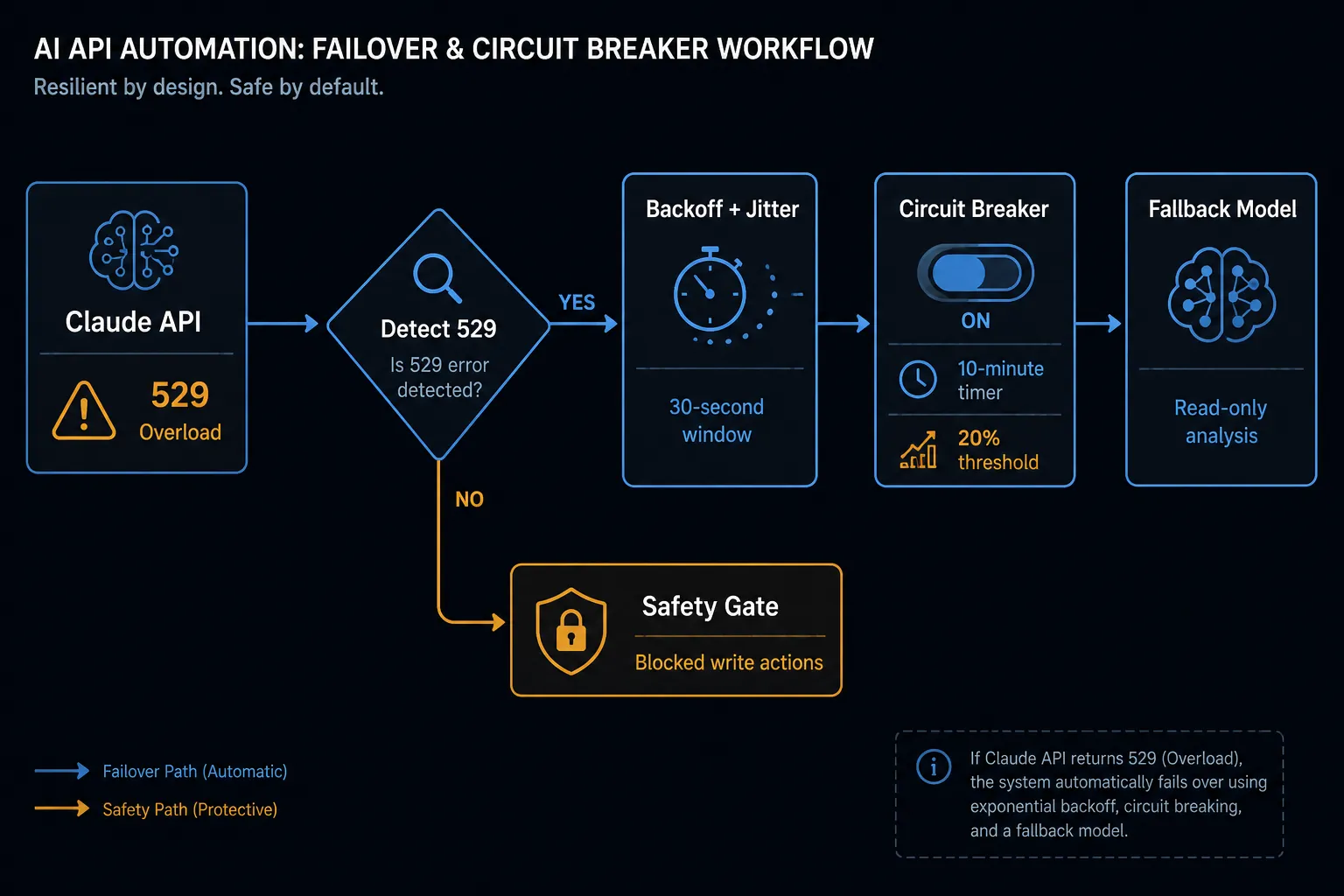
The 30-second retry window gives the system a chance to recover from short overload without letting jobs pile up indefinitely. Jitter prevents every worker from retrying on the same schedule. The 20% rolling-error threshold keeps the decision tied to current system health instead of one unlucky request. The 10-minute circuit break forces the automation layer to stop asking the same failing dependency for help.
The circuit breaker should not simply throw a generic error and disappear. It should change the operating mode of the ad tool. During the open circuit, Claude-dependent actions are marked degraded, live write automation is blocked unless separately approved, and read-only jobs either move to a fallback model or wait for the next half-open test.
async function callClaudeWithAdSafety(payload, context) {
  if (circuitBreaker.isOpen('anthropic-529')) {
    return routeDegraded(payload, context);
  }

  const deadline = Date.now() + 30_000;
  let attempt = 0;

  while (Date.now() < deadline) {
    try {
      return await anthropic.messages.create(payload);
    } catch (error) {
      if (error.status !== 529) throw error;

      metrics.count('anthropic.529', { accountId: context.accountId });
      attempt += 1;

      if (metrics.rate('anthropic.529', '5m') > 0.20) {
        circuitBreaker.open('anthropic-529', { durationMs: 10 * 60_000 });
        return routeDegraded(payload, context);
      }

      await sleep(backoffWithJitter(attempt));
    }
  }

  circuitBreaker.open('anthropic-529', { durationMs: 10 * 60_000 });
  return routeDegraded(payload, context);
}
The important part is not the syntax. It is where the fallback function leads. If degraded mode still allows the same automation worker to hammer Meta with delayed budget decisions, the circuit breaker protected Anthropic while leaving the ad account exposed.
Fail Over Only for Work That Can Safely Move
Cross-provider failover is a viable pattern when it is preconfigured and scoped. In a vendor-reported June 2 production example, an ad automation team routed 78% of Anthropic traffic to GPT-5.5 within 2 minutes and reported zero customer-facing errors.[1] That is useful as a directional operating pattern, not as independently verified proof that every advertiser should copy the same provider chain.
The safe version of failover has three filters. First, decide which tasks are eligible: summarizing delivery, classifying creative themes, drafting recommendations, and anomaly explanation are easier to move than live campaign mutation. Second, confirm that advertiser data can legally and contractually be routed to the fallback provider. Third, keep model output behind the same Meta write gates used during normal operation.
A fallback model should not receive more authority just because the primary model is down. If Claude normally recommends a budget shift that a human approves, the fallback model should also recommend, not execute. If Claude normally writes directly through a tightly scoped service account, degraded mode should reduce that permission, not preserve it.
Put Meta Write Actions Behind a Separate Safety Gate
The ad-account safety layer should sit after model recovery, not inside it. Claude may be healthy, degraded, or replaced by a fallback provider; Meta write permissions should still be governed by their own controls.
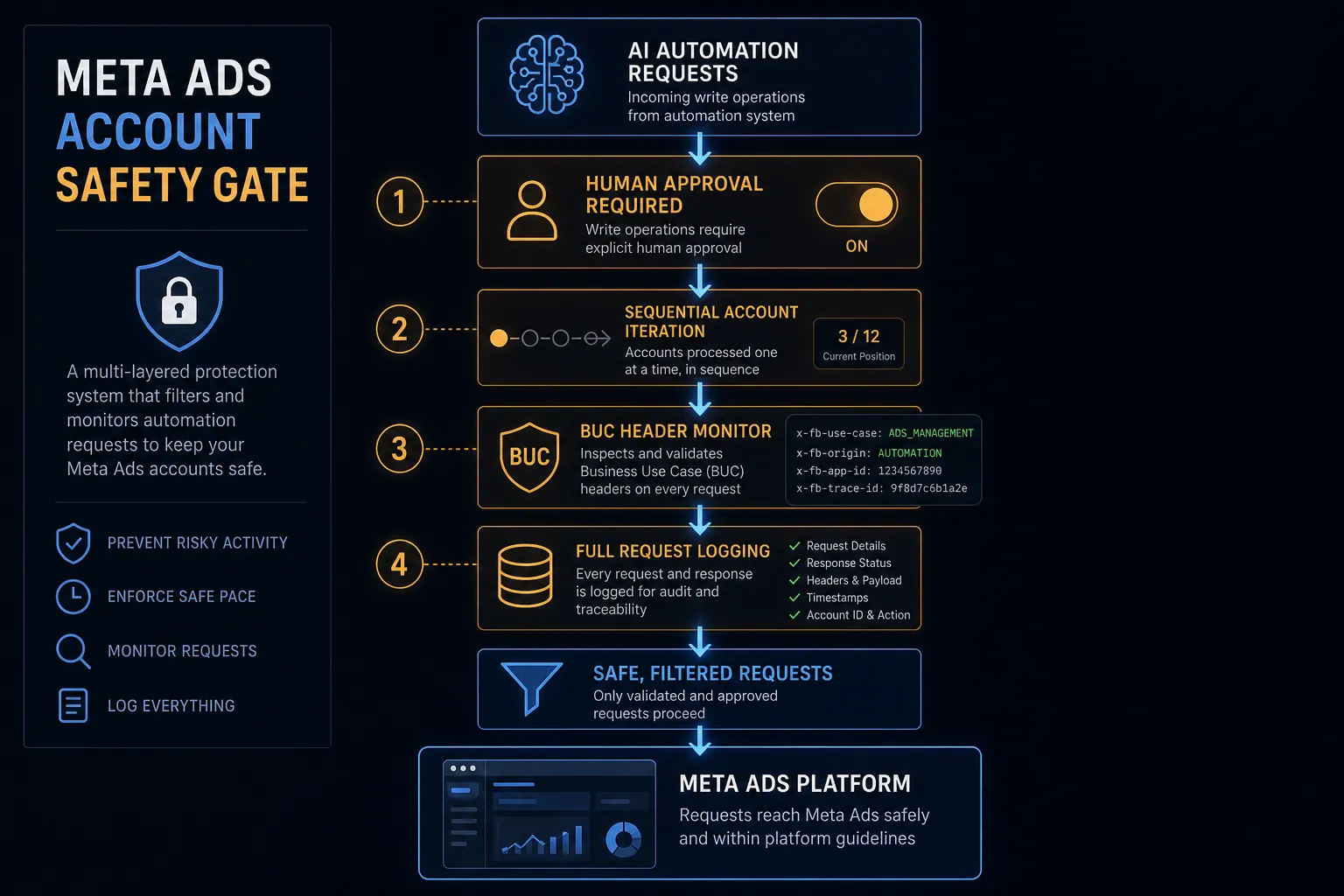
- Require human approval for writes during degraded AI mode, especially budget edits, status changes, campaign creation, audience changes, and bulk creative updates.
- Iterate accounts sequentially rather than in parallel, so one recovery process does not create a cross-account burst of Marketing API activity.
- Monitor Meta business-use-case headers where available, including BUC-related rate and usage signals, so the automation layer can slow down before Meta forces the issue.
- Log every model request, model response, proposed action, approval, Meta API request, Meta response, account ID, campaign ID, and timestamp for auditability.
- Use idempotency or deduplication keys around write jobs, so a recovered queue does not create duplicate campaign objects or repeated budget edits.
The BUC and logging pieces are easy to underrate until something goes wrong. If Meta restricts an asset or a client asks why spend changed, “the AI retried” is not an audit trail. You need to know which system made the recommendation, what account state it saw, who approved it, and which exact API request changed the account.
Sequential account iteration is also not just politeness toward an API. If one Claude outage causes 30 client accounts to enter recovery at the same time, parallel workers can make a local capacity incident look like coordinated automation behavior. Slowing the loop down preserves optionality. It gives operators time to see whether the problem is isolated, whether the fallback is producing sensible output, and whether Meta usage signals are changing.
A Practical Recovery Flow for Advertiser AI Tools
For a custom Claude-to-Meta workflow, the recovery flow should be explicit enough that an operator can read it during an incident and know what the system is doing.
- Detect 529 separately from 429, 500, authentication failures, and Meta API errors.
- Retry Claude only inside a bounded 30-second window with exponential backoff and jitter.
- Track 529 rate over a 5-minute rolling window and open a 10-minute circuit breaker when the rate exceeds 20%.
- Move eligible read-only analysis to a fallback model if data policy, provider terms, and client obligations allow it.
- Freeze or queue unsafe Meta writes behind human approval while the AI layer is degraded.
- Process accounts sequentially, watch usage headers, and log the full chain from model input to Meta response.
- After the circuit half-opens, test with low-risk read-only calls before restoring write automation.
The half-open step is where many ad tools are too optimistic. A single successful Claude call does not mean the campaign automation loop should resume full control. Restore read-only monitoring first, then recommendation generation, then approved writes, and only then any narrow direct-write automation that existed before the incident.
Where Message Batches Fit
Anthropic’s Message Batches API is a good lane for work that does not belong in a live recovery loop. Ryze’s advertising workflow writeup describes batch creative analysis as a fit for overnight processing, with a 50% discount and a 24-hour processing window.[7] That tradeoff is useful for creative-fatigue reports, account summaries, post-launch diagnostics, and bulk ad-copy review.
It is not the main fix for live campaign continuity. A 24-hour window is the wrong shape for a budget guardrail, a launch monitor, or an alert that needs to tell a buyer why delivery fell apart this morning. Use batches to remove non-urgent load from synchronous Claude calls before the next incident, not to rescue a live loop that is already failing.
What Smaller Buyers Can Do Without a Full Gateway
Not every media buyer has an API gateway, circuit-breaker service, and observability stack. The same safety logic still applies at a smaller scale.
- Turn off auto-apply for budget and status changes in any Claude-connected ad workflow during a 529 incident.
- Reduce the tool to read-only reporting until Claude responses stabilize.
- Avoid bulk retries across multiple ad accounts; check one account at a time.
- Export or screenshot the tool’s recommendations before manually applying anything in Meta Ads Manager.
- Do not reconnect multiple automation tools at once after the outage clears.
A simple manual pause is often safer than a clever retry configuration nobody will inspect until Monday. The operational goal is to preserve campaign control and account trust while the model provider is unstable.
The Standard That Fixes Claude 529 for Advertisers
Fixing Claude 529 for advertiser AI tools is not the same as forcing Claude to answer. A healthy design accepts that Anthropic can be overloaded, that fallback models have limits, and that Meta Ads is not a passive downstream database.
The safe standard is narrower and more useful: detect 529 correctly, retry briefly, break the circuit early, fail over only where the work and data policy allow it, and keep Meta write actions behind approval, sequencing, usage monitoring, and logs. That keeps ad operations stable without letting degraded AI infrastructure create platform behavior that looks abusive.
References
- Claude API Error 529 'overloaded_error': 8 Fixes + Failover (2026), ofox.ai
- Claude Code Overloaded Error? Fix API Error 529 Without Mistaking It for 429, LaoZhang.ai
- Anthropic confirms Claude is down worldwide, BleepingComputer
- AI Ad Tools for Media Buyers: The 2026 Working Stack, Ad Library
- Will Claude Code Get My Meta Ads Account Banned?, Zentric Digital
- Can You Automate Meta Ads With Claude Code?, Adamigo
- Claude API Advertising Creative Analysis Automation, Ryze
Built on this evidence
No Bidding tactic or Creative record currently cites this case file. Compare it against other results in Benchmarks.
Related benchmark reading
Report a corroborating or contradicting result
Seeing something different in your own account? Feed the data-integrity loop instead of leaving an open comment.