
The Five-Year Playbook Behind Burger King's Whopper Guarantee
Brands considering a public product guarantee often skip the foundational work. Burger King's five-year turnaround shows why operations, product quality, and customer listening must come first, and how that sequence made the Whopper Guarantee a credible capstone rather than a risky promotion.
Burger King’s Whopper Guarantee went live on July 20, 2026, with a simple public promise: if a guest’s Whopper does not meet expectations, the guest can scan a QR code and redeem a free Whopper. The company also put a Your Way Champion role inside restaurants to oversee the experience, a detail that matters more than the novelty of the offer itself.[1]
Three days after launch, there is no serious way to call the Whopper Guarantee a proven redemption driver, traffic engine, or ROI story. There is no post-launch redemption curve to study yet, no evidence of repeat behavior, and no public read on whether guests will treat the pledge as a trust signal or simply as a free-food mechanic. What can be evaluated is the sequence that made the promise survivable.
That sequence is the useful part. A brand with inconsistent food, strained operators, and stores that cannot absorb extra pressure should be careful about inviting the public to judge every sandwich. Burger King had been that kind of system not very long ago. In 2021, it ranked 10th out of 12 in guest satisfaction, franchisee profitability sat around $125,000, only 37% of stores had a modern image, and same-store sales trailed the category by 700 basis points.[2]
The guarantee would have been reckless in 2021
A product guarantee sounds like a marketing department decision. In a franchise system, it is an operating decision with a marketing wrapper. The guest hears a promise from the brand. The store manager inherits the lunch-rush dispute. The franchisee pays for labor, training, equipment, remodel participation, and whatever friction the promise creates at the counter or drive-thru.
That is why the 2021 baseline is not background decoration. It explains why a Whopper guarantee would have had a different meaning then. If satisfaction is low, stores are under-modernized, and franchisee profitability is weak, a public pledge does not create accountability. It exposes the gap between headquarters’ language and the store’s capacity to deliver.
Burger King’s eventual guarantee is interesting because the company did not begin with the guarantee. It began with the less glamorous repair work: capital, field support, franchisee quality, store modernization, product changes, and guest listening. Those pieces do not make for the cleanest campaign deck, but they decide whether a campaign can travel through the system without breaking.
Reclaim the Flame put money and supervision behind the message
Burger King’s Reclaim the Flame plan, running through the 2022–2025 period, put parent-company investment and franchisee co-investment behind the turnaround. QSR Magazine reported a $700 million parent investment, plus $1.5 billion in franchisee co-investment.[2]
The money matters, but the allocation matters more. A brand can spend heavily and still leave operators facing the same bottlenecks. Burger King’s reported changes touched the parts of the system that determine whether a promise becomes real inside restaurants: the field team doubled to more than 200 coaches, more than 1,000 franchise ownership swaps took place to strengthen the operator base, and 60% of stores were remodeled through the Royal Reset program.[2]
| Turnaround lever | Why it mattered before a public guarantee |
|---|---|
| $700 million parent investment | Gave the turnaround corporate funding rather than asking operators to absorb the full burden |
| $1.5 billion franchisee co-investment | Signaled that the store base had to participate in the reset, not just receive a campaign |
| 200+ field coaches | Put more operational support closer to restaurants |
| 1,000+ ownership swaps | Addressed operator quality and system alignment |
| 60% remodeled stores | Improved the physical environment where the brand promise had to be delivered |
The remodel figure is especially practical. Guarantees are experienced in real buildings, with real kitchen flows, drive-thru pressure, dining-room expectations, and equipment constraints. A more modern store base does not guarantee perfect execution, but it reduces the absurdity of asking dated restaurants to carry a fresh public promise.

The operating movement showed up in the reported trajectory. Burger King moved from 10th to 6th in QSR guest satisfaction, and same-store sales shifted from 700 basis points behind the field to 300 basis points ahead.[2] Those numbers do not prove the guarantee will work. They do show that the company was no longer making the pledge from the same weak position it occupied in 2021.
The Whopper itself had to earn the right to be guaranteed
A guarantee attached to a flagship product is unforgiving. It concentrates judgment on the item the brand most wants to own. For Burger King, that meant the Whopper could not remain merely familiar. It had to become more reliably satisfying.
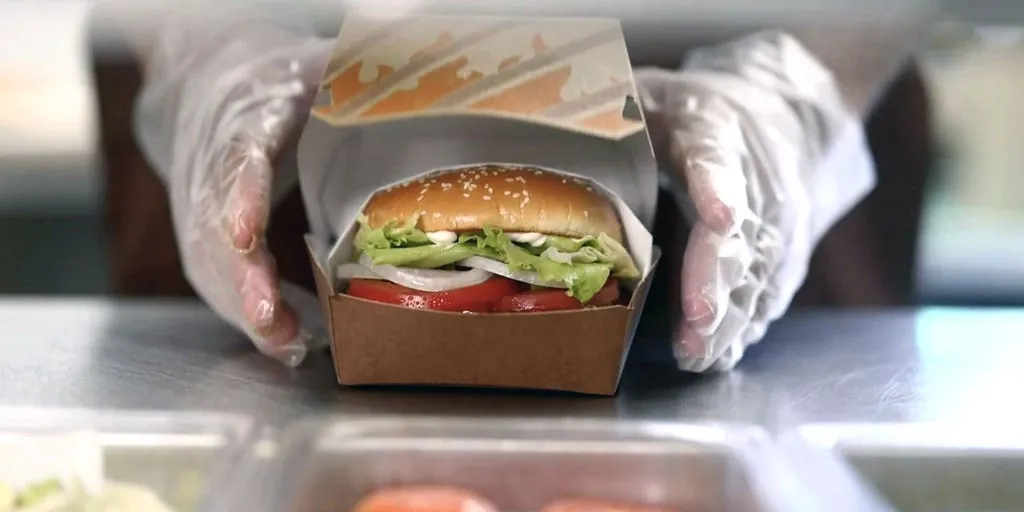
The product changes were specific rather than abstract: a glazed bun, new mayonnaise, and a clamshell box designed to keep the sandwich hotter. QSR Magazine’s investor day coverage, attributed to Tom Curtis’s presentation, reported that Whopper satisfaction rose from about 77% in 2022 to more than 87% by 2026, a near-10-point gain.[2]
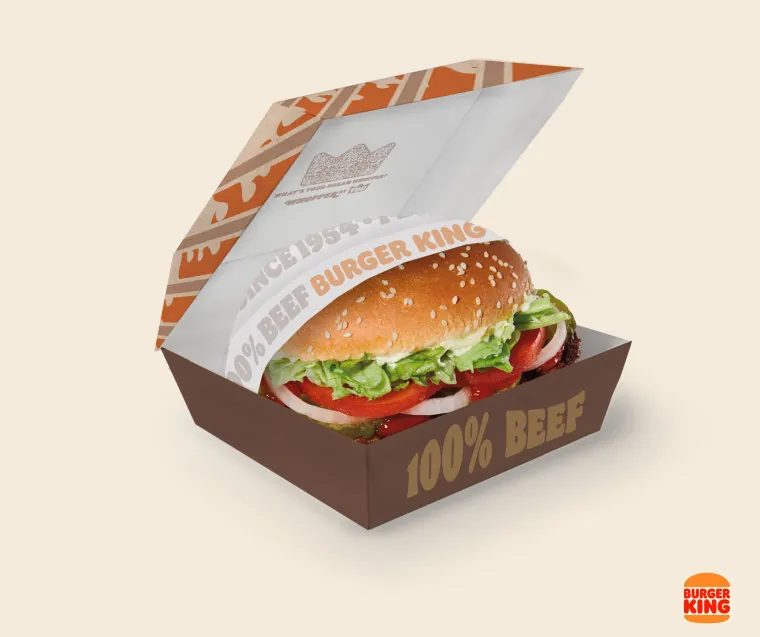
That 87% figure should be used carefully. It is not an independently audited public standard in the materials available here; it comes through QSR Magazine’s account of Curtis’s investor day presentation. Still, the directional point is important. Burger King did not ask guests to hold the Whopper to a higher standard before it had changed the sandwich and reported a material satisfaction gain.
The clamshell detail is a good example of the kind of improvement that rarely gets campaign-level attention but often decides the guest experience. A hotter sandwich is not a positioning line. It is the result of packaging, holding time, kitchen discipline, and handoff. If those conditions are not handled, the guarantee becomes an invitation for avoidable complaints.
Listening came after repair, not instead of it
In February 2026, Burger King president Tom Curtis put his personal phone number into a national announcement and invited guests to send feedback directly. The company said the move produced more than 30,000 calls and texts.[3]
That kind of gesture can be empty if it arrives too early. Giving out an executive phone number does not fix slow service, cold food, outdated stores, or strained franchise economics. It can even make things worse by collecting evidence the system has no realistic plan to act on.
Placed after the Reclaim the Flame work, the listening initiative did something different. It shifted the brand’s posture from broadcast to response. The message was no longer only “look at the new campaign.” It became “tell us what is still wrong.” That is a harder stance for a brand because it creates witnesses, records complaints, and hands the organization a backlog of expectations.
The Your Way Champion role in the guarantee phase sits on that same operating line. A QR-code redemption mechanism may handle the offer, but someone in the restaurant still has to own the experience. Naming a store-level role does not guarantee flawless execution. It does show that Burger King understood the pledge needed a human owner inside the unit, not just a consumer-facing mechanic.[1]
The Oscars apology worked because it was not carrying the whole turnaround
Burger King’s March 2026 brand campaign, “There’s A New King And It’s You,” gave the turnaround its loudest public moment. The 60-second Oscars ad apologized to guests and symbolically fired the King mascot. BarkleyOKRP’s case study reported 7.2 billion earned impressions and 4.5 million social engagements from the campaign.[4]
Those are the numbers that travel easily in executive presentations. They should, because earned attention at that scale is hard to get. But they are campaign-phase metrics, not proof that the later Whopper Guarantee drove redemption, traffic, or incremental profit. They show reach and reaction around the broader brand reset.
The apology mattered because it did not ask a mascot to solve an operating problem. By the time the brand took that stage, Burger King had already been investing in the system, changing the store base, adjusting product quality, and gathering guest feedback. The creative could be bold because it was not the first act of accountability.
The broader 2026 results were strong enough to make the campaign look less like noise. BarkleyOKRP reported 5.8% same-store sales growth, number-one QSR traffic growth for four consecutive weeks, and more than 500 stores with record sales in March.[4] QSR Magazine also covered the revival strategy’s notable results.[5] Those outcomes belong to the broader turnaround and campaign period, not specifically to the July guarantee.
What the Whopper Guarantee actually proves so far
The guarantee is a public accountability mechanism attached to a product that Burger King says it improved. It is also a demand placed on stores. Guests have been given a visible path to say the sandwich missed expectations, and stores have been given a named role to help manage the promise.[1]
That makes the campaign structurally different from a discount, a mascot reset, or a limited-time stunt. A discount can succeed even if the underlying experience remains mediocre; it only has to move transactions for a period. A guarantee asks the organization to let the customer judge whether the core product lives up to the claim.
Still, the launch timing limits the conclusion. As of July 23, 2026, the Whopper Guarantee has been in market for only three days. The available evidence supports a case that Burger King earned a more credible position from which to make the pledge. It does not yet support claims about adoption, redemption quality, margin impact, sustained traffic, or franchisee satisfaction with the execution burden.
The transferable lesson is the order of work
For marketers studying the Burger King case, the temptation is to copy the visible move: put a guarantee on the hero product, add a QR code, give the campaign a public accountability hook, and build a media plan around confidence. That is the wrong extraction.
The more useful playbook is sequential:
- Identify the operational baseline honestly, including satisfaction, franchisee economics, store condition, and sales position.
- Fund the parts of the system that will have to carry the public promise.
- Improve the flagship product in ways guests can experience, not just ways the brand can describe.
- Create feedback channels only when the organization has enough capacity to respond.
- Turn the campaign outward after the system has been given roles, tools, and standards.
- Treat the guarantee as a consequence of earned confidence, not as the source of it.
That order is less glamorous than the final promise, but it is the part leadership teams can actually use. A guarantee without preparation transfers risk downward. A guarantee after product work, store investment, field support, franchisee repair, and listening can become a credible expression of the work already done.
Burger King’s Whopper Guarantee may become a strong promotion. It may create useful feedback, strengthen trust, or generate measurable repeat behavior. Those outcomes have not been proven yet. As of Q3 2026, the proven lesson is sequencing: do not copy the guarantee first; copy the order of work that made the guarantee survivable.
References
- Burger King Continues Turning Guest Feedback into Action with the 'Your Way Champion' and Whopper Guarantee, BK Newsroom
- The Multi-Year Journey of How Burger King Earned the Right to Grow Again, QSR Magazine
- Burger King Puts Its President on the Line, Giving Guests Direct Access to Share Feedback, BK Newsroom
- There's a new king and it's you., BarkleyOKRP
- Burger King's Revival Strategy Shows Notable Results, QSR Magazine
Built on this evidence
No Bidding tactic or Creative record currently cites this case file. Compare it against other results in Benchmarks.
Related benchmark reading
Report a corroborating or contradicting result
Seeing something different in your own account? Feed the data-integrity loop instead of leaving an open comment.