
How 35,000 Customer Calls Built the Whopper Guarantee
A case study of Burger King's Listening Initiative and the Whopper Guarantee: how President Tom Curtis's personal feedback line generated over 35,000 unfiltered conversations, and how that operational feedback loop produced on-site manager roles and a frictionless redemption mechanic that the brand could market as evidence, not aspiration.
Burger King’s Whopper Guarantee is only three days old as of July 23, 2026, so the honest version starts with a constraint: there is no meaningful post-launch evidence yet. No redemption rate, no proven satisfaction lift, no sales impact. What exists is the launch design. On July 20, Burger King announced that guests who are unhappy with a Whopper can use a QR code in the Whopper box, enter a six-digit code, and receive a free Whopper on a future visit without needing to download the Burger King app.[1]
That mechanic is the part worth slowing down for. A guarantee can be written in one meeting. A frictionless recovery path usually cannot. The Whopper Guarantee becomes a more defensible marketing claim because Burger King can point upstream: before the public promise, President Tom Curtis put his personal phone number into the market, personally returned roughly 2,000 customer calls, and the company collected more than 35,000 calls and texts within weeks through what it called the Listening Initiative.[2]
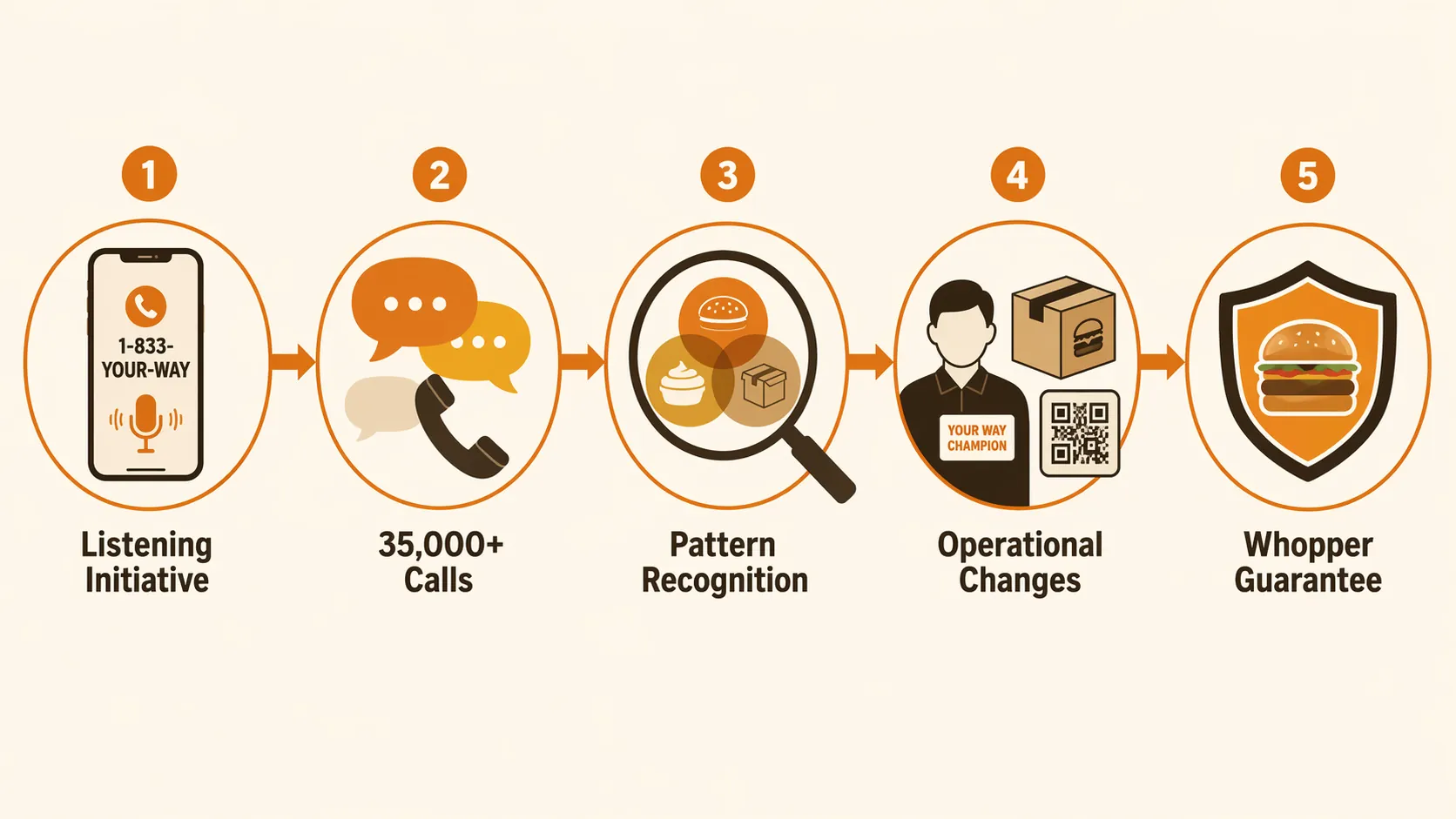
The marketing lesson is not that every brand should publish an executive’s phone number. Most should not. The useful lesson is narrower: customer feedback becomes campaign material only after it has changed something a customer can actually experience. In this case, the chain is visible enough to inspect.
| Stage | What Burger King Put Into The System | Why It Matters For Marketing |
|---|---|---|
| Listening | Curtis’s personal number, returned calls, franchisee phone numbers in restaurants | Feedback was not confined to a survey dashboard or social media recap |
| Diagnosis | Repeated complaints about product quality, packaging, service recovery, and order fixes | The brand could identify operational patterns rather than isolated anecdotes |
| Operational change | Bun, packaging, mayo, Your Way Champion role, and QR-code recovery flow | The promise was attached to things restaurants and guests could recognize |
| Marketing claim | Whopper Guarantee announced publicly on July 20, 2026 | The campaign could say it was built from feedback, not merely inspired by feedback |
The Guarantee Is New. The Listening Was Not.
The timeline matters because it keeps the case from becoming a campaign recap. In March 2026, Burger King’s brand reset included a more exposed form of listening: Curtis’s number was made available to customers, and early coverage reported more than 20,000 messages by that point.[3] By April, the cumulative figure had passed 35,000 calls and texts.[2] Those numbers do not need to be treated as a contradiction. They look like two measurement points in a fast-moving feedback push.
The more important distinction is not 20,000 versus 35,000. It is filtered versus unfiltered. Standard surveys are useful, but they are usually built around what the company already knows how to ask. Social listening is useful, but it often captures public performance, outrage, jokes, and complaints shaped by platform behavior. A customer call to the president’s phone number is messier. It is harder to categorize cleanly. It also makes evasive internal language harder to sustain.
When a customer says the burger arrived smashed, the issue is not only sentiment. Someone has to decide whether the wrapper, the handoff, the hold time, or the store process is creating the disappointment. When a customer says the order was wrong and nobody fixed it, the issue is not brand love. It is authority: who in the restaurant is responsible for making the customer whole before the frustration leaves the building?
That is where Burger King’s case becomes stronger than the usual “we heard you” message. Curtis told BuzzFeed Business that specific product and presentation changes came from customer feedback, including a fluffier glazed bun, box packaging replacing the wrapper to help prevent the Whopper from getting smashed, and a mayo upgrade.[2] None of those changes is glamorous as a standalone campaign idea. That is exactly why they matter.
A Complaint Is Not An Insight Until It Changes The Work
A marketer can turn a complaint into content too early. The move is familiar: quote the customer, apologize, show a revised tagline, and call it transparency. Burger King’s more interesting move was slower. The company appears to have treated the complaints as instructions for where the restaurant system needed a new behavior, not just where the brand needed a new message.
The Your Way Champion role is the clearest example. Burger King described it as a dedicated on-shift manager role designed to improve order accuracy and guest satisfaction.[1] In marketing language, that might sound like another service initiative. Operationally, it answers a specific customer problem: when the order is wrong, who is watching, who has authority, and who can fix it while the guest is still there?
That is a different insight from “customers want discounts.” Discounts can compensate for disappointment after the fact. They do not necessarily reduce the number of people standing at the counter, waiting in the drive-thru lane, or leaving with the wrong item. A dedicated manager role puts responsibility closer to the moment of failure.
It also changes what a marketing team is allowed to say. Without that on-site role, a Whopper Guarantee risks sounding like a coupon wrapped in a promise. With the role, the guarantee is part of a service-recovery system: one piece inside the store, one piece inside the package, and one public claim connecting the two.
The QR Code Matters More Than The Word “Guarantee”
Guarantee language is easy to overvalue. It sounds decisive, and it gives the campaign a clean hook. But for a disappointed customer, the terms decide whether the promise feels usable or performative.
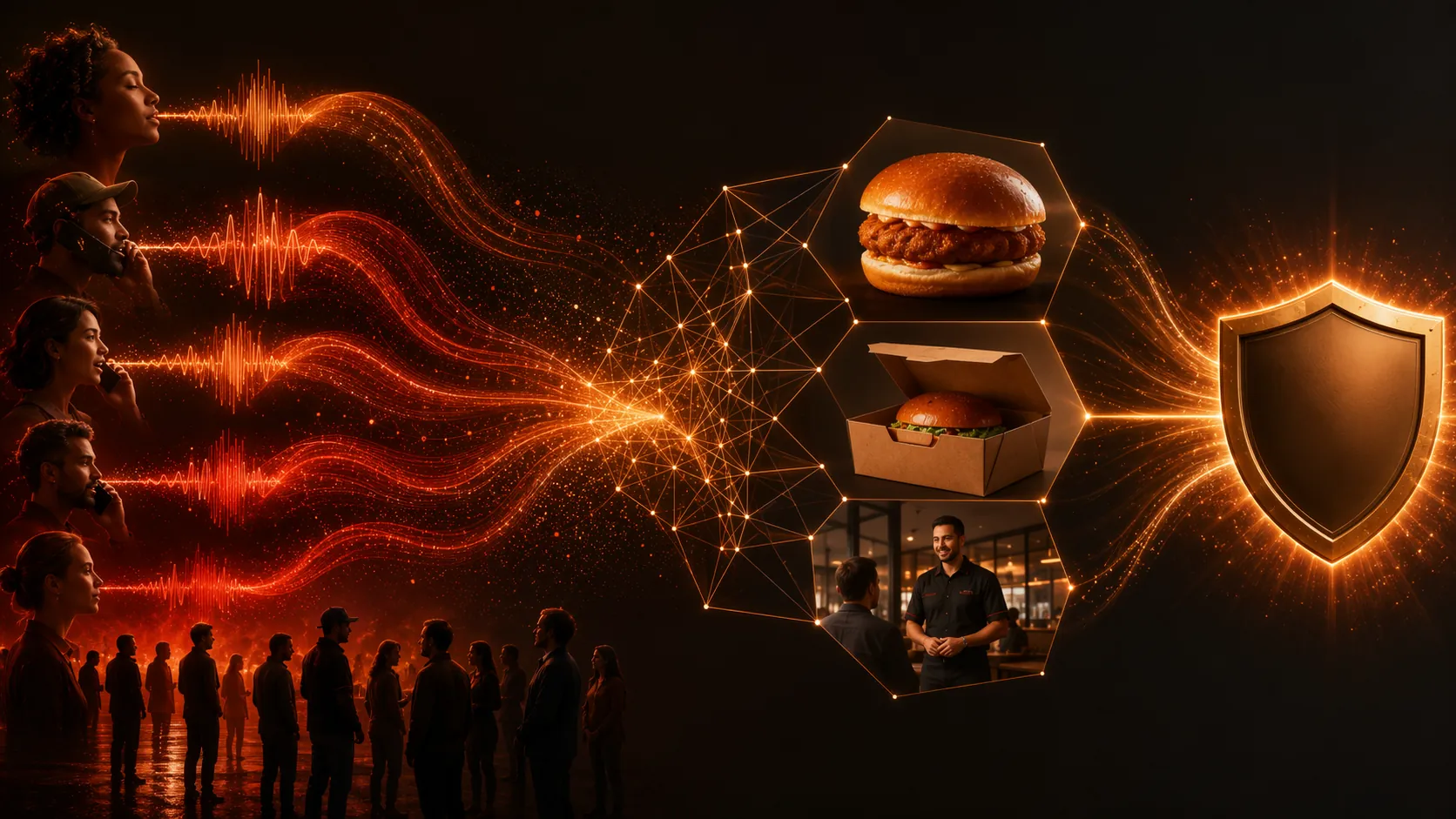
Burger King’s announced Whopper Guarantee terms are built around a QR code in the Whopper box and a six-digit code guests can use to claim a free Whopper on a future visit, with no app download required.[1] That last detail is not cosmetic. App-only recovery can quietly turn a service failure into a data-capture demand. It asks the customer to create an account, remember a password, accept notifications, or navigate a loyalty flow at the exact moment the brand already owes them simplicity.
The six-digit code also shows that Burger King located the recovery mechanic at the point of disappointment. The code is in the box, not buried in a receipt survey that asks the guest to rate friendliness on a scale. The box is where the customer sees the burger. If the burger misses the mark, the path to recovery is physically near the failure.
That does not prove guests will use it. It does not prove restaurants will execute the upstream work consistently. It does show a sharper understanding of friction than many satisfaction promises manage. The guarantee terms are not the emotional center of the case; they are evidence of whether the company understood the complaint it says it heard.
Scaling Listening Without Turning It Back Into Theater
Publishing a president’s phone number creates attention. It also creates a bottleneck. The Listening Initiative becomes more credible when it moves beyond one executive’s personal stamina. Burger King’s process expanded as franchisees began posting their own phone numbers in restaurants, giving guests a more local path to be heard.[2]
That move changes the nature of the channel. A national executive can identify recurring patterns and signal seriousness. A franchisee or restaurant operator can see whether the issue is happening in a specific store, shift, handoff, or training routine. For the customer, the difference is practical: the person receiving the complaint is closer to the place where the next order will be made.
There is still a risk here. Open phone lines can become symbolic if messages pile up without authority, staffing, or follow-through. A feedback channel is not automatically a feedback loop. The loop closes only when the contact produces a decision: change the bun, change the package, add a manager role, change the redemption path, or decide not to change and say why internally.
For content strategists, this is the uncomfortable middle work that usually disappears from the case study slide. The strongest material is not the volume of feedback. It is the conversion of feedback into work instructions. A customer quote may start the story, but the campaign earns credibility only when the kitchen, counter, drive-thru, packaging, manager escalation, or recovery flow looks different afterward.
The Turnaround Context Helps, But It Does Not Prove The Guarantee
Burger King did not launch the Whopper Guarantee in a vacuum. The company had already been working through a broader brand reset, and CMO Joel Yashinsky said Circana data showed Burger King moving from 10th to 6th in guest satisfaction among top QSR brands.[3] That is useful pre-guarantee context. It suggests the company had some momentum in how guests perceived the experience before the guarantee arrived.
The sales story also needs restraint. QSR Magazine reported turnaround momentum tied to Restaurant Brands International Investor Day, including same-store sales outperformance claims, but those figures came from company investor materials rather than independent auditing.[4] They are relevant to the business backdrop, not proof that the Listening Initiative or Whopper Guarantee caused the improvement.
The economics are not uniformly celebratory either. Franchisee profitability reportedly dipped from $205,000 to $185,000 in 2025 under beef-cost pressure.[4] That matters because guarantees and service roles do not live in a brand deck. They land inside restaurants with labor constraints, food costs, franchisee economics, and managers who already have a long list of things to watch.
A guarantee can create goodwill, but it can also create operational expense if defects are frequent or if recovery becomes the substitute for fixing the underlying problem. Burger King’s better argument is that the guarantee arrived after product, packaging, and service changes, not before them. The business still has to prove that those changes hold at scale.
What Marketers Can Actually Take From This
The easy version of this case is “listen to customers.” That sentence rarely survives contact with a leadership review because it does not say who listens, what reaches them, what changes, or how the customer experiences the change. Burger King’s case is more useful because it gives marketers a stricter standard.
- Put feedback where it can disturb decision-makers, not only where it can be summarized safely.
- Separate complaint volume from pattern recognition; a large number of contacts is a signal source, not proof.
- Translate patterns into operating changes before turning them into campaign claims.
- Design recovery around the customer’s moment of failure, not around the brand’s preferred data flow.
- Treat launch coverage as the beginning of measurement, not the evidence of success.
That last point is especially important for the Whopper Guarantee. As of now, Burger King has not shown that the program will lift sales, raise satisfaction, reduce complaints, or improve repeat visits. It has shown something narrower: a public promise connected to observable upstream actions.
That is still a meaningful marketing distinction. A standalone promise asks customers to believe the brand. A promise attached to changed packaging, changed ingredients, an on-shift manager role, and a low-friction redemption mechanic asks customers to inspect the work. For a customer who just wants the order fixed, and for the worker who has to fix it in real time, that difference is not abstract.
Customer feedback becomes credible campaign material only after it changes the operating system customers experience. Anything earlier is just a listening message.
References
- Burger King Continues Turning Guest Feedback Into Action With the Your Way Champion and Whopper Guarantee, Burger King Newsroom, July 20, 2026.
- Tom Curtis Burger King Customer Feedback, BuzzFeed Business, April 2026.
- Burger King Brand Reset Owning Mistakes CMO Joel Yashinsky, Marketing Brew, March 16, 2026.
- Burger King’s Revival Strategy Shows Notable Results, QSR Magazine.
Built on this evidence
No Bidding tactic or Creative record currently cites this case file. Compare it against other results in Benchmarks.
Related benchmark reading
Report a corroborating or contradicting result
Seeing something different in your own account? Feed the data-integrity loop instead of leaving an open comment.