
Plan a Local National Ice Cream Day Deal with AI in 7 Days
Learn how local businesses can use AI tools to plan, create, and execute a competitive National Ice Cream Day campaign in just 7 days — with real examples from 2026 chain deals and a framework you can adapt for next year.
National Ice Cream Day 2026 has already passed, which makes this the useful moment to look at what actually happened instead of pretending anyone needs another July 19 reminder. The better question now is how a local shop can build next year’s campaign without the usual last-minute scramble: one owner approving a Canva flyer at midnight, one employee posting a blurry cone photo, and no one remembering to update Google Business Profile until the line is already out the door.
The national chains did what national chains do. Dairy Queen ran a free Dilly Bar with a $1 purchase from July 13–19. Baskin-Robbins stretched its deals from July 19–26. Friendly’s offered BOGO scoops, Cold Stone used BOGO framing for loyalty members, Häagen-Dazs and Ben & Jerry’s promoted scoop shop deals, and grocery chains including Kroger, Publix, and Walmart pushed packaged ice cream promotions around the same holiday window. The mechanics were not mysterious: limited-time urgency, a simple free-or-discounted item, loyalty capture, and enough repetition across channels that customers saw the offer more than once [1][2].
That competitive scan can feel annoying if you run a neighborhood shop. Chains have app teams, email teams, store ops teams, legal review, and budgets that make a hand-lettered window sign look lonely. But the useful lesson is not that local shops should copy the chain scale. It is that the core deal structure is simple enough to borrow, and local shops have advantages chains cannot fake: proximity, regulars, school calendars, neighborhood partnerships, staff who know names, and flavors that belong to the block.
This holiday is local enough to be worth the work
National Ice Cream Day is not a fake holiday invented last Tuesday by a coupon app. It traces back to a 1984 presidential proclamation from Ronald Reagan, and July is recognized as National Ice Cream Month. The International Dairy Foods Association also notes that ice cream marketing is predominantly local or regional, which matters more than a giant market-size number when you are deciding whether to make a neighborhood campaign [3].
The demand is real enough without dressing it up. Americans eat about 18 pounds, or roughly 4 gallons, of ice cream per person per year, and ice cream companies contribute $11.6 billion to the U.S. economy while supporting 26,704 direct jobs [3]. For a local shop, the practical takeaway is not “everyone loves ice cream,” because you already know that by watching the freezer case on a humid Saturday. The takeaway is that the holiday gives customers a socially accepted excuse to buy what they already like.
The newer pressure is digital. Online orders for dessert shops have surged more than 300% since 2020, according to Restolabs [4]. That does not mean every scoop shop needs to become a ghost kitchen. It does mean a National Ice Cream Day deal cannot live only on a paper sign or a single Instagram Story. If a customer searches, orders ahead, checks hours, opens an email, or taps a loyalty message, the offer needs to be there too.
Borrow the chain mechanics, not the chain costume
The 2026 chain offers are most useful when treated as a menu of campaign mechanics. A local National Ice Cream Day deal plan should start by picking one mechanic that fits capacity, margin, and staff reality.
| Chain-style mechanic | What it looked like in 2026 | Local version that is easier to execute |
|---|---|---|
| Free-with-purchase | Dairy Queen offered a free Dilly Bar with a $1 purchase during a July 13–19 window [1]. | Free kiddie scoop with any $10 order, limited to one per customer. |
| BOGO framing | Friendly’s and Cold Stone used buy-one-get-one style offers, with Cold Stone tying the offer to loyalty members [1][2]. | Buy one scoop, get one half off for loyalty members or email subscribers. |
| Weeklong window | Baskin-Robbins extended deals beyond July 19 into a July 19–26 promotional period [1]. | Run a “National Ice Cream Week” flavor special, with the strongest offer only on Sunday. |
| Loyalty hook | Several national offers used app or rewards membership as the access point [1][2]. | Let customers unlock the deal by joining the email or SMS list at checkout. |
| Retail tie-in | Grocery chains promoted packaged ice cream around the holiday [1]. | Bundle pints, toppings, or take-home sundae kits for families. |
The mistake is trying to run all of these at once. A small shop does not need a free scoop, a BOGO, a pint bundle, a school fundraiser, a loyalty launch, and a new flavor flight in the same weekend. That is how the counter staff ends up explaining six exceptions while the line melts. Pick one primary offer, one secondary upsell if the team can handle it, and one clear rule for redemption.
The 7-day sprint: one offer, many touchpoints
A seven-day sprint is not magic. It is a practical container modeled on the same kind of weeklong promotional windows chains used in 2026, and it needs to shrink if staffing, inventory, or approvals are tight [1]. The point is to stop treating “make a post” as the campaign. The offer has to travel through the places customers actually make decisions: search, email, SMS, social, the ordering page, the window, and the counter script.
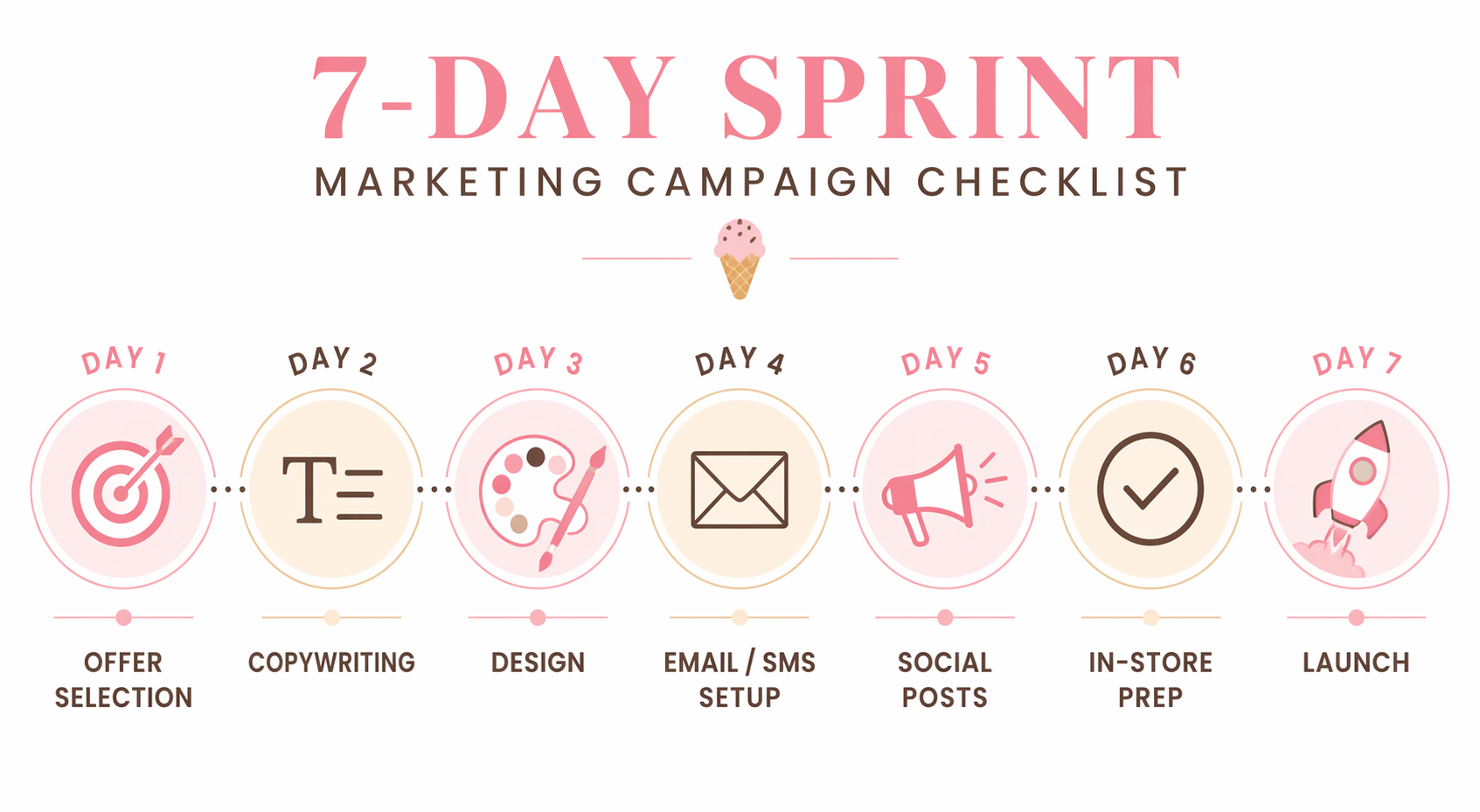
| Day | Main decision | AI can help with | Human must check |
|---|---|---|---|
| Day 1 | Choose the offer | Generate offer options, margin questions, and audience angles. | Food cost, staffing, inventory, and whether the offer is simple at the register. |
| Day 2 | Build the message | Draft copy for email, SMS, social, Google Business Profile, flyers, and staff scripts. | Local tone, accuracy, redemption rules, and any legal or platform limits. |
| Day 3 | Create visual directions | Produce design prompts, layout variations, sign copy, and image concepts. | Brand consistency, readability, and whether the visuals match the actual product. |
| Day 4 | Set up email and SMS | Write subject lines, short messages, loyalty variants, and reminders. | Consent, send timing, offer limits, and links to ordering or directions. |
| Day 5 | Schedule social and local listings | Repurpose the offer into posts, captions, event copy, and listing updates. | Hours, address, local hashtags, tagged partners, and correct menu availability. |
| Day 6 | Prep the store | Write counter scripts, FAQs, signage copy, and manager checklists. | Whether staff can explain the deal in one sentence during a rush. |
| Day 7 | Launch and adjust | Draft quick replies, same-day updates, and sold-out alternatives. | Real-time capacity, customer complaints, and when to stop promoting an item. |
Day 1 is where the campaign is won or made impossible
AI is useful on Day 1 because it can give an owner something better than a blank page. Ask it for ten National Ice Cream Day offer ideas for a single-location ice cream shop, then add constraints: no new inventory, no register confusion, profitable at normal Saturday traffic, easy for teenage staff to explain, and appealing to families within a few miles. The first output will probably be too generic. That is fine. The job is to pressure-test, not publish.
A good offer survives three questions before anyone designs a flyer:
- Can the staff explain it in one sentence while taking payment?
- Does it reward the behavior the shop actually wants, such as larger orders, loyalty signups, preorders, or slower-hour visits?
- Can the shop fulfill it if the campaign works better than expected?
A hypothetical example: instead of “free ice cream all day,” a neighborhood shop could run “Free mini scoop for kids with any family sundae kit preorder, pickup Sunday.” That offer narrows the audience, encourages advance ordering, limits the free item, and gives the shop a better chance to plan inventory. Another shop might choose “Buy one scoop, get one half off from 2–5 p.m.” if the real business problem is a slow afternoon gap, not a lack of evening demand.
Day 2 turns the offer into channel-specific copy
This is where AI saves the kind of time that actually matters. One offer needs different shapes. The email can explain the deal and include a preorder link. The SMS needs to be short and direct. The Google Business Profile update should include the date, offer, hours, and redemption rule. The Instagram caption can lead with the flavor photo. The in-store sign should be readable from six feet away.
A strong prompt gives AI the real operating details instead of asking for “fun ice cream copy.” Include the shop name, neighborhood, offer, dates, exclusions, ordering link, tone, audience, and what not to say. If the shop is family-run and low-key, say that. If it has a bright retro brand, say that. If the owner never uses words like “indulge” or “treat yourself to bliss,” ban them.
Create National Ice Cream Day campaign copy for a single-location ice cream shop in [neighborhood].
Offer: [clear offer]
Date/time: [date and hours]
Goal: [loyalty signups / preorders / afternoon traffic / family bundles]
Tone: warm, local, clear, not corporate
Must include: redemption rule, ordering link, reminder that supplies may be limited
Avoid: exaggerated claims, generic summer clichés, confusing terms
Create:
1 email subject line options
1 short email
3 SMS versions under 160 characters
3 Instagram captions
1 Google Business Profile update
1 window sign headline
1 staff script under 20 seconds
The staff script belongs in the same prompt as the social copy. If the public message says “Free mini scoop with any sundae kit preorder,” the person at the counter needs the same language, not a vague instruction to “mention the promo.” Customers forgive a small shop for being busy. They are less forgiving when three employees give three different answers.
Day 3 is design direction, not pretending AI knows your freezer case
AI-generated visuals can help with layout ideas, color palettes, sign concepts, and ad variations. They are less reliable as proof of what a customer will actually receive. If the campaign promotes a strawberry shortcake sundae, use a real product photo or a design that does not misrepresent the item. Nothing ruins a holiday deal faster than a customer pointing at a generated image and asking why their cup looks smaller.
Use AI to create design briefs for the tools the shop already uses. A prompt can ask for a square Instagram layout, a vertical Story, a half-page flyer, a counter card, and a window sign, all using the same offer hierarchy. The hierarchy should stay boringly clear: offer first, date second, redemption rule third, shop name and ordering link fourth. Pretty comes after legible.
Days 4 and 5 make the campaign visible before customers are already deciding
Email and SMS are where local shops can quietly outperform a bigger brand’s generic blast. A regular who buys pints should not get the same emphasis as a parent who usually orders cones after soccer practice. AI can draft variants for loyalty members, lapsed customers, birthday club subscribers, pint buyers, families, or office-order customers, as long as the shop has permission to contact them and enough data to segment responsibly.
The personalization does not need to be creepy or elaborate. “Your Sunday sundae plan is ready” is enough for customers who preorder family kits. “Stop by after camp pickup” can work if the shop genuinely serves that crowd and the timing fits. The owner or manager should still read every variant out loud. If it sounds like a national brand trying to impersonate a neighbor, rewrite it.
Social scheduling should not carry the whole campaign. Post the offer, yes. Pin it if the platform allows. Add a short video if the team can film the actual product. But also update Google Business Profile, the website banner, online ordering notes, and any local event page. With dessert shop online orders up sharply since 2020, the ordering path is not an afterthought [4]. If the customer clicks and cannot find the deal, the campaign has leaked at the exact point of intent.
Day 6 belongs to operations
The least glamorous day may be the most protective. Print the sign. Tape the register cheat sheet where staff can see it. Decide what happens if the featured flavor sells out. Check the online ordering test transaction. Make sure the manager on duty knows whether the deal stacks with loyalty points. Put the exact promo language in the shift notes.
AI can draft the checklist, but it cannot watch the line. A one-person shop may need to cut the plan down to an email, a Google update, a window sign, and one staff script. That is still a campaign if the offer is clear and the customer journey is connected. It is better than six channels with six half-finished messages.
Day 7 is launch, reply, and adjust
On launch day, AI is useful for fast response drafts: sold-out notices, rain updates, reminder posts, thank-you messages, and replies to common questions. It should not be left alone with customer complaints or anything involving allergies, refunds, or a disappointed parent at the counter. Those need human judgment.
A local campaign can adjust in ways a chain usually cannot. If the morning is slow, the shop can send an afternoon SMS. If the sundae kits move faster than expected, the shop can switch the post from “order now” to “last call.” If the line is overwhelming, stop pushing the offer and protect the in-store experience. More traffic is only useful when the team can serve it well.
Where AI helps most for a local National Ice Cream Day deal
The strongest use of AI is not handing it the campaign and accepting whatever comes back. It is using it as a production assistant that keeps the owner from having to start every asset from scratch.
- Offer pressure-testing: Ask AI to identify confusion points, margin risks, fulfillment problems, and better wording for the same deal.
- Copy repurposing: Turn one approved offer into email, SMS, social, listing, website, signage, and staff-script versions.
- Localization: Generate variants for nearby schools, offices, families, tourists, loyalty members, or regular pint buyers, then edit them until they sound like the shop.
- Design briefing: Create clear layout instructions and headline options for flyers, counter cards, Stories, and online ordering banners.
- Response prep: Draft quick replies for hours, availability, redemption rules, preorder links, and sold-out updates.
There is also a good partnership angle, especially for shops that do not want to discount heavily. National Ice Cream Day is visual, broadly positive, and easy for other local businesses to join, which is why it can work beyond ice cream-only brands [5]. A bookstore can pair a children’s story hour with mini cones. A coffee shop can feature an affogato collaboration. A neighborhood market can sell take-home sundae kits from the local creamery. The AI job is to draft the partner pitch, shared post copy, and simple redemption terms. The human job is choosing a partner who will actually promote it.
The checks that keep the campaign from sounding generic
AI tends to over-polish local charm until every shop becomes “your neighborhood destination for sweet summer memories.” That sentence could belong to anyone, which means it belongs to no one. Before anything goes live, check for details only the shop can honestly claim: the street, the patio, the local school rush, the house-made waffle cones, the dairy-free flavor regulars ask about, the staff nickname for the blue sprinkle mix.
The review pass should be practical, not precious:
- Remove any claim the shop cannot fulfill during peak traffic.
- Replace generic adjectives with real product or neighborhood details.
- Make the redemption rule visible everywhere, not buried in a caption.
- Check that the ordering link, hours, address, and date match across all channels.
- Give staff one approved sentence for the deal and one approved answer for “Does this stack with other discounts?”
Capacity is the guardrail. If the freezer is tight, do not promote a pint bundle that depends on extra stock. If Sunday staffing is thin, do not run a deal that requires custom explanations. If the online ordering system is clumsy, test it early or keep the offer in-store. AI can make the materials faster; it cannot make a chaotic operation painless.
Build the 2027 campaign while the 2026 lesson is still fresh
The chains will be back next July with free items, BOGO offers, loyalty hooks, app pushes, and grocery freezer promotions. That does not make the local shop invisible. It means the local shop should not wait until the week of National Ice Cream Day 2027 to decide what the offer is, where it will appear, and who has to explain it.
A local shop does not need to outspend Dairy Queen or Baskin-Robbins to compete for nearby customers. It does need a clear offer, fast asset production, digital ordering awareness, and enough human review to make AI output sound like it came from the shop down the street. Start with one workable deal now, save the prompts and templates, and next year’s National Ice Cream Day campaign can be built calmly instead of rescued at the last minute.
References
- National Ice Cream Day 2026 deals, freebies on July 19 — USA Today, 2026
- 19 National Ice Cream Day Deals and Freebies for 2026 — Food Network, 2026
- July is National Ice Cream Month — International Dairy Foods Association
- 12 Ice Cream Shop Marketing Ideas That Work — Restolabs
- National Ice Cream Day Marketing Opportunities — Sponsor Concierge
Comments
Join the discussion with an anonymous comment.