

What Meta's AI Ad System Needs From Your Creative Team in 2026
Meta's Andromeda ad system makes creative diversity the binding constraint on performance. This guide covers the creative specs, volume targets, enhancement toggles, refresh cadence, and production workflow needed to feed it effectively.
The uncomfortable part of facebook ai advertising in 2026 is that Meta’s system is no longer waiting for a buyer to find the perfect interest stack. It is waiting for the account to contain enough creative worth choosing from.
Meta’s Andromeda retrieval system is designed to process thousands of candidate ads in parallel for a single impression, then pass a more useful set of possibilities into the next ranking stages. Meta Engineering describes this as a response to the scale and personalization demands created by modern ad inventory, including far larger creative pools than older retrieval systems were built to handle.[1] That one mechanism explains why so many old account habits now feel underpowered. If the system can consider a wide pool, the question is not whether the media buyer moved a lookalike from 2% to 5%. The question is whether the pool contains real differences for the model to evaluate.
This is the practical shift: targeting has not become irrelevant, but it has stopped being the most interesting place to hide weak creative. Meta’s broader GEM foundation model context reinforces the same direction: more automated interpretation of people, placements, and ad candidates means the operator’s highest-leverage input is the quality and range of what the system is allowed to choose from.[1]
That is good news if your team can produce disciplined creative range. It is bad news if “AI creative” has become shorthand for asking someone to make 100 beige variations by Friday.
The baseline specs are not strategy, but they do remove easy failure points
Before debating concepts, the production file has to survive the feed. In 2026, that starts with vertical creative. Meta inventory is overwhelmingly vertical, with 9:16 as the primary planning format and 90% of Meta’s inventory described as vertical in the available guidance.[2] If the first approved version of an ad is still a landscape cutdown with the product trapped in the middle third, the campaign is already paying a tax.
| Requirement | Operator guidance |
|---|---|
| Primary format | Build 9:16 vertical first, then adapt outward only where the placement mix justifies it. |
| Opening hook | Assume the first 3 seconds carry the burden. Show the product, problem, payoff, or pattern interrupt immediately. |
| Sound behavior | Design for sound-off consumption with captions, visible product context, and readable on-screen structure. |
| Safe zones | Leave room for interface overlays and for image expansion so core product, faces, and claims are not cropped or stretched into awkward positions. |
The 3-second hook window should not be treated as a demand for louder editing. It is a demand for clarity. A skincare ad that opens with a hand holding an unmarked bottle against a bathroom mirror has asked the system to work too hard. A B2B ad that spends the first seconds on an abstract animated gradient has done the same. The early frame needs to tell the model and the person what kind of problem, product, or desire is in play.
Captions are not a finishing touch. They are part of the creative object. If the selling point only exists in voiceover, the ad has one version for people listening and a worse version for everyone else. The same applies to safe-zone planning: if a face, price point, or product benefit sits where interface elements commonly appear, the account may technically have assets, but not clean inputs.
Twenty assets is not the same thing as twenty ideas
The working volume target should be concrete: a minimum of 20–50 assets per ad set, and 150 assets recommended for Advantage+ Shopping Campaigns.[2] Those numbers are useful only if the assets give Andromeda different material to retrieve. Fifty ads that change only the headline from “Shop now” to “Try it today” to “Discover more” are not a creative library. They are a filing problem.
A healthier target is at least five genuinely distinct concepts, each expressed in the formats the account actually uses. The difference is conceptual distance, not cosmetic distance.
| Weak variation | Useful variation |
|---|---|
| Same product shot with ten headline swaps | Product demo, founder explanation, creator testimonial, problem/solution, and comparison angle |
| Same UGC script read by five creators | Different creator roles: skeptical first-time user, expert educator, existing customer, gift buyer, and category switcher |
| Same claim placed on five background colors | Different benefit structures: speed, comfort, savings, confidence, durability |
| Same video exported in multiple lengths without rethinking the opening | Distinct hooks for cold discovery, retargeting, cart recovery, and offer-led pushes |
The easiest way to test whether a batch has enough range is to remove the brand name and read the first frame or first line of each asset. If most of them could be summarized as “nice product, vague benefit,” the volume is fake. If each asset gives the system a different buyer motivation, objection, use case, or proof style, the pool starts to become useful.
What counts as a separate concept
A separate concept changes the reason someone might care. It does not merely change the wrapper around the same reason.
- A problem-led concept starts with the pain or frustration before introducing the product.
- A proof-led concept starts with evidence: demonstration, comparison, review, credential, or before/after structure where permitted.
- A use-case concept shows the product in a specific moment, environment, or routine.
- An objection-led concept answers the reason the buyer has not acted yet.
- An identity or aspiration concept frames the product around who the buyer wants to be, not only what the product does.
Those five can produce a larger asset set without turning the team into a headline factory. Each concept can have a vertical video, a static, a creator cut, a carousel, and a shorter retargeting edit. Now 25 assets represent five actual bets, not one idea wearing 25 outfits.
Use Advantage+ Creative enhancements as a control surface, not a personality test
Advantage+ Creative enhancements are where a lot of teams either over-trust automation or turn every toggle into a committee debate. The practical middle is simpler: allow the enhancements that protect placement fit and visual polish; be more selective with anything that can change tone.
| Enhancement | Default stance | Why |
|---|---|---|
| Visual touch-ups | Generally safe | Useful for polish when brand rules allow modest automated adjustment. |
| Image expansion | Generally safe with safe-zone review | Helps placement adaptation, but only if the original composition gives the system room to extend. |
| 3D animation | Conditional | Can create motion where none existed, but may feel cheap, uncanny, or off-brand for premium and regulated categories. |
| Auto-music | Conditional | Can help some lightweight social formats, but tonal mismatch can make a serious product feel unserious. |
AdMove’s 2026 guidance treats visual touch-ups and image expansion as broadly useful defaults, while calling for more caution around features such as 3D animation and auto-music because they can create mismatch between the ad’s intended tone and the delivered experience.[2] That distinction matters. Expansion helps the asset fit the placement. Auto-music can change how the brand feels.
For a deeper toggle-by-toggle setup, use the Meta Advantage+ Creative Enhancement Decision Matrix. The shortcut for day-to-day work is this: if an enhancement changes composition while preserving the idea, it is usually easier to approve. If it changes mood, movement, music, or perceived production value, it needs a brand and category check.
One more reason not to panic early: Meta’s enhancement testing can use up to 5% of impressions to test new combinations, which means the first read on a campaign can include extra noise.[2] A strange early delivery pattern is not automatically a verdict on the concept. It may be the system exploring combinations that will not remain dominant.
Refresh when the delivery curve asks for it, not when the calendar looks tidy
A useful fatigue signal is CPM-reach. Under $20 is treated as a healthy range in the available 2026 operating guidance; a sustained move above $20 is a trigger to refresh creative within a 7+ day window rather than keep squeezing the same pool.[2] The word “sustained” does real work here. One expensive day during learning, promo changes, or enhancement exploration should not send the team into a scramble.
| Signal | Action |
|---|---|
| CPM-reach remains under $20 | Keep monitoring. Do not refresh just to look busy. |
| CPM-reach climbs above $20 and stays there | Prepare a refresh within 7+ days, prioritizing new concepts before minor edits. |
| Frequency rises while hooks and hold rates weaken | Rotate in new openings or new angles, not only new thumbnails. |
| One concept keeps spending while others barely deliver | Study why the winning concept is legible, then build neighboring concepts rather than clones. |
The refresh discipline should protect the team from two opposite mistakes. The first is leaving tired creative live because performance has not completely collapsed. The second is replacing assets so fast that the account never gets a clean read. A 7+ day refresh window gives the system some room to learn while keeping production close enough to fatigue signals that the next batch is not a guess.
The production system matters more than raw asset volume
The teams that get useful volume from AI do not start with “make more ads.” They start with a brief that makes variation governable.
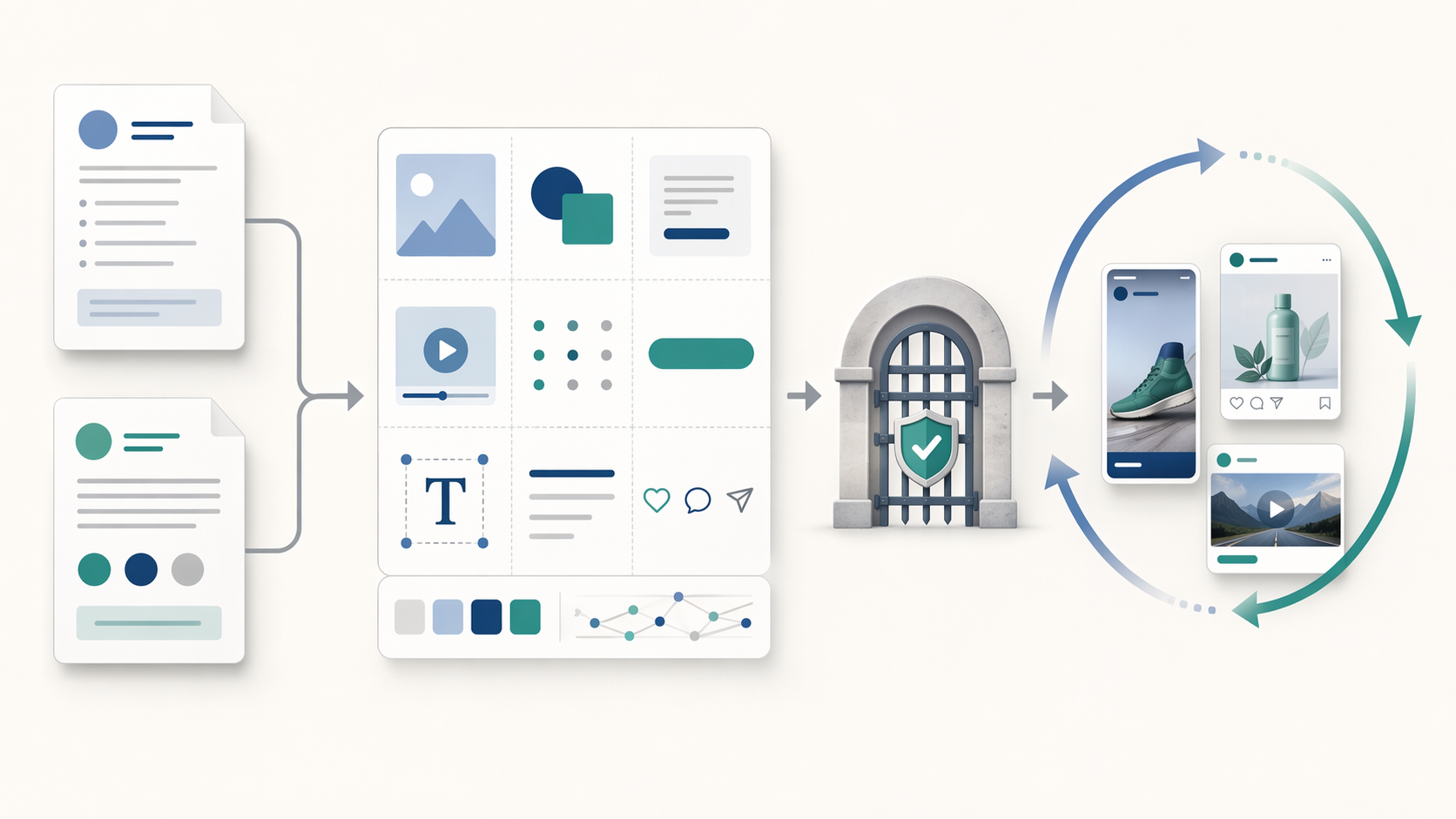
A workable brief for Meta creative in 2026 should specify the buyer moment, the concept, the proof source, the opening hook, the required claim language, the visual constraints, the enhancement permissions, and the disclosure status. That sounds heavier than “give me 30 videos,” but it prevents the familiar mess where paid media rejects half the batch, brand rewrites the rest, and the deadline turns every asset into the safest possible version of the same idea.
- Creative strategy owns the concept map: which buyer motivations, objections, and use cases the batch should cover.
- Design and editing own format integrity: vertical framing, safe zones, captions, pacing, and placement-ready exports.
- Brand owns voice rules: approved claim language, prohibited tones, product naming, visual guardrails, and music or motion boundaries.
- Paid media owns deployment logic: which concepts enter which campaign structure, how refreshes are triggered, and how learning is read.
- Legal or compliance owns required review gates, including AI-content disclosure checks before launch.
Since March 2026, Meta has required AI-content disclosure on AI-generated ad creative. Treat that as a launch checklist item, not a note to clean up after upload. Skipping disclosure is described in the available operating guidance as a top rejection reason, and it is exactly the kind of preventable delay that makes teams blame the platform when the workflow failed.
A modular asset system keeps scale from turning into sludge
The best AI-assisted production examples are not magic tricks. They are modular systems with clear boundaries.
Salomon’s documented AI advertising workflow produced more than 1,600 creatives in 8 weeks with zero physical shoots through Pencil, according to Pragmatic Digital’s case study roundup.[3] The interesting part is not only the count. It is that the count came from a production model capable of generating market and scene variation around an outdoor athletic brand without sending a crew to every environment.

Unilever’s example is useful for a different reason. The case describes more than 200 edits built from 12 benefit modules and 5 audience segments.[3] That is the shape most teams should study: benefit modules, audience segments, and controlled recombination. It gives the creative team room to produce range without letting every asset become an unreviewable one-off.

A smaller team can use the same logic without producing hundreds of ads at once. Build a matrix with five concepts, three hooks per concept, two proof styles, and the core placement formats. Then decide which combinations are allowed before production starts. The governance happens at the system level, not after 60 exports land in someone’s inbox.
| Module | Examples of controlled variation |
|---|---|
| Concept | Problem-led, proof-led, use-case, objection-led, aspiration-led |
| Hook | Question, demonstration, claim, contrast, creator confession |
| Proof | Demo, review, comparison, expert explanation, product close-up |
| Format | 9:16 video, static, carousel, short retargeting cut, creator edit |
| Brand controls | Approved claims, caption style, color range, music rules, disclosure status |
Be careful with performance claims about AI-generated creative
Benchmarks can be useful, but they should not be turned into superstition. Digital Applied reports an 18% CTR lift for AI-generated creative in its 2026 Facebook ads benchmark material.[4] That is worth noticing. It is not enough to prove that the AI generation itself caused the lift in every account, especially when the public methodology does not fully isolate “AI-generated” from the surrounding factors that often travel with it: more variants, faster refreshes, different review standards, or stronger offer packaging.
The safer interpretation is narrower and more useful: AI-assisted creative systems can outperform when they increase meaningful concept coverage and keep production close to performance feedback. If they only increase the number of files, the account may simply fail faster and at larger scale.
For documented brand-outcome examples, use the AI Generative Creative in Paid Social case study. For broader workflow governance beyond Meta, the AI Creative Advertising Playbook is the better next stop.
The workflow to run every week
A practical weekly operating loop does not need to be complicated. It does need owners.
- Read delivery by concept first. Do not start with micro-edits. Identify which buyer motivations, proof types, and hooks are receiving spend and which are not getting traction.
- Check fatigue signals. Watch CPM-reach, frequency, hook performance, and sustained delivery changes before deciding whether the next batch is a refresh, an expansion, or a replacement.
- Write the next brief from observed gaps. If proof-led ads are carrying the account, brief adjacent proof concepts. If all winning ads solve the same objection, brief a new objection rather than copying the winning script.
- Produce in modules. Keep hooks, benefit claims, product visuals, captions, and formats organized so the team can recombine without losing review control.
- Run brand and compliance review before upload. Confirm claim language, safe zones, enhancement permissions, music rules, and AI-content disclosure.
- Launch with enough patience to read the system. Account for early volatility from enhancement testing and avoid killing every asset before it has a fair delivery window.
This is where Meta’s automation is genuinely useful. It removes a lot of fake precision from the targeting panel and puts pressure back where it belongs: on the creative input system. The accounts that benefit are not the ones producing the most assets in the abstract. They are the ones producing enough distinct, reviewable, placement-ready creative for Andromeda to evaluate without forcing the brand to clean up the mess afterward.
References
- Andromeda: Meta’s next-generation personalized ads retrieval engine, Meta Engineering, Dec. 2024
- Meta Advantage+ Creative Best Practices for 2026, AdMove
- Case Study: The Best AI Advertising Campaigns and Their Impact, Pragmatic Digital
- Facebook Ads Benchmarks 2026: CPC, CPM, CTR by Industry, Digital Applied
Comments
Join the discussion with an anonymous comment.