

Meta Advantage+ Creative Controls: A Decision Framework for Balancing Automation and Brand Safety
Meta's February 2026 default-ON change for Advantage+ creative enhancements forces paid media managers to decide which automation to allow and when to override. This framework helps you choose based on campaign type, regulatory requirements, and creative resources, with a three-level override workflow that preserves brand governance.
Meta Advantage+ creative controls became a different management problem in February 2026, when creative enhancements shifted toward a default-ON posture rather than a deliberately selected test for many advertisers.[1] For a paid social team, that changes the burden of proof. The question is no longer whether Meta can resize, recompose, add music, generate backgrounds, or apply overlays. The question is where those changes are allowed to happen before spend, learning, and stakeholder review make them harder to unwind.
The most workable answer is a structured hybrid model: use Advantage+ creative automation where variation is the job, especially prospecting and catalog-heavy ecommerce campaigns; keep manual control where message precision is the job, especially retargeting, brand campaigns, regulated categories, and legal-sensitive offers. Then enforce that choice through Meta’s control hierarchy: account defaults, ad-set overrides, and ad-level exceptions.
Why “leave it on” and “turn it all off” both miss the point
There is a real performance reason not to reflexively disable everything. A 2026 practitioner roadmap reports a 22% ROAS lift and a 4% lower cost-per-result average for Advantage+ usage.[2] That is enough to deserve testing in accounts where the business can absorb creative variation and learn from it quickly.
It is not enough to prove that every creative enhancement belongs in every campaign. The 22% figure is usually discussed around the broader Advantage+ system, where audience, placement, budget, and creative automation can all be in motion. Public practitioner data does not cleanly isolate the lift from creative enhancements alone. Treat the number as a reason to investigate, not as permission to let generated assets ship without a control plan.
Creative still deserves attention inside that broader system. AdRiseLab’s 2026 analysis attributes 56% of performance impact to creative, compared with 22% to audience and 12% to placement, and also breaks out ROAS patterns across 12 Advantage+ creative settings.[3] The exact allocations come from a commercial practitioner source, so they should not be treated like neutral academic measurement. But the direction matches what most paid social teams already see in the account: creative changes can move outcomes materially, and bad creative changes can move brand conversations just as quickly.
The decision should start with campaign context, not the toggle list
A toggle-by-toggle review matters, but it is the second decision. The first decision is whether the campaign is allowed to let the system invent or alter presentation at all. That depends less on whether a specific feature sounds clever and more on what the campaign is accountable for.
| Campaign context | Default control stance | Why |
|---|---|---|
| Cold prospecting with broad audiences | Automation-eligible | The campaign is already looking for new pockets of response, and variation can help discover which formats, placements, and treatments earn attention. |
| Catalog-heavy ecommerce prospecting | Automation-eligible with exclusions | Large SKU sets benefit from scalable formatting, but brand rules still need to block risky overlays, generated backgrounds, or mismatched creative treatments. |
| Retargeting and warm lifecycle campaigns | Manual-first | The audience already has context. Message sequencing, offer accuracy, and expectation management matter more than additional machine-side variation. |
| Brand launch, reputation, executive, or PR-sensitive campaigns | Manual control | The cost of an off-brand frame, caption, or generated scene can outweigh any marginal delivery efficiency. |
| Regulated, legal-reviewed, medical, financial, employment, housing, or political-adjacent use cases | Manual control unless explicitly approved | Creative changes can create disclosure, claims, fairness, or compliance questions that performance reporting does not resolve. |
| Low-resource performance accounts with limited creative supply | Controlled testing | Automation may expand surface area when the team cannot produce enough variants, but the account still needs a review cadence and escalation rule. |
This is where the hybrid model becomes operational rather than philosophical. A campaign that needs reach, learning, and creative breadth can tolerate more Advantage+ variation. A campaign that needs exact claims, exact product depiction, exact sequencing, or exact brand tone should not outsource those decisions to a default setting.
AdManage.ai reaches a similar practical split in its Advantage+ versus manual creative comparison: Advantage+ fits performance-oriented campaigns, while manual creative remains better suited to brand and compliance-sensitive work.[6] That conclusion is not anti-automation. It simply puts automation where its upside is most likely to be useful and its mistakes are least likely to become a stakeholder problem.
Where Advantage+ creative earns trust
Prospecting is the cleanest use case. In cold traffic, the ad is often being asked to find which angle, crop, format, and placement combination can create enough signal for the account to learn. If the brand has flexible visual rules and a product that is easy to represent accurately, Advantage+ enhancements can extend the number of usable surfaces without waiting for a designer to rebuild every variation.
Catalog-heavy ecommerce is another strong candidate. Product feeds already create a semi-modular environment: product image, price, promotion, destination, and audience intent are assembled at scale. In that setting, automation that resizes, adapts, or lightly optimizes media can be useful, particularly when the alternative is running a narrow set of static assets across too many placements.
The key word is “lightly.” There is a difference between letting the system adapt a product image to placement and letting it invent a visual context the brand would not have approved. Ads Uploader’s June 2026 matrix is useful because it separates more than 20 creative enhancements into practical risk tiers rather than treating Advantage+ creative as a single switch.[4] That tiered view is the right level of thinking for performance-first accounts: do not punish low-risk formatting improvements because some generative options require stricter review.
Where controlled testing is safer than trust
Some campaigns sit in the middle. They are not so brand-sensitive that every asset needs full manual production, but they are not casual enough for unattended enhancement either. This is common in growth accounts with a serious brand system, subscription products with offer nuance, and challenger brands where performance pressure is high but executive scrutiny is not theoretical.
For these campaigns, automation should enter through controlled tests: limited budgets, named campaign classes, documented enhancement categories, and a review standard that includes both performance and brand acceptability. The useful question is not “Did ROAS improve?” alone. It is “Would we have approved the winning ad if a designer had sent it to us?”
That second question matters because the worst failures are not always catastrophic. Sometimes they are just embarrassing enough to waste a client call. Ads Uploader cites a True Classic incident involving an AI-generated grandma image in 2025, though the public details are limited and the exact enhancement or failure mechanism is not fully clear.[4] The same source also describes a spin-class ad receiving horror-movie-style music, and notes Jon Loomer’s criticism that Add Overlays is “pretty awful” for professional brand work.[4] These examples do not prove the system is broadly unsafe. They show the kind of avoidable creative mismatch that default-ON settings can let through when nobody owns the override.
Where manual creative should win by default
Retargeting deserves more manual control than many teams give it. These audiences have already interacted with the brand, product, offer, or content. The campaign is usually doing a more specific job: answer an objection, reinforce a proof point, recover a cart, renew interest, or move someone from comparison to purchase. A generated background, unexpected music track, or aggressive overlay can easily interrupt that sequence.
Brand campaigns are even less forgiving. If the point of the media buy is to establish a visual world, launch a message, reposition a company, support a reputation moment, or create familiarity with a precise line, then the creative system should not be free to reinterpret presentation. The brand team is not being precious when it asks for control. It is protecting the thing the campaign was funded to build.
Regulated and legal-reviewed categories should start manual unless an explicit approval path says otherwise. AdMove AI’s 2026 guidance discusses March 2026 AI disclosure requirements and the way disclosure obligations interact with generative-AI enhancements.[5] Even when a generated change is technically allowed, it may create a new review need: Was the product depicted accurately? Did the ad imply an unapproved claim? Did the disclosure match the actual creative process? Did the reviewer approve the asset that actually shipped?
The four inputs that decide your control model
A usable governance policy should not say “Advantage+ is allowed” or “Advantage+ is banned.” It should classify campaigns by the inputs that change the risk-reward calculation.
- Campaign type: Prospecting, catalog expansion, and high-volume acquisition can justify more automation. Retargeting, brand, launch, and reputation campaigns usually justify less.
- Regulatory exposure: If claims, eligibility, disclosures, targeting category, or legal review are material, generated and presentation-changing enhancements need a higher approval bar.
- Creative resources: Teams with strong production capacity can choose manual variants without starving the algorithm. Teams with limited assets may need automation, but should narrow which enhancements are allowed.
- First-party data maturity: Accounts with reliable conversion signals, clean catalog data, and meaningful post-click measurement can evaluate automation with more confidence than accounts optimizing against thin or noisy events.
Those inputs create three practical classes. Automation-eligible campaigns can inherit permissive defaults, with only the riskiest enhancements blocked. Controlled-test campaigns can allow a narrow set of enhancements under budget and review limits. Manual-control campaigns should override defaults and document that creative changes require human approval before launch.
The account → ad-set → ad workflow
The control model only works if it is applied where Meta actually gives you leverage. HyperFX’s 2026 documentation describes a three-level hierarchy: account-level defaults in Business Settings and Advertising Settings, ad-set-level overrides, and ad-level toggles under Creative and Optimize Media.[1] The important part is not the menu path. It is the governance rule: broad defaults set the baseline, campaign context changes the baseline, and individual ads get final exceptions.
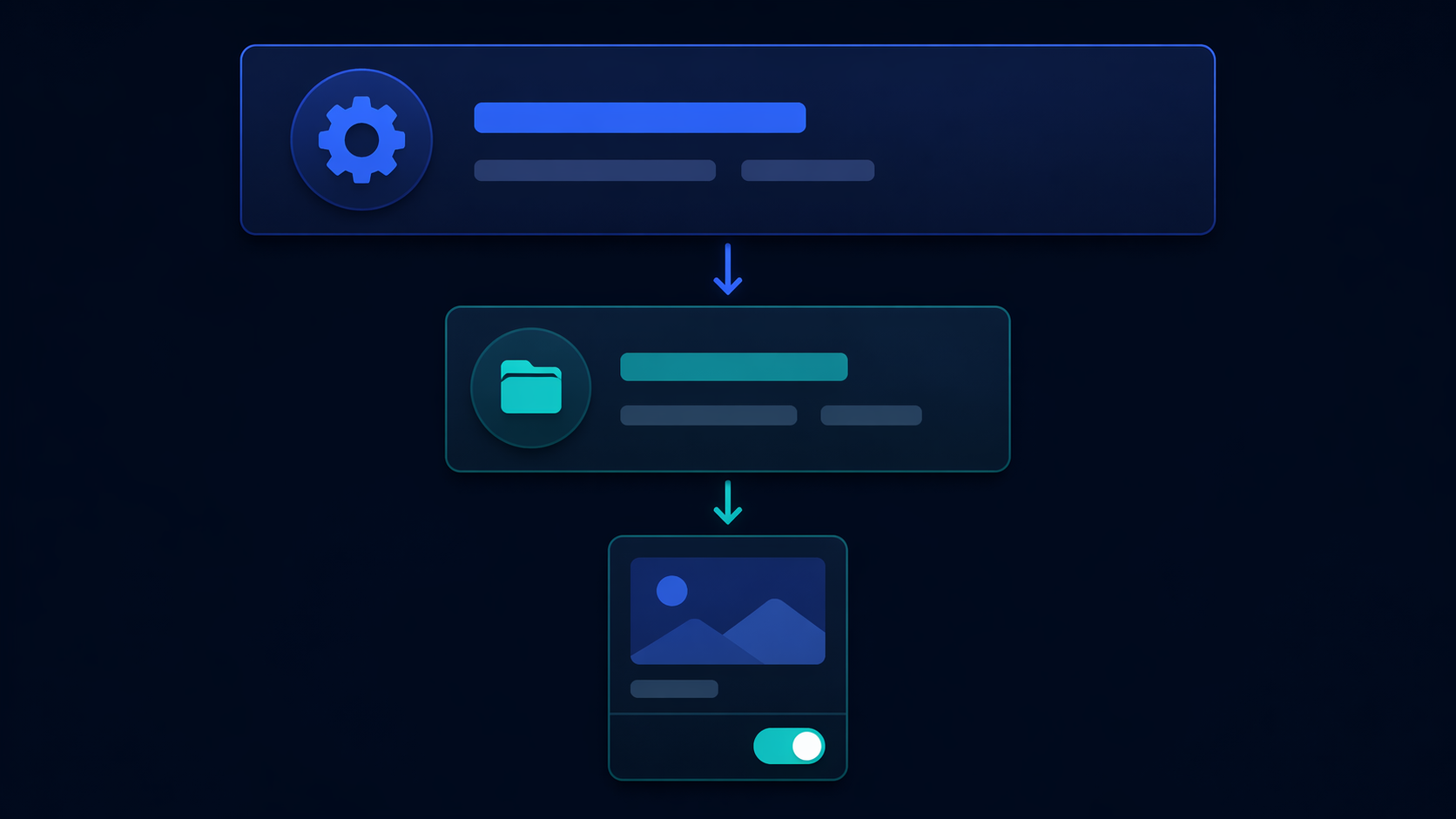
1. Set account defaults as the safety baseline
Account-level settings should reflect the strictest baseline the business can defend without campaign-by-campaign heroics. For a brand-sensitive agency account, that may mean disabling generative or high-visibility enhancements by default, then allowing specific campaigns to opt in. For a performance-first ecommerce account, it may mean allowing lower-risk formatting and placement adaptations while blocking enhancements that add copy, overlays, new scenes, or music without review.
This is the place to remove quiet surprises. If an enhancement would trigger a brand, legal, or client conversation after the fact, it should not be silently available at the account baseline. Put the burden back where it belongs: someone chooses to test the enhancement, names the campaign class, and accepts the review obligation.
2. Use ad-set overrides for campaign context
Ad-set overrides are where the framework becomes flexible. A prospecting ad set for a large catalog can opt into more enhancement categories than the account baseline allows. A retargeting ad set can do the opposite, even inside an account that generally uses automation. A regulated campaign can sit inside a performance account without inheriting all of that account’s creative freedom.
This level is also where budgets and learning matter. If a test is too small, the team may overreact to noise. If it is too large, the brand risk accumulates before anyone sees the actual served variants. A good ad-set override is specific enough that a reviewer can understand what is being tested and limited enough that a bad generated treatment does not become the dominant customer experience.
3. Keep ad-level toggles for exceptions, not cleanup
Ad-level controls are useful when a specific asset has a specific constraint: the product must not be cropped, the model image must not be extended, the compliance line must not be covered, the background is part of the concept, or the creative has already passed legal review. These are not edge cases. They are normal reasons to protect an individual ad from broad automation.
What ad-level toggles should not become is a daily rescue mission. If buyers are constantly turning off enhancements one ad at a time, the account or ad-set default is probably wrong. The hierarchy should reduce manual cleanup, not hide governance failure under more clicking.
A practical policy for 2026 accounts
For most teams, the cleanest policy is to define campaign classes before touching the toggles. Write down which classes are automation-eligible, which require controlled testing, and which are manual-only. Then map those classes to the account, ad-set, and ad-level hierarchy.
| Policy class | Allowed control posture | Review requirement |
|---|---|---|
| Automation-eligible | Account default may allow low- and moderate-risk enhancements; ad sets can expand where appropriate. | Performance review plus periodic creative QA. |
| Controlled test | Account default stays conservative; ad-set override names the approved enhancement categories. | Pre-launch stakeholder approval and post-launch review of served variants where available. |
| Manual-only | Account or ad-set settings disable presentation-changing and generative enhancements; ad-level exceptions protect reviewed assets. | Explicit approval required before any automation is introduced. |
Ads Uploader’s enhancement matrix is a useful companion once that policy exists, because it helps translate the control stance into specific toggle decisions: which enhancements are usually safe, which deserve testing, and which need caution because they alter brand presentation or invoke AI labeling.[4] If you need that per-toggle configuration layer, use the Meta Advantage+ Creative Enhancement Decision Matrix as the tactical follow-up.
The final governance habit is calendar-based. Review account defaults, ad-set overrides, and ad-level exceptions after meaningful platform changes, not only after something goes wrong. The February 2026 default-ON shift is exactly the kind of change that can make an old control assumption false. A campaign that was manual by design can become partially automated by neglect.
That is the real balance for Meta Advantage+ creative controls in 2026: do not shut off useful machine-side variation where it can improve prospecting and catalog delivery, and do not let default automation rewrite the brand rules for campaigns that were never meant to be flexible. Make the control line explicit, enforce it through account, ad-set, and ad-level overrides, and revisit it when Meta changes the defaults.
References
- Meta Advantage+ Creative Enhancements Issues, HyperFX, April 2026
- The Complete Roadmap to Using Meta Advantage+ in 2026, Marketing Agent Blog, May 2026
- Meta Advantage Plus Creative Best Practices 2026, AdRiseLab, 2026
- Advantage Plus Creative Enhancements, Ads Uploader, June 2026
- Meta Advantage Creative Best Practices for 2026, AdMove AI, 2026
- Meta Advantage Plus vs Manual Creative, AdManage.ai
Comments
Join the discussion with an anonymous comment.