

Generative AI Video Ads for Ecommerce: The 2026 ROI Case
A data-backed assessment of generative AI video ads for ecommerce in 2026, covering real cost savings, platform-level lift benchmarks, tool selection by ad format, and the critical nuance of declining consumer trust — to help leaders decide where and how to invest.
Generative AI video ads for ecommerce are worth investing in during 2026, but not for the reason that usually gets the loudest slide in the deck. The strongest ROI case is not simply that a 30-second spot can be made cheaper. It is that the same ecommerce team can ship, test, retire, and replace far more video variants across Meta, YouTube, TikTok, Amazon, and programmatic placements without rebuilding the production department.
The market has already moved past the demo phase. Global AI video ad spend is projected at $9.1 billion in 2026, about 12% of all digital video advertising; that figure refers to media spend on AI-generated creative, not spend on AI software subscriptions, which matters when sizing the opportunity inside a marketing budget.[1]
| Evidence | What it supports | What it does not prove |
|---|---|---|
| $9.1B projected AI video ad spend in 2026 | AI-generated video creative is already being used in paid media at scale. | It does not show that every brand should buy a large AI tool stack. |
| 91% production cost reduction in one cited cost comparison | AI can materially reduce asset production costs. | It does not prove the ads will convert or protect brand equity. |
| +17% ROAS on YouTube AI-optimized campaigns and 32% lower CPA on Meta Advantage+ Shopping | Platform AI systems can improve campaign performance in measured environments. | These are platform or vendor-cited benchmarks, not guarantees for a specific ecommerce account. |
| 78% of ad buyers plan to strengthen GenAI use in media campaigns in 2026 | Adoption pressure is real, and teams are budgeting around it. | Intent to adopt is not the same as effectiveness. |
| Only 13% of consumers completely trust AI-generated ads | Trust has to be part of the ROI model. | It does not mean brands should avoid AI creative entirely. |
The ROI Case Starts With Throughput, Not Cheapness
The cleanest near-term business case for generative AI video ads is production leverage. AI-assisted video production has been cited as reducing per-minute costs from about $4,500 to about $400, a 91% reduction.[1] Another cited comparison places traditional 30-second spots in the $10,000 to $50,000 range, while AI tools can produce comparable assets for roughly $100 to $1,000.[2]
That gets the CFO’s attention. It should. But cost reduction is the permission to test, not the full performance case. A brand that spends less to make the same three videos still has the same testing problem: the platforms need fresh hooks, formats, product angles, creator styles, offer treatments, and aspect ratios. The paid social manager does not need one cheaper ad. She needs enough usable creative to keep learning after the first winners fatigue.
That is where the 11x figure matters. Agencies cited in the research reported producing 11 times more video content per month with the same team size after adopting AI tools.[1] This is not a claim that each AI-generated ad is 11 times better. It is a claim about operating capacity. If a team previously launched 10 meaningful video variants in a month and can now launch closer to 100, the media account gets a different learning surface.
In ecommerce, that learning surface is often the difference between one approved brand concept and a real creative matrix. Product demo versus social proof. Benefit-led opener versus price-led opener. Founder voice versus customer-style voice. Vertical-first crop versus square feed placement. New customer offer versus bundle angle. None of those require a cinematic breakthrough. They require enough production capacity to make the tests real.
What Performance Benchmarks Can and Cannot Tell You
The platform performance numbers are encouraging, but they should be carried into a leadership meeting with labels attached. A Nielsen 2025 marketing mix modeling study of more than 50,000 campaigns, cited in Virvid’s guide, found YouTube AI-optimized campaigns delivered 17% higher ROAS, while combining Video Reach and Video View campaigns delivered 23% higher sales effectiveness.[2] Meta Advantage+ Shopping benchmarks cited in the same source show 32% lower CPA and 17% higher ROAS compared with manual setups.[2]
Those numbers support investment in AI-assisted campaign systems and creative workflows. They do not isolate the effect of generative video creative by itself. The lift may come from targeting, bidding, placement mix, creative assembly, or the interaction among all of those. For a practical ecommerce decision, that is still useful. The buyer does not need to prove that every percentage point came from a generated product scene; she needs to know whether AI-enabled workflows are improving the economics of video advertising.
Programmatic evidence points in the same direction. StackAdapt reports dynamic creative optimization benchmarks of 32% higher CTR and 56% lower CPC.[3] Again, this is not a pure generative video result, and it should not be presented as one. It does reinforce the same operating logic: performance improves when creative can be adapted more precisely to audiences, contexts, and placements.
The more independent academic signal is narrower but relevant. An MIT IDE study found personalized AI video ads generated 9.4% higher CTR than personalized image ads and 6.5% higher CTR than generic video.[4] That supports a specific claim: personalized AI video can outperform less dynamic creative formats on click-through rate in the studied context. It does not prove a universal conversion lift, nor does it settle what happens to long-term brand trust.
Adoption Is Moving Faster Than Most Approval Workflows
Adoption pressure is no longer theoretical. The IAB 2026 Outlook Study reports that 78% of ad buyers plan to strengthen their use of generative AI in media campaigns in 2026, up from 62% in 2025, and 86% currently use or plan to use GenAI to build video ads.[5] That does not mean every ecommerce brand is late. It does mean leadership teams should stop treating AI video as a side experiment run by one curious designer.
Large brands are already using AI to remove cost and speed constraints. P&G committed to 50% AI-generated content by 2025, and AI-driven media buying cut cost per acquisition by 20% in the cited case material.[6] Klarna separately documented $10 million in annual marketing savings from AI in a Q1 2024 press release.[7] These are not plug-and-play ecommerce playbooks, but they are useful proof that AI is being used to change marketing cost structures, not just to make speculative creative tests.
The lesson for a mid-market ecommerce team is not to copy an enterprise AI mandate. It is to define which part of the creative workflow is currently constraining revenue. If approvals are slow, AI generation alone will not fix the bottleneck. If the account lacks fresh variants every two to four weeks, AI can directly relieve pressure. If the team cannot localize product videos for channels, offers, and audiences, the case gets stronger.
Choose Tools by Ad Format, Not by Demo Reel
Most bad AI tool decisions start with the wrong comparison. Ecommerce teams do not need to ask which tool makes the most impressive video in a vacuum. They need to ask which tool produces the format the media plan actually requires, at a quality level the brand can approve, often enough to matter.
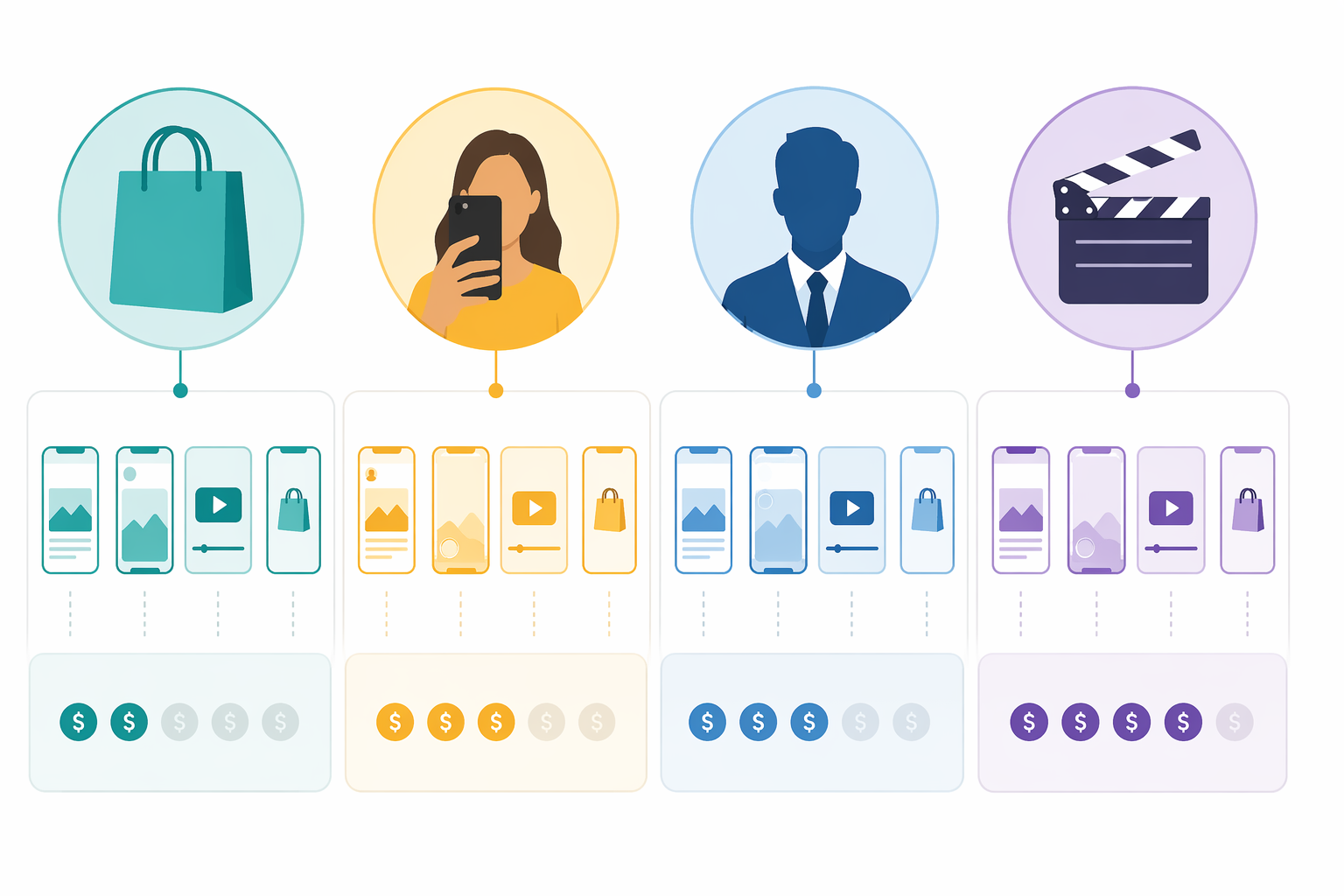
| Ad need | Best-fit tool category | Examples and pricing from the research brief | Where it fits |
|---|---|---|---|
| High-volume product variants | Product-first | PixVerse Ad Master; Amazon Video Generator, free | Catalog items, product pages, Amazon listings, simple promotional videos |
| Paid social creative that feels native | UGC-style | Creatify from $33/mo; Arcads from $99/mo | TikTok, Reels, Shorts, creator-style product hooks |
| Explainers and controlled messaging | Spokesperson | HeyGen from $24/mo; Synthesia from $18/mo | Founder-style explainers, product education, offer walkthroughs |
| Hero concepts and visual experimentation | Cinematic | Runway from $12/mo; PixVerse V6 | Launch assets, premium brand scenes, high-impact testing concepts |
| Platform-native asset expansion | Free or included platform tools | Amazon Video Generator, TikTok Symphony, Meta Advantage+ Creative, Google Ads Asset Studio | Fast resizing, remixing, variant creation, and channel-specific adaptation |
Pricing changes frequently, and free tiers may carry usage caps, but the budget pattern is clear: most ecommerce teams should not start by buying every impressive AI video subscription on the market. A more defensible stack pairs one platform-native volume tool with one dedicated creative tool chosen around the hardest ad format the team needs to produce.
Product-first tools for volume and catalog pressure
Product-first tools are the right first layer when the team has many SKUs, frequent offers, or weak product video coverage. The goal is not to create a brand film. It is to turn product images, catalog inputs, and basic selling points into usable motion assets that can feed retail media, Amazon, paid social, and remarketing.
Amazon Video Generator is especially important because it sits close to the commerce environment and is listed as free in the available tool set.[2] For a brand already selling through Amazon, that reduces the friction of turning product detail page material into video. The limitation is also obvious: platform-native tools tend to be strongest inside their own ecosystem, and a brand should not assume the same asset will carry equally well across Meta, TikTok, YouTube, and its own site.
UGC-style tools for hooks, angles, and paid social fatigue
UGC-style tools are often where the performance team feels the fastest relief. The work is not only generating a person on screen. It is multiplying hooks and angles quickly enough to keep up with fatigue. A skincare brand, for example, may need variants around texture, routine placement, dermatologist-style explanation, price objection, gifting, and before-bed use. That is a volume problem before it is an art direction problem.
Tools such as Creatify and Arcads sit in this lane, with cited pricing starting at $33 per month and $99 per month respectively.[2] The approval bar should be higher than “looks like UGC.” The paid social manager needs assets that do not trip obvious AI discomfort, make claims the compliance reviewer can support, and still look native enough for the placement.
Spokesperson tools when message control matters
Spokesperson tools make sense when the ad has to explain something clearly: how a supplement is used, why a subscription saves money, how a sizing tool works, or what changed in a product reformulation. HeyGen and Synthesia are listed with starting prices of $24 per month and $18 per month respectively.[2]
The benefit is message control. The risk is sameness. If every competitor in the category uses a polished synthetic presenter against a clean backdrop, the format can become invisible quickly. These tools work best when the script is specific, the claim set is disciplined, and the asset is used where explanation is genuinely needed.
Cinematic tools are useful, but not the whole stack
Cinematic tools such as Runway and PixVerse V6 are useful for hero concepts, launch moments, category storytelling, and visual territories that would be expensive to produce traditionally.[2] They are also the easiest tools to overbuy because their demos look the most exciting.
For ecommerce ROI, cinematic generation should be tied to a format and a campaign job. A new product launch may need a premium visual opener. A holiday campaign may need several seasonal worlds. A commodity product trying to scale on Meta may not need cinematic generation first; it may need 60 more hook and offer variants.
A Practical Spend Model for 2026
The safest starting point is controlled spend, not a full creative operations rebuild. A small ecommerce team can begin with free platform-native tools and one paid tool matched to its highest-friction format. A larger team with multiple product lines may justify a broader stack, but only if it has the approval process, testing plan, and measurement discipline to use the extra output.
- If the bottleneck is SKU coverage, start with product-first and platform-native tools.
- If the bottleneck is paid social fatigue, prioritize UGC-style variant generation.
- If the bottleneck is education or claims clarity, test spokesperson tools with tight script review.
- If the bottleneck is campaign concepting, use cinematic tools selectively for launch or hero assets.
- If the bottleneck is media performance rather than asset supply, fix campaign structure before adding more tools.
A reasonable pilot should measure more than production cost. Track number of approved variants, time from brief to launch, percentage of generated assets rejected, spend per winning concept, fatigue window, CPA or ROAS by creative family, and any customer feedback tied to AI-looking assets. The point is to determine whether AI is increasing the number of useful tests, not merely increasing the number of files in a folder.
What Can Break the ROI Case
The weakest version of the AI video business case treats trust as a separate ethics topic. It is not. Trust affects click quality, conversion rates, repeat purchase, reviews, complaint volume, and the willingness of internal teams to approve more assets.

The consumer data is uncomfortable enough to include in the financial model. Klaviyo’s 2026 AI Consumer Trends Report found that only 13% of consumers completely trust AI-generated ads, while 36% somewhat trust them.[8] Gartner’s 2026 survey found that 50% of U.S. consumers prefer brands to avoid using GenAI.[9] StackAdapt cites consumer trust in AI ads declining 14 percentage points from 2023 to 2024.[3]
These surveys are not a command to stop. They are a warning against lazy scaling. If the asset looks fake, makes a product claim too cleanly, uses a synthetic person in a way that feels undisclosed, or shows product behavior that the real item cannot match, the production savings can turn into brand cost.
Creative fatigue is the more immediate operational risk. Available research places fatigue at roughly two to four weeks per variant. That makes generative AI attractive because it can refill the pipeline, but it also raises the burden on the review system. More assets mean more chances for off-brand language, inaccurate demonstrations, visual artifacts, unsupported claims, and channel mismatches.
Compliance is also becoming less optional. Disclosure obligations are emerging through New York law in December 2025 and the EU AI Act in August 2026. The operating implication is simple: teams should decide how they will disclose, label, store, and review AI-generated assets before volume ramps, not after a questionable ad is already live.
How to Make the Investment Defensible
The investment case that can survive scrutiny is controlled and specific: use generative AI video ads to increase approved creative testing volume, reduce production cost where quality holds, and improve channel fit without pretending that every generated asset is incremental value.
| Decision area | Defensible choice | Metric to watch |
|---|---|---|
| Budget | Start with platform-native tools plus one paid tool for the main format bottleneck. | Approved assets per month and cost per approved asset |
| Creative volume | Increase variant output around hooks, offers, product angles, and aspect ratios. | Number of launched tests and spend per winning concept |
| Performance | Compare AI-assisted creative families against current control assets. | CPA, ROAS, CTR, conversion rate, and holdout performance where available |
| Quality | Review for product accuracy, claims, artifacts, tone, and brand fit. | Rejection rate and reasons for rejection |
| Trust | Monitor feedback, comments, refunds, complaint themes, and disclosure requirements. | Negative sentiment tied to AI-looking or misleading creative |
For most ecommerce brands, the right 2026 answer is yes, invest. But invest in the workflow, not the novelty. Buy enough tooling to multiply useful creative tests. Keep the stack tied to actual ad formats. Let free platform-native tools handle some of the volume work. Use a dedicated tool where the brand needs more control. Treat consumer trust as part of ROI, because a cheap ad that damages confidence is not cheap.
References
- AI Advertising Statistics 2026: Spend, Adoption & Creative Data, Morphed
- AI Video Ads That Convert in 2026: Complete Guide, Virvid
- State of Programmatic Advertising 2026, StackAdapt
- Personalized AI video ads study, MIT IDE
- IAB 2026 Outlook Study, IAB
- P&G case study examples, LeonardoM
- Klarna press release, Klarna, Q1 2024
- AI Consumer Trends Report 2026, Klaviyo
- Gartner 2026 survey, Gartner
Comments
Join the discussion with an anonymous comment.