
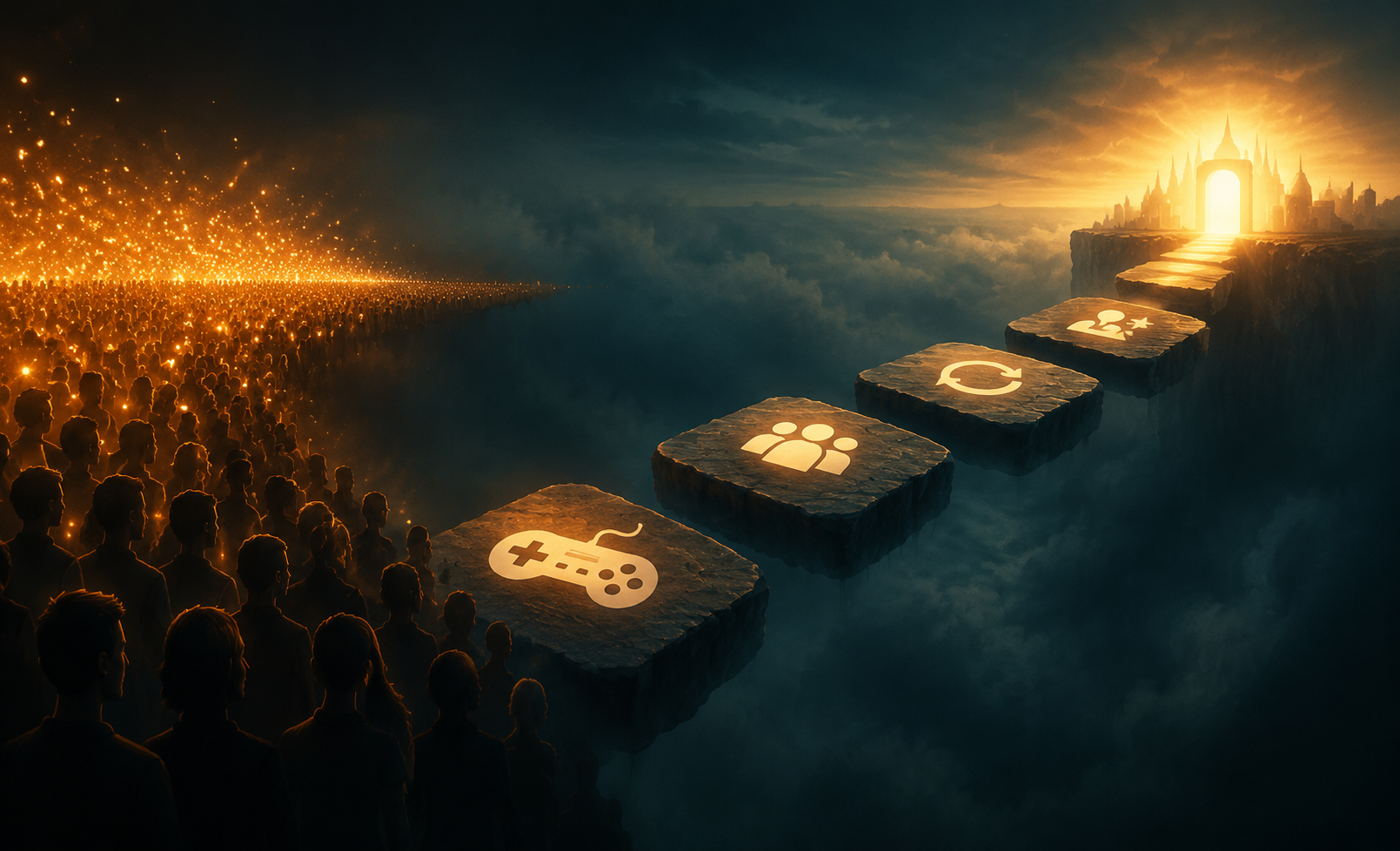
How Fallout 5's marketing strategy converts TV viewers into buyers
Bethesda's Fallout 5 faces a unique marketing challenge: the TV show already delivered massive awareness, but the game won't ship for years. This article examines how a staircase of bridge experiences — classic game purchases, Fallout 76 engagement, remasters, and UGC — can sustain demand and progressively convert the 65-million-strong TV audience into qualified buyers by launch.
Amazon says Fallout Season 1 reached more than 65 million viewers in its first 16 days on Prime Video, making it the platform’s second-most-watched title at the time.[1] For most game launches, that would be the dream: mass awareness, mainstream conversation, and a clean permission slip to start selling.
Fallout 5 does not get that clean version of the problem. Bethesda has said The Elder Scrolls VI remains the primary development focus, with Fallout 5 still in pre-production and no release window announced; the practical expectation is a launch gap that could stretch toward 2029–2031.[2][3] That turns the Fallout 5 marketing strategy into something less glamorous than a launch campaign and more difficult than a media plan: keeping a TV-warmed audience from cooling into nostalgia before there is a new flagship product to buy.
The useful question is no longer whether the show created demand. It did. The harder question is what kind of demand can survive long enough to matter. A viewer who finished eight episodes in 2024 is not automatically a Fallout 5 buyer years later. Something has to happen in between: a purchase, a login, a lore binge, a multiplayer habit, a mod download, a mobile return, an anniversary moment that reminds people they still belong here.
MIDiA Research called the absence of a new Fallout game alongside the show a “massive missed opportunity.”[4] That critique is fair, but it is also the beginning of the strategy problem, not the end of it. Bethesda cannot go back and ship Fallout 5 into the Season 1 window. It can only decide whether the audience created by that window is allowed to leak away.
Awareness Already Happened. Now Behavior Matters.
The encouraging part is that Fallout’s TV halo did not stay trapped in viewing metrics. Fallout 4’s daily Steam player count averaged around 200,000 after Season 1, roughly a tenfold increase from pre-show levels for a 2015 single-player title.[5] Fallout 76 daily active users reportedly jumped from about 100,000–200,000 before the show to more than 1 million after Season 1.[6] Those are not the same as Fallout 5 preorders, but they are much better than passive recognition.
The pre-Season 2 signal matters even more because it suggests the show’s effect was not limited to a one-week binge hangover. G2A data reported by MCV UK found Fallout game sales in the month before Season 2’s premiere were 78% higher than the previous quarterly average.[7] That is a marketplace-specific view, and G2A’s position as a third-party key reseller means the data should not be treated as a complete picture of official demand. Still, when it sits beside Steam activity and Fallout 76 engagement, the direction is hard to ignore.
The distinction is important for marketers because scale can flatter a team into stopping too early. A 65-million-viewer audience is an acquisition event. A tenfold Steam spike, a seven-figure DAU surge, and higher game sales before the next season are qualification signals. They show that at least part of the TV audience was willing to move from watching into playing.
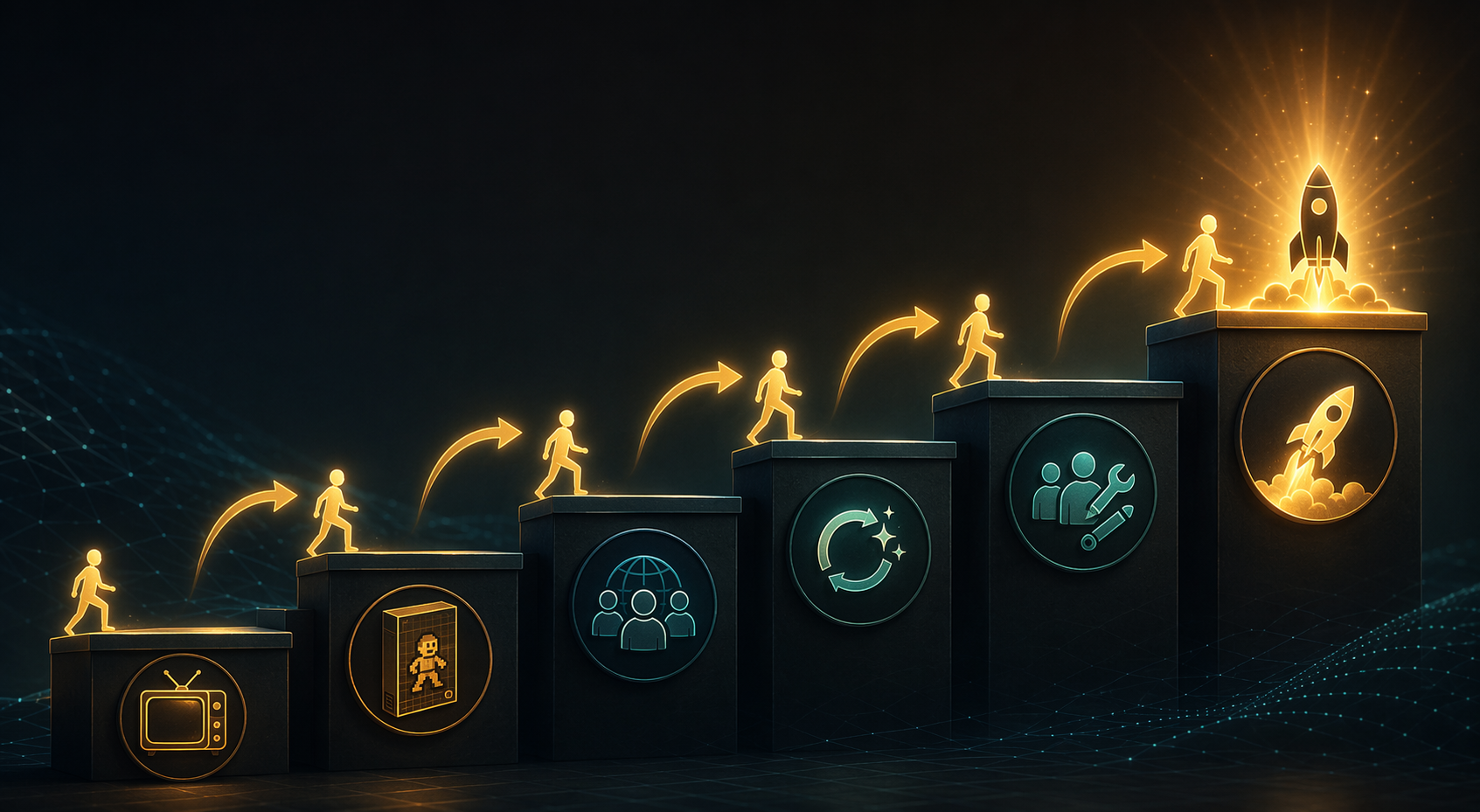
| Audience State | Bridge Experience | Behavior That Matters |
|---|---|---|
| TV-aware | Prime Video series | Finishes the show and recognizes the world |
| Lore-curious | Classic games and Complete editions | Pays for deeper franchise context |
| Actively engaged | Fallout 76 | Returns, plays with others, joins live updates |
| Reactivated or newly accessible | Fallout 3 and New Vegas remasters | Enters older canon through a lower-friction product |
| Participatory | Creations and community content | Adds, downloads, shares, or follows player-made extensions |
| Launch-qualified | Fallout 5 | Arrives with prior investment rather than distant awareness |
Classic Purchases Are More Than Back-Catalog Revenue
The cleanest bridge between a TV viewer and a future Fallout 5 buyer is not necessarily a trailer. It may be an older game bought at the moment curiosity is still warm. That purchase changes the relationship. The viewer is no longer only aware of Fallout as a show; they have paid to explore the world on game terms.
This is why the Complete edition signal is worth more attention than the raw sales lift. G2A reported that more than 60% of post-show Fallout game purchases were Complete editions.[7] Within the limits of that marketplace data, the behavior suggests a meaningful share of new or returning buyers wanted the fuller lore package, not just the cheapest base-game entry. That is a different level of intent.
For a long-lead product, that kind of buying behavior is valuable because it creates memory with receipts attached. Someone who buys a Complete edition has more chances to encounter factions, vaults, moral systems, settlements, and regional stories that can make a future Fallout 5 reveal feel personally legible. The marketing value is not only today’s unit sale. It is the creation of a player who can understand tomorrow’s promise.
There is a caveat. Fallout games’ availability through subscription services such as Game Pass may weaken the link between interest and per-unit purchase intent. A player who samples Fallout through a subscription can still become highly qualified, but they will not always show up in sales data. That makes the staircase harder to measure cleanly. Purchase data, platform engagement, completion behavior, wishlist movement, and community participation all need to be read together.
Fallout 76 Is the Most Important Living Bridge
Back-catalog purchases can convert curiosity into investment. Fallout 76 can do something harder: turn the audience into a recurring population. That makes it the most important bridge asset in the gap before Fallout 5.
The post-show DAU jump from roughly 100,000–200,000 to more than 1 million is the clearest sign that Fallout 76 could absorb TV-driven attention into an active game environment.[6] A live game gives marketers and product teams a place to observe behavior over time: who returns after the first session, who joins events, who brings friends, who spends, who churns after realizing the community is not what they expected.
That last point matters. A live community is not automatically welcoming just because the top of the funnel is full. Keywords Studios has identified “OG vs. noob” tension as a transmedia failure mode, where longtime fans can alienate newcomers arriving from another medium.[8] Fallout 76 gives Bethesda a conversion surface, but it also exposes TV-first players to norms, jokes, friction, and gatekeeping that can either deepen attachment or end the journey.
The product roadmap helps. Bethesda has continued supporting Fallout 76 with major expansions, including Raven Rock, planned for 2027 as a prequel story to Fallout 3.[6] That is useful positioning because it gives the live game a job beyond keeping servers active. It can connect modern participation to older canon, letting a newer viewer move sideways into franchise history without being handed a homework list.
For the Fallout 5 marketing strategy, the operational question is not whether Fallout 76 is “the next Fallout.” It is whether the game can keep enough people in a measurable loop while the next mainline entry is absent. A player who logs in for seasonal content, recognizes Raven Rock, then later buys or plays a Fallout 3 remaster is no longer a cold prospect. They are carrying recent behavior into the eventual launch cycle.
Remasters Can Lower the Friction Around Canon
Confirmed remasters of Fallout 3 and Fallout: New Vegas give Bethesda another bridge with a different job.[2] Fallout 76 asks viewers to join a live, social, evolving product. Remasters can meet players who want a more self-contained entry into the titles longtime fans keep recommending.
That distinction matters because “play the classics” is often terrible advice when the classics feel mechanically or technically old to a new audience. A remaster can turn an intimidating canon assignment into a modernized purchase. If Fallout 5 is years away, making older tentpoles easier to buy, install, and finish is not just fan service. It is mid-funnel work.
New Vegas also has a timely advantage. G2A’s marketplace data found Fallout: New Vegas saw a 12.5% relative market share increase during Season 2, correlating with the show’s Las Vegas narrative shift.[7] Correlation is the right word here. The data does not prove the story beat caused the buying shift across the whole market. But it does show how narrative focus can redirect demand toward a specific back-catalog title.
That is the kind of signal marketers should care about. If the show moves attention toward a place, faction, or era, the bridge product should be ready to receive it. A remaster timed near that interest does not need to pretend to be Fallout 5. It only needs to move the viewer one step deeper while the larger promise remains distant.
Creations Makes the Gap Less Empty
User-generated content is easy to praise vaguely and hard to manage well. In Fallout’s case, Creations deserves serious attention because there is real economic activity behind it: Bethesda says it has paid creators more than $10 million in royalties.[6] That does not prove every creator-made add-on retains TV viewers, but it does show the program is more than a decorative community label.
The marketing value of Creations is that it gives the franchise more surface area during a quiet mainline calendar. Official campaigns have to wait for assets, approvals, release beats, and platform coordination. Creator ecosystems can keep producing reasons to open the game, watch a video, browse a build, or talk about a strange new addition while the flagship sequel is still nowhere near launch.
There is a measurement trap here too. UGC can create activity without necessarily creating future purchase intent. A player may love mods and ignore Fallout 5. A creator economy may serve the most dedicated existing fans more than the TV-first audience. But in a multi-year gap, even that is useful if it keeps the world socially alive. A dormant franchise has to restart conversation from zero. A modded, streamed, argued-over franchise does not.
Low-Friction Touchpoints Still Have a Job
Not every bridge has to carry the same weight. Fallout Shelter, with more than 250 million lifetime players and ongoing new seasons, is not the deepest qualification path.[6] It is a low-friction re-entry point. That makes it useful for reminders, light engagement, and mobile-first audiences who are not ready to install a large RPG or join a live multiplayer world.
The 30th anniversary in 2027 has a similar role. Bethesda has announced anniversary activity including a live Fallout Day in Washington, DC.[6] An anniversary event will not solve the Fallout 5 gap by itself, and it should not be asked to. Its value is audience reassembly: giving scattered viewers, classic players, Fallout 76 regulars, creators, and lapsed fans a shared moment to gather before the next major product is ready.
These touchpoints matter because long gaps punish silence. The audience does not decay all at once. It drifts. One month, the show is still fresh. A year later, the viewer remembers the vibe but not the factions. Two years later, the franchise becomes something they liked once. Low-friction contact is not the core conversion engine, but it slows the slide.
The Numbers Are Promising, Not Perfect
The Fallout halo is real enough to plan around, but not clean enough to oversell. Amazon’s 65-million-viewer figure is self-reported and not independently audited.[1] G2A’s sales data offers useful directional signals but represents a single third-party marketplace with contested publisher relationships.[7] SteamDB-style player spikes show activity on one platform, not total franchise conversion.[5]
There are also tempting estimates that should stay out of the core argument. VG Insights has discussed an $80 million Fallout impact estimate that includes an assumed licensing fee of roughly $30 million, based on 10%–20% of production budget rather than a confirmed disclosed figure.[9] That may be interesting industry modeling, but it is not the same as verified incremental profit or future Fallout 5 demand.
A serious strategy can live with imperfect evidence. It just has to avoid pretending every metric measures the same thing. Viewership measures reach. Steam activity measures platform play. DAU measures recurring use. Complete edition purchasing suggests appetite for depth. UGC royalties show creator-economy scale. None of those individually proves a future Fallout 5 sale. Together, they describe an audience that is still moving.
The Marketing Plan Is the Continuity System
No official Fallout 5 marketing strategy has been published, and it would be a mistake to present this staircase as Bethesda’s announced plan. The point is more practical: if Fallout 5 is still several years away, then the go-to-market work cannot wait for the first trailer.
The campaign before the campaign is already happening. Classic editions convert curiosity into paid lore exploration. Fallout 76 converts passive interest into repeat participation. Remasters can make canonical favorites easier to enter. Creations can keep the world producing new reasons to return. Fallout Shelter and anniversary events can reassemble lighter audiences before they disappear completely.
If Bethesda lets the TV audience sit idle until Fallout 5 trailers arrive, the show becomes a memory spike: impressive, expensive, and increasingly detached from purchase behavior. If it uses the intervening years as a progressive conversion system, the eventual launch audience can arrive already warmed, literate, and invested.
That is the broader advertising lesson inside the Fallout case. When awareness peaks years before product availability, the marketer’s job shifts. Acquisition has already happened. The hard work is engineered continuity.
References
- Fallout Season 1 viewership announcement, Amazon MGM Studios.
- Fallout 5 development status and Fallout 3 / New Vegas remaster confirmation, IGN, July 2026.
- Bethesda development focus and Fallout 5 timing coverage, PC Gamer, July 2026.
- MIDiA Research critique of Fallout game timing, MIDiA Research.
- Fallout 4 Steam player spike after the TV series, Ars Technica / SteamDB.
- Bethesda Fallout July 2026 official update, Bethesda, July 2026.
- G2A Fallout marketplace sales data, MCV UK, 2026.
- Transmedia audience tension and “OG vs. noob” failure mode, Keywords Studios.
- VG Insights Fallout revenue and licensing estimate, VG Insights.
Comments
Join the discussion with an anonymous comment.