
How Amazon Advertisers Should Adapt to the Alexa for Shopping Era
Amazon's May 2026 rebrand of Rufus to Alexa for Shopping marks a shift from keyword-based to intent-driven product discovery. This guide explains how the new AI layer changes visibility, what advertisers need to optimize, and how to adjust PPC strategy accordingly.
What Alexa for Shopping Is and Why the Rufus Rebrand Matters
On May 13, 2026, Amazon replaced its Rufus chatbot with a fundamentally different product: Alexa for Shopping. This is not a simple rename. Where Rufus was a conversational interface that answered product questions, Alexa for Shopping is an AI shopping agent that can take actions on behalf of users — running multi-step research, comparing products across categories, and producing buying guides with embedded add-to-cart buttons. Amazon described it as "the world's best, most personalized AI assistant for shopping," combining Rufus with Alexa+ and tapping users' shopping history to deliver personalized recommendations.
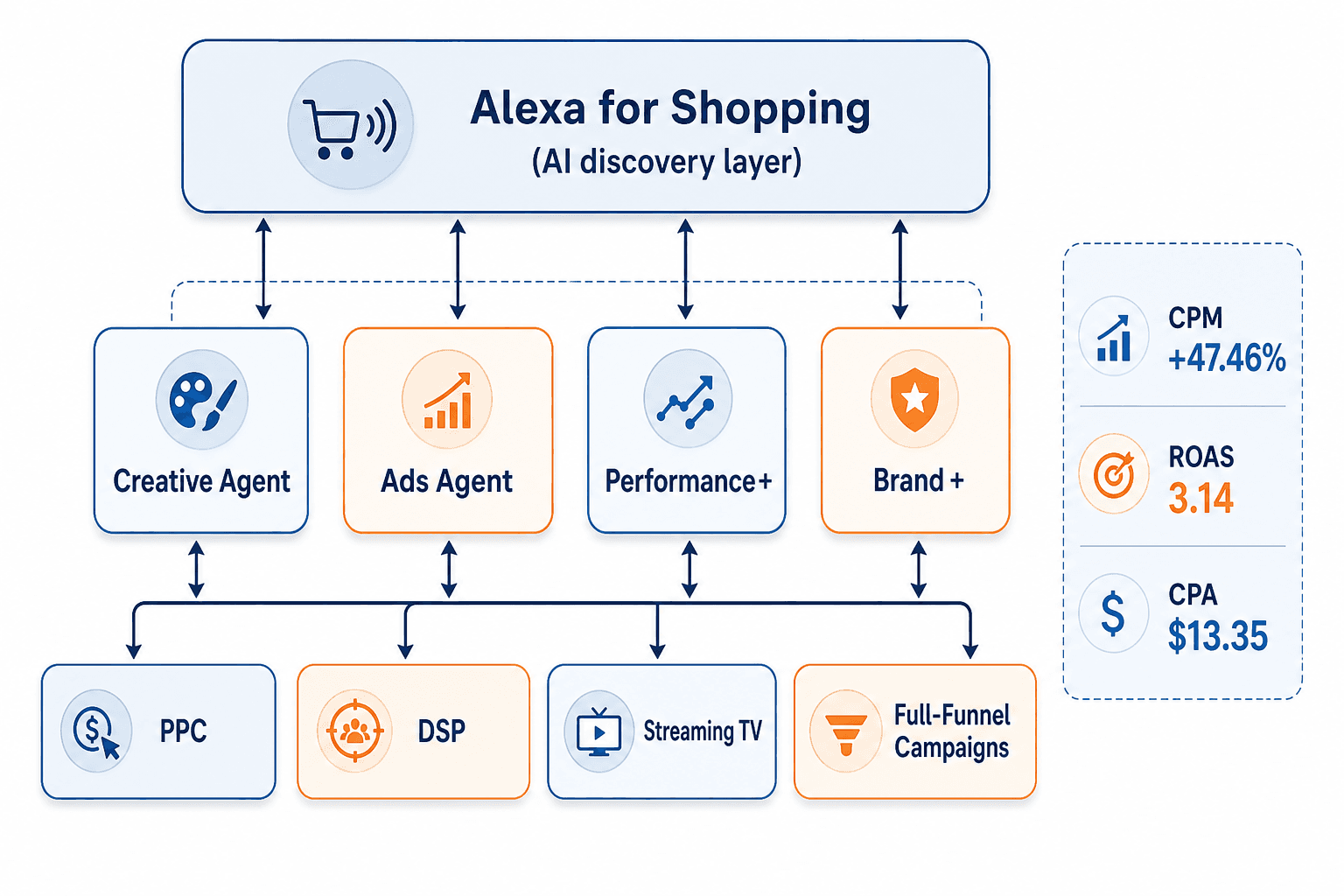
The strategic significance for advertisers is hard to overstate. Alexa for Shopping is not a standalone chatbot that users must discover and open. It is woven directly into the Amazon shopping experience — appearing in search results, on product detail pages, and even in the cart. Amazon has stated that the tool will feature ads "where they're relevant" and when they "enhance" the shopping experience, which means the AI layer is not just a new feature but a new distribution channel for product discovery.
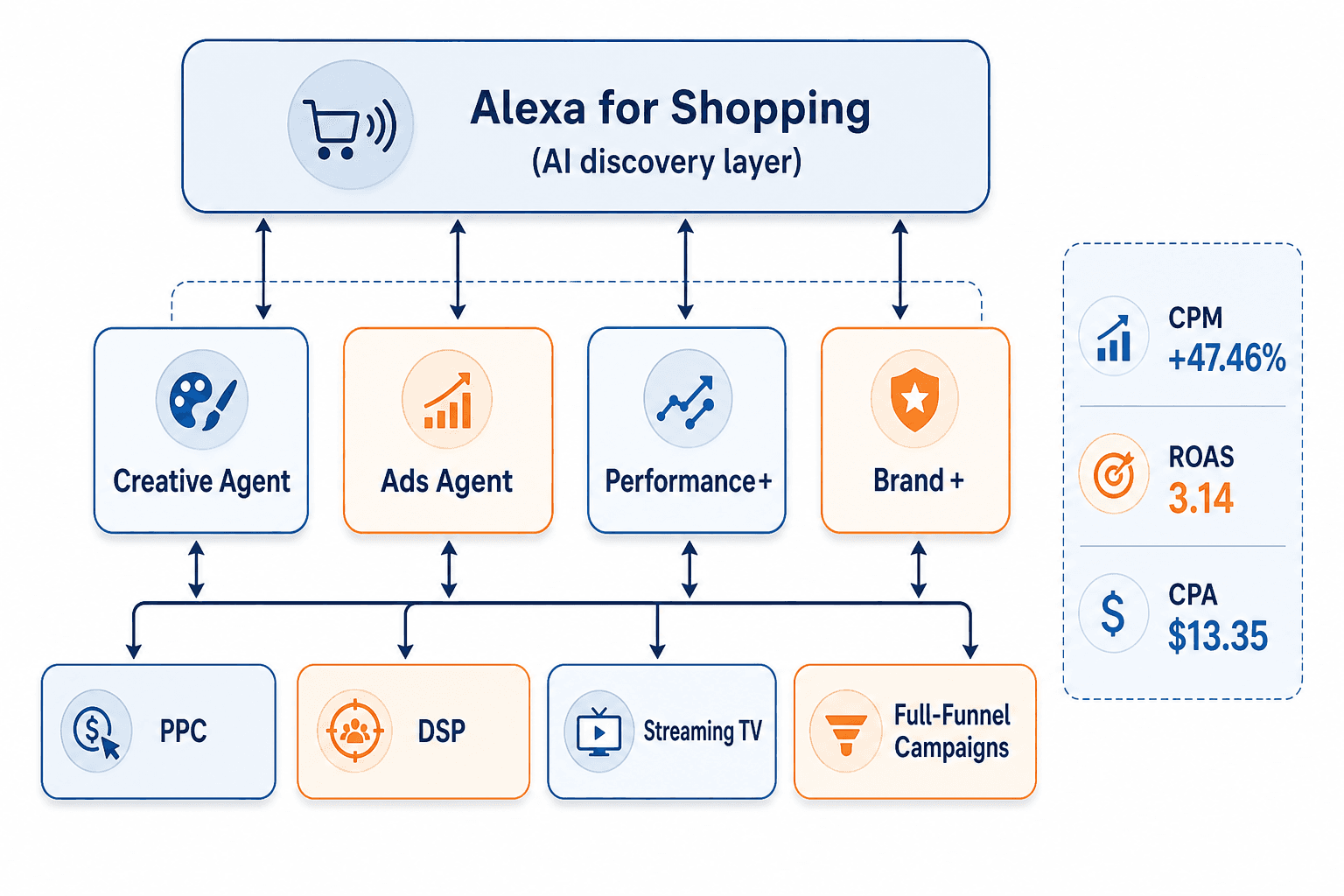
The rebrand also signals Amazon's broader AI strategy. The company has been rolling out AI-powered advertising tools — including Brand+ and Performance+ (which helped H&R Block achieve a 144% lift in full-funnel conversion rate and a 35% improvement in CPA, according to Amazon's own data shared at IAB NewFronts 2025). Alexa for Shopping is the consumer-facing manifestation of this same AI infrastructure, and it changes how products get discovered, evaluated, and purchased.
Six Key Touchpoints Where Alexa for Shopping Appears
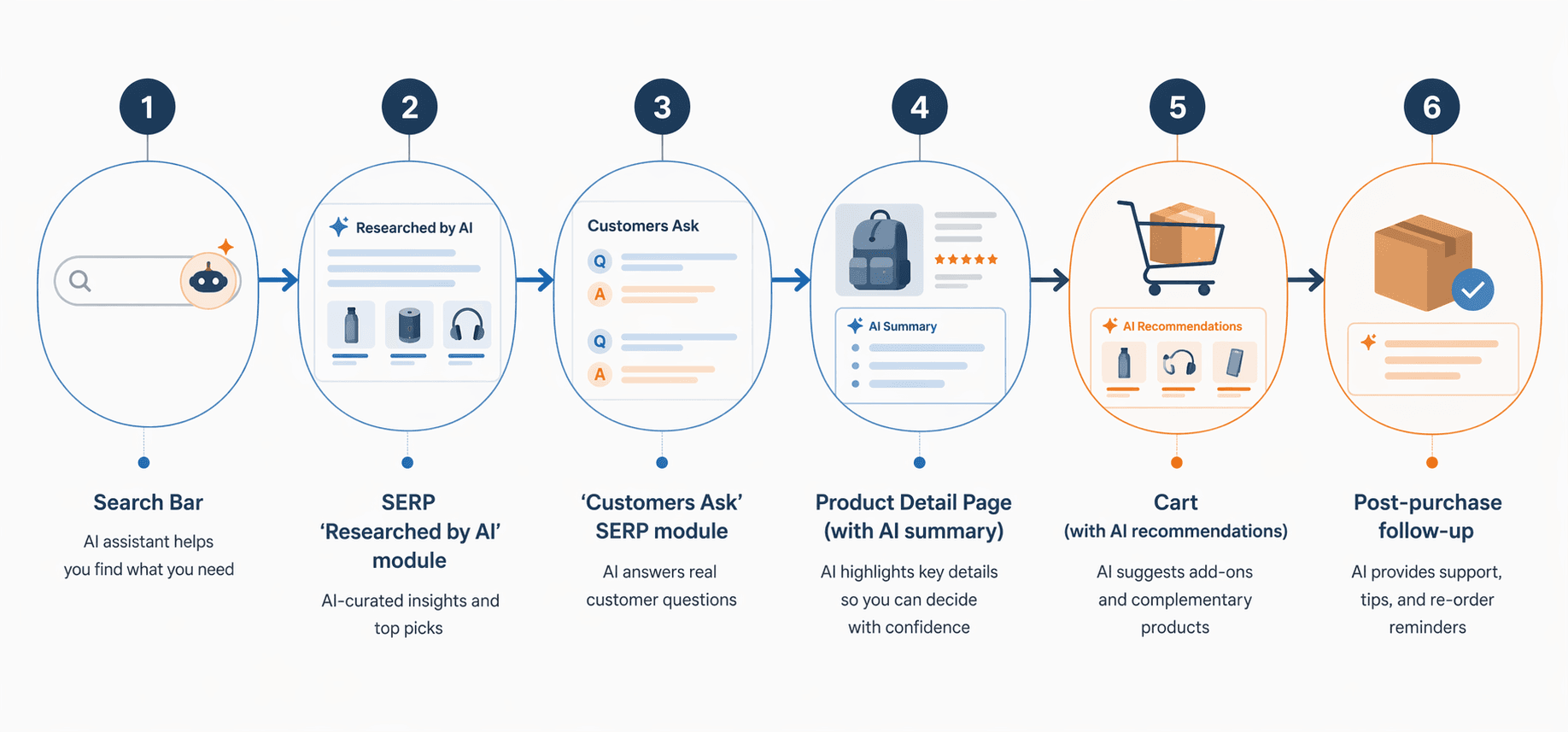
According to AMALYTIX's comprehensive analysis updated May 20, 2026, Alexa for Shopping surfaces across six distinct touchpoints in the customer journey. Each represents a new opportunity — or risk — for advertisers depending on how their products are positioned.
- Search bar with Alexa prompts before SERP: Before users even see traditional search results, Alexa for Shopping displays conversational prompts and recommended items in a chat window. This is the first AI-mediated filter on product visibility.
- "Researched by AI" SERP module: A dedicated section on the search results page that surfaces products the AI has evaluated and recommends. This module sits above or alongside traditional organic and sponsored listings.
- "Customers Ask" SERP module: This module promotes high-click Alexa dialog prompts into standard search results. It creates a feedback loop between AI interactions and organic visibility — popular questions and their AI-generated answers get surfaced more prominently.
- Product detail page via "Ask Alexa": On PDPs, users can ask Alexa for Shopping specific questions about the product. The AI draws from listing content, A+ Content, and reviews to generate answers.
- Product detail page via "Why you might like this": A personalized AI-generated explanation of why the product is relevant to the user, based on their shopping history and the product's attributes.
- Cart via "Compare with similar items": When a user has a product in their cart, Alexa for Shopping can suggest comparable alternatives, creating a new competitive dynamic at the point of purchase.
Additionally, Alexa for Shopping can run multi-step research workflows called "Custom Guide" that produce full buying guides with embedded add-to-cart functionality. This means the AI can effectively become a product curator, bypassing traditional search entirely for certain user journeys.
How Recommendation Logic Differs from Classic Keyword Search
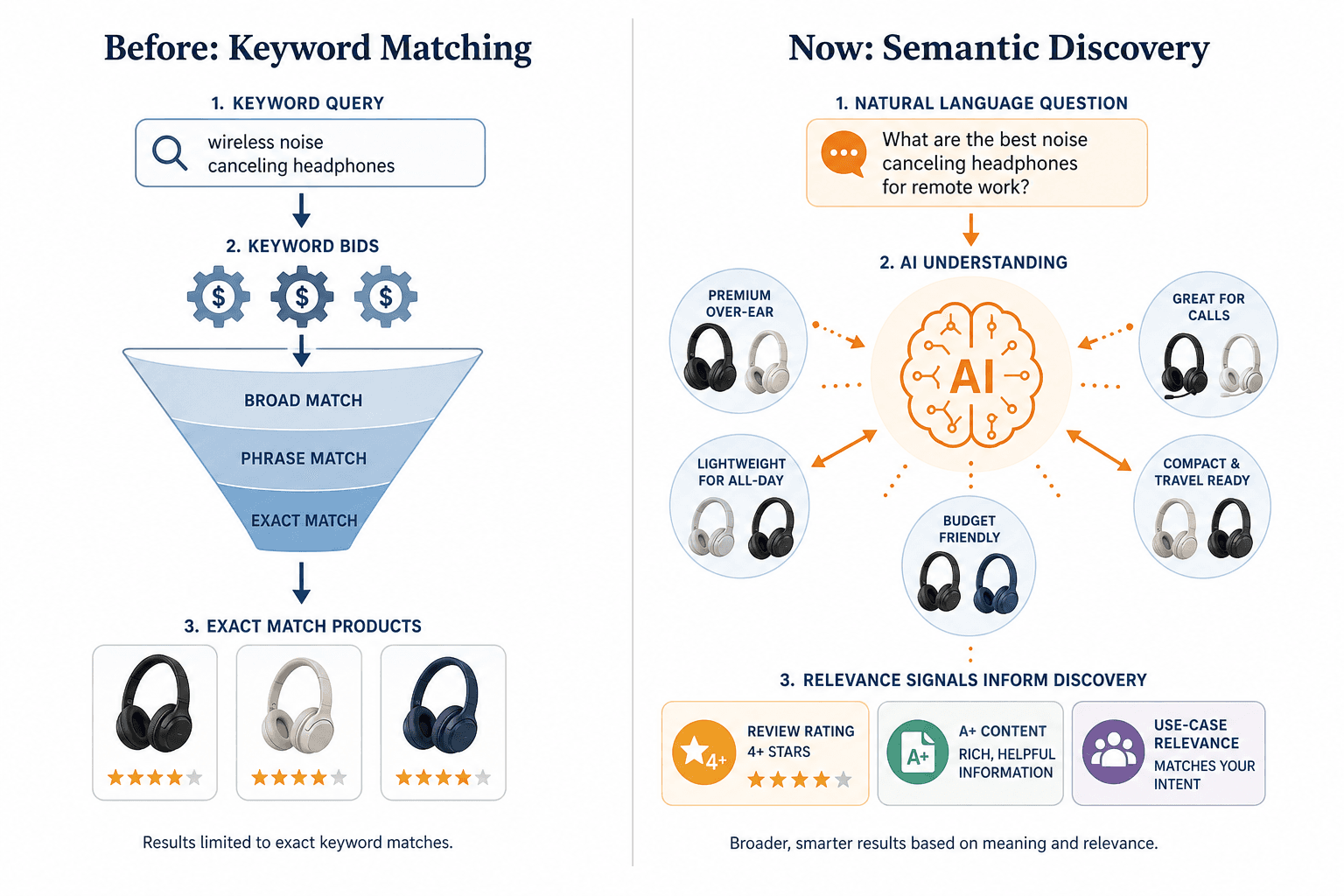
The most important change for advertisers to understand is the shift from keyword matching to semantic fit. Traditional Amazon search works by matching user queries to keywords in product titles, bullet points, and backend search terms. Alexa for Shopping works differently: it interprets the intent behind a natural language question, evaluates products against that intent, and recommends based on semantic relevance rather than exact keyword matches.
AMALYTIX's analysis reveals several specific mechanics that advertisers need to understand:
| Factor | How It Works in Alexa for Shopping | Advertiser Implication |
|---|---|---|
| Rating threshold | Products below 4.0 stars are typically excluded from Alexa for Shopping recommendations. | Review management becomes a direct visibility factor, not just a conversion lever. |
| A+ Content as knowledge source | A+ Content functions as a knowledge source for the AI assistant, not just a visual branding canvas. Text-light modules leave value on the table. | Maximize information density in A+ Content — the AI reads and uses this text to understand what your product does and who it's for. |
| Use-case clarity | The AI evaluates products based on how well they match the user's described need or use case, not just keyword matches. | Listings must be explicit about use cases, not just feature lists. "Great for small kitchens" is more valuable than "Compact design." |
| Category relevance | The AI considers category placement as a signal of product relevance and intent alignment. | Ensure products are in the most specific and accurate categories. Misplaced products lose semantic signal. |
| Customer Ask feedback loop | Popular questions and their AI-generated answers get promoted into standard search results via the 'Customers Ask' module. | Monitor which questions are being asked about your products and categories — they become organic visibility drivers. |
The practical implication is clear: products that rank well in traditional keyword search may not be recommended by Alexa for Shopping if they lack strong ratings, thin A+ Content, or unclear use-case positioning. Conversely, products that optimize for semantic fit may gain visibility in the AI layer even if they don't dominate traditional keyword rankings.
Sponsored Prompts: The Paid Visibility Lever into AI Recommendations
Amazon has introduced AI-generated Sponsored Prompts delivered inside Sponsored Brand ads as the primary paid mechanism for influencing Alexa for Shopping recommendations. These prompts are derived from real user questions and can drive stronger interaction than standard ad formats because they appear in the conversational flow where users are actively seeking recommendations.
However, there is a critical limitation that advertisers must understand: prompt control is limited. According to AMALYTIX's analysis, advertisers can usually disable prompts but cannot freely author them. This means you cannot simply write your own Sponsored Prompts to steer the AI toward your products. Instead, Amazon's AI generates prompts based on real user questions and your listing content.
This creates a new dynamic where organic listing optimization and paid advertising strategy converge. The same content that helps Alexa for Shopping understand your product for organic recommendations also feeds the AI that generates Sponsored Prompts. Advertisers who treat listing content and ad copy as separate workstreams will be at a disadvantage.
Concrete Optimization Checklist for Advertisers
Based on the mechanics described above, here is a practical checklist for optimizing your Amazon presence for the Alexa for Shopping era. These actions go beyond traditional keyword optimization and address the semantic discovery layer directly.
| Optimization Area | Action | Priority |
|---|---|---|
| Use-case explicit listings | Rewrite titles and bullet points to describe use cases and scenarios, not just features. Example: "Perfect for small apartments and dorm rooms" instead of "Compact size." | High |
| A+ Content information density | Audit A+ Content modules. Replace image-heavy, text-light modules with text-rich modules that explain product benefits, use cases, and differentiators. The AI reads this content. | High |
| Review management | Monitor and manage reviews to maintain a 4.0+ star average. Products below this threshold are typically excluded from Alexa for Shopping recommendations. | High |
| Category accuracy | Verify products are in the most specific and accurate categories. Misplaced products lose semantic signal and may not be recommended for relevant queries. | Medium |
| Customers Ask monitoring | Set up monitoring for the 'Customers Ask' module in your categories. Identify which questions are being surfaced and ensure your listings answer them clearly. | Medium |
| Sponsored Prompts enablement | Enable Sponsored Prompts within Sponsored Brand ads where available. Monitor which prompts are generated for your products and adjust listing content accordingly. | Medium |
| Backend keyword optimization | Include use-case and scenario-based keywords in backend search terms, not just product attributes. Think about how users describe their needs in natural language. | Low |
What This Means for Amazon PPC Strategy
The rise of Alexa for Shopping does not make traditional keyword PPC obsolete, but it does mean that keyword PPC alone is no longer sufficient. Advertisers must now manage two parallel discovery paths: the traditional keyword-driven path and the new semantic, AI-mediated path. Budget allocation, campaign structure, and performance measurement all need to account for this dual reality.
Current market conditions make this strategic shift particularly urgent. Triple Whale's 2025 benchmark data (covering January-December 2025, published March 24, 2026) shows that Amazon advertising costs are rising significantly: CPM surged 47.46% year over year to $7.82, while platform-wide CPA fell to $13.35 (down 5.65% YoY) and ROAS climbed 10.16% to 3.14. Conversion rates improved 9.97% to 11.02%. The CPM increase is described as "the most important number to carry into planning in 2026" — it means that reaching users through traditional display and sponsored brand ads is getting more expensive.
| Metric | 2025 Value | YoY Change |
|---|---|---|
| CPM | $7.82 | +47.46% |
| CPA | $13.35 | -5.65% |
| ROAS | 3.14 | +10.16% |
| CVR | 11.02% | +9.97% |

Comments
Join the discussion with an anonymous comment.