
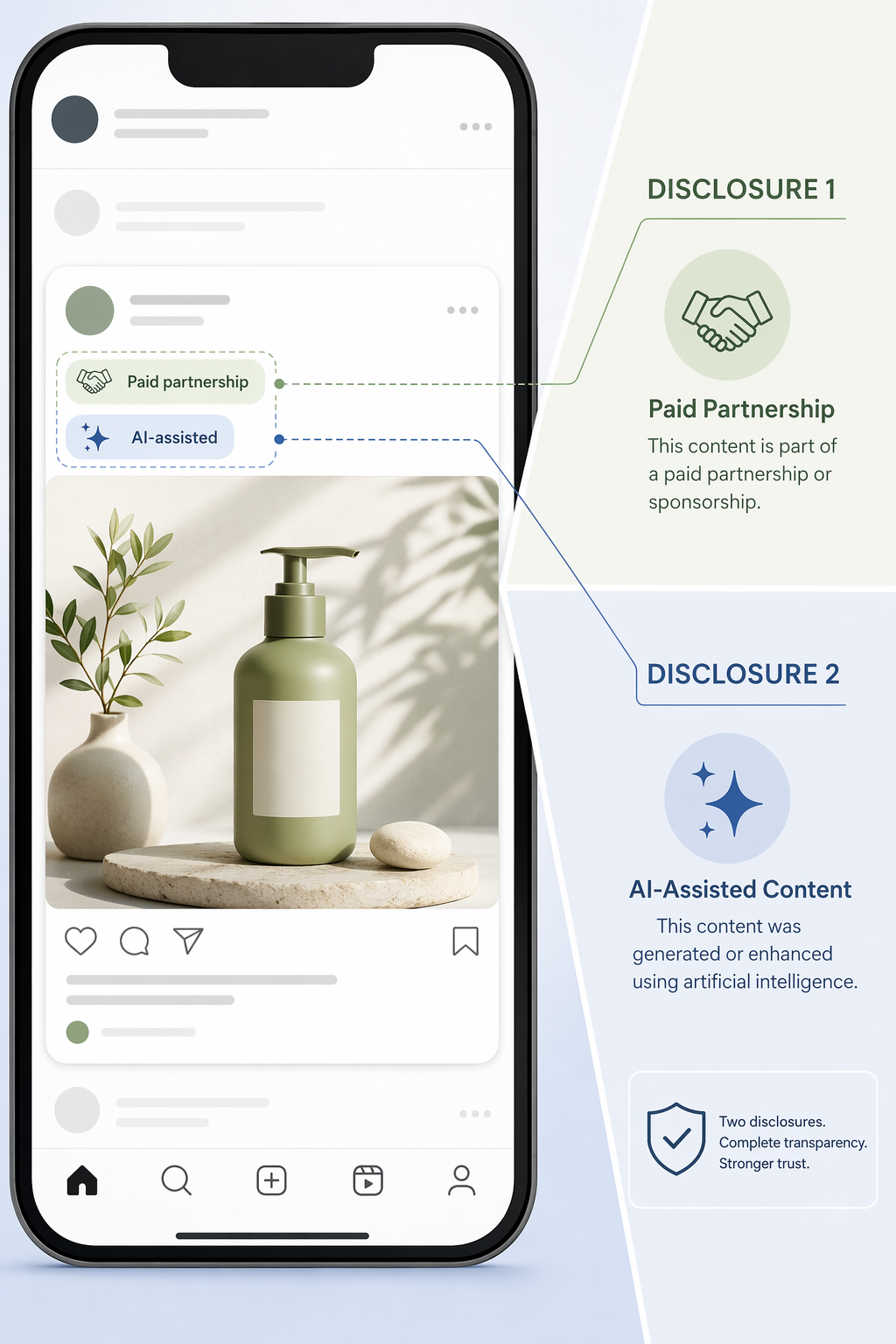
The Double Disclosure Playbook for AI Influencer Campaigns
This playbook outlines the double disclosure requirements for AI-involved influencer campaigns in 2026, giving brand and agency teams a practical framework to comply with FTC rules and avoid per-violation penalties.
The campaign looks clean in the approval thread. The creator is contracted. The paid partnership tag is turned on. The platform’s AI label may even be visible somewhere in the interface. Then the post goes live and the caption says nothing plain about the sponsorship, nothing plain about the AI-generated caption variants the agency supplied, and nothing about the AI translation used for the second market.
That is the disclosure problem AI influencer ads create in 2026. Two separate facts can affect how a consumer reads the endorsement: the creator has a material connection to the brand, and AI materially shaped the content the audience is seeing. The practical rule is simple enough to put in a campaign checklist: disclose the sponsorship and disclose the AI involvement, clearly and conspicuously, in the post itself. Industry lawyers often call this “double disclosure,” although that phrase is an applied compliance framework rather than a standalone FTC term or new FTC statute.[1]
The stakes are no longer theoretical. The 2026 FTC civil penalty amount is $53,088 per violation, and each non-compliant post can count separately.[2] A ten-creator burst with three weak caption variants per creator is not one tidy mistake. It is a campaign-scale exposure problem.
Platform-native labels help, but they are not a compliance system. Paid partnership tags, branded content tools, and AI content toggles can support the record that the brand tried to disclose. They do not reliably solve placement, language, visibility, or context. A consumer should not have to click a label, inspect a profile, decode platform UI, or infer what “AI” means in order to understand why the post exists and how it was made.[1]
For the broader FTC treatment of AI-generated marketing content, use this foundation reference: FTC disclosure requirements for AI-generated marketing content. This playbook stays narrower: creator posts, campaign handoffs, approval steps, and the exact disclosure decision teams need before content goes live.
The Rule Behind Double Disclosure
A sponsorship disclosure answers one consumer question: is this creator recommending the product because of a relationship with the brand? An AI disclosure answers a different question: is the content, likeness, voice, text, image, translation, or endorsement presentation materially shaped by synthetic or AI-assisted production?
Those questions can overlap in the same post, but they are not the same disclosure. A caption that says “Ad” does not tell the audience that the product testimonial was rewritten by a generative AI tool. A platform AI label does not tell the audience that the creator was paid, gifted product, given affiliate commission, or otherwise connected to the brand.
The legal standard that matters for both is the familiar clear and conspicuous standard: the disclosure needs to be hard to miss and understandable to ordinary consumers in the context where the endorsement appears. Dynamis LLP’s 2026 analysis frames the sponsorship and AI notices as separate obligations triggered by separate facts, with both requiring placement and wording that consumers can actually see and understand.[1]
That is why “we checked the platform box” is thin protection. Native labels vary by platform, move around the interface, and may not explain the relationship or the AI use in plain language. AdExchanger’s coverage of AI disclosure requirements also treats platform rules and labels as a moving layer of compliance rather than a substitute for advertiser-controlled disclosure language.[3]
Start With The Material Connection
Before anyone debates AI wording, confirm whether the creator relationship itself needs disclosure. In most influencer campaigns, this is the easy part because the campaign would not exist without a material connection. Payment, free product, affiliate commission, usage rights, a family or employment relationship, equity, sweepstakes entry, or any other benefit that could affect the credibility of the endorsement belongs in the review.
The operational mistake is treating the sponsorship disclosure as a platform setting instead of caption copy. A paid partnership tag is useful, but the creator’s own post should still carry plain words such as “Ad,” “Sponsored by [Brand],” or “Paid partnership with [Brand],” placed where the audience encounters the endorsement without digging.
This is especially important when the campaign has multiple assets. The hero video, cutdown, story frame, repost, creator whitelisting ad, translated version, and affiliate follow-up may all need their own disclosure review. The first post being clean does not rescue the later version if the disclosure drops out during editing.
Then Decide Whether The AI Use Crosses The Line
Not every AI tool in the workflow needs to be disclosed. If a creator uses AI-enabled grammar checking, scheduling, performance analytics, or routine file organization, the audience is not usually being misled about the origin or substance of the endorsement. The more important trigger is whether AI materially shaped what the consumer sees, hears, or understands.
FTC staff guidance and 2026 advisory analysis draw the practical boundary this way: grammar-checking, scheduling, and analytics generally do not require AI disclosure; AI content generation, substantial AI editing, and AI translation do.[1] That distinction is useful because it keeps teams from over-labeling every ordinary production tool while still catching the places where AI changes the message.
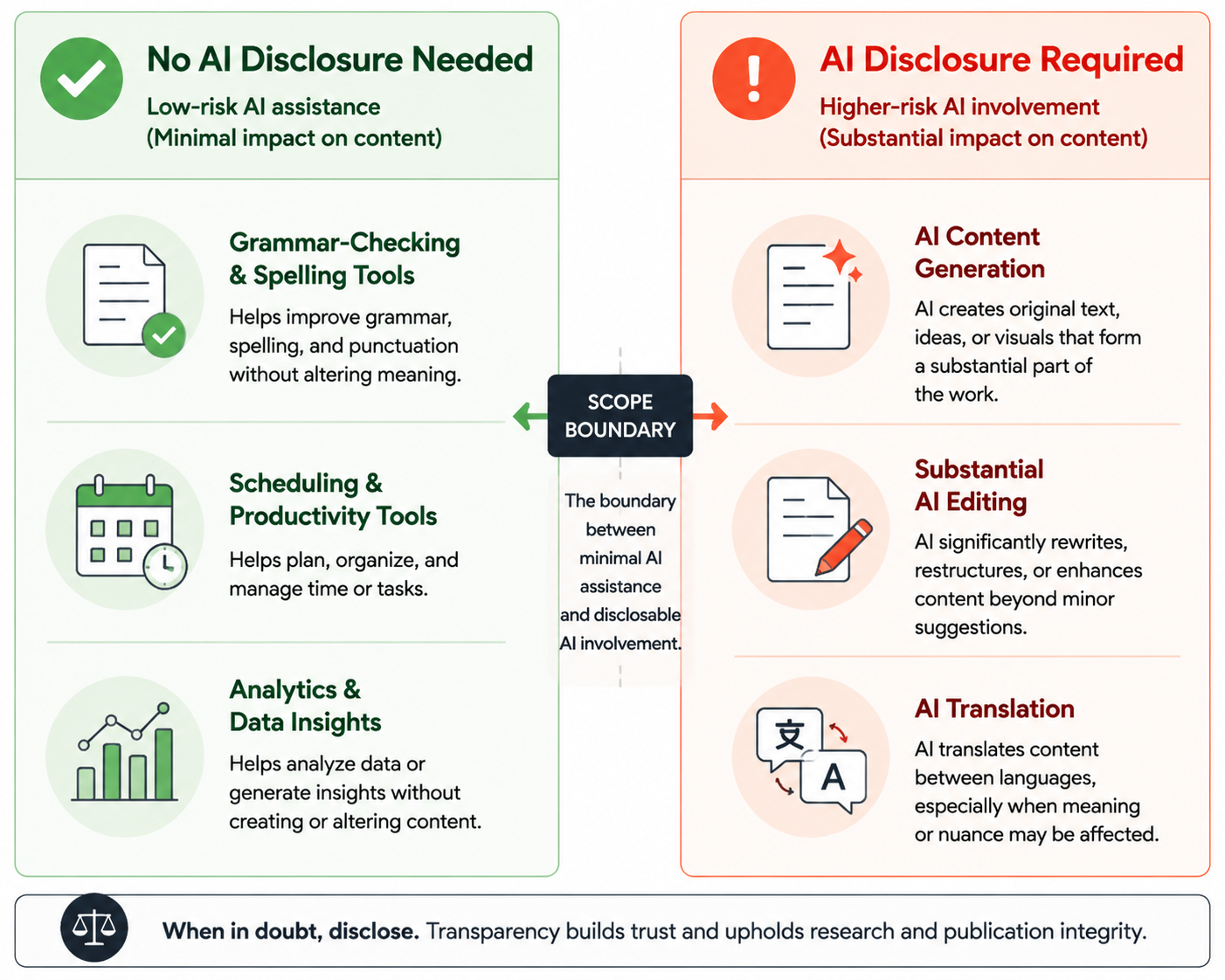
| AI use in the creator workflow | Disclosure posture | Why it matters |
|---|---|---|
| Grammar or spelling cleanup | Usually no AI disclosure | The tool polishes expression without materially changing the endorsement. |
| Scheduling, analytics, or reporting tools | Usually no AI disclosure | The AI affects campaign operations, not the consumer-facing claim. |
| Generated caption options supplied by the brand or agency | AI disclosure should be considered and often required | The consumer-facing endorsement language was materially created or shaped by AI. |
| Substantial AI rewrite of creator copy | AI disclosure required | The final message may no longer be only the creator’s unaided expression. |
| AI-generated image, video, voice, avatar, or synthetic scene | AI disclosure required | The audience may misunderstand the origin or authenticity of what it sees or hears. |
| AI translation for another market | AI disclosure required | The audience is receiving a materially AI-shaped version of the endorsement. |
The translation point is where campaign teams often lose the thread. The English version may have been approved with “Ad” and “AI-assisted caption,” but the localized caption gets routed through a different vendor, adjusted in-market, and posted without the AI note. If AI translation materially produced the consumer-facing endorsement, it should be treated as part of the disclosure review, not as a back-office convenience.
Substantial editing deserves the same attention. A creator drafting a caption and accepting a spellcheck suggestion is not the same as an agency feeding a rough testimonial into a model and generating a more persuasive final version. The disclosure question follows the audience-facing output, not the tool subscription line item.
Use One Workflow, Not Two Last-Minute Checks
The easiest way to miss the disclosure rule in AI influencer campaigns is to run sponsorship review and AI review in separate lanes. The brand manager approves the creator brief. The agency generates caption variants later. The creator edits one version in-app. The media team boosts the post. Nobody owns the final disclosure sentence.
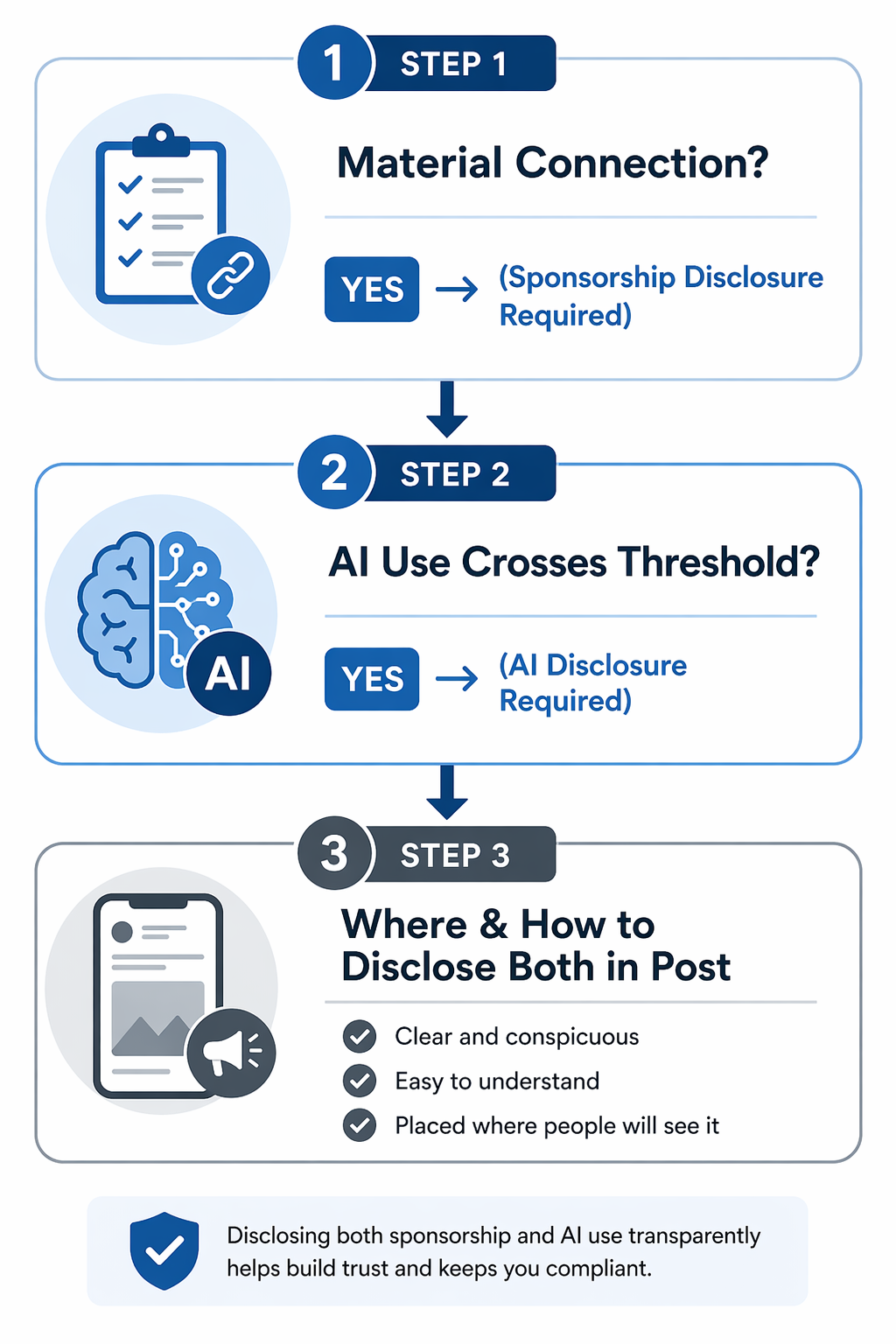
A workable review flow has three gates:
- Material connection: does the creator have any relationship, payment, incentive, or benefit that could affect how consumers evaluate the endorsement?
- AI involvement: did AI materially generate, edit, translate, synthesize, or alter the consumer-facing content?
- Placement and wording: are both disclosures visible and understandable where the audience encounters the post?
The third gate is where the work actually becomes defensible. It is not enough for a disclosure to exist somewhere in the asset folder. The final post needs the right words in the right place, in the same language as the ad, before the endorsement claim starts doing its job.
What The Reviewer Should Actually Look At
A pre-launch review should inspect the final creator-facing version, not only the brand brief. For a short-form video, that means the caption, on-screen text if used, spoken copy when relevant, pinned comments if the team is relying on them, and any version that will be amplified as paid media. For a still image post, it means the visible caption and any creative text that carries the endorsement. For a story or temporary format, each frame that can stand alone needs review because viewers may not watch the whole sequence.
The reviewer should also confirm that the disclosure survives common handoffs: creator edits, agency copy polish, legal redlines, localization, last-minute product claim changes, and paid media adaptation. Disclosure failures are often version-control failures wearing a legal costume.
Build Wording That Says Both Things Plainly
Good disclosure language is not clever. It is short, direct, and close to the endorsement. If both facts are present, the audience should understand both without needing an internal glossary.
| Scenario | Cleaner disclosure construction | Why it works better |
|---|---|---|
| Paid creator post with AI-assisted caption | Ad. This caption was AI-assisted and reviewed by me. | It separates the sponsorship from the AI involvement in plain language. |
| Sponsored product video with AI-generated visuals | Paid partnership with [Brand]. Some visuals in this video were AI-generated. | It tells the viewer both why the post exists and what part of the content is synthetic. |
| Creator campaign translated with AI for another market | Sponsored by [Brand]. This post was translated with AI assistance. | It carries the disclosure into the localized version instead of relying on the source post. |
| Virtual or synthetic influencer endorsement | Ad for [Brand]. This creator is AI-generated. | It avoids letting the audience assume a human creator personally experienced the product. |
| Affiliate creator using generated caption variants | Ad/affiliate link. Caption drafted with AI assistance. | It addresses both compensation and AI-shaped endorsement copy. |
The exact sentence can change with the asset, but the standard should not. Put the disclosure in the same language as the ad. Use words ordinary consumers understand. Place it before or near the claim it qualifies. Do not bury it after a stack of hashtags, inside a profile bio, behind a link, or only in a contract provision the audience will never see.
“AI-assisted” can be enough when the use was genuinely assistance, such as a caption drafted or translated with a tool and then reviewed. “AI-generated” is more accurate when the image, video, voice, avatar, or copy was generated by AI. “Enhanced” is usually weaker because it does not tell the audience what happened. The safer wording names the relevant piece of the post: caption, image, voiceover, translation, visuals, or creator.
The creator’s own words matter too. If a video makes a spoken endorsement and the AI involvement is central to the content, the disclosure may need to appear in the spoken or visual experience, not only in a caption most viewers never expand. The point is not to duplicate every phrase in every location; it is to make the sponsorship and AI involvement obvious at the moment the endorsement is consumed.
Do Not Let Platform Labels Carry The Whole Campaign
Platforms keep changing their branded content tools and AI labeling features. Some labels are prominent. Some are easy to miss. Some apply only to certain media types or account categories. Some may be triggered by the creator, not the brand. That variability is exactly why platform UI should be treated as supplemental evidence, not the primary disclosure plan.
Dynamis LLP and ArentFox Schiff both emphasize that native labels and platform mechanisms do not replace clear text-based disclosure controlled by the advertiser and creator.[1][4] The practical consequence is straightforward: use the platform tools, screenshot the settings when helpful, but still require plain disclosure language in the post or content itself.
This is also where national campaigns need current platform and state-law review. AdExchanger notes that AI disclosure requirements are developing across platform rules and state-level approaches, and Common Thread’s discussion of New York’s AI influencer law highlights why ecommerce brands cannot assume one generic setting will satisfy every market.[3][5] That does not mean every campaign needs a state-by-state essay in the caption. It means the launch checklist should include a current legal or compliance check before national distribution.
Why The Penalty Math Changes The Review Standard
FTC enforcement pressure is not limited to a theoretical warning buried in a webinar. Benesch Law reports that the FTC’s Operation AI Comply continued under the new administration, that the agency established a dedicated AI enforcement unit in January 2026, and that the 2026 civil penalty amount is $53,088 per violation.[2] ArentFox Schiff also describes advertising enforcement as having increased by 40% in 2025.[4]
That enforcement context matters because influencer campaigns multiply assets quickly. One weak disclosure template can travel from the creator brief into twenty captions, a paid amplification unit, a localized repost, and an affiliate email. If each non-compliant post can be counted separately, the risk is not proportional to the size of the mistake in the brief. It is proportional to the number of times the mistake goes public.
The private litigation environment adds pressure. Morgan Lewis reported in June 2025 that influencer marketing class actions were on the rise, and ArentFox Schiff has warned that the plaintiffs bar is treating compliance failures as class action opportunities.[6][4] Even when a regulator never appears, a sloppy disclosure record can become an expensive exhibit.
None of this requires turning a creator campaign into a legal memo. It requires a launch process that produces evidence of sensible decisions: what the material connection was, how AI was used, what disclosure language was approved, where it appeared, and whether the final post matched the approved version.
The Campaign Review Steps That Prevent The Handoff Failure
The disclosure process should sit inside production, not after it. A clean workflow starts when the brief is written and ends only after the final live post is checked.
- Mark the relationship in the brief: paid, gifted, affiliate, employee, equity, sweepstakes, or another material connection.
- Log AI use by asset: caption generation, image generation, synthetic voice, AI translation, substantial rewrite, or no material AI use.
- Approve disclosure language with the asset, not separately from it.
- Require the creator to keep the disclosure in the final caption, spoken content, or visual field where relevant.
- Check the live post, including localized versions and paid amplification units.
- Save the final post record, including screenshots or exports showing the disclosure as published.
The asset log does not need to be elaborate. A simple column for material connection, one for AI use, one for required disclosure, one for final placement, and one for live-post verification will catch more risk than a polished policy deck nobody opens during production.
| Review field | What to capture | Example entry |
|---|---|---|
| Creator relationship | The benefit or connection triggering sponsorship disclosure | Paid flat fee plus affiliate commission |
| AI use | Whether AI materially shaped consumer-facing content | AI-generated caption draft and AI translation |
| Required disclosure | The exact words approved for the asset | Ad. Caption and translation were AI-assisted. |
| Placement | Where the disclosure appears in the final post | Opening caption line and on-screen text |
| Verification | Who checked the live post and when | Creator lead verified after publication |
For teams already using an AI content quality process, this disclosure review can sit alongside the broader QC framework for AI-generated marketing content rather than becoming a separate spreadsheet nobody maintains. The same handoff that checks claims, brand safety, and approvals can check whether the audience-facing AI disclosure survived. For adjacent issues, especially ownership and reuse of AI-assisted creative, the AI copyright gray zone for ad creative article belongs in the same risk conversation.
A Practical Pre-Launch Standard
Before an AI-involved influencer post goes live, the team should be able to answer five questions without opening a legal research file:
- Would a normal viewer immediately understand that the creator has a relationship with the brand?
- Would that same viewer understand whether AI materially shaped the caption, image, video, voice, translation, or creator presentation?
- Are both disclosures in the same language as the ad and close to the endorsement?
- Does the disclosure survive if the viewer does not click, expand, visit a profile, or understand platform-specific labels?
- Has someone checked the live post, not just the approved draft?
If the answer to any of those is unclear, the campaign is not ready. The fix is usually not dramatic: move the disclosure higher, make the AI wording more specific, add the notice to the spoken or visual content, carry the disclosure into the translated version, or stop relying on the platform label as the whole plan.
A compliant AI influencer campaign in 2026 is not the one where every box in the platform interface was checked. It is the one where the sponsorship relationship and the AI involvement are both obvious to the audience when the endorsement reaches them.
References
- AI Disclosure Rules 2026: What Brands & Influencers Must Do, Dynamis LLP
- One Year In, FTC's Operation AI Comply Continues Under New Administration, Benesch Law
- AI Disclosure Requirements: Navigating State Laws And Platform Rules, AdExchanger
- Advertising Law Compliance in 2026: Five Developments Every Advertiser Should Know, ArentFox Schiff, February 2026
- New York's AI Influencer Law Takes Effect June 9: What Ecommerce Brands Need to Know, Common Thread
- Influencer Marketing Class Actions on the Rise, Morgan Lewis, June 2025
Comments
Join the discussion with an anonymous comment.