

The AI Ad Perception Gap: What Marketers Get Wrong About Consumer Trust
Most ad executives believe consumers love AI-powered ads, but the data shows a growing 37-point gap in perception. This article explains why the disconnect exists and how brands can rebuild trust through disclosure, quality-focused creative, and hybrid human-AI approaches.
The sharpest problem in AI powered advertising is not that marketers are using it. They are. The problem is that many marketers appear to be grading consumer acceptance on a curve that consumers did not agree to.
In IAB and Sonata Insights’ January 2026 research, 82% of ad executives said they believe consumers feel positive about AI in advertising. Only 45% of consumers actually reported positive sentiment. That is a 37-point perception gap, up from 32 points the year before.[1]
That gap does not prove that consumers hate AI ads. It proves something more useful for budget decisions: marketers are overestimating positive sentiment, and the overestimate is getting worse while adoption continues. The commercial risk is not a dramatic consumer revolt. It is a quieter misread — more synthetic creative, more automated variation, more confidence inside the campaign review, and less certainty that the audience feels the same way.
The 37-point gap is a budgeting problem, not a sentiment trivia point
Paid media teams have good reasons to like AI. It can shorten creative cycles, expand variant testing, and lower the cost of producing assets that would once have required more time and more people. The IAB research also reports that cost savings are now cited as the top benefit of AI in advertising.[1]
But cost savings and consumer acceptance are different measurements. One belongs inside the operating model. The other lives in the audience’s judgment of the brand. When executives treat faster production as evidence of better reception, they quietly move the success metric from “people trusted and responded to the ad” to “we made more ads faster.”
| What the metric says | What it does not say |
|---|---|
| 82% of ad executives believe consumers feel positive about AI in advertising.[1] | It does not show that consumers themselves are broadly enthusiastic. |
| 45% of consumers report positive sentiment toward AI in advertising.[1] | It does not mean the remaining consumers all feel negative; some may be neutral or mixed. |
| The gap widened from 32 to 37 points year over year.[1] | It does not prove a single cause, but it does show marketer perception and consumer sentiment are not converging. |
The distinction matters because AI creative can make a weak signal look stronger than it is. If a team generates many variants, finds a few winners on click-through rate, and reports a lower production cost, the workflow looks healthier. Yet none of that automatically tells the brand manager whether the ad felt credible, whether the imagery looked synthetic, whether the copy sounded generic, or whether the audience felt manipulated.
The widening from 32 to 37 points is the part marketers should sit with. A static gap could be written off as a temporary measurement lag. A widening gap suggests that advertising teams may be learning the wrong lesson from their own tools. The machine is making campaign production feel more efficient at the same time that consumer trust is becoming more conditional.
Gen Z is not the easy win marketers may have assumed
A common mistake is to assume younger consumers will be more relaxed about synthetic advertising because they are more accustomed to AI tools. The available data points in the opposite direction, or at least complicates that assumption.
Fractl’s Q2 2026 consumer study, reported by Search Engine Land, found that 39% of Gen Z consumers feel negative about AI-generated advertising, compared with 20% of Millennials. The same study reported that 54% of Gen Z consumers say heavy AI use decreases brand trust, up from 20% in 2025.[2]

That does not make Gen Z anti-technology. It may make them harder to fool. A consumer who has grown up around filters, generated images, creator sponsorships, and algorithmic feeds may be faster to notice when an ad has the flattened texture of machine-made persuasion. The issue is not only whether AI was used. It is whether the output feels cheap, evasive, or disconnected from how people actually speak and choose.
For brands trying to build durable preference, this is not a minor demographic footnote. Gen Z’s higher negativity and sharp trust decline suggest that AI literacy may raise the standard for believability rather than lower it. A younger consumer may not be shocked that an ad was generated or assisted by AI. They may simply punish the brand for pretending a mediocre synthetic asset deserves their attention.
When an ad is perceived as AI-generated, the penalty can move beyond attitude
Sentiment data is useful, but advertisers ultimately need to know whether perception changes commercial outcomes. Digital Applied’s Q1 2026 benchmark offers one answer, with an important caveat: it comes from a single paid media dataset of more than 50,000 ad variations and may lean toward Meta-style creative environments. It should not be treated as a universal law of advertising performance.[3]
Still, the direction of the findings is hard to ignore. In that benchmark, when users perceived an ad as AI-generated, purchase intent dropped 14%, premium perception dropped 17%, and inspiration scores fell 19%.[3]
| Perceived AI-generated ad effect | Reported change |
|---|---|
| Purchase intent | Down 14%[3] |
| Premium perception | Down 17%[3] |
| Inspiration score | Down 19%[3] |
This is where the perception gap becomes expensive. A brand can win on production efficiency and still lose on perceived quality. It can test more assets and still teach consumers that the brand looks less premium. It can increase creative volume while making the campaign feel less inspiring.
The benchmark also undercuts a lazy defense of AI creative: that performance platforms will automatically sort out the problem. Platforms can optimize toward the signals they are given. If the short-term signal is a click, a watch, or a cheap conversion, the system may not fully price in the longer-term damage of looking generic, synthetic, or low-effort. Brand perception is not always visible in the same dashboard that made the production savings look so attractive.
Visible AI use has a trust asymmetry
Separate consumer research from Klaviyo and Datalily, reported by EMARKETER, found that only 7% of consumers said visible AI-generated marketing increases brand trust, while 31% said it decreases trust. That is a 4.4x negative skew.[4]
This should be read carefully. The Klaviyo/Datalily research used a different methodology and timing than the IAB/Sonata work, so the two should not be merged into one neat dataset. But as corroborating evidence, it reinforces the same practical warning: visible AI use is more likely to create a trust downside than a trust upside unless the brand gives consumers a reason to accept it.
That asymmetry matters in creative review. A team may ask, “Will anyone care that this was AI-generated?” The better question is, “If they notice, what will they infer about us?” Consumers rarely evaluate the production method in isolation. They infer effort, honesty, taste, quality control, and respect for their attention.
Disclosure is less damaging than many marketers fear
The case for disclosure is often framed as a compliance or ethics debate. In AI advertising, it is also a performance and trust debate.
IAB’s January 2026 research found that 73% of Gen Z and Millennial consumers said awareness of AI use in ads would either increase or not change their purchase intent.[1] Fractl’s Q2 2026 study, meanwhile, found that 84% to 91% of consumers want AI-generated content labeled.[2]
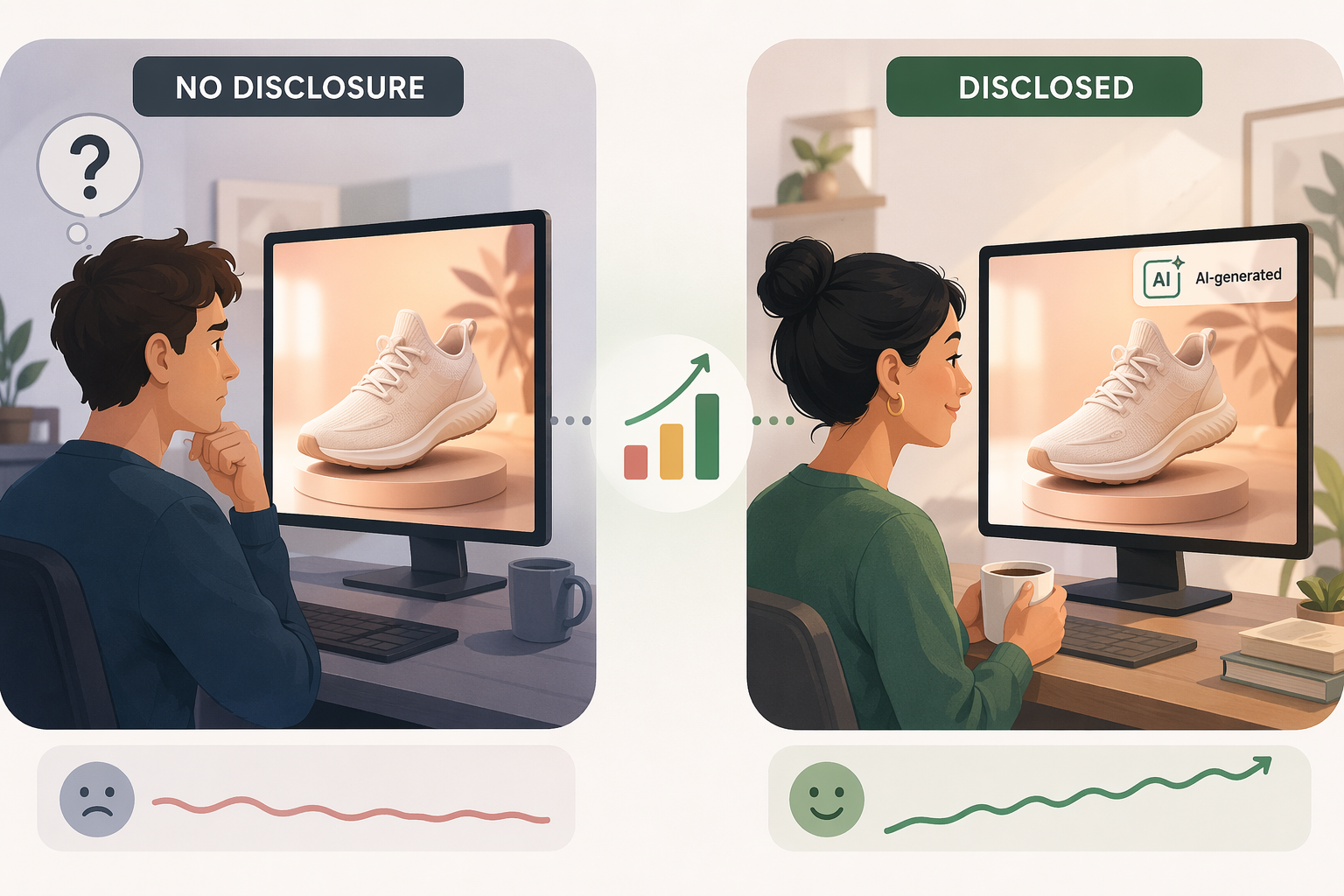
Those findings create a useful paradox. Many consumers want labeling, and among younger consumers, awareness of AI use does not necessarily damage purchase intent. That does not mean every ad needs a loud disclaimer that overwhelms the creative. It does mean hiding automation is a fragile bargain. The brand may enjoy the efficiency until the audience notices, at which point the lack of disclosure can make the creative feel evasive.
Disclosure also changes the interpretation of the work. A small, clear label can tell the consumer that the brand is not trying to pass off synthetic material as something else. It will not rescue bad creative, and it will not make every category equally tolerant of AI use. But it can remove one layer of suspicion before the audience decides whether the ad itself is worth believing.
The creative quality bar has to rise, not fall
The easiest AI advertising mistake is to treat cheaper output as acceptable output. Consumers do not experience a lower production budget. They experience the ad in front of them.
That means the brand has to judge AI-assisted creative by the same questions it would apply to any other paid asset: Does the claim feel specific? Does the visual match the product reality? Does the testimonial or scenario seem credible? Does the ad preserve the brand’s price position? Does it sound like something a person in the category would actually say?
AI can help create more first drafts and testable variants. It should not be allowed to lower the threshold for taste. If the Digital Applied benchmark is even directionally right, perceived AI generation can harm the very qualities that many brands pay media to build: purchase interest, premium cues, and inspiration.[3]
This is where hybrid execution matters. AI can accelerate versioning, localization, headline exploration, background generation, editing, and format adaptation. Humans still need to make the calls that require judgment: which idea is actually on-brand, which image looks uncanny, which joke is culturally off, which performance winner is too cheap-looking to scale, and which claim will create support tickets after the campaign goes live.
For teams looking at where AI performs acceptably versus where it can damage trust, Signal & Convert’s AI advertising examples and AOV decision rule is a useful companion. The point is not to ban AI from higher-stakes creative, but to stop pretending all creative risk is equal.
What should change inside the campaign system
The practical answer is not “use less AI.” It is to make trust a managed part of the AI advertising workflow, not an assumed byproduct of targeting and optimization.
- Label AI-generated or heavily AI-assisted content where audience expectations for transparency are high, especially in categories where authenticity, identity, health, money, or premium positioning matter.
- Separate production efficiency metrics from audience trust metrics. A cheaper asset is not a better asset unless it also protects credibility, perceived quality, and conversion intent.
- Review AI variants for synthetic tells: generic faces, unnatural hands, over-polished product scenes, vague claims, copy that sounds statistically correct but emotionally empty, and imagery that implies a product experience the brand cannot deliver.
- Keep human approval at the final selection stage, especially before scaling a performance winner. The best-clicking variant may not be the best brand asset.
- Track reactions by audience segment instead of assuming younger consumers are automatically more tolerant of AI-generated ads.
The teams doing this well are not usually the ones treating AI as a replacement for creative discipline. They use AI to widen the option set, then use human judgment to narrow it. That pattern shows up in campaign workflows where AI is useful precisely because it is contained: research support, rapid mockups, message variation, format resizing, and controlled testing before broader spend. The execution examples in AI Advertising Examples: 7 Campaigns With Real Workflows That Delivered are most relevant when read this way — not as proof that AI creative always works, but as evidence that workflow design matters.
A responsible AI powered advertising process should make room for a few uncomfortable review questions before money moves:
- If consumers recognize this as AI-generated, does the ad still feel honest?
- Does the creative make the brand feel more premium, or merely more efficient?
- Would disclosure reduce suspicion, or would it expose that the asset was not strong enough to run?
- Are performance metrics being read alongside brand perception, or replacing it?
- Who is accountable if the automated asset creates a trust problem after launch?
That last question is not theoretical inside a marketing organization. The executive may remember the cost savings. The media buyer may remember the winning variant. The customer team, social team, and brand manager are often the ones left handling the audience’s interpretation after the ad has done its damage.
Efficiency only holds if trust is part of the model
The AI ad perception gap is not an argument for slowing every AI initiative. It is an argument against confusing operational enthusiasm with consumer permission.
The evidence is narrow enough to avoid panic and strong enough to change behavior. Consumers are not uniformly hostile to AI ads. Younger consumers are not automatically accepting. Perceived AI generation can carry commercial penalties. Visible AI use has more trust downside than upside unless the brand handles it well. Disclosure may be less harmful to purchase intent than marketers fear, particularly when consumers already want labeling.
AI powered advertising can keep its efficiency advantage only if marketers stop treating consumer trust as something the platform will solve for them. Trust has to be designed into the campaign system: in what gets disclosed, what gets rejected, what gets scaled, and who has the authority to say that a cheaper asset is still too costly for the brand.
References
- The AI Ad Gap Widens, IAB, January 2026.
- AI Search Adoption Rises as Consumer Trust Declines, Search Engine Land / Fractl, Q2 2026.
- AI Ad Creative Benchmarks 2026, Digital Applied, Q1 2026.
- Shoppers Aren't Impressed by AI-Generated Marketing, EMARKETER / Klaviyo, December 2025.
Comments
Join the discussion with an anonymous comment.