
The Right Order for Testing AI Ad Copy
Most AI ad copy tests fail because they test the wrong variable first. This framework outlines a three-rung ladder that prioritizes audience-intent alignment before headline wording, so each test cycle produces a clear learning.
The easiest AI ad copy test to misread is the one where the click winner looks obvious.
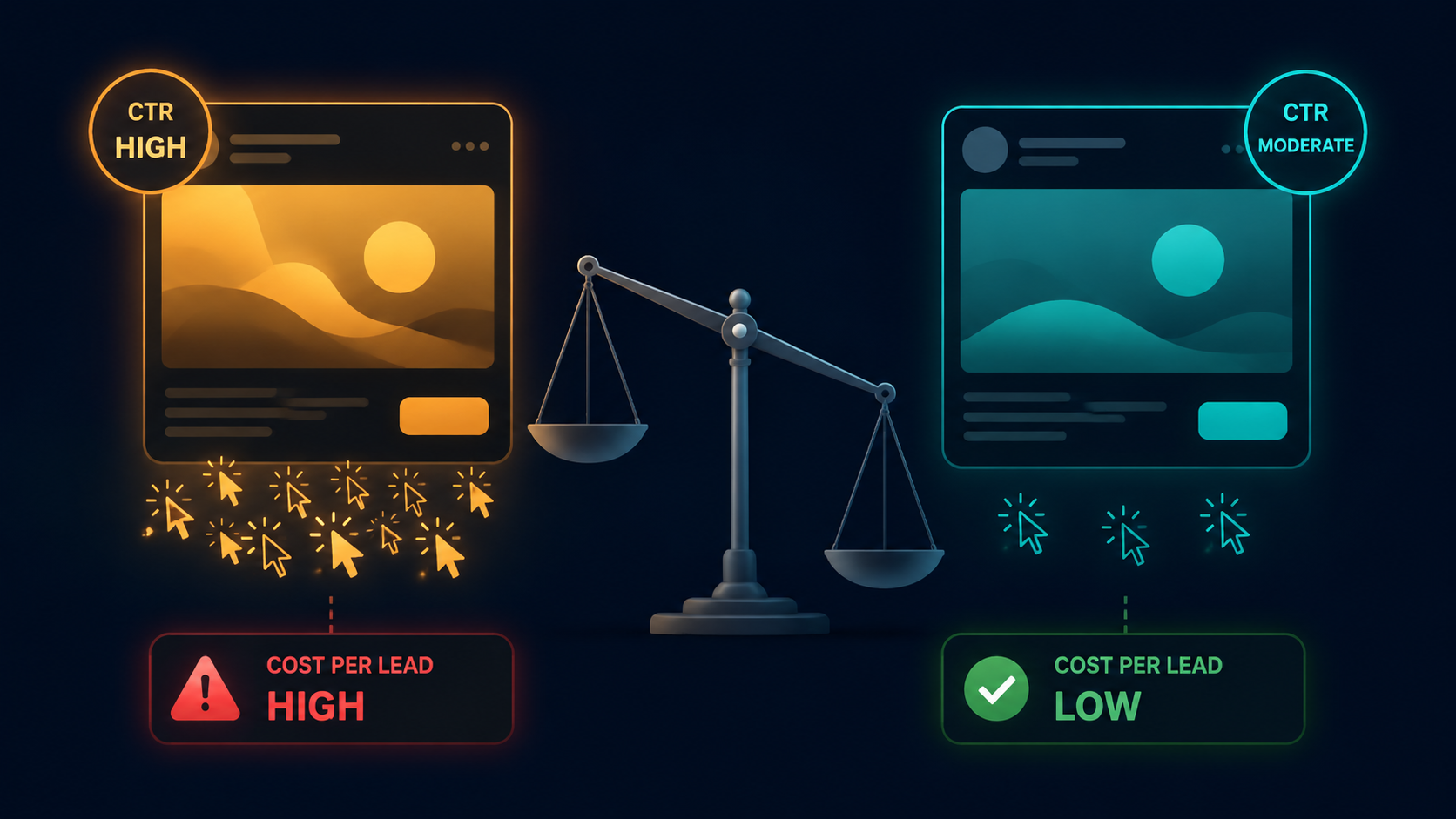
In a worked Google Ads example from dynares.ai, one ad variant drove 236 clicks while another drove 135. If the team stopped at CTR or click volume, the first variant would move forward. But the economics told the opposite story: the 236-click ad produced leads at $285.71 CPL, while the 135-click ad produced leads at $125.93 CPL. [1]
That is the CTR trap. The ad did not necessarily attract more qualified demand. It attracted more clicks. Those are not the same job, and the difference matters more once AI makes it cheap to generate another ten headlines before anyone has decided what the test is supposed to learn.
A useful AI ad copy testing framework starts with a less glamorous question: when you have a pile of AI-generated variants, which difference deserves budget first? Not which headline sounds sharper. Not which CTA feels more urgent. Which underlying variable, if it wins or loses, will explain the most about the next dollar you should spend?
Before Testing Copy, Sort What The Copy Is Actually Testing
AI tends to produce variants that look different on the surface while testing the same assumption underneath. One says “Launch campaigns faster.” Another says “Go live in hours.” A third says “Speed up your paid media workflow.” Those are not three serious test cells. They are one message territory wearing different jackets.
The first pass through AI-generated copy should not be a taste ranking. It should be a sorting exercise. Put each ad into the bucket it is really testing:
- Audience intent: who the ad assumes is searching, scrolling, or comparing.
- Value proposition: what benefit the ad asks the audience to care about.
- Proof type: what evidence the ad uses to make the claim believable.
- CTA: what next action the ad asks for.
This is where most “10 AI variants” tests start leaking budget. The team thinks it is testing copy breadth, but the account is really running a messy bundle of audience assumptions, benefit claims, proof formats, and CTA pressure. When the results come back mixed, nobody can say whether the winner worked because it matched intent, promised the right outcome, sounded more credible, or simply used a softer ask.
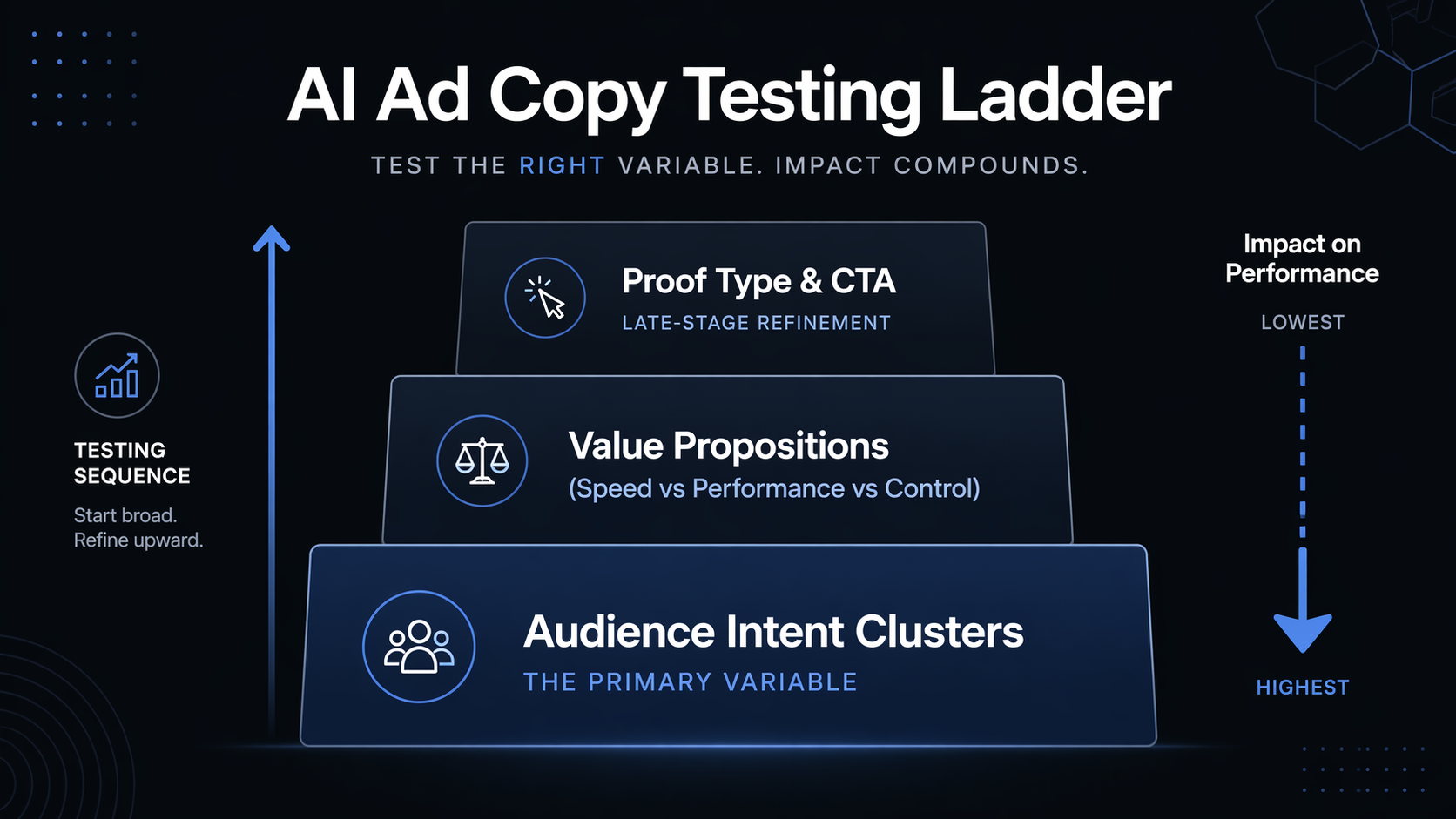
The dynares.ai methodology frames this as a three-rung testing ladder: audience alignment first, message differentiation second, proof and CTA isolation third. It is a vendor-published, Google Ads-oriented framework, so it should be treated as a practical methodology reference rather than a universal law. The useful part is the hierarchy: test the variable most likely to change the quality of demand before spending money polishing phrasing. [1]
Rung 1: Audience Intent Comes Before Headline Polish
Audience-intent alignment is the first rung because it determines what kind of demand the ad is inviting into the funnel. A clever headline aimed at the wrong intent can still earn clicks. That is exactly why it is dangerous.
For a B2B SaaS offer, AI might generate copy for at least three different intent clusters from the same product brief. One cluster speaks to a practitioner trying to save time. Another speaks to a department lead trying to improve performance. A third speaks to an executive or operations owner worried about visibility, governance, or control. Those ads may all be “about” the same software, but they are not competing on wording. They are competing on who the ad is for.
A cleaner first test would not run ten variants. It would select two or three strategically different intent clusters and make each one clear enough to win or lose on its own terms. For example:
| Intent cluster | What the ad is really testing | What to avoid |
|---|---|---|
| Time-saving practitioner | Does the audience respond to removing manual work? | Testing five ways to say “faster” |
| Performance-driven manager | Does the audience care more about better outcomes than workflow relief? | Mixing performance claims with unrelated ease-of-use copy |
| Control-focused operator | Does the audience value visibility, process, or governance enough to click and convert? | Treating “control” as just another CTA angle |
That structure leaves the manager with a usable answer. If the control-focused variant produces fewer clicks but better CPL or stronger downstream quality, the next round should not chase the clickier practitioner copy. It should build deeper into the control territory: stronger proof, clearer qualification, and a landing page that does not suddenly switch back to generic productivity language.
The key is that each variant must stay internally consistent. If one ad opens with a time-saving pain point, shifts into a revenue claim, and closes with a compliance-oriented CTA, the result will be hard to read even if the numbers look decisive. AI is useful here because it can generate enough raw material to reveal the possible clusters. The media lead still has to choose the clusters worth paying to test.
How To Reduce 10 AI Variants To 2 Or 3 Intent Tests
Start by removing cosmetic duplicates. If three variants differ only by “boost,” “improve,” and “increase,” keep one. Then label the remaining ads by the person or moment they appear to address. If the label is unclear, the ad is probably too blended to deserve a test cell.
- Group variants by intent, not by sentence structure.
- Keep the strongest representative of each intent cluster.
- Rewrite each finalist so the audience, pain, promise, and CTA point in the same direction.
- Launch only the clusters that would change your next decision if they won.
This is also where input quality matters. Stackmatix describes AI ad copy testing as depending on input strategy, creative structure, variant volume logic, and rotation rules. Those mechanics matter because a vague prompt creates vague variants, and vague variants are difficult to classify before launch. [2]
For live setup mechanics, the ladder pairs best with an operational workflow rather than replacing one. The ladder decides what variable to isolate; an AI ad copy A/B testing workflow decides how to structure the campaign, rotation, naming, and readout.
Rung 2: Test The Value Proposition Inside The Winning Intent
Once an intent cluster earns more budget, the next question is not “Which headline won?” It is “Which value proposition does this audience care about enough to become qualified demand?”
Speed, performance, and control are useful message territories because they imply different buyer motivations. They are not headline synonyms.
| Message territory | What it asks the audience to value | What a win would suggest |
|---|---|---|
| Speed | Less time, less friction, faster launch or execution | The audience feels operational drag and wants relief |
| Performance | Better outcomes, stronger results, more efficient spend | The audience is evaluating impact and return |
| Control | Visibility, governance, predictability, reduced chaos | The audience is managing risk, complexity, or accountability |
The transition from Rung 1 to Rung 2 is where many accounts accidentally contaminate the test. Suppose the first round shows that control-focused messaging attracts fewer but better leads. The second round should stay within that same audience-intent lane and test different control-related value propositions. It should not bring back a speed headline just because the stakeholder liked its CTR in the first round.
A disciplined Rung 2 test might compare “see every campaign change before it goes live” against “standardize approvals across every paid channel.” Both belong to a control territory, but they emphasize different value propositions: visibility versus process consistency. If one improves CPL and lead quality, the team has learned something more durable than which verb performed better.
AI helps here by producing controlled variations inside a message territory. The instruction should restrict the model instead of asking for maximum variety. A useful request is closer to: generate three ad variants for a control-focused operations buyer, each emphasizing a different value proposition, without changing the audience, offer, or CTA. That kind of constraint is less exciting than “give me ten bold hooks,” but it produces a test a manager can defend after the spend is gone.
Rung 3: Proof And CTA Are Refinements, Not Starting Points
Proof type and CTA matter. They just should not usually get first claim on the budget when the audience and value proposition are still unresolved.
At this rung, the message territory has already earned another test. Now the team can isolate whether the winning value proposition needs a customer proof point, a quantified claim, a product capability, a comparison frame, or a lower-friction ask. The difference is that the test is no longer trying to discover the whole market conversation at once.
CTA tests belong here for the same reason. “Book a demo” versus “See how it works” may change conversion behavior, especially in high-friction categories. But if the ad is pointed at the wrong intent, a CTA test mostly tells you how different asks perform against a mismatched audience. That is a weak learning to buy.
Use Click Thresholds To Stop Tests From Drifting
A hierarchy is only useful if the team is willing to make decisions. The dynares.ai methodology gives a practical rule of thumb: for many lead-gen accounts, 250–400 clicks per variant can provide enough directional signal to make a business decision, while full statistical confidence may require 300–500 clicks per variant at 95% confidence. [1]
| Signal level | What to do | What not to claim |
|---|---|---|
| Low click volume | Keep reading results cautiously or consolidate the test | Do not declare a winner from early CTR movement |
| About 250–400 clicks per variant | Use CPL, conversion rate, and lead quality to kill, keep, or promote | Do not call the result statistically final by default |
| About 300–500 clicks per variant at 95% confidence | Consider a stronger statistical read if the setup supports it | Do not ignore business economics because a click metric looks clean |
The threshold is not magic. A low-volume enterprise SaaS account and a high-volume ecommerce account will not accumulate evidence the same way. Meta, LinkedIn, and Google also differ in auction behavior, automation, and signal speed. On Meta, platform automation can make controlled creative testing harder if delivery shifts before the test has a clean read; that is a different problem from a search campaign where query intent is more explicit. For that platform-specific issue, a Meta Advantage+ creative enhancement decision matrix is a better companion than a generic ladder.
LinkedIn has its own pacing and audience-size constraints, especially in B2B campaigns where clicks are expensive and conversion volume is thin. The same variable hierarchy still helps, but the kill criteria may need to be adapted. A B2B LinkedIn AI ad creative testing playbook can handle those platform-specific constraints without turning this framework into three separate channel guides.
What A Clean AI Copy Test Leaves Behind
The output of an AI ad copy test should not be a screenshot of the highest CTR ad. It should be a decision record the next test can use.
A clean readout says which rung was tested, which variants represented that rung, what metric decided the result, and what gets tested next. For example: “Control-focused intent beat time-saving intent on CPL and qualified lead rate, despite lower click volume. Next test: compare visibility-led control messaging against approval-process control messaging.” That is a usable decision. It prevents the next round from drifting back into random headline generation.
This also changes how AI gets used in the workflow. The model is not the strategist. It is the variant engine, classifier, and pressure tester around a human decision about what variable deserves spend. Teams that need the broader operating system around briefs, review gates, and learning loops can connect this ladder to a wider AI campaign operating system, but the core discipline is simple: do not let volume replace hierarchy.
When ten AI-generated ads are sitting in front of you, the first move is not to pick the cleverest line. Sort them by what they are testing. Run audience intent first. Move into value proposition only after an intent cluster earns it. Save proof and CTA tests for the message territory that deserves refinement. The result may not be a perfect universal winner, but it should leave behind something more valuable: cleaner learning and fewer expensive guesses.
References
- Google Ads Ad Copy Testing Framework for Founders, dynares.ai, Jun 2026.
- AI Ad Copy Testing, Stackmatix, Apr 2026.
Comments
Join the discussion with an anonymous comment.