
Palantir's benchmaking standard for AI ad lift claims
Palantir's Q2 2026 call argued that public AI benchmarks are gameable and only customer-specific testing proves value. Media buyers can apply that benchmaking standard to Advantage+, Performance Max, AI Max, and Symphony lift claims by logging dated, verdict-tracked benchmarks instead of trusting vendor figures.
- Platform
- Google Ads, Meta0 TikTok
- Change category
- bidding0 creative
- Effective date
- 0-08-03
- Change type
- opt-in feature
- Impact level
- low
Last reviewed: Aug. 5, 2026.
The useful line from Palantir’s Aug. 3, 2026 Q2 call was not an ad-tech line. CTO Shyam Sankar was talking about enterprise AI evaluation when he drew the split: “a handful of common benchmarks can be gamed. That era, benchmaxing, has ended. The new era is benchmaking.” The transcript carrying that quote was published by Investing.com and says it was generated with AI support and reviewed by an editor, so the wording should be checked against Palantir’s webcast replay before anyone treats it as a final source quote. Still, the distinction is worth pulling into media buying: public benchmark theater is different from customer-specific proof. [1]
Scope matters here. Palantir did not validate Advantage+, Performance Max, AI Max, Amazon ad automation, TikTok Symphony, or any other ad platform on that call. The company’s Q2 materials contain no advertising-performance finding. The analysis below applies Sankar’s verification standard to ad-platform lift claims, not as a Palantir statement about media buying.
The earnings context explains why the call is being watched. Palantir reported Q2 2026 revenue of $1.935 billion, up 93% year over year; U.S. commercial revenue of $764 million, up 149% year over year; a Rule of 40 score of 155%; and raised full-year 2026 revenue guidance to $8.150 billion to $8.158 billion. [2] The signal-side read of that event belongs in the companion record, Palantir’s earnings beat signals AI budgets, not ad tech. The narrower question here is what a buyer should do when an AI vendor publishes a lift number.

What Palantir’s benchmark argument actually supports
Sankar’s argument is operational, not inspirational. In Palantir’s telling, a model’s value is not established by winning a shared leaderboard. It is established when the customer’s actual work changes: a production task is completed, a workflow is automated, a decision improves, or a contract moves because the system solved the buyer’s problem under the buyer’s conditions.
The call gave two examples. First, Sankar said Palantir brought Nemotron Ultra into its stacks and that, within 24 hours, it beat frontier models on five production tasks without post-training. That is a company-reported production-task example, not an independent benchmark study and not a general finding about all enterprise AI deployments. [1]
Second, he described a bake-off tied to a $10 million annual contract value opportunity. In that account, according to Sankar, a frontier lab failed a ticketing automation task, while Palantir’s AIP team built agent swarms that recommended “marketing, packaging, and pricing changes,” and the work converted into a $10 million ACV contract. Again, that is a single company-reported case. Its value here is not that Palantir proved a universal rule. Its value is the shape of the test: specific customer, specific task, specific commercial outcome, recorded verdict. [1]
That is the part media buyers should care about. A vendor claim becomes more useful when it leaves the slide deck and enters a dated account file. The file does not need to be glamorous. It needs to say what was tested, what changed, what counted as success, and who is willing to keep the result on record.
Why the distinction fits AI ad lift claims
Ad platforms already publish AI lift claims in formats that can sound more settled than they are. A buyer sees an uplift number for an automated campaign type, a creative tool, or an optimization layer. The number may be real for the sample behind it. It may be measured over a valid window. It may also be measured against a baseline, conversion definition, spend level, account maturity, or objective that does not resemble the buyer’s account.
That is where “benchmaking” is the better word. The platform figure is a hypothesis: this product might improve this class of outcome for this class of advertiser. The buyer’s benchmark run decides whether it improves the buyer’s outcome, under the buyer’s constraints, with the buyer’s definition of success.
This does not mean platform data is useless. It means platform data is unproven inside the account until the account has tested it. That distinction is important because a media plan has consequences a vendor webinar does not: budget shifts, CPA pressure, creative workload, reporting credibility, and sometimes a very direct conversation with finance about why an “AI lift” translated into a worse blended result.
The same issue shows up across the current AI ad-product landscape: Performance Max, Advantage+, Google’s AI Max, Amazon’s automated surfaces, and TikTok Symphony Agent are not one product category with one test design. They sit in different parts of the campaign stack. A useful verification file must name the actual product and campaign type being tested rather than labeling the whole thing “AI.” For a broader map of those products, see the site’s benchmark record on PMax, Advantage+, AI Max, and Symphony Agent.

The buyer’s benchmark file
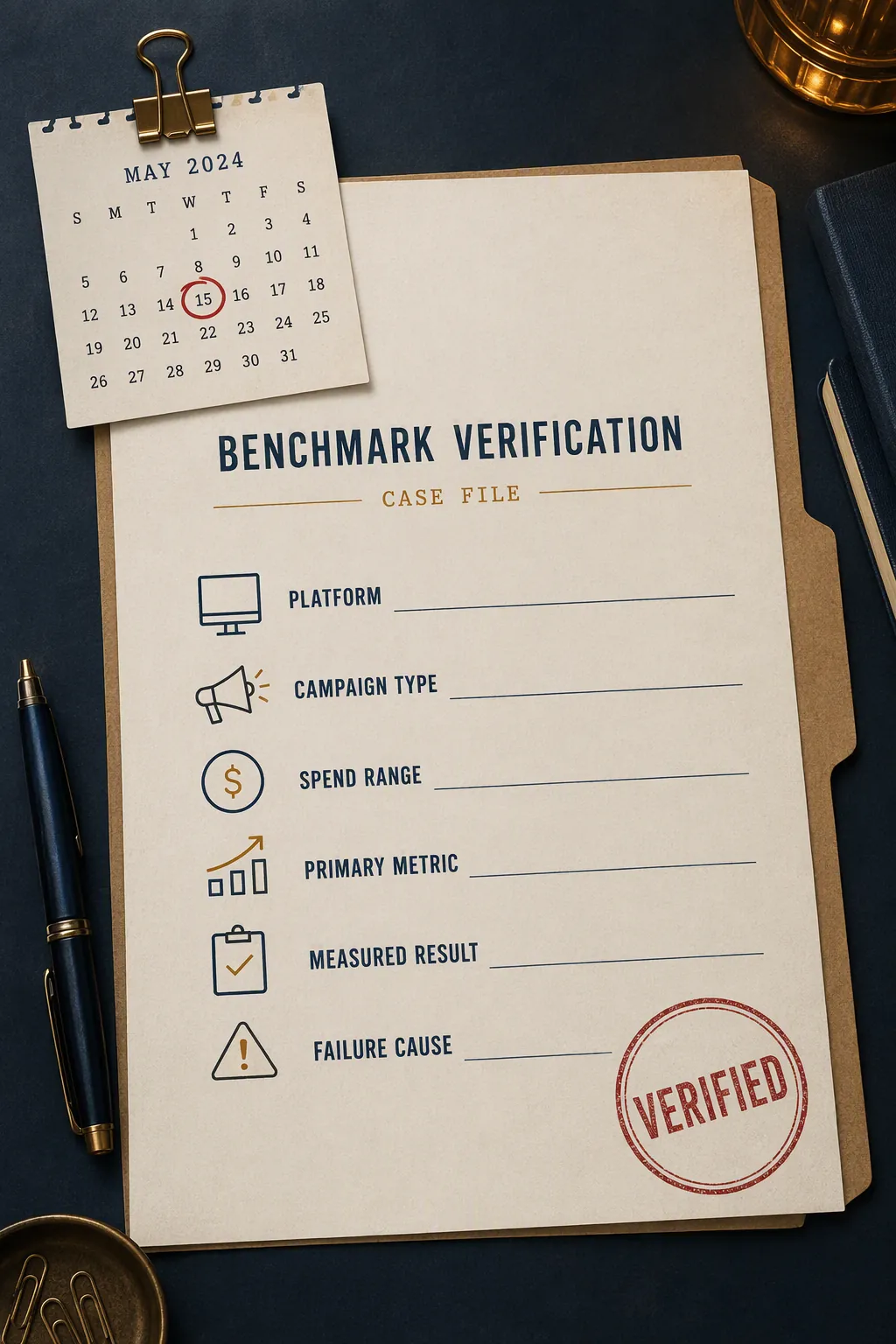
The practical output is a case file, not a debate about whether AI is good or bad for advertising. If a platform claims its automated system improves ROAS, lowers CPA, raises conversion volume, or reduces creative production time, the buyer should log the claim as a test candidate and then record the account-specific result.
| Field | What belongs in the file |
|---|---|
| Source claim | The dated platform statement, deck, help-center page, case study, earnings remark, or webinar that triggered the test. |
| Platform and product | For example: Meta Advantage+, Google Performance Max, Google AI Max, Amazon Ads automation, or TikTok Symphony. Name the actual tool. |
| Campaign type | Prospecting, retargeting, shopping, lead generation, app install, creative production, or another defined use case. |
| Account goal | The business objective the buyer actually needs: CPA, ROAS, qualified lead rate, incrementality, conversion volume, margin-adjusted revenue, or cycle-time reduction. |
| Spend range | The approximate budget band used for the test, so the result is not later applied to accounts operating at a different scale. |
| Test window | Start date, end date, ramp period if any, and any blackout dates or promotional periods that affected interpretation. |
| Comparison | The baseline or control: prior structure, holdout, split, matched campaign, geo comparison, or another documented comparator. |
| Measured result | The observed movement in the primary metric and any guardrail metrics that materially changed. |
| Verdict | Adopt, expand, retest, limit, or reject. The verdict should be dated and tied to the named account goal. |
| Failure cause | If the test failed or produced mixed results, log the likely cause: tracking gap, learning-period instability, weak creative supply, poor audience fit, budget constraint, seasonality, or measurement mismatch. |
The spend range field is not decorative. A result from a small, constrained test may be directionally useful, but it should not be treated as planning evidence for a much larger budget without another run. The same goes for conversion definition. A campaign that lowers platform-reported CPA while reducing qualified lead rate has not proven the same thing as a campaign that lowers sales-qualified CPA.
The verdict field is where most vendor claims either become useful or stop traveling. “Promising” is not a verdict. “Adopt for non-brand prospecting at this spend band because CPA stayed inside target while qualified volume increased during the test window” is a verdict. So is “reject for this account because the reported CPA improvement disappeared after offline-quality review.” The second result is not wasted work; it is the record a buyer needs before the same claim returns in the next quarterly business review.
How to read a platform lift number before testing it
A public AI lift figure should be read with four questions before it earns test budget.
- What exactly improved? ROAS, CPA, conversion rate, revenue, lead volume, creative output, or another metric. A lift in one does not imply a lift in the others.
- What was the comparison? Prior campaign setup, advertiser average, matched control, modeled counterfactual, or platform-defined benchmark.
- Whose accounts were included? Account size, vertical, optimization maturity, creative volume, and data quality can all affect whether the result transfers.
- What would count as failure in your account? A test without a failure condition is usually just a budget migration with a nicer name.
The last question is the one most likely to be skipped. Buyers often define the upside clearly and the downside vaguely. That creates a reporting trap: the platform can be credited for any positive movement, while negative movement gets absorbed into seasonality, learning period, creative fatigue, or attribution noise. Some of those explanations may be true. They still need to be logged as part of the verdict, not discovered only after the budget has already moved.
The same discipline also helps when public AI claims conflict with measured account results. Signal & Convert has already tracked cases where claimed lift figures and buyer-side outcomes do not line up cleanly; that is the reason a claim should enter the file as a test prompt, not as a planning assumption. See the record on contradictory AI lift claims versus measured results.
What the Palantir examples do not prove
Palantir is being treated seriously by outside analysts as an enterprise AI scale story. The Guardian quoted Emarketer analyst Jacob Bourne calling Palantir “the clearest counter-example to the claim that enterprise AI doesn’t scale past pilots.” [3] That is relevant context for why Sankar’s benchmark language is getting attention. It is not evidence that any ad platform’s AI automation improves paid-media performance.
The clean read is narrower. Palantir’s reported examples show how a company wants investors and customers to think about production proof: not a public score, but a task inside a customer environment with a visible outcome. Media buyers can borrow that standard without borrowing Palantir’s conclusion about its own business.
That borrowing is especially useful because ad automation often asks for control before the buyer has account-specific evidence. Budget allocation, audience construction, search-query expansion, creative assembly, bidding, and reporting can all move under automated systems. The trade-off between efficiency and control has to be judged inside the account, not inferred from a market-wide claim. For more on that control problem, see the related analysis of the AI automation trade-off.
Before a platform number enters planning
A platform-published lift figure can be useful. It can identify a product worth testing, a setup worth comparing, or a metric worth watching. It should not be copied into a forecast as if it already survived the buyer’s account.
The minimum standard is simple: dated source, named platform product, account-specific goal, defined comparison, test window, spend range, measured result, and verdict. If the result fails, keep the failure cause. If the result works only under narrow conditions, keep those conditions. If the source claim cannot be traced back to a dated document or transcript, do not let it harden into planning evidence.
That is the useful ad-tech impact of Palantir’s Q2 call: not proof that ad platforms perform, but a sharper language for refusing untested AI lift claims. Vendor numbers can open the file. The buyer’s benchmark run decides whether they stay there.
References
- Earnings call transcript: Palantir tops Q2 2026 forecasts, shares jump after hours — Investing.com
- Palantir Reports Q2 2026 U.S. Comm Revenue Growth of 149% Y/Y and Revenue Growth of 93% Y/Y, Raises FY 2026 Revenue Guidance to 82% Y/Y Growth and U.S. Comm Revenue Guidance to 134% Y/Y, Crushing Consensus Expectations — Business Wire
- ‘This quarter was otherworldly’: Palantir earnings surge past expectations — The Guardian, Aug. 3, 2026
Primary source: https://www.investing.com/news/stock-market-news/palantir-tops-q2-2026-forecasts-shares-jump-after-hours