
Which AI Marketing Tools Survive OpenAI's Spending?
OpenAI spent $5.73 billion on sales and marketing in 2025, simultaneously expanding the AI tool market and threatening thin-wrapper tools built on its API. Read how to distinguish structurally safe marketing tools from those at risk of being displaced.
OpenAI's spending impact on AI marketing tools starts with an uncomfortable piece of math. In 2025, OpenAI reportedly spent $34 billion in total against $13.1 billion in revenue, including $5.73 billion on sales and marketing alone, and recorded a $38.5 billion net loss. That sales and marketing line was about five times the prior year and amounted to roughly 44 cents for every dollar of revenue.[1]
For marketing teams, that is not just a finance curiosity. It means ChatGPT is being pushed into the workplace with the kind of subsidized distribution that most software vendors can only envy. The same spending makes AI more normal inside companies, opens budget conversations for specialist tools, and trains employees to expect AI in daily workflows. It also raises a sharper renewal question: if OpenAI is paying heavily to make ChatGPT the default interface at work, what exactly does a separate AI marketing tool own that ChatGPT cannot add next quarter?

The market is expanding, but the moat is shrinking
A rising ChatGPT habit does not automatically kill AI marketing software. Enterprise adoption is moving in the opposite direction. Ramp AI Index data cited by Menlo Ventures found that 46.6% of US businesses were paying for AI by December 2025.[2] That is a real demand signal, even with the caveat that Ramp's index reflects companies using spend management software and may not represent every business.
The same Menlo report puts marketing in a more modest position inside enterprise AI budgets. In its departmental AI spend breakdown, marketing accounted for $660 million, or 9%, while coding accounted for 55%.[2] That does not mean marketing is unimportant. It means the budget center of gravity is not automatically with content teams, and marketing tools have to justify themselves against broader company AI spend, not just against other copywriting products.
The safest reading is directional, not triumphalist. More companies are paying for AI. More employees are comfortable using it. More executives are asking why five separate tools are needed when one workplace AI interface can draft, summarize, search, analyze, and connect to files. That combination creates demand and compression at the same time.
Jasper shows what happens when generic writing becomes a platform feature
Jasper is the useful case because it was not a weak company that missed the AI wave. It was early, visible, and closely associated with generative AI writing before ChatGPT changed buyer expectations. After ChatGPT launched, Jasper's reported valuation fell from $1.5 billion to $1.2 billion, and the company repositioned from consumer-facing AI writing toward an enterprise marketing copilot.[3]
That shift is the core platform-risk story in miniature. When the differentiator is mainly, "we make it easier to get AI-written copy," the product sits directly in the blast radius of a better-distributed general assistant. Once employees already have ChatGPT open, generic headline variations, email drafts, landing page copy, and social captions stop feeling like enough of a standalone reason to buy.
The more interesting part is not that Jasper had to move. It is where it had to move: toward enterprise marketing use cases where buyers care about campaign context, brand governance, team permissions, workflows, and repeatability. That is the direction many AI marketing tools will have to travel if they want to survive procurement reviews after the novelty budget is gone.

The tools most exposed are the ones that rent differentiation
The riskiest AI marketing tools are thin wrappers: products whose real asset is a prompt library, a cleaner interface, or a narrow content template built over the same base model the customer can access elsewhere. They can still be useful. A small team may happily pay for convenience. But convenience is a fragile moat when the platform vendor has the customer relationship, the model roadmap, and the distribution budget.
The red flags tend to show up quickly in a renewal conversation. If the vendor demo spends most of its time showing generic outputs rather than workflow ownership, the buyer should press harder. If the tool cannot explain what improves when the underlying model changes, it may be selling packaging rather than capability. If the switching cost is mostly "our team knows where the buttons are," finance will notice.
| Tool pattern | Procurement question | Structural risk |
|---|---|---|
| Prompt library or template wrapper | Could ChatGPT reproduce this with saved prompts or a new workspace feature? | High |
| Generic AI writing assistant | Does it own brand rules, campaign history, approvals, or performance data? | High to medium |
| Workflow system with AI inside | Would removing the tool break review, publishing, compliance, or reporting? | Medium to low |
| Data-rich marketing intelligence tool | Does it use proprietary, first-party, or hard-to-recreate datasets? | Lower, if the data advantage is real |
| Multi-model orchestration layer | Can it route work across models as quality and price change? | Lower, if routing is tied to measurable outcomes |
The table is not a ranking of companies. It is a way to separate where value lives. If value lives in the prompt, the interface, or access to a single model, the tool is exposed. If value lives in data, workflow, governance, integrations, measurement, or model flexibility, the tool has more room to defend itself.
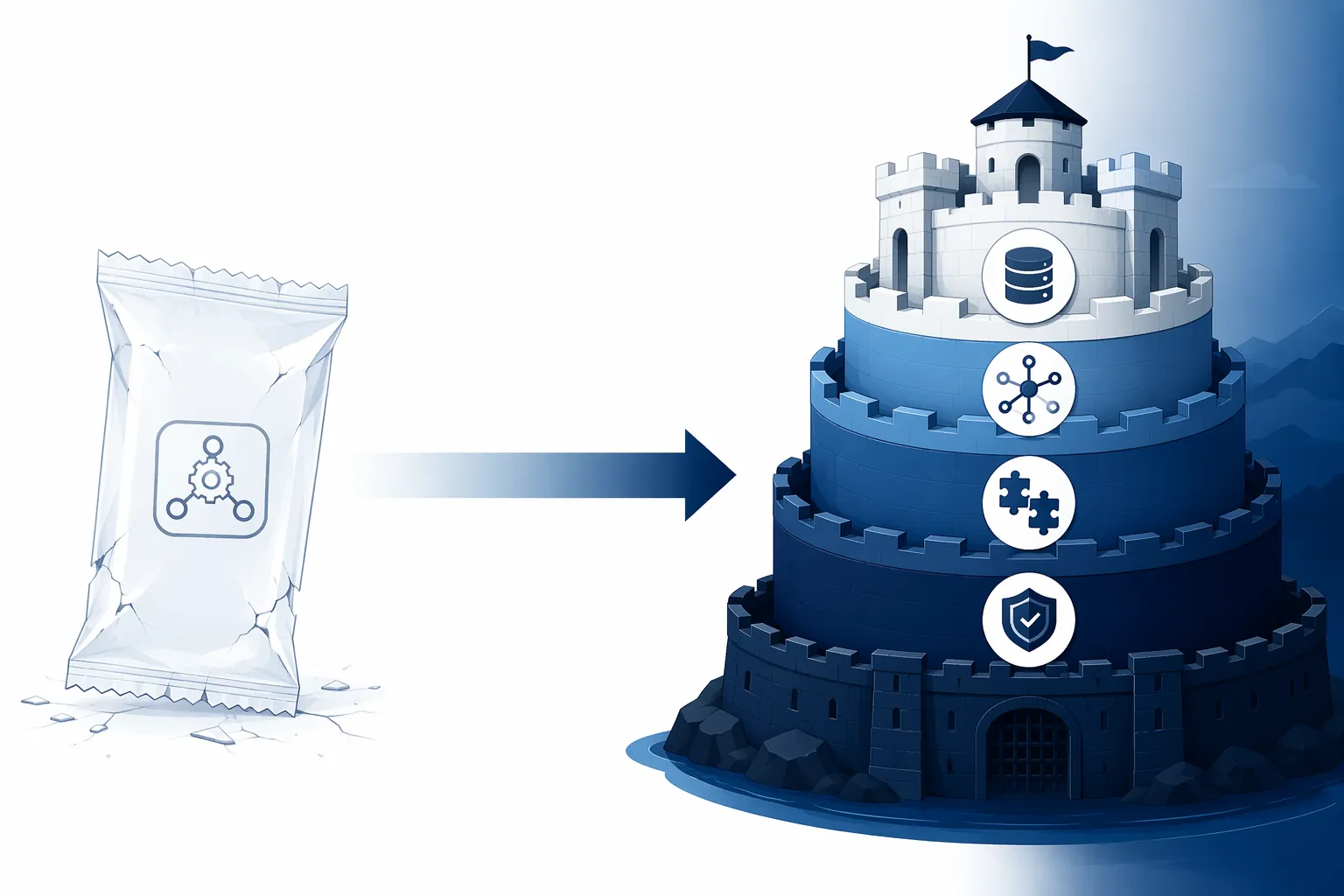
What a defensible AI marketing tool actually owns
A structurally safer AI marketing tool does not need to beat ChatGPT at everything. It needs to own a job ChatGPT cannot casually absorb without rebuilding the surrounding system. In marketing, that usually means one or more of four assets.
First-party or proprietary data
The strongest tools know things the base model does not know by default: customer segments, campaign history, product taxonomy, creative performance, search behavior, sales objections, brand exclusions, regional constraints, or audience-specific language patterns. The point is not to sprinkle a brand voice prompt on top of a model. The point is to make the tool better because it has access to marketing-specific information that is clean, permissioned, current, and connected to business outcomes.
This is where many demos get slippery. A vendor saying it "learns your brand" is not the same as owning a durable data asset. Buyers should ask what data is ingested, how it is updated, who can approve it, whether it is separated by workspace or region, and whether performance feedback changes future recommendations.
Workflow ownership
Marketing work rarely fails because no one can generate another draft. It fails because campaign context is scattered, reviewers arrive late, legal guidance is buried, UTM conventions drift, CRM fields are incomplete, and the final asset that ships is not the one leadership approved. A tool that reduces those points of failure is selling more than generation.
This is why approval flows, shared workspaces, audit trails, role-based permissions, content calendars, experiment logs, and campaign handoffs matter. They sound less exciting than a clever model demo, but they are exactly the features that make a renewal defensible. A team can replace a paragraph generator. It is harder to replace the system of record for how marketing work moves from brief to launch.
Integration into the marketing stack
A tool gets safer when it sits inside systems marketers already use: ad platforms, CRMs, CMSs, analytics suites, DAMs, email platforms, project management tools, and customer data platforms. The integration has to be more than "export this copy." It should reduce manual steps, preserve metadata, push changes into the right destination, or pull performance signals back into planning.
This is the difference between a content assistant and an operating layer. If a paid social team can generate variants, apply channel constraints, route creative for approval, publish to the ad account, and compare results without rebuilding the process in spreadsheets, the tool has a stronger claim. If the team still has to copy text from one tab, paste into another, chase approval in Slack, and update reporting by hand, the AI feature may be doing less work than the invoice suggests.
Model flexibility
A single-model dependency is not a comfortable place to build a marketing platform. Menlo's enterprise survey reported that OpenAI's share fell from 50% in 2023 to 27% by the end of 2025, while Anthropic rose to 40% and Google to 21%.[2] That data deserves caveats: it comes from a survey of roughly 500 US enterprise decision-makers, not audited financials, and Menlo has invested in Anthropic. Still, the direction supports what buyers are already seeing in procurement: model preference can move.
The operational implication is straightforward. A safer AI marketing tool should be able to switch, blend, or route across models when cost, latency, quality, privacy, or task fit changes. The vendor does not need to expose every model choice to every marketer. In many cases, marketers should not have to think about it. But the product should not be trapped if one provider changes pricing, deprecates a model, worsens output quality for a use case, or competes more directly with the vendor's front end.
Cost discipline is arriving faster than the demos suggest
The first wave of generative AI buying often tolerated duplication because teams were still learning. That grace period is narrowing. CNBC reported that Uber instituted $1,500-per-month AI spend caps after running through its annual AI budget in four months, and that Lindy moved 100% of its Anthropic traffic to DeepSeek for cost reasons.[4]
Those are individual cases, not proof that every enterprise will behave the same way. But they show the shape of the next budget conversation. Once AI line items become large enough to be governed, buyers will ask which tools are essential, which are redundant, and which are merely passing model costs through with a markup.
Marketing teams should expect this scrutiny because their AI spend competes with media, headcount, analytics, agencies, production, and sales tooling. A tool that saves ten minutes on a draft may be appreciated by users and still be weak in procurement. A tool that prevents brand mistakes, shortens review cycles, improves campaign handoffs, or makes performance learning reusable has a better finance story.
OpenAI does not need to kill a category to pressure it
The danger is not that OpenAI announces a perfect replacement for every specialist marketing platform. The pressure can be much simpler. If ChatGPT adds one more tab, one more shared workspace feature, one more connector, one more brand instruction layer, or one more low-cost team plan, a slice of marginal tools becomes harder to defend.
Digiday has reported that OpenAI is building ChatGPT Work for marketing teams, weighing ad-supported lower-cost tiers such as ChatGPT Go in the $5 to $8 per month range, and has discussed an ad business projection reaching $100 billion by 2030.[5] The ad figure should be treated as a reported projection, not a confirmed outcome. The practical point is narrower: OpenAI appears interested in both workplace team use and advertising-supported distribution, which puts it closer to marketing workflows than a neutral API supplier would be.
That matters because distribution changes what buyers perceive as "good enough." A specialist tool may produce somewhat better outputs, but if ChatGPT is already approved by IT, already paid for by another department, already used by the team, and increasingly connected to workplace files, the specialist has to clear a higher bar. Better copy in a controlled demo is not enough.
How to evaluate a renewal without overreacting
The wrong response is to cancel every AI marketing tool and tell the team to use ChatGPT. That usually recreates the old mess in a new interface: prompts in personal accounts, source material in scattered docs, approvals in chat threads, brand rules applied inconsistently, and no clean way to know what actually shipped.
A better evaluation starts with the work that would break if the tool disappeared. If the answer is mostly "people would need to write their own prompts," the tool is exposed. If the answer includes campaign routing, compliance review, content inventory, CRM enrichment, ad account execution, analytics feedback, localization governance, or reusable customer intelligence, the tool has more substance.
- Ask what proprietary or first-party data the tool uses, how that data is governed, and whether it improves future work.
- Map which workflow steps the tool owns before and after generation: briefing, review, approval, publishing, measurement, and learning.
- Check whether integrations move structured data both ways or simply export finished copy.
- Ask whether the vendor can route across models and how it protects customers from model price or quality changes.
- Compare the tool against the approved internal ChatGPT deployment, not against a blank page.
- Measure saved risk and reduced cycle time, not just content volume.
The comparison should also include user behavior. If employees are already doing the same work in ChatGPT because the specialist tool is slower, more constrained, or disconnected from the rest of the stack, adoption data inside the company is telling you something. A renewal cannot be defended by licenses alone. It has to show that the tool is where the real work happens.
Which tools are structurally safer
The safer tools tend to look less like standalone AI toys and more like marketing infrastructure with AI embedded. They help teams make decisions, enforce constraints, coordinate people, and connect execution to outcomes. The model is part of the product, but it is not the whole product.
A customer intelligence tool that turns support calls, CRM notes, win-loss analysis, and campaign performance into usable messaging guidance has a better foundation than a generic landing page generator. A brand governance platform that checks claims, tone, terminology, and regional requirements before assets go live has a clearer role than another copy assistant. A paid media tool that generates, launches, and learns from ad variants inside real account constraints is harder to replace than a prompt that says "write five Facebook ads."
There is still execution risk. Proprietary data can be messy. Integrations can be shallow. Approval workflows can become theater. Multi-model routing can sound sophisticated while producing no measurable gain. Buyers should not accept defensibility language at face value. The test is whether the tool controls an important part of the marketing operating system, not whether the sales deck names the right moat.
Which tools are hardest to defend
The weakest tools are those whose value disappears if ChatGPT adds a template gallery, team folder, brand memory, lightweight approval flow, or connector to a common marketing system. That includes many narrow writing products, generic ideation tools, and single-channel generators that do not own data, workflow, publishing, or measurement.
This does not mean every thin tool vanishes. Some will survive as cheap utilities, agency-side accelerators, or niche products for teams that prefer a focused interface. But the procurement standard changes. A low-cost utility can live as a convenience. A high-priced platform has to prove that it is not just a cleaner wrapper around someone else's model.
The hardest category to justify is the mid-priced tool with light differentiation: expensive enough to attract finance scrutiny, but not embedded enough to create switching cost. Those products may have happy users and weak renewals at the same time.
The buying discipline
OpenAI's spending makes AI easier to sell internally and harder to sell lazily. It expands the category by pushing AI into everyday enterprise behavior. It also funds the distribution, product expansion, and pricing pressure that make undifferentiated AI marketing tools vulnerable.
The practical standard is simple: buy tools that reduce workflow risk, own useful data or integrations, support governance, and can adapt when model economics change. Be cautious with tools whose main advantage is that they make the same base model feel more convenient. If the value can be erased by one more ChatGPT tab, template, connector, or team feature, it is not a safe place to build the marketing stack.
References
- OpenAI spending hit $34 billion last year ahead of planned IPO, FT reports, Reuters, 2026-06-16
- 2025: The State of Generative AI in the Enterprise, Menlo Ventures
- JasperAI, Turing Post
- OpenAI, Anthropic face new AI spending reality as users shift to efficiency, CNBC, 2026-06-26
- OpenAI's bold vision for ChatGPT seems poised for a familiar business model: ads, Digiday
No independently checkable source link was provided for this entry.