
What Grand MediaCon 2026 Revealed About AI in Advertising
A consolidated, evidence-based synthesis of what the 2026 conference circuit and major industry reports actually revealed about AI adoption in advertising — showing that while AI is now near-universal, most advertisers have not captured meaningful results due to a persistent trust and measurement gap.
- Platform
- General
- Change category
- creative
- Change type
- default-on change
As of July 29, 2026, the cleanest read for anyone looking for Grand MediaCon 2026 advertising AI insights is not that AI finally arrived in advertising. It is that AI has arrived faster than advertisers' ability to verify it. The 2026 conference-and-report circuit produced two truths that sit badly together: AI is now embedded across buying, creative, analytics, and platform automation, while most advertisers still cannot point to meaningful business results they trust.
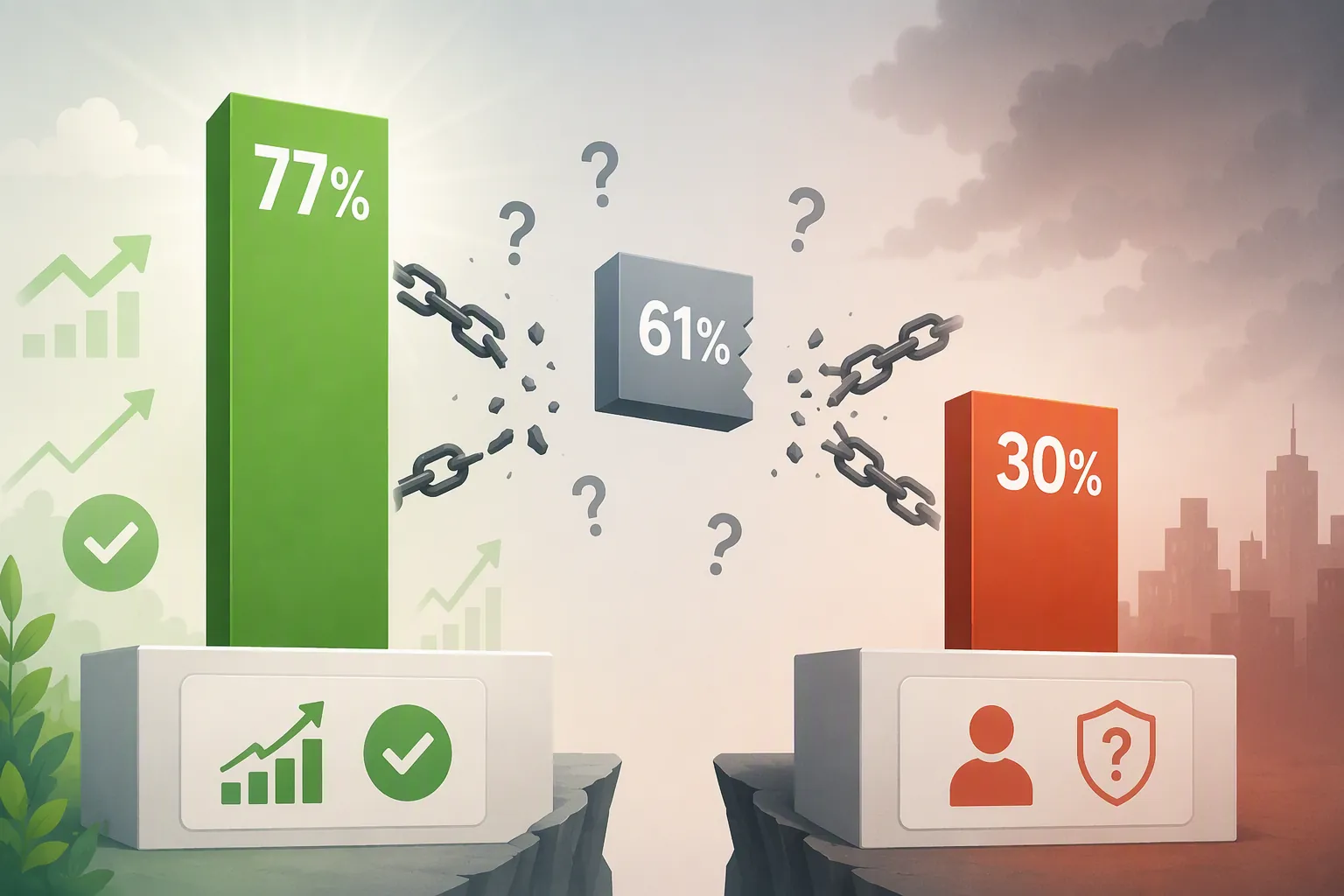
The contradiction is not subtle. In Mediaocean's H2 2026 Market Report, 75% of respondents ranked AI as the top consumer and technology trend, and AI adoption for data analysis reached 50%; at the same time, belief that AI represents a “major transformation” fell from 28% to 19% between reporting periods.[1] Comcast Advertising's State of AI in Advertising found a different version of the same split: 77% of advertising decision-makers said AI is transforming advertising, 61% said they had not yet seen meaningful results, and only 30% said they trust AI to do advertising tasks.[2]
That is the useful starting point. The industry's argument has moved beyond whether AI will be used. It is being used. The budget question is narrower and more uncomfortable: which AI changes should earn more spend, more automation authority, or fewer human checks inside live accounts?
The adoption curve is real, but it is not the same as performance
Mediaocean's report is useful because it captures a buyer mood that conference stages usually flatten. AI is still the top-ranked trend by a wide margin in that survey, and data analysis is now a mainstream use case rather than an experimental one.[1] A media team using AI to summarize performance, segment audiences, generate creative variants, or speed up reporting is no longer doing anything exotic.
But the drop in “major transformation” belief matters because it suggests that familiarity is making buyers more discriminating, not more dazzled. A feature can become common and still disappoint. A workflow can get faster without making CPA lower. A dashboard can produce more recommendations without improving budget allocation. Adoption answers the question “did teams try it?” Transformation answers “did the work change enough to matter?” Mediaocean's numbers point in different directions on those two questions.[1]
Comcast's survey puts that split into operational language. The sample was 216 advertising decision-makers surveyed in November 2025, with 75% at director level or above.[2] That is not a census of the industry, and it is still a vendor-published report. But the gap it reports is too large to wave away: 77% say AI is transforming advertising, 61% have not seen meaningful results, and only 30% trust AI to do advertising tasks.[2]
For a performance team, “meaningful results” is the hard line. If AI saves hours in reporting but does not change bid decisions, creative throughput, conversion quality, incrementality, or margin-adjusted ROAS, it belongs in the efficiency column, not the growth column. That distinction is where a lot of 2026 AI discussion still gets sloppy.
What the strongest evidence says, and what it does not say
The 2026 evidence base is uneven. Some of it comes from broad survey work. Some of it comes from public landing pages for gated reports. Some of it comes from conference coverage. Some of it is platform-reported lift. Those categories should not be blended into one confident story.
| Evidence type | What it supports | How much weight to give it |
|---|---|---|
| Survey-reported buyer sentiment | AI is widely adopted, but confidence in results and task-level trust remain weak | High for understanding market mood; not proof of account-level performance |
| Public pages for gated reports | Useful directional findings on measurement and creative workflows | Moderate; cite carefully because the full methodology may not be visible |
| Conference coverage | AI has moved into mainstream creative, media, and agentic discussions | Good for posture and priority shifts; weak as ROI evidence |
| Platform-reported lift | Vendors are seeing performance gains in selected products or tests | Treat as hypotheses to validate in your own accounts |
That separation is not academic. If a platform says an AI feature delivered more conversions, that may be true under its reporting conditions. It still does not tell you whether the same result holds for your conversion mix, your attribution windows, your margin structure, your branded demand, or your tolerance for creative and query expansion. The closer a claim gets to budget reallocation, the more it needs local verification.
The most valuable 2026 finding is therefore not a single product launch. It is the pattern across sources: buyers are using AI, platforms are deploying it aggressively, and the proof layer is lagging.
Measurement is where adoption starts to break
The IAB State of Data 2026 material makes the measurement problem explicit. Public-facing IAB materials and coverage of the report state that 60% to 75% of buy-side users of AI measurement tools say those tools fall short on rigor, timeliness, trust, and efficiency.[3] The full report sits behind registration, so that figure should be treated as a public-summary finding rather than a fully inspectable data table. Even with that caveat, the directional message is hard to miss.
Measurement is not a supporting function in AI media buying. It is the control system. If an AI bidding tool expands traffic, an AI creative tool multiplies variations, and an AI advisor recommends budget shifts, the buyer needs to know whether the system is improving actual business outcomes or just moving spend through easier-to-measure paths. Weak measurement turns automation into a trust exercise.
This is why default-on or quietly expanding AI features deserve more attention than launch decks. When Google moves AI deeper into campaign setup, shopping discovery, or ad surfaces, the operational issue is not simply whether the feature exists. It is whether a buyer can see where it ran, what it changed, which queries or placements it touched, what creative it assembled, and whether the incremental outcome survived a proper holdout or lift read. Signal & Convert's GML 2026 infrastructure tracker and AI Mode Ads tracker are useful companion reads for that account-level surface area.
The same standard should apply to AI advisors. A recommendation that looks fluent can still be wrong for a business constraint the model cannot see. Verification has to cover the data source, the action taken, the expected lift, and the rollback path. That is the practical trust issue behind the broader question of whether marketers can trust Gemini-style campaign advisors.
Creative AI has a scale problem and a sameness problem
Smartly's 2026 Digital Advertising Trends material brings the trust gap into a place buyers recognize immediately: the ad itself. Its public report page says 46% of advertisers use AI for creative, 95% are testing, and 42% remain in “initial testing.” It also reports that 75% worry about brand sameness and 86% have seen AI outputs that resemble competitors.[4]
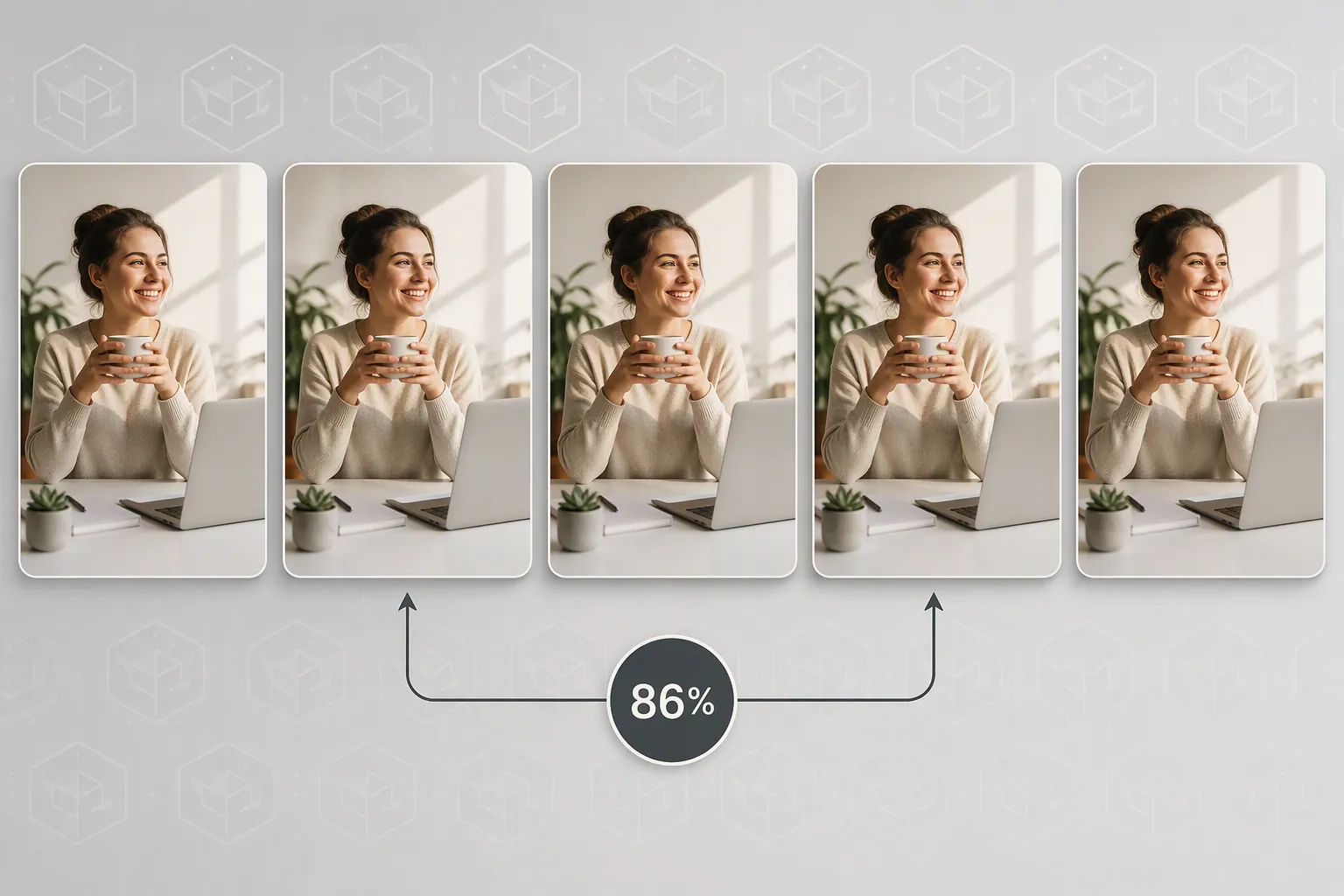
Those findings are more useful than a generic “AI accelerates creative” claim. Faster creative production is real value when the bottleneck is versioning, localization, resizing, or structured testing. It is less useful when the output collapses into the same visual grammar everyone else is using: polished lifestyle scene, centered product, clean desk, generic benefit line, safe emotion. In auction environments, sameness is not an aesthetic complaint. It affects thumb-stop rate, brand recognition, message recall, and the ability to separate your test from the category's background noise.
The 86% competitor-resemblance figure should make teams slow down before treating AI creative volume as a performance strategy by itself.[4] More variants can produce faster learning only if the variants are meaningfully different. A feed full of near-duplicates can make the testing dashboard look active while giving the algorithm little real signal about audience response.
The useful workflow is not “let AI make more ads.” It is more specific: define the strategic difference each variant is meant to test, lock brand constraints before generation, review competitor resemblance before launch, and separate production-speed metrics from business-outcome metrics. If a creative AI tool cuts production time but increases brand ambiguity, the saved hours may be paid back in weaker media efficiency.
Cannes showed the posture shift, not the proof
Cannes Lions 2026 mattered because AI was no longer framed as a speculative creative tool. Advertising Week reported Phil Thomas saying 40% of entries used AI, double the 2025 level, and that agentic AI was everywhere in the Cannes conversation.[5] That is a clear industry posture shift: AI is now part of the creative and media operating environment, not a side-stage novelty.
The more interesting Cannes thread was not whether AI can automate tasks. It was whether automated execution can be trusted. Cape.io's Cannes coverage framed the industry's central question as moving from “can AI automate?” toward whether automated execution can be trusted.[6] That aligns with the survey data much better than the celebratory version of the week.
ExchangeWire's Cannes coverage also cited McKinsey data saying 60% use AI weekly but only 10% have redesigned workflows.[7] Because that statistic is secondhand in the available material, it should not be treated as primary evidence. Still, the distinction is the right one. Weekly usage can mean prompting, summarizing, drafting, or checking. Workflow redesign means roles, approvals, measurement, and budget decisions have changed around the technology.
LiveRamp's Cannes recap added another pressure point, reporting that agentic browser traffic was up 8,000% year over year.[8] That does not prove advertising performance. It does suggest that non-human discovery, comparison, and transaction behavior is becoming a media-planning concern rather than a lab curiosity. If agents begin mediating more user journeys, buyers will need cleaner data permissions, stronger identity logic, and better ways to distinguish human intent from automated activity.
Google Marketing Live accelerated deployment faster than verification
Google Marketing Live 2026 showed how quickly platform AI is moving from optional feature to operating layer. Search Engine Land's recap covered announcements across AI-powered search, shopping, creative, measurement, and campaign management.[9] The direction is clear: fewer isolated AI tools, more AI woven into the surfaces where advertisers already build and optimize campaigns.
That matters because platform AI does not enter an account like a normal vendor pilot. It often arrives inside defaults, recommendations, campaign types, asset generation, query expansion, or reporting interfaces. The buyer may experience it less as a procurement decision and more as a change in the terrain. Signal & Convert's Meta AI auto-enrollment audit is a useful parallel: the risk is not only bad automation, but automation that changes campaign behavior before governance catches up.
Monks' analysis of GML 2026 described an agentic shift and warned that Universal Cart could remove “research-as-buffer” for premium brands.[10] That is the kind of change a media buyer has to translate into account questions. If discovery, comparison, and purchase compress inside AI-mediated surfaces, what happens to upper-funnel influence? Which brands gain from shorter paths to checkout? Which lose the chance to educate before price comparison?
Google's own performance claims should be read in that context. Making Science's GML recap reported Google-published figures including AI Max producing 27% more conversions, AI Brief producing 15% more conversions, YouTube producing 2x ROAS, and 86% higher long-term ROAS in the cited context.[11] Those are platform-reported claims, not independent benchmarks. They are good reasons to design a test. They are not good reasons to overwrite your account's evidence.
A practical test does not just ask whether the AI product increased conversions. It asks what conversion type increased, whether branded demand or remarketing carried the lift, how costs moved, whether incrementality changed, whether creative or query expansion introduced brand risk, and whether the result survived outside the vendor's preferred reporting view. If the answer requires pulling data from multiple systems, that is not a reason to skip the question. It is evidence that the measurement layer is still behind the automation layer.
What to believe before moving budget
The 2026 record supports a firm but limited conclusion: AI is now advertising infrastructure, but it is not self-validating infrastructure. The buyer's job is no longer to decide whether AI belongs in the stack. It is to decide where AI gets authority, where humans still review, and which claims deserve budget before independent account evidence exists.
- Treat vendor lift numbers as hypotheses. Use them to prioritize tests, not to set expected account performance.
- Separate adoption from outcome. A team using AI daily has not necessarily redesigned workflow or improved CPA, ROAS, incrementality, or creative quality.
- Audit measurement before expanding automation. If reporting cannot explain what changed, automation should not receive more budget authority.
- Watch default-on and embedded platform changes. The biggest AI shifts may appear as settings, recommendations, or campaign-surface changes rather than standalone launches.
- Review creative for strategic difference and competitor resemblance. More assets do not create more learning if the variants are functionally the same.
The uncomfortable part is that the optimistic and skeptical reads are both partly right. Cannes and GML showed real infrastructure progress. Mediaocean, Comcast, IAB, and Smartly showed why that progress has not yet translated into broadly trusted business results. Until the trust and measurement layer catches up, the safest posture is not resistance. It is controlled adoption with proof requirements attached.
References
- H2 Market Report, Mediaocean, June 16, 2026.
- State of AI in Advertising, Comcast Advertising.
- 2026 State of Data Report, IAB.
- 2026 Digital Advertising Trends Report, Smartly.
- Cannes Lions 2026: The Industry Has Moved Beyond AI Hype, Advertising Week.
- Cannes Lions 2026: AI Grew Up. Now the Industry Has to Learn to Trust It, Cape.io.
- Cannes Lions 2026: Agentic AI Is Moving Closer to the Media Decision, ExchangeWire, July 20, 2026.
- The 5 Big Takeaways from Cannes 2026, LiveRamp.
- Google Marketing Live 2026: Everything You Need to Know, Search Engine Land.
- Steering the Machine: Our Take on the Agentic Shift at Google Marketing Live 2026, Monks.
- Google Just Changed Everything Again: Our Takeaways from Google Marketing Live 2026, Making Science.
Primary source: https://www.mediaincanada.com/grand-mediacon-2026-advertising-ai-insights