
Six ChatGPT Lawsuits That Change AI Ad Liability
Six lawsuits filed between April and July 2026 are shifting liability for AI-generated ad content from OpenAI to the advertisers who deploy it. This Tracker entry breaks down each case, the exposure bucket it creates, and the operational controls advertisers need to implement today.
- Platform
- Regulatory
- Change category
- policy
- Change type
- policy or regulatory shift
- Impact level
- High
Current as of July 25, 2026, the practical question is not whether ChatGPT lawsuits are interesting. It is which part of an AI-assisted ad workflow now needs a control before copy, targeting logic, or synthetic creative goes live.
| Record | Status Or Date | Exposure Bucket | Advertiser Action |
|---|---|---|---|
| Mobley v. Workday | April 2026 ruling; discovery-stage classification, not a final liability finding | Audience and screening liability where AI tools filter people or outcomes | Treat AI segmentation, scoring, and exclusion logic as advertiser-deployed decisioning; document review before use [1] |
| Walters v. OpenAI | Dismissed May 2025; affirmed through 2026 | Defamation and hallucination risk | Do not republish AI-generated factual claims about people, companies, or events without independent verification [2] |
| Richner Communications v. OpenAI/Microsoft | Filed June 24, 2026; no merits ruling yet | Copyright training-data and local journalism exposure | Escalate local-market copy that appears to track source journalism or uses publication-specific detail [3] |
| Bartz v. Anthropic | Settlement reported at about $1.5 billion, about $3,000 per work; preliminary approval in September 2025 | Training-data copyright exposure with real settlement value | Assume copyright costs can move into platform pricing and vendor terms; keep rights questions separate from ad-performance review [1] |
| In Re OpenAI Copyright MDL | Consolidated in SDNY in April 2025; court ordered production of more than 20 million output logs in January 2026 | Copyright output risk | Run source-similarity review when AI ad copy closely tracks books, articles, scripts, or other protected works [4] |
| FTC Operation AI Comply | Ongoing into 2026; includes Workado consent order and Click Profit judgments above $20 million | Regulatory substantiation risk | Build claim files before launch for AI-generated accuracy, income, health, detection, or performance claims [5] |
That table is the useful shape of the problem. Copyright, defamation, and substantiation are not three names for the same legal anxiety. They land in different parts of the campaign process, and they need different controls.
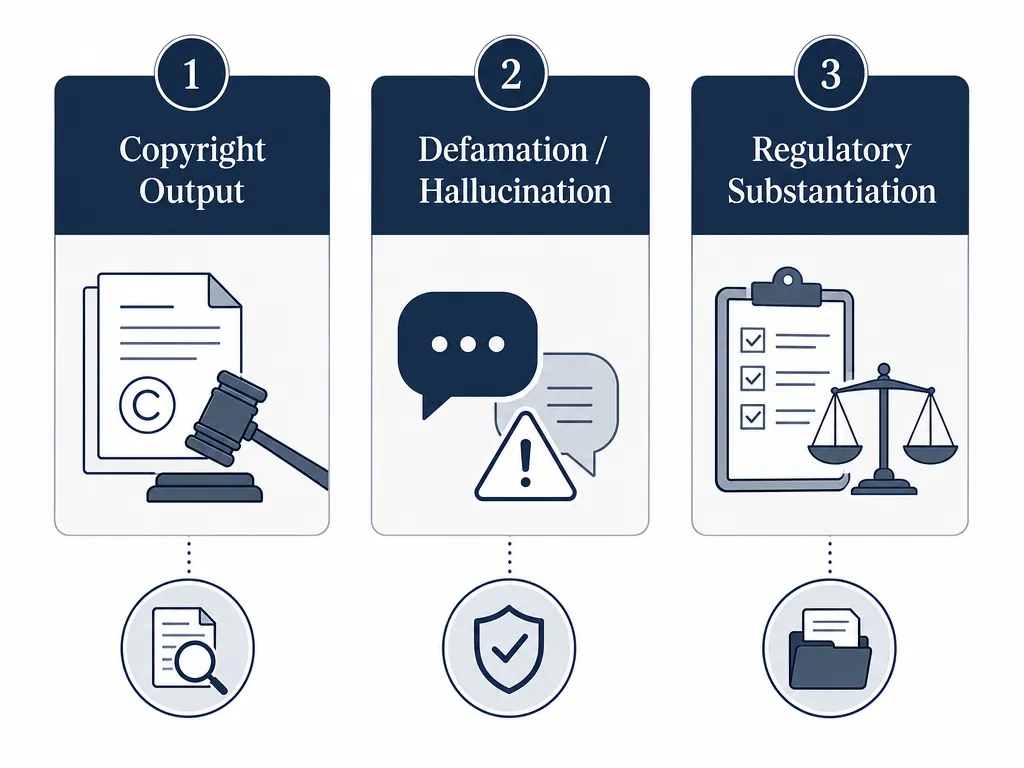
Copyright: Separate Training Exposure From Output Publication
The copyright bucket is the easiest to overstate because several disputes sit on top of one another. A lawsuit about training data does not automatically prove that a specific advertiser infringed by publishing an AI-assisted ad. But an advertiser also should not treat training-data litigation as someone else’s problem when the output itself begins to resemble a protected source.
Richner Communications is a newly filed complaint, not a ruling. The plaintiffs are 35 publishers representing nearly 400 newspapers, and the complaint alleges that OpenAI and Microsoft stripped copyright management information from local journalism [3]. For a national advertiser, that mainly belongs in vendor diligence. For a local-market campaign team, it is more immediate: AI-generated copy that sounds unusually specific to a market, publication beat, neighborhood controversy, or local reporting trail deserves a source check before it becomes paid media.
Bartz is the reason the training-data side cannot be dismissed as background noise. The reported Anthropic settlement is about $1.5 billion, or about $3,000 per work, with preliminary approval in September 2025 [1]. That does not decide OpenAI’s liability, and final approval or appeal could change the outcome. It does prove that copyright claims around AI inputs can carry balance-sheet consequences large enough to affect vendor economics, contract language, indemnity limits, and the price of API access.
The output side is more directly relevant to ad review. In Re OpenAI Copyright MDL was consolidated in the Southern District of New York in April 2025, and a January 2026 order required production of more than 20 million ChatGPT output logs [4]. The MDL includes claims that ChatGPT can generate detailed summaries of copyrighted books [4]. For advertisers, the operational lesson is narrow but important: if copy, landing-page text, video scripts, email sequences, or advertorial content closely track a copyrighted source, the exposed party is the one publishing and monetizing the output.
A useful campaign rule is to split the review into two questions. First, did the vendor’s tool create contract, indemnity, or procurement risk because of how it was trained? Second, does the specific asset look substantially similar to a protected work the advertiser is about to publish? The first question belongs with legal and procurement. The second belongs in the creative approval queue, because it decides whether the ad ships.
- Flag AI-generated copy that reproduces unusual phrasing, character names, article structure, book summaries, lyrics, scripts, or publication-specific local reporting.
- Escalate assets that were prompted with copyrighted or paywalled material, even if the final copy has been rewritten.
- Keep prompt records, draft history, source notes, and reviewer approvals for high-value or high-volume campaigns.
- Do not let a platform’s general AI terms replace a source-similarity review on the specific asset being published.
Defamation And Hallucination: Disclaimers Help OpenAI More Than They Help The Republisher
Walters is a short section for advertisers because the workflow consequence is direct. A Georgia court dismissed defamation claims against OpenAI in May 2025, and that result remained affirmed through 2026, with ChatGPT’s disclaimers playing a key role [2]. That does not make hallucinated output safe. It means the disclaimer that may protect OpenAI is not a fact-check for the advertiser who copies the statement into an ad, sales page, email, influencer brief, or comparison chart.
The risky step is republication. If a campaign says a named person committed misconduct, a competitor was investigated, a product failed a test, a clinic has a disciplinary history, or a public figure endorsed a claim, the advertiser has created a new publication event. “The model produced it” is not a substitute for checking the underlying fact.
This is also where autonomous-agent incidents matter, but only as an adjacent control problem. A buyer reviewing AI agents that draft, approve, or route creative without enough human verification should pair this entry with the rogue-model tracker. The legal issue here remains simpler: factual claims generated by AI need verification before they are republished.
Regulatory Substantiation: The FTC Already Has A Playbook
The regulatory bucket is the clearest near-term workflow change because it does not depend on a newly filed complaint surviving years of motion practice. FTC Operation AI Comply is already applying ordinary advertising substantiation rules to AI claims. Workado allegedly claimed 98% AI-detection accuracy when the actual rate was 53%, leading to a consent order with monitoring [5]. Click Profit produced judgments above $20 million [5].
For campaign teams, the lesson is not “avoid AI claims.” It is that AI-generated claims need the same evidence file a human copywriter would have needed, and sometimes a better one because the model may invent confidence where the business has none. Accuracy claims, income claims, health outcomes, detection rates, automation performance, fraud reduction, lead quality, productivity gains, and “guaranteed” results should not enter ad rotation until someone can point to the proof.
| Claim Type | Before Launch, Keep |
|---|---|
| AI accuracy or detection rate | Test methodology, sample description, measured rate, limitations, and approval owner |
| Income, revenue, savings, or ROI | Underlying customer data, calculation method, typicality review, and disclosure language |
| Health, safety, or risk reduction | Competent evidence, scope limits, substantiation review, and prohibited-claim check |
| Performance lift from AI optimization | Baseline period, test design, confidence limits where available, and exclusions |
| Competitor comparison | Current source documents, date checked, exact comparison basis, and legal review trigger |
This is the point where many AI ad workflows are still behind the exposure. An IAB survey of 125 advertising executives found that 70% had encountered an AI incident and 40% had pulled or paused ads, while fewer than 35% planned to increase AI governance investment [6]. The sample is not large enough to describe every advertiser segment, but it matches the pattern visible in many campaign operations: adoption has moved faster than evidence retention.
Teams tracking FTC posture alongside platform enforcement can pair this section with the Slaughter and FTC enforcement tracker. The campaign-level change is still straightforward: if the claim would require substantiation when written by a person, it requires substantiation when drafted, improved, or suggested by AI.
Audience Segmentation Is Part Of The Same Liability Map
Mobley is not an advertising case in the ordinary copy-review sense, so it should not be stretched into a final rule for paid media. The April 2026 ruling classified employers using AI screening tools as agents sharing liability, but that classification sits at the discovery stage rather than as a final appellate liability finding [1].
It still belongs in an advertiser tracker because many campaigns use AI to rank, suppress, qualify, score, or segment people. If a tool helps decide who sees housing, credit, employment, education, insurance, health, or income-related offers, the advertiser should not assume the vendor is the only deploying party. The action item is process ownership: document who selected the model, which variables were used, which audiences were excluded, who reviewed the output, and what exception process exists when outcomes are challenged.
Synthetic Creative Gets Its Own Disclosure Check
New York’s Synthetic Performer Disclosure Law, S.8420-A/A.8887-B, became effective June 9, 2026 and requires conspicuous disclosure when ads use AI-generated synthetic performers [7]. The research record describes it as the first U.S. state law of its kind and notes an industry analyst projection that 10 to 15 states may follow by the end of 2026, although that projection depends on legislative calendars [7].
This does not replace the copyright, defamation, or substantiation controls. It adds a creative-disclosure gate for synthetic people, voices, likenesses, and performances. For teams already tracking public trust problems around AI ad creative, the Hochul verification benchmark is the better place to follow the disclosure angle.
This entry is also U.S.-focused. The EU AI Act, effective August 2, 2026, and GDPR create additional obligations for advertisers operating in European markets, but they are outside this tracker’s liability buckets.
Operational Control Map For Q3 2026
| Exposure | Control | Owner Before Launch |
|---|---|---|
| Copyright output risk | Source-similarity review; prompt and draft retention; rights escalation for close-tracking copy | Creative lead, legal reviewer, or agency account owner |
| Defamation and hallucination risk | Independent fact verification before republishing statements about people, companies, events, or competitors | Copy approver and brand/legal reviewer |
| Regulatory substantiation risk | Claim file with evidence, methodology, disclosure language, and retention rule | Growth lead, compliance owner, or performance marketing manager |
| AI segmentation or filtering risk | Audience logic documentation, variable review, exclusion review, and challenge process | Media buyer, data lead, or platform operations owner |
| Synthetic performer risk | Disclosure review for AI-generated performers, voices, likenesses, and performances | Creative producer and compliance reviewer |
The companion Scott Winters v. OpenAI tracker covers the July 22, 2026 misdiagnosis lawsuit and the adjacent question of AI platforms giving high-stakes advice. This entry is narrower: when advertisers deploy AI-generated content, targeting logic, or claims, they need controls in the campaign workflow itself.
None of these records proves that every AI-assisted ad is dangerous. Richner is newly filed, Mobley is not a final appellate liability ruling, and the copyright cases are still moving. They do make one assumption unsafe in Q3 2026: advertisers cannot treat AI vendors as the liability shield for content they approve, target, publish, and keep spending behind.
References
- AI in litigation series: An update on AI copyright cases in 2026, Norton Rose Fulbright
- Georgia Court Dismisses Defamation Lawsuit Against OpenAI Over ChatGPT Output, Cleary Gottlieb
- Coalition of hundreds of local and regional newspapers sues OpenAI and Microsoft, Insider NJ
- OpenAI ChatGPT Litigation, Baker Law
- One Year In, FTC's 'Operation AI Comply' Continues Under New Administration, Benesch Law
- AI Adoption Is Surging in Advertising, IAB
- New York's Synthetic Performer Disclosure Law, Stensul industry analyst consensus
Primary source: https://www.nortonrosefulbright.com/en/knowledge/publications/ai-in-litigation-series-2026